
Remington 870 Series: The Evolution of an Iconic Shotgun
Joseph McLain Nov 07, 2026
You've decided on a pump shotgun, and the Remington 870 keeps coming up. Then you find a used Wingmaster with a walnut stock, a used Express for less money, a new Fieldmaster and a short black 870 Tactical, all with the same number on them, plus a Mossberg 500 that costs about the same.
All of those 870s are the same basic shotgun, and that is the key to choosing one. By the end you should be able to tell the 870 models apart, pick the one that fits your job, judge a used one before you pay for it, and decide between the 870 and the Mossberg 500 for a reason that actually matters to you.
One shotgun, many versions
The Remington 870 has been made since 1950, longer than almost any other shotgun, and nearly every version uses the same action. The action is the working heart of the gun: the parts that load a shell, lock it in place, and throw the empty out. On a pump shotgun your support hand runs it. Pull the forend (the grip under the barrel) back and the bolt opens and kicks out the empty; push it forward and the bolt picks up a fresh shell from the magazine tube under the barrel and locks it in the chamber.
The 870 runs its bolt with two action bars, steel rails that connect the forend to the bolt on both sides. Pushing a drawer by both handles keeps it from twisting and sticking, and two bars do the same for the bolt. Its receiver, the body of the gun that holds the action, is machined steel. Those two things are why 870s from the 1960s are still working on farms and in police cars today.
Because the action is shared, the models differ only in four things: the finish on the metal, the stock, the barrel and how carefully the gun was finished at the factory. That means you choose an 870 by the job, not by the name.
Key idea: Every 870 works the same way. The model tells you how it was finished and what it was set up for, and the barrel decides most of what the gun is good at.
Telling the models apart
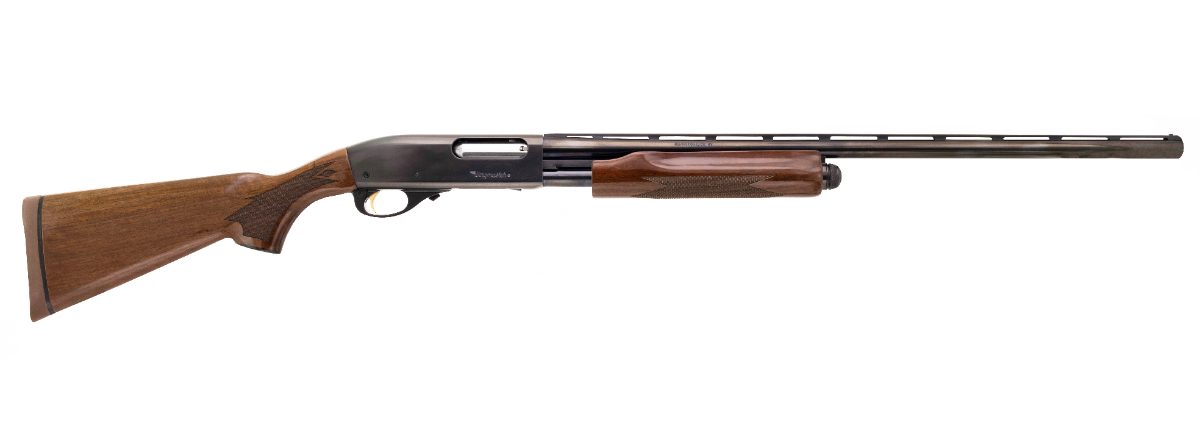
Wingmaster is the original: polished, deep-blued steel and a walnut stock, finished with more care than the low-cost versions. It is the version gunsmiths and experienced shotgunners tend to look for on the used rack, because the action is usually slick and the metal resists rust when it's cared for.
Express was the low-cost version, made from the late 1980s until Remington's 2020 bankruptcy, with a dull matte black finish and a plain hardwood or synthetic stock. It is the same action with less finishing work. That shows up in two ways many owners report: the matte finish rusts if the gun is put away wet, and some Express chambers were left rough enough that fired shells, especially cheap ones with steel heads, stick and won't eject. A gunsmith can polish a rough chamber, and once that's done, an Express is a sound shotgun.
Fieldmaster replaced the Express after Remington's 2020 bankruptcy, when the shotgun business became RemArms. It is the current lower-priced 870, with a better finish than the Express, and its receiver is drilled and tapped so you can mount a small red-dot sight.
Tactical, Police and Marine models are the same action set up for defense or hard use: a short barrel, extra magazine capacity, sights or rails, and sometimes a nickel or other rust-resistant finish for boats and wet climates. The Police versions were built with heavier-duty parts for guns that are cycled every shift.
You can recognize most of these on sight. Shiny bluing and walnut means a Wingmaster. Dull black metal on an older gun means an Express. A newer gun with screw holes on top of the receiver is likely a Fieldmaster.
Choosing by the job
Since the action is the same, the barrel is where the job is decided. Every Remington barrel is stamped with its gauge and the longest shell its chamber accepts, such as "12 GA 3 IN."
- If the gun is for birds, clays and small game, choose a 26- or 28-inch barrel with a ventilated rib (the raised strip along the top that you look down) and screw-in choke tubes. The longer barrel swings smoothly through a moving target, and the choke tubes let you tighten or open the pattern for the distance you shoot.
- If the gun is for home defense, choose an 18- to 20-inch barrel with an open choke and good sights. A short barrel turns through a doorway or down a hallway without catching, and an open choke spreads buckshot just enough at room distances. Federal law treats a shotgun barrel shorter than 18 inches as a regulated short-barreled shotgun, which is why the shortest ordinary barrels are 18 to 18.5 inches.
- If you want one gun for both, buy one 870 and two barrels. An 870 barrel comes off without tools: with the gun unloaded and the action open, unscrew the magazine cap at the front and slide the barrel forward off the gun. A standard 12-gauge 870 barrel fits other 12-gauge 870s (the exception is a 3½-inch Super Magnum barrel, which needs the longer Super Magnum receiver), so a long bird barrel and a short defense barrel turn one shotgun into two.
If you're not sure, a used Wingmaster in good condition is the best value in the 870 family, and a Fieldmaster is the choice if you want new. Either can wear a second barrel later.
Good practice: For ducks, geese and other migratory birds, federal law limits a shotgun to three shells total. Field 870s usually come with a plug for the magazine tube that holds it to two shells plus one in the chamber, and a plug is inexpensive if yours didn't. Put it in before waterfowl season and leave it in for the season.
How to judge a used 870
Used 870s are everywhere, and most are good guns. Check these things before you pay, starting the way you handle any gun: muzzle in a safe direction, finger off the trigger, action open. Look in the chamber and the magazine tube to confirm there are no shells.
- The action. Work the forend slowly, then briskly. It should run straight without grinding or catching. A gritty feel is usually dirt; a catch at the same spot every stroke can be a bent action bar or a damaged part.
- The barrel. Read the stamp for gauge and chamber length, and measure the barrel. Anything under 18 inches makes the gun a short-barreled shotgun, an item covered by the National Firearms Act. Walk away from a home-cut barrel: it rarely has a properly finished crown or sights, and its legal status depends on an enforcement policy that could change. Look through the bore toward a light for rust pitting or a dark ring, which can mean a bulge from an obstruction.
- The finish. A little wear where hands and cases rub is normal. Rust that has left pits in the metal, especially on an Express, tells you how the gun was stored.
- Feeding and ejecting. If the seller allows it, load a few snap caps (dummy shells with no powder or primer) into the magazine and cycle them through. Each one should feed, lock and eject cleanly.
- Add-ons. Aftermarket stocks, magazine extensions and side saddles are common and usually harmless, but the gun should run before and after them. Ask whether the original parts come with it.
Then shoot it with the shells you'll use. If fired shells stick in an Express, you've found the rough-chamber problem, and a gunsmith's chamber polish is the fix.
The 870 or the Mossberg 500?
These are the two most common pump shotguns in America, and either will serve you well for decades. The honest differences are few and specific.
The safety is the one that matters most. The 870's safety is a cross-bolt button behind the trigger. A right-handed shooter pushes it with the trigger finger. It can be pushed from either side, but for a left-handed shooter the motion is less natural, and many lefties have a gunsmith install a left-hand safety. The Mossberg's safety is a slide on top of the receiver, right under your thumb, and it works the same for left and right hands. The receiver is the second: the 870's is steel and the Mossberg's is aluminum, which makes the Mossberg lighter to carry. Both use two action bars. The Mossberg has two extractors to the 870's one. The action release, the lever that lets you open the action when the gun is cocked, sits in front of the trigger guard on the 870 and behind it on the Mossberg.
- If you shoot left-handed, lean toward the Mossberg 500, because its top safety works the same in either hand. Both guns eject to the right, though, so handle and shoulder both before you decide.
- If you'll carry the gun all day in the field, the lighter Mossberg is easier on your arms.
- If you want a steel receiver and a smooth, refined action, and you shoot right-handed, choose a Wingmaster or Fieldmaster 870.
For defense, the safety matters more than any other difference, because you'll take it off under stress. Pick the gun whose safety your hand works without shifting your grip. Our look at the Mossberg 500 family covers the Mossberg side in detail.
Common mistake: Buying an 870 because police used it, then loading it with every accessory a police gun might carry. Each add-on adds weight and something else to go wrong. A shotgun kept for home defense needs a short barrel, a light and a secure place to be stored.
Check your understanding
Try answering these before you open the answer. If you can decide what to do and explain why, you have it.
1. You find a used Express for $250 and a used Wingmaster for $400, both in good shape. You want a gun for pheasants and the house. Which do you buy?
Either works, because it's the same action. The Wingmaster is the better gun for the money if you can afford it: smoother, better finished and less prone to rust and sticky shells. If you buy the Express, shoot it before you count on it, and plan on a chamber polish if empties stick. Then add an 18.5-inch barrel for the house.
2. A seller's 870 has a barrel that measures 16 inches, and he says he cut it himself. What do you do?
Walk away. A shotgun barrel under 18 inches makes a short-barreled shotgun, an item covered by the National Firearms Act. Since October 9, 2026, ATF has said it will not enforce its approval and registration requirements for short-barreled shotguns (see ATF's current guidance), but that is an enforcement policy that could change, and state and local laws still apply. Even apart from the law, a home-cut barrel is a poor buy: it rarely has a properly finished crown or sights, and you would be paying for someone else's hacksaw work.
3. Your left-handed daughter wants her own pump shotgun for home defense. 870 or Mossberg 500?
Probably the Mossberg 500. Its safety sits on top of the receiver under her thumb and works the same in either hand. The 870's cross-bolt safety can be pushed from her side, but the motion is less natural, which matters under stress. Both guns eject to the right, so have her handle and shoulder each one before you buy.
4. You're heading to the marsh for ducks with the 870 you keep for the house, which holds five shells in the magazine. What do you change?
Swap to your longer barrel if you have one, and install the magazine plug so the gun holds no more than three shells total. Federal law requires that for migratory birds, and a game warden will check.
5. A friend is looking at a used Remington 1100 or 11-87, a semi-automatic, and asks whether what you learned about the 870 applies. What carries over?
Most of the judgment does. Choose by the barrel for the job, check the bore and finish, cycle dummy shells, and walk away from a barrel under 18 inches. What changes is the action: a semi-automatic uses the gas from each shot to cycle itself, so it also needs to be clean and fed shells strong enough to run it, which a pump never does.
Where to go next
You can find Remington 870 accessories on our website, including side saddles, magazine extensions, stocks and sights, and anything listed there can be ordered if it isn't in stock.
If you're setting up a shotgun for defense, choosing a defensive shotgun covers barrel, sights and lights, and buckshot explained helps you pick the shells. For hunting, patterning your shotgun shows you how to match choke and shell to the distance you shoot. And a shotgun kept in the house needs a plan for safe storage.
If this article helped you, we invite you to sign up for email notifications of new blog articles.