
Mossberg 5xx Series: The Evolution of a Legendary Pump-Action Shotgun
Joseph McLain Nov 07, 2026
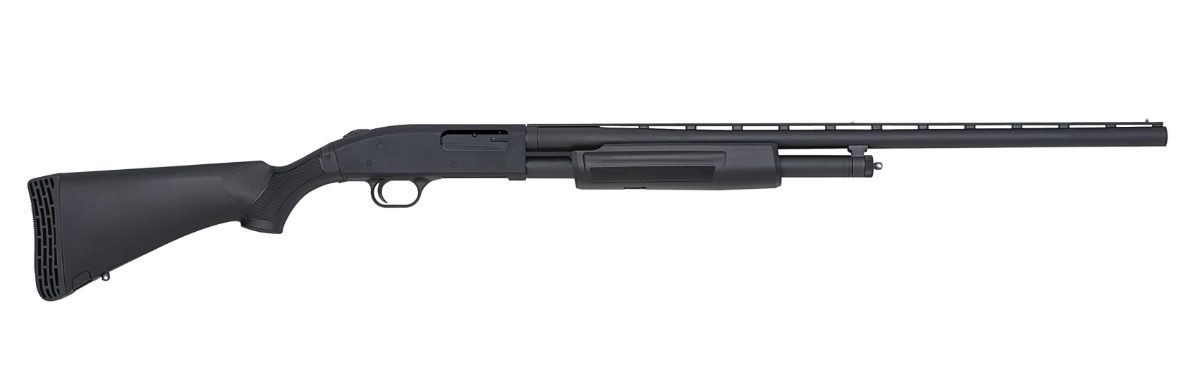
You want one shotgun for pheasants in the fall, slugs for Iowa deer and home defense, and the name that keeps coming up is Mossberg. Then you see the numbers: 500, 590, 590A1, Shockwave, Maverick 88. And the Remington 870 has just as many loyal owners.
By the end you should be able to say how the Mossberg family fits together, pick the model and barrel for the job you have, set it up for Iowa deer without the most common slug mistake, and decide between it and an 870 for a reason that matters.
One shotgun, many versions
The Mossberg 500, made since 1960, is one of the most common pump shotguns in America. You run a pump with your own hand: pull the forend back to throw out the empty, push it forward to load the next shell. Because your arm cycles it, not the energy of the shot, a pump runs everything from light target loads to heavy slugs, which is a big part of its reputation for reliability.
Mossberg designed the 500 so barrels swap in seconds without tools, and that's what turns one shotgun into several. A long vent-rib barrel makes it a bird gun; a short barrel makes it a home-defense gun; a slug barrel makes it a deer gun. The receiver is aluminum, which keeps it light; the bolt locks into a steel extension on the barrel, so the aluminum doesn't take the force of firing.
Key idea: Choose the job first, then the barrel. Most of what a Mossberg is good at is decided by the barrel you put on it.
Which Mossberg
500 is the everyday model for hunting and home defense, in 12 and 20 gauge and .410, with youth-size Bantam versions. 590 is built for harder use: a heavier barrel, and a longer magazine tube that holds 7 to 9 shells depending on barrel length. 590A1 goes further, with a heavy-walled barrel and a metal trigger guard and safety, built to a military specification. Maverick 88 is Mossberg's lower-priced pump; most 500 barrels fit it, but its safety is a crossbolt behind the trigger rather than on top. Shockwave is a 590 with a 14-inch barrel and a bird's-head grip instead of a stock.
- If you want one gun for birds, deer and the house, choose a 500 Field/Deer Combo, which comes with a long bird barrel and a short slug barrel, and later add an 18.5-inch defense barrel if you like.
- If the gun is mainly for home defense and will be shot a lot, choose a 590 or 590A1, because the heavier barrel and parts take hard use and the longer tube holds more.
- If the budget is tight, a Maverick 88 is a sound pump for less, as long as you're comfortable with its trigger-guard safety.
- If a smaller or younger shooter will use it, choose a 20-gauge 500 Bantam or Super Bantam, because the shorter stock fits and the 20 gauge kicks less.
If you're not sure, start with a 500 combo. It covers the most jobs and grows with you.
The Shockwave deserves an honest word. Without a stock, it's hard to aim and hard to control; most people shoot it much worse than a shotgun with a stock. Under federal law it's classified as a "firearm," not a short-barreled shotgun, so it isn't an NFA item, but state laws vary, so confirm it's legal where you live before buying. For most home defenders, an 18.5-inch 500 or 590 with a stock is the better choice.
Setting it up for Iowa deer: Match the slug to the barrel
Iowa's gun seasons allow 10-, 12-, 16- and 20-gauge shotguns firing single slugs; buckshot isn't allowed for deer. The most common mistake is pairing the wrong slug with the barrel.
- If your slug barrel is fully rifled (spiral grooves inside), shoot sabot slugs, which the rifling spins for accuracy out to 100 yards and beyond.
- If your barrel is smooth (a bird barrel, or a smooth "slug" barrel with rifle sights), shoot rifled (Foster) slugs, which fly straight without needing spin and are best inside about 75 yards.
Look down the barrel with the gun unloaded to see which you have, and check the barrel's markings. Then sight in with the exact slug you'll hunt with, because slugs from different makers can hit inches apart. Our guide to shotgun slugs for deer goes deeper.
Common mistake: Buying expensive sabot slugs for a smooth bird barrel. Without rifling to spin them, they often group worse than inexpensive rifled slugs.
Mossberg or Remington 870?
Both are excellent pumps that last for decades. The difference that matters most is the safety. The Mossberg's is a slide on top of the receiver, right under your thumb, and works the same for either hand. The 870's is a button behind the trigger, set up for right-handed shooters. The Mossberg's aluminum receiver makes it lighter; the 870's steel receiver feels more solid. The Mossberg's action release sits behind the trigger guard, the 870's in front of it.
- If you shoot left-handed, or several family members of either hand share the gun, choose the Mossberg, because its top safety works naturally for everyone.
- If you're right-handed and prefer a heavier, steel-receiver gun, the 870 is equally good.
Before you buy, with the action open and the chamber and tube confirmed empty, shoulder each, work the safety without looking, and run the action. Choose the one your hands operate without thinking. Our guide to the Remington 870 covers the other side.
Check your understanding
Try answering these before you open the answer. If you can decide what to do and explain why, you have it.
1. You want one shotgun for Iowa pheasants and deer. What do you buy and how do you set it up?
A Mossberg 500 Field/Deer Combo. Use the long vent-rib barrel for pheasants and the slug barrel for deer. Check whether the slug barrel is rifled or smooth, buy sabot or rifled slugs to match, and sight in with the slug you'll hunt with.
2. Your 12-year-old daughter is starting to shoot. Which Mossberg fits?
A 20-gauge 500 Bantam or Super Bantam. The shorter stock fits a smaller shooter, and the 20 gauge kicks less, so she'll learn without flinching.
3. A friend wants a Shockwave for home defense because it's compact. What do you tell him?
It's compact, but without a stock it's hard to aim and control, and most people shoot it far worse than a stocked shotgun. Check your state's law first; then consider an 18.5-inch 500 or 590 with a stock, which is easier to hit with in a hallway.
4. Your rifled slug barrel scatters your cheap rifled slugs across the target. What's wrong?
Rifled (Foster) slugs are made for smooth barrels. A fully rifled barrel needs sabot slugs. Switch to sabots and sight in again.
5. A neighbor bought a Maverick 88 and wants to add your spare 500 bird barrel. Will it work, and what's different about his gun?
Most 500 barrels fit the Maverick 88, so it likely will; check the barrel and gauge match. The main difference he'll notice is the safety: the Maverick's is a crossbolt behind the trigger rather than on top.
Where to go next
You can find Mossberg 500 shotguns, barrels and accessories on our website, along with Mossberg 590 models, and anything listed there can be ordered if it isn't in stock.
For setting up a defensive shotgun, read choosing a defensive shotgun. For bird hunting, patterning your shotgun shows how to match choke and shell to your distances. And for the slug side of deer season, see shotgun slugs for deer.
If this article helped you, we invite you to sign up for email notifications of new blog articles.