
Demystifying Shotgun Chokes
Joseph McLain Nov 07, 2026
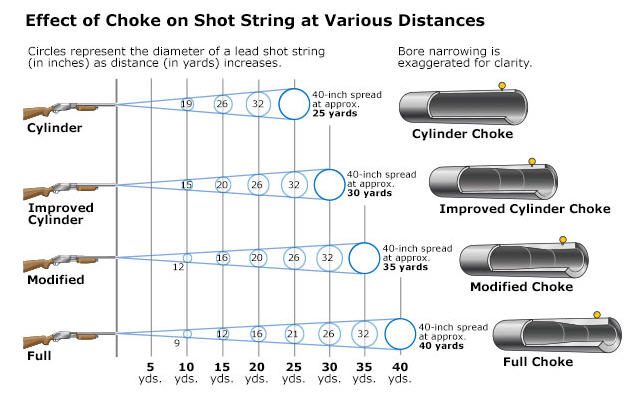
You are at the bench with your shotgun and a handful of choke tubes. Will the full choke reach out farther? Is it the reason you keep missing roosters at 20 yards? Is the modified tube that came with the gun good for everything? Each question points at something real, and none has a one-word answer.
By the end you should understand what a choke physically does to a load of shot, why tighter isn't the same as better, how the common chokes compare and what steel shot changes, so you can choose a choke for any shooting you do and prove the choice on paper.
What a choke does, and what it does not do
A choke is a slight narrowing at the muzzle end of a shotgun barrel. As the column of pellets passes through it, the narrowing squeezes the column a little, and that controls how quickly the pellets spread apart after they leave the barrel. The cluster of pellets that arrives at the target is called the pattern.
Think of the nozzle on a garden hose. Open it wide and the water fans out into a broad spray that soaks a big area up close but thins out quickly. Tighten it and the water holds together in a narrower stream that stays concentrated farther away. A choke does the same thing to pellets. An open choke spreads the pattern quickly, and a tight choke keeps it together longer.
What a choke does not do is make the pellets fly faster or hit harder. Each pellet carries the energy the shell gave it, and that energy is set by the pellet's size, material and speed. A tighter choke only keeps more of those pellets inside a given circle at a given distance. That is why the right choke depends almost entirely on how far away and how fast your target will be.
Key idea: A choke does not add power or reach. It controls how quickly the pattern opens, so you choose it by the distance at which you expect to hit the target.
Coverage against density: The trade every pattern makes
Every pattern trades coverage against density. A wide pattern covers more area, so a slightly off-target shot still puts some pellets on the target. A tight pattern puts more pellets in the center, so the pellets that hit are closer together and more of them strike the target.
Too wide for the distance, and the pellets are so spread out that a clay can slip through a gap or a bird is hit by only one or two pellets, which can wound it without bringing it down. Too tight for the distance, and the pattern is so small that a tiny error in your swing misses completely, and anything you do hit at close range is struck by a dense mass of shot that can ruin meat. The right choke gives a pattern that is dense enough to do the job and as wide as possible at the distance where you will actually shoot.
The common chokes, from open to tight
Chokes are traditionally rated by the percentage of a load's pellets that land inside a 30-inch circle at 40 yards. The table shows typical figures for a 12-gauge with lead shot. Real results vary with the gun, the choke tube and especially the ammunition, which is why patterning your own gun matters.
| Choke | Typical pellets in a 30-inch circle at 40 yards | Where it usually shines |
|---|---|---|
| Cylinder | About 40 percent | Very close targets, buckshot at home-defense distances, many slugs |
| Skeet | About 45 percent | Skeet and close crossing targets |
| Improved cylinder | About 50 percent | Upland birds flushing close, close sporting clays |
| Modified | About 60 percent | General hunting, trap from the 16-yard line, many waterfowl loads |
| Improved modified | About 65 percent | Trap, longer upland shots |
| Full | About 70 percent | Long trap shots, passing birds at distance |
| Extra-full or turkey | Higher still | Turkey head shots |
The table is a ladder. Each step up keeps more pellets in the circle at 40 yards, which pushes the distance where the pattern is at its best farther out. The same ladder works in reverse at close range: At 20 yards, a full choke's pattern may be only about the size of a dinner plate, which is easy to miss with, while improved cylinder gives you a pattern several times larger. Pick the step on the ladder whose best distance matches the distance of most of your shots.
Common mistake: Assuming a tighter choke is always better. A full choke is unforgiving on a close, fast target, and on game it can damage meat at short range. Match the choke to the distance, not to a hope of reaching farther.
Choosing a choke for what you shoot
Start with two questions: How far away will the target be when you shoot, and how much is it moving across your line? The usual answers look like this.
| Activity | Common starting choke | Why |
|---|---|---|
| Skeet | Skeet or improved cylinder | Close, fast crossing targets |
| Trap | Modified, improved modified or full | Targets going away, hit farther out |
| Sporting clays | Changes stand to stand | Distances and angles vary |
| Pheasant and other upland birds | Improved cylinder or modified | Birds flush close and quickly go away |
| Ducks and geese | Improved cylinder to modified with steel shot | Steel patterns tighter than lead through the same choke |
| Turkey | Extra-full or turkey tube | A dense pattern on a small target at a known distance |
The table follows the same logic as the ladder. Close and quick targets call for open chokes, and targets taken farther away call for tighter ones. Waterfowl is the exception that surprises people. Steel shot is harder than lead and does not deform in the barrel, so it naturally patterns tighter. Many waterfowl hunters find that an improved cylinder or modified tube with steel gives the kind of pattern a tighter choke gives with lead. For the shells that go with these chokes, see our guides to pheasant, duck and turkey loads.
If you hunt or shoot more than one way, choose the choke for the distance of the shots you most need to make, and change tubes when you change activities.
Fixed chokes and interchangeable tubes
Older shotguns, and some inexpensive new ones, have a fixed choke machined into the barrel. The choke is usually stamped on the barrel, sometimes as words and sometimes as symbols, and your owner's manual explains the marking. A fixed choke is simple and cannot loosen, but you are limited to the one pattern the barrel was built with, so you choose your shooting to suit the gun.
Most modern shotguns use screw-in choke tubes, so you can change from skeet to trap or from clays to pheasants in a minute. The cost is a little maintenance. Tubes must be screwed fully in before you shoot, because a loose tube can be damaged or, in rare cases, damage the barrel, and the threads need occasional cleaning so residue does not lock them in place. Never fire a barrel built for choke tubes without a tube installed unless the manufacturer says it is safe, because the threads are not designed to be exposed to the shot.
Good practice: Most tubes are marked with their name, a set of notches or both. Check the marking before each outing, because it is easy to leave last week's tube in the gun.
Steel shot and your chokes
Federal law requires nontoxic shot, such as steel, bismuth or tungsten, for waterfowl, and some public areas require it for other hunting as well. Check the Iowa DNR regulations, or the rules where you hunt, for where nontoxic shot is required.
Because steel does not compress, pushing it through a very tight choke puts more stress on the choke and barrel than lead does. Many older fixed-choke barrels and many full or extra-full tubes are not rated for steel. Check your owner's manual and the marking on the tube before you shoot steel. Some manufacturers also limit steel to certain shell sizes or chokes. Bismuth and some tungsten blends behave more like lead and may be allowed where steel is not; again, follow the manufacturer's guidance for your gun.
Confirm that the barrel and the tube are rated for the shot you are loading, and to start one step more open with steel than you would with lead.
Pattern your shotgun to see what it really does
Choke ratings describe what a choke is meant to do with a typical load. The only way to know what your gun does with your shell is to shoot it on paper, because different loads can pattern very differently through the same choke. Patterning also shows whether your gun shoots where you look, which matters as much as the choke itself.
A pattern test answers two questions. Is the pattern centered where you aimed? And is it dense and even enough for your target at your distance, without large gaps? A pattern with a dense center and an empty ring around it behaves differently from one that is evenly spread, even if both put the same percentage in the circle.
Patterning your shotgun
A pattern sheet shows what your choke and shell really do. At a range or backstop safe for shotgun pellets, with eye and ear protection on and the muzzle downrange, hang a sheet at least 40 inches square at the distance you expect to shoot, such as 25 yards for skeet or close upland birds and 35 to 40 for trap or decoying ducks, with a small aiming point in the center. From a steady position, fire one shot with the choke and shell you plan to use, then open the action and confirm the gun is unloaded before anyone walks downrange during a cease-fire. A 30-inch circle around the densest part shows how far the pattern's center is from your aim and whether it has gaps a target could slip through, and a second shell or choke on a fresh sheet gives you a comparison. The combination that puts an even, gap-free pattern on your aim at your usual distance is your answer.
Putting it together
Choose a choke by the distance at which you expect to hit your target. Close, fast targets such as skeet and early-season roosters call for open chokes. Targets taken farther away, such as trap and passing birds, call for tighter ones. Steel shot patterns tighter than lead, so start more open with steel and confirm your gun and tubes are rated for it. Then pattern the exact choke and shell you plan to use, and trust the paper over the label.
Check your understanding
Try answering these before you open the answer. If you can decide what to do and explain why, you have it.
1. A friend switches to a full choke so his pellets will "hit harder at 40 yards." Will they?
No. A choke doesn't add speed or energy. It only keeps the pattern tighter for longer, so more pellets stay inside a circle at longer distances.
2. A pheasant flushes at 15 yards. Why might a full choke cause a miss?
At that distance a full choke's pattern is very small, so a small error in your swing misses completely. An improved cylinder pattern is much wider at close range.
3. Your duck-hunting partner uses improved cylinder with steel but modified with lead. Why the more open choke for steel?
Steel doesn't deform in the barrel the way lead does, so it naturally patterns tighter through the same choke. Opening the choke a step brings the pattern back to the size you want.
4. You inherited an older shotgun and want to shoot steel through it. What do you check first?
Whether the barrel and the choke are rated for steel shot, using the owner's manual and the markings on the tube or barrel. Some older guns and fixed chokes aren't.
5. Your pattern test is dense but centered 8 inches left of your aiming point. What does that tell you?
The choke may be fine, but the gun is not shooting where you look. Check your mount and stock fit before changing chokes.
Where to go next
A good pattern only helps if it arrives in the right place, so skeet shooting tips on leading the target is a natural next step. Innovative shot designs explains how steel, bismuth and tungsten pellets behave and why that changes your choke choice. If you are choosing a clay gun, 12-gauge shotguns for trap and skeet shows how chokes fit with barrel length and stock fit.
If this article helped you, we invite you to sign up for email notifications of new blog articles.