
Winchester Model 70 vs. Remington 700: How to Choose Between Two American Classics
Joseph McLain Nov 07, 2026
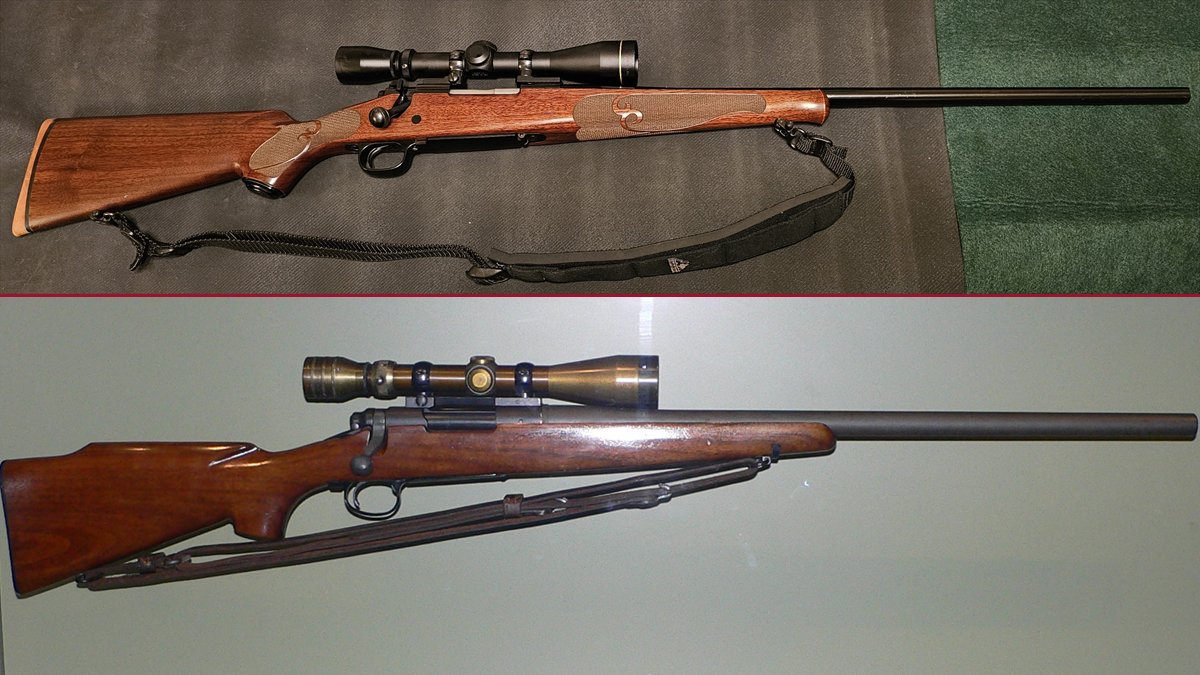
Picture your brother-in-law shopping for the one centerfire rifle he expects to keep for the rest of his life. He has narrowed it to two names, and each one has its case: the Model 70's big claw extractor never lets go of a cartridge; nearly everything on the market fits a Remington 700; the 700 carries a trigger history some buyers avoid; and Carlos Hathcock, the most famous Marine sniper of the Vietnam War, carried a Model 70, yet the Marines switched to the Remington.
These two rifles were built on different ideas, and those ideas still show in how each feeds, how it fits into the wider world of parts and what can go wrong with a used one. But comparisons often set a rifle from one decade against one from another, or treat a famous owner as proof of which is better.
Our separate histories of the Winchester Model 70 and the Remington 700 cover each rifle; this comparison covers feeding, what the Marine Corps story really shows, triggers and safeties, the accuracy evidence and where each stands if you're buying now. By the end you should be able to explain the real differences, tell which matter for the way you shoot and choose the right rifle for your job.
Two rifles, two ideas: What each maker set out to do
Winchester introduced the Model 70 in 1936, building on its earlier Model 54 and on the Mauser tradition that came before it. The goal was a refined hunting rifle suited to telescopic sights, with a Mauser-type claw extractor and a three-position safety. Remington came at the problem from another direction. After World War II, its engineers, led by Mike Walker, looked for a bolt action that cost less to build than the Mauser-style rifles of the day. The result was the 721 and 722 of 1948, with a round receiver that could be turned on a lathe rather than milled from a complicated shape. The Model 700 grew from that family in 1962.
Think of two kitchen tables. One is designed around how it will feel and work for the family using it. The other is designed so the factory can build thousands that all come out the same. Either can be a very good table, and neither idea guarantees the result. In rifles, the Winchester idea tends to show up in how the action handles a cartridge, and the Remington idea tends to show up in consistency and in how easily others can build parts for it.
Neither maker stayed in one place, though. Winchester made its own cost-cutting redesign in 1964, and Remington's rifle has been built in many forms for more than 60 years. So start with this: Before you compare a Model 70 with a 700, find out which years and versions you are actually comparing.
Controlled-round feed vs. push feed: What happens at the bolt
This is the difference most people mean when they argue about these rifles. Every new Model 70 uses controlled-round feed. As the bolt moves forward, the rim of the cartridge slides up under a large claw on the side of the bolt, and that claw holds the cartridge all the way into the chamber and back out again. Winchester says the claw grips about a quarter of the base of the cartridge. A fixed blade kicks the case out at the end of the bolt's travel, so how hard you pull the bolt back decides whether the case flies clear or drops gently into your hand.
The 700 uses push feed. The bolt shoves the cartridge forward out of the magazine, and the cartridge is not attached to the bolt until the bolt closes. Only then does a small clip inside the recessed bolt face snap over the rim. When you open the bolt, a spring-loaded plunger pushes against the case and throws it out as soon as it clears the action.
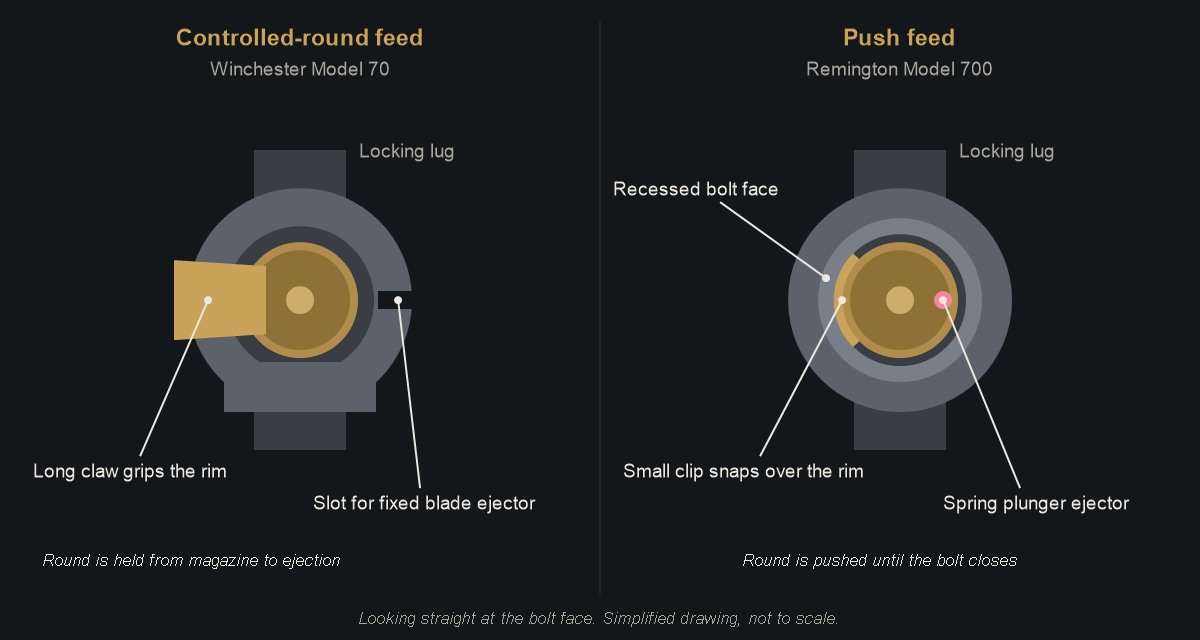
Picture moving a full coffee mug across a table. Controlled-round feed is holding it by the handle the whole way. Push feed is sliding it along with your hand behind it until it reaches the spot where you want it. On a level table in calm conditions, both work fine. The difference shows up when things get awkward: The rifle is tilted, you are working the bolt fast, or you close the bolt partway, change your mind and pull it back. A push-feed rifle can leave a loose round in the action in that last case, and closing the bolt again can try to feed a second one on top of it.
How often does that matter? Less often than the arguments suggest. Writing in Rifle magazine in 2025, Brian Pearce reported that his records for thousands of rounds through a range of controlled-feed rifles showed no failures, and that he values the design for dangerous game, where a stoppage could cost a life. He also concluded that both systems can be reliable or unreliable depending on design and quality. That is one experienced shooter's record rather than a controlled study, but we found no independent test that settles the question between these two rifles.
Common mistake: Assuming the name on the receiver tells you how a rifle feeds. Model 70s made from 1964 until the Classic arrived in the early 1990s were generally push feed. Look at the bolt: A long claw down the side means controlled-round feed, and a small clip inside a recessed face means push feed.
A claw costs money for a margin you may rarely use. A claw adds machining and adds cost, which is why Winchester gave it up in 1964. If you take one or two careful shots from a deer stand, the feed system will probably never decide your hunt. If you hunt game that can hurt you, want every bit of margin for a fast second shot, or simply like knowing the round is held the whole way, controlled-round feed earns its place.
The Hathcock question: Why the Marines went from one to the other
Few stories come up more in this debate, and it teaches more than it first seems to. Carlos Hathcock won the 1,000-yard Wimbledon Cup at Camp Perry in 1965 with a Model 70. On his first tour in Vietnam, starting in 1966, he carried a Model 70 target rifle in .30-06 with an 8-power Unertl scope. When he returned in 1969, he used the new M40, a Remington 700 in 7.62mm NATO with a Redfield 3-9x scope, according to Edward Land, the Marine officer who ran the sniper program.
That sounds like a clean verdict for the Remington, but look closer. The Corps had never formally adopted the Model 70 as a sniper rifle. It bought 373 in 1942 and rejected them for sniping at the time, then used most of them for match shooting. A 1951 Marine report ranked the Model 70 as the most accurate American .30 caliber rifle on the market and still declined to buy more. The rifles that reached Vietnam were mostly match rifles pulled from armories, and American Rifleman describes them as a stopgap.
When the Corps went looking for a permanent rifle in 1966, the pre-'64 Model 70 was no longer being built. Winchester had already switched to push feed. Land's explanation for why the Corps did not simply buy new Winchesters was that the post-1964 extractor was weak and needed a clean chamber about every 10 shots, a luxury Marines in the field did not have. Another account in American Rifleman says the Corps saw no compelling reason to stay with Winchester. The Marines tested existing bolt rifles for accuracy, durability and availability, adopted the Remington on April 7, 1966, and ordered 700 of them.
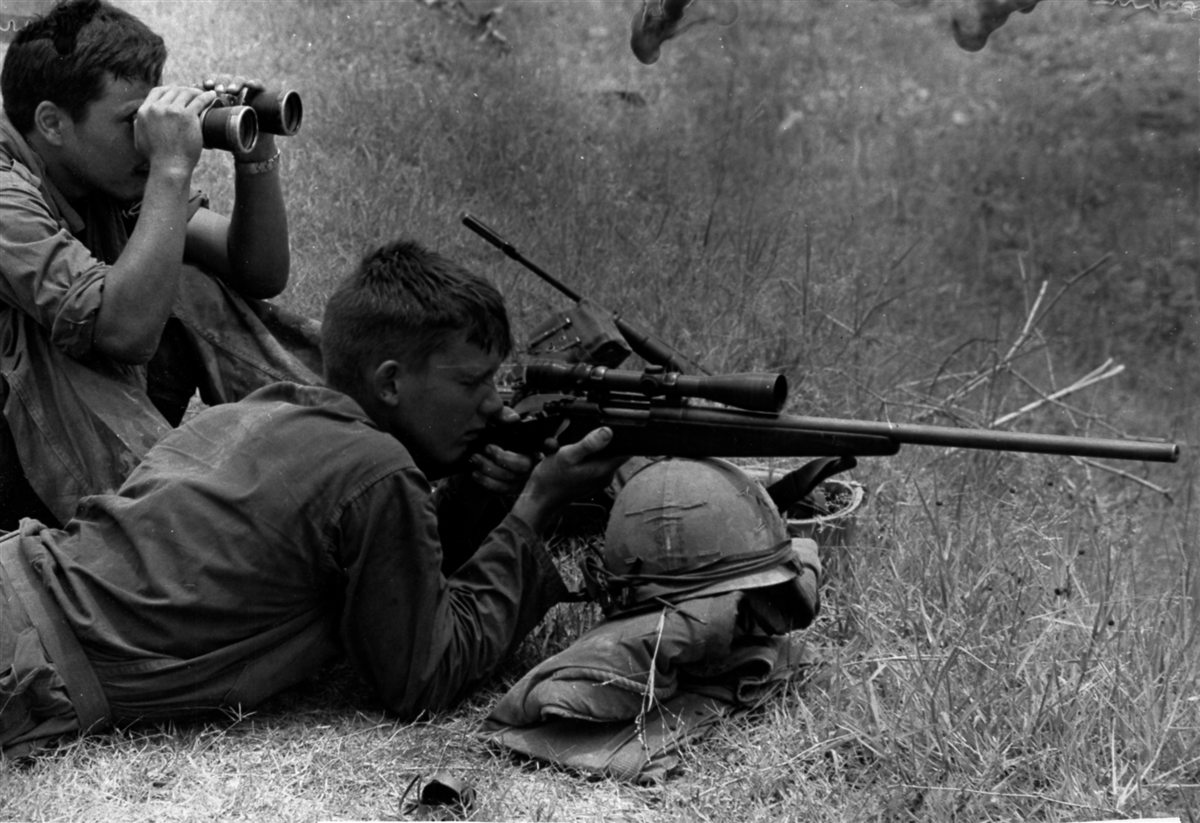
So the Marines never chose a 700 over the Model 70 most people picture. They chose it over what Winchester was selling at the time, and over a stock of aging match rifles. The new rifle was not perfect either. Its wood stock suffered in Vietnam's humidity, and by June 1969 only 45 of the 82 M40s allocated to the 1st Marine Division's sniper teams remained in the field. The Corps later rebuilt the design with fiberglass stocks and heavier barrels, and kept 700-based rifles in service for about five decades.
The story also tells you something about the man behind the rifle. Land recalled that Hathcock's Model 70 had pitting in its barrel and held about two minutes of angle, which is roughly two inches at 100 yards, and that it stayed zeroed day after day. He said the delicate Unertl scopes "would not have lasted an hour in the hands of regular Marines," but that Hathcock understood his and knew how to care for it.
Key idea: A famous rifle tells you what was available and what a highly skilled person could do with it. It does not tell you which rifle will work best for you. Hathcock's results came from a rifle that held zero and a shooter with the skill to use it.
Both rifles earned their military history, and the history is worth knowing. Just do not let it choose for you. Use it to ask a better question: What did that shooter need the rifle to do, and do you need the same thing?
Triggers and safeties: The honest comparison
The 700's trigger history is the biggest cloud over the rifle, and it deserves a plain explanation. Lawsuits and news investigations claimed that the older trigger design, often called the Walker trigger, could let the rifle fire without the trigger being pulled under some conditions. In 2014 Remington agreed to a class-action settlement offering trigger replacements for millions of rifles, while saying the settlement was not a recall. The deadline to claim a replacement was April 23, 2020.
The newer X-Mark Pro trigger was the subject of a separate voluntary recall. It covered Model 700 and Model Seven rifles made from May 1, 2006 to April 9, 2014, because excess bonding agent could cause an unintended discharge, and Remington told owners to stop using those rifles. The recall notice said inspected and cleaned rifles would get a punch mark on the bolt release. In 2023 Remington's successor announced that new 700s would ship with Timney triggers, most of them a non-adjustable design rated at 3 to 4 pounds.
That history means a 700's age matters a great deal, so have a qualified gunsmith inspect any older one before you trust it. It does not mean a Model 70 is safe to handle carelessly. Winchester's current M.O.A. trigger is advertised as adjustable from 3 to 5 pounds, set at 3¾ pounds from the factory, but no trigger or safety replaces muzzle discipline. Our guide to trigger upgrades explains what to look for if you ever change one.
The safeties differ too. The Model 70's three-position safety sits on the bolt shroud. In the middle position, the firing mechanism is blocked but the bolt can still move, so you can unload the rifle with the safety on. The 700 uses a two-position lever beside the bolt shroud, within easy reach of your thumb. It is simple and quick, but it does not offer that separate middle step, so read the manual for the exact rifle to see what the bolt does on safe.
Safety: Whichever rifle you choose, unload it the same careful way every time: Muzzle in a safe direction, finger outside the trigger guard, and magazine and chamber checked by eye and by feel. A safety is a mechanical device, and mechanical devices can fail.
Here it comes down to familiarity against features. If you unload in the field often, for example climbing down from a stand or crossing a fence, the Model 70's middle position is a real convenience. If you are looking at a used 700, start by identifying the trigger and date first, and do not load it until a qualified person has checked it.
Accuracy: Why the evidence does not crown a winner
You will hear confident claims in both directions. Fans of the 700 point to its stiff round receiver and enclosed bolt face, and a Guns & Ammo writer argued that the enclosed face makes the action more accurate on average. Winchester points to its flat-bottomed forged receiver and epoxy bedding, and claims a 1-inch, three-shot group at 100 yards with match ammunition under ideal conditions. We found no good head-to-head test of matching rifles that settles it, so the available evidence does not establish that one is more accurate.
What the evidence does show is how much rifles of one name vary. An American Hunter test of seven decades of Model 70s recorded a 1959 .30-06 printing groups of 0.37 and 0.54 inch with one load, a late-1938 rifle averaging 0.98 inch, and a 2008 .300 WSM shooting a 0.56-inch group. An early 2007 prototype, however, shot about 3 inches. Those are different rifles, loads and shot counts, so they are not a fair ranking, but they make the point. The gap within one model can be bigger than any gap you are likely to find between the two brands.
So what makes the difference? Mostly the individual rifle's barrel and bedding, plus the ammunition you feed it and the shooter behind it.
Shopping by reputation feels easier than testing, but it can cost you the rifle that would actually have shot best. Do not choose between these two for accuracy alone. Choose the rifle for its other features, then test several loads at the range and keep the one it likes.
The aftermarket: Where the 700 pulls ahead
This is the clearest win in the comparison. So many 700s were sold that parts makers design for its receiver dimensions first, and many custom actions copy those dimensions so they fit the same parts. Stocks, chassis, triggers, scope bases and bottom metal are all easy to find. The Model 70 has good support too, with replacement triggers, bases and stocks from several makers, but your choices are much narrower, especially for modern chassis.
A big catalog only helps if you plan to use it, and a factory hunting rifle that already does its job may never need any of it.
If you expect to rebuild or customize a rifle for competition or long range, the 700 pattern gives you far more room. If you plan to mount a scope and hunt for 30 years, the catalog should not decide this for you.
Buying one today: New rifles and used ones
The two brands are in very different places right now. Winchester-brand Model 70 production moved after the New Haven, Connecticut plant closed in 2006. It resumed in South Carolina and moved to Portugal in 2013, and current rifles have controlled-round feed across the line. They run from synthetic-stocked hunting models to walnut rifles such as the 2026 Featherweight AA French, which lists at about $1,900. A pre-'64 in good shape can bring considerably more than that from collectors, and you are often paying for history rather than for better results in the field.
Remington's path has been rougher. The company went through bankruptcy in 2018, was broken up in 2020, and closed its longtime plant in Ilion, New York in 2024. An October 2026 company announcement said new Model 700s from LaGrange, Georgia were expected to reach dealers this fall, but it gave no quantities, complete model list or new suggested prices. New production has little public track record yet, so judge those rifles on what they show when they arrive. Meanwhile, a huge number of used 700s remain in circulation, which is why trigger history matters so much.
| Feature | Winchester Model 70 | Remington Model 700 |
|---|---|---|
| Introduced | 1936 | 1962, from the 1948 721 and 722 |
| Feed | Controlled-round on current rifles; push feed on most from 1964 to the early 1990s | Push feed |
| Extractor and ejector | Long claw; fixed blade | Small clip in the bolt face; spring plunger |
| Safety | Three-position on the bolt shroud | Two-position lever |
| Trigger | M.O.A., advertised as adjustable from 3 to 5 pounds | Varies by era: Walker, X-Mark Pro, Timney since 2023 |
| Aftermarket | Good, but narrower | Very wide; many parts are designed for it first |
| Check first when buying used | Era and feed type | Trigger, date and any recall work |
Start from the bottom row if you are shopping used, because the last row can end the conversation before the others matter. Of the rest, the feed row does the most work for a hunter who wants a margin for hurried shots, and the aftermarket row does the most work for someone who plans to build. Put simply, the Model 70 gives you more of the design in the box today, and the 700 gives you more options afterward. Decide which of those you are really paying for.
What either rifle means for an Iowa hunter
Here is the question that matters more than feed type for many Iowa hunters: What will you hunt with it? Iowa allows rifles for deer during the youth and disabled season and the first and second shotgun seasons only if they fire an expanding bullet from .350 to .500 inch with at least 500 foot-pounds of muzzle energy. The Iowa DNR's deer hunting page lists examples such as .35 Whelen and .350 Legend. A .270, .308 or .30-06 fires a bullet well under .350 inch, so those classic chamberings for either rifle do not qualify for those seasons, even though they are fine for many other uses. Some January antlerless seasons have different limits. Laws change, so check the current regulations or ask a conservation officer.
Our guide to straight-walled hunting cartridges explains how those rules work here and in nearby states.
Pick the cartridge for your season first, then look for a rifle offered in it. If your Iowa deer hunting is the whole plan, you may find that neither of these rifles is offered in what you need. If you also travel for elk or antelope, or want a rifle for the range, the classic chamberings make good sense.
Comparing two bolts safely
Ten minutes with both rifles shows the differences better than any argument. With both unloaded, actions open, ammunition in another room and each chamber and magazine checked by eye and feel, look straight at each bolt face with a flashlight: the extractor and ejector tell you whether it's controlled-round or push feed. Work each bolt slowly, then faster, and notice how the lift and travel feel. Move each safety through its positions and check in the manual what each does, including whether the bolt can move. Then shoulder each with your eyes closed and open them: the rifle that puts you straight behind the scope is the one that fits.
Putting it together
Every argument he heard describes something real. A claw does hold a round more securely, though that margin rarely decides a calm shot from a stand. The 700's parts world is far bigger, which matters most if he plans to build. The 700's trigger history does demand attention, especially on a used rifle. And the Hathcock story is true, but it shows what the Marines could buy in 1966 and what a gifted shooter could do, not which rifle is better for a deer hunter today.
So work through it in order. Start with your hunt and the cartridge it requires. If you want the most margin in feeding and a three-position safety in the box, lean toward a Model 70. If you plan to customize, or you have found a carefully checked rifle at the right price, lean toward a 700. On any used rifle, confirm the era, the feed type and the trigger before anything else. Then shoulder it, test ammunition in it, and let the rifle in your hands make the final case.
Check your understanding
Try answering these before you open the answer. If you can decide what to do and explain why, you have it.
1. A friend says, "All Model 70s have controlled-round feed." How would you respond?
Not all of them. Winchester moved to push feed in 1964 and did not start bringing the claw back until the Classic of the early 1990s. Current Model 70s have it, but a rifle from those middle decades may not, so check the bolt instead of trusting the name.
2. Someone says the Marines proved the 700 is better because they replaced Hathcock's Model 70 with the M40. What is missing from that argument?
The Corps was not comparing the 700 with a pre-'64 rifle it could still buy new. It was choosing among rifles available in 1966, after Winchester's redesign, and the Model 70s in Vietnam were older match rifles never formally adopted for sniping. The story also says a lot about Hathcock's skill rather than just his equipment.
3. A friend offers you a good price on a 2010 Remington 700. What do you do before loading it?
Treat it as a rifle that may fall within the X-Mark Pro recall, which covered rifles made from May 2006 to April 2014. Identify the trigger, look for evidence of recall work, and have a qualified gunsmith inspect it before you use it. A good price is not a reason to skip that step.
4. You want a rifle for Iowa's first shotgun deer season. A .30-06 Model 70 and a .30-06 Model 700 are both on your list. What is the first problem?
Neither qualifies for that season, because a .30-06 fires a .308-inch bullet and Iowa's rifle rule for that season starts at .350 inch. Choose a legal cartridge first, then look at which rifles are offered in it, and confirm the current rules with the Iowa DNR.
Where to go next
To see how the moving parts work together, read how bolt actions work. For the full background on each rifle, see our histories of the Winchester Model 70 and the Remington 700. And to judge what a given price actually buys in a factory rifle, read out-of-the-box hunting rifle quality.
Photo: Top, "Winchester Model 70 Classic Featherweight .300 WSM" by Efeesh, via Wikimedia Commons, licensed CC BY 4.0. Bottom, "Chuck Mawhinney's sniper rifle," an M40 at the National Museum of the Marine Corps, by Mark Pellegrini, via Wikimedia Commons, licensed CC BY-SA 3.0. Both cropped and combined. Bolt drawing by Premier Services.
If this article helped you, we invite you to sign up for email notifications of new blog articles.