
Understanding MOA (Minute of Angle) and Its Impact on Long-Range Precision
Joseph McLain Nov 07, 2026
You are shooting at 300 yards and your bullet lands six inches below the bull. You could dial up two MOA, hold over, or wish you had a MIL scope. Each fix works, but only if you understand the angle behind it.
By the end you should be able to turn a miss into a scope correction yourself, explain why two MOA was the right number at 300 yards, compare MOA with milliradians (MILs), and choose the system and turrets that suit your shooting.
What MOA means: A slice of angle that widens with distance
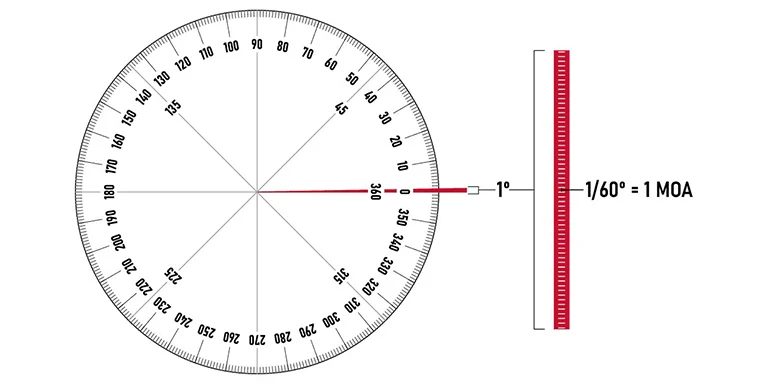
MOA stands for Minute of Angle. A circle has 360 degrees, and each degree is divided into 60 minutes, so one MOA is 1/60 of a degree. That is a very small angle, and because it is an angle, the width it covers grows with distance.
Picture a thin slice of pizza. Near the point the slice is almost nothing; toward the crust it gets wider. One MOA is one fixed slice. At 100 yards it is about 1.047 inches wide, which most shooters round to 1 inch. At 200 yards it is about 2 inches, and at 300 yards about 3 inches. The pattern is easy to remember: The number of inches in one MOA is about the distance in hundreds of yards.
MOA describes two things. It describes accuracy, so a rifle that shoots "one-MOA groups" keeps its shots in about an inch at 100 yards and about three inches at 300. It also describes scope adjustments, so a turret marked in MOA moves the point of impact by an angle rather than a fixed number of inches.
Common mistake: Treating 1 MOA as 1 inch at every distance. It is about 1 inch only at 100 yards. At 300 yards a 1 MOA change moves your point of impact about 3 inches.
The rule that follows is to always convert inches to MOA at the distance you are shooting, never at 100 yards by habit.
Turning a miss into a correction
As a bullet travels downrange, gravity pulls it below your line of sight and wind pushes it sideways. The elevation turret on your scope corrects up and down, and the windage turret corrects left and right. Our guide to the role of ballistics in long-range shooting explains why both forces act on every shot.
Every correction uses one formula: Divide the error in inches by the inches per MOA at that distance. In the opening example, the bullet hit 6 inches low at 300 yards, where one MOA is about 3 inches. Six divided by three is two, so you dial 2 MOA up. Sideways errors work the same way. If wind moved your group 6 inches right at 300 yards, you would dial 2 MOA left.
The last step is converting MOA to clicks. Many hunting and target scopes move 1/4 MOA per click, so 2 MOA is 8 clicks. Others use 1/8 MOA or 1/2 MOA clicks. The value is printed on the turret or in the manual, and it is the number you must check before you dial.
Key idea: Error in inches divided by inches per MOA at that distance gives the MOA to dial. MOA divided by the click value gives the number of clicks.
A real scope adds one complication: Actual clicks are not always exactly the value printed. Confirm your scope's adjustments on paper once, with the tall-target test below, before trusting them at long range.
Holding over instead of dialing
You do not always have to turn a turret. Many scopes have reticles with marks below the center crosshair, measured in MOA or MILs. Instead of dialing 2 MOA, you can aim with the mark 2 MOA below center. That is called holdover, and the same idea sideways is called holding for wind.
Dialing puts the center crosshair exactly on target, which is precise and easy to see, but takes time. Holding is faster, which matters when an animal is moving or the wind is changing, but it is easier to misjudge. Many shooters dial for elevation when they have time and hold for wind. Our guide to rifle scope reticles explains how the marks are spaced. Holdover marks on second focal plane scopes are correct at only one magnification, usually the highest, so check your manual.
MOA or MIL: Two ways to measure the same idea
A milliradian, or MIL, is another angular unit: One thousandth of a radian. Both work on the pizza-slice principle; the difference is the size of the slice.
| System | Size at 100 yards | Typical click | Where it is common |
|---|---|---|---|
| MOA | About 1.047 inches | 1/4 MOA, about 0.26 inch at 100 yards | Hunting and general target shooting in the United States |
| MIL | About 3.6 inches | 0.1 MIL, about 0.36 inch at 100 yards | Military and long-range competition |
Two things stand out. First, a MIL is about three and a half times larger than an MOA, so a number in one unit is badly wrong in the other. Second, a typical quarter-MOA click is actually slightly finer than a typical tenth-MIL click; MIL's popularity in long-range competition comes from its decimal arithmetic and from many shooters and spotters sharing it, not from finer clicks.
Choose one system and match it everywhere: A scope whose turrets and reticle use the same unit, and the same unit in your ballistic app and your log. If your shooting partners or instructor use one system, using it too makes communication easier. Either system is accurate.
What to look for in a scope's adjustments
Scope models change often, so focus on features rather than a particular model. Many well-known lines, such as Vortex, Leupold and Nightforce, offer scopes in both MOA and MIL versions.
Check that the turret and reticle use the same unit, and that the click value is one you can count easily. Look for turrets that can be reset to zero after sighting in, so you can return to your zero, and a zero stop, which prevents you from dialing below it. Check the total elevation travel if you plan to shoot far, because long shots need many MOA of adjustment. Finally, understand the focal plane: In a first focal plane scope, reticle marks keep their MOA value at every magnification; in a second focal plane scope, they are correct at only one setting. Our article on what the numbers on a rifle scope mean explains magnification and objective size, and mounting a rifle scope covers getting it on the rifle level and secure.
Buy matching units, resettable turrets and enough travel for the distances you will actually shoot; extra magnification matters less than reliable adjustments.
Habits that make MOA work
MOA math is only as good as your data about your own rifle. The most valuable habit is a shooting log: The load, distance, conditions and the correction that worked. Over time it becomes a map of how your rifle and ammunition behave, and you will need the calculator less.
Second is consistent ammunition. Different loads drop and drift differently, so a correction learned with one load does not transfer to another. Our guide to how ammunition affects accuracy explains why. A ballistic calculator gives you a good starting estimate, but the shots you fire and record confirm it.
Safety: Practice at distances where you can see your hits, and only on ranges with a backstop rated for your rifle and distance. Confirm every new correction on paper before using it on game.
Confirming your clicks with a tall-target test
Turret markings are a promise, and a tall-target test checks it. At 100 yards, with a safe backstop and eye and ear protection, hang a tall target with a vertical line drawn on it. From a solid rest, fire a three-shot group at an aim point near the bottom of the line. Dial 10 MOA up, keep the same aim point, and fire another group. The group centers should be about 10.5 inches apart, because one true MOA is 1.047 inches at 100 yards. If they're noticeably closer or farther apart, your scope moves a little more or less than it says, and you can use the real number in your corrections. Dial back to zero and record the result in your log.
Putting it together
MOA is an angle, about one inch at 100 yards and growing with distance. To correct a miss, convert the error in inches to MOA at that distance, then convert MOA to clicks using your turret's printed value, and confirm on paper. You can dial or hold over, and the choice is speed against precision. MOA and MIL are equally capable; what matters is using one unit everywhere. Choose a scope with matching units, resettable turrets and enough travel, and keep a log so each correction becomes knowledge rather than a guess.
Check your understanding
Try answering these before you open the answer. If you can decide what to do and explain why, you have it.
1. Your 100-yard groups measure 1 inch, and a friend says the rifle will shoot 1-inch groups at 300 yards too. What would you expect instead, and why?
About 3 inches. MOA is an angle, so a 1-MOA group widens with distance: about 1 inch at 100 yards, 2 at 200 and 3 at 300.
2. At 400 yards your bullet lands 8 inches low. How many quarter-MOA clicks should you dial?
At 400 yards 1 MOA is about 4 inches, so 8 inches is 2 MOA, which is 8 clicks of 1/4 MOA up.
3. A friend tells you to dial 2 on a MIL scope using a number calculated in MOA. What is wrong?
The units do not match. A MIL is about 3.6 inches at 100 yards, so 2 MIL would overcorrect badly.
4. An elk crosses at an unknown distance and the wind is gusting. Do you dial or hold over, and what do you give up?
Hold over. It's faster when conditions change or an animal is moving, but holdover is easier to misjudge than a dialed correction, so dial when you have the time.
5. Your new scope says 1/4 MOA per click, but your corrections keep falling a little short. What test would settle it?
A tall-target test. Dial a known amount, such as 10 MOA, at 100 yards and measure how far the group moves. If it moves less than about 10.5 inches, the scope's clicks are smaller than marked, and you can correct with the real value.
Where to go next
Every MOA correction starts with a good zero, so read our guide to sighting in a rifle scope. Rifle scope reticles explains holdover marks, the role of ballistics in long-range shooting shows where drop and drift numbers come from, and sighting in rifles at different distances helps you choose a zero distance.
If this article helped you, we invite you to sign up for email notifications of new blog articles.