
Fitting a Rifle to a Youth or Smaller Shooter: Length of Pull, Weight and Recoil
Joseph McLain Nov 06, 2026
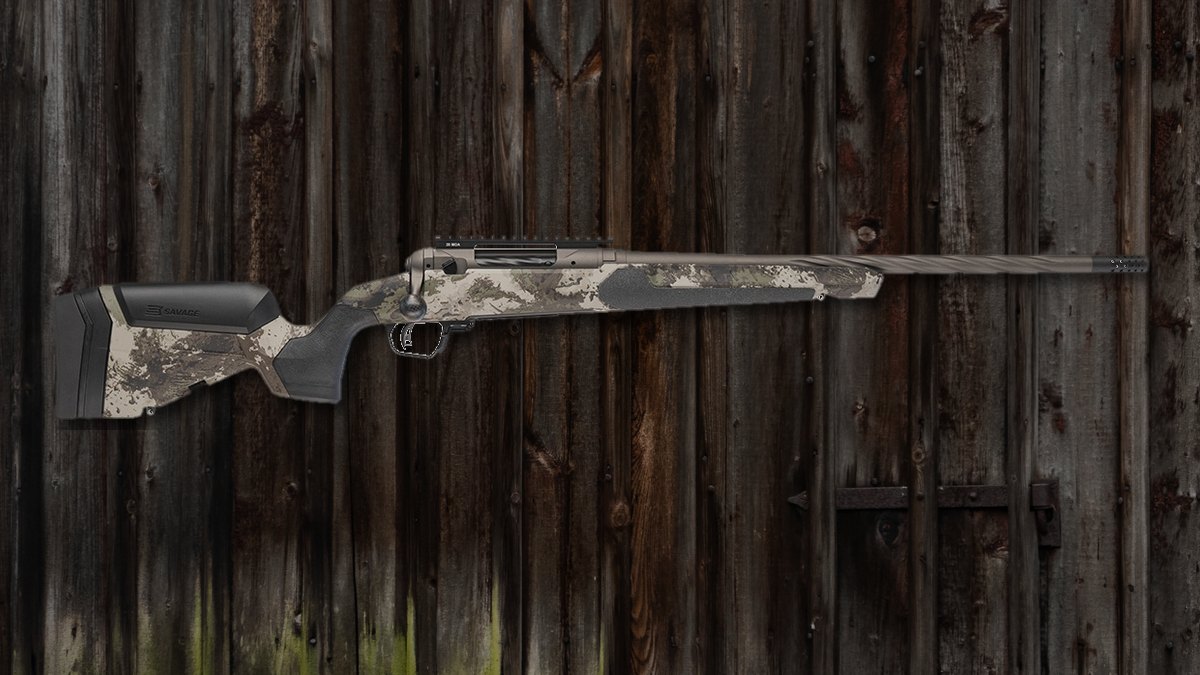
Your daughter is ready for her first deer season, and the family rifle is waiting in the safe. When she shoulders it, her head leans back, her arm stretches to reach the trigger and the barrel slowly sinks toward the ground. Your father says she will grow into it. A friend says buy her a youth model. Her uncle says the real problem is recoil, so get her the smallest caliber legal. Each of them is right about something. Fit, weight and recoil all matter, and they affect each other.
A rifle that does not fit is not just uncomfortable. It makes good shooting harder, it makes recoil feel worse and it teaches bad habits, like flinching or leaning away from the stock, that take a long time to unlearn. That is true for young hunters, and it is just as true for adults of smaller build, who are often handed a standard rifle and told to make it work.
This article explains how a rifle should fit, how to measure it at home, how weight and recoil interact, which cartridges are easiest to learn on and how to set up a rifle that can grow with a young shooter. By the end you should be able to check how a rifle fits a particular person, recognize the signs of a poor fit and choose changes that make the rifle easier to shoot well.
What good fit looks like
When a rifle fits, the shooter can stand or sit with their head upright, bring the rifle to their shoulder and find the sight or scope picture right in front of their eye without craning their neck. Their trigger hand reaches the grip naturally, with the first pad of the trigger finger resting on the trigger. Their support arm holds the forend without stretching. And they can hold the rifle steady long enough to aim without shaking.
Think of it like a bicycle. A bike that is too big can still be ridden, but the rider reaches for the handlebars, cannot touch the ground comfortably and wobbles. On a bike that fits, the rider stops thinking about the bike and pays attention to the road. A rifle that fits lets the shooter stop fighting the rifle and pay attention to the target.
Three measurements do most of the work: Length of pull, comb height and, if there is a scope, eye relief. Weight and recoil decide whether the shooter can hold and shoot the rifle comfortably once it fits.
The rule: A rifle fits when the shooter's head stays upright, the eye lines up with the sight without effort and the trigger finger reaches naturally. If any of those requires effort, something needs adjusting.
Length of pull: The measurement that matters most
Length of pull is the distance from the center of the trigger to the middle of the buttpad. Most adult rifles come with about 13.5 to 14 inches. Youth and compact rifles commonly run around 12 to 12.5 inches, and some have spacers that let you lengthen the stock later.
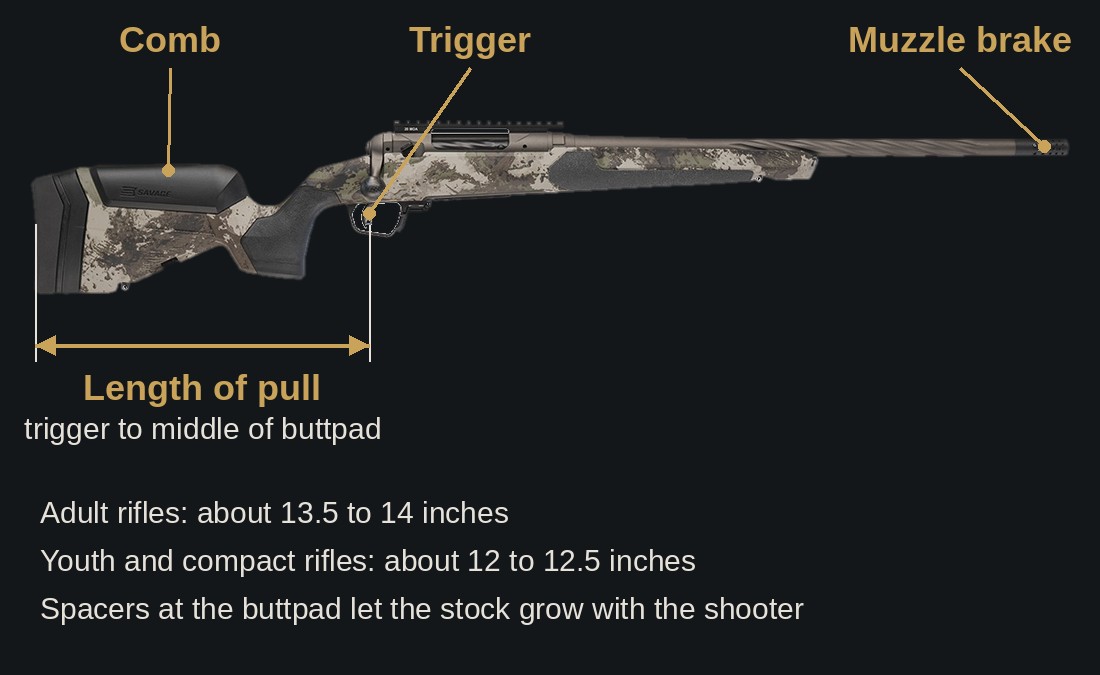
When the length of pull is too long, the shooter leans back to reach the trigger, their head moves away from the scope and the rifle feels heavier because the weight sits farther out in front. They often place the buttpad on the upper arm instead of the shoulder pocket, which makes recoil hurt more. When it is too short, the shooter's nose or thumb can get close to their hand on the grip, and with a scope, their eye may be too close to it.
A common quick check is to place the buttpad in the crook of the elbow and see whether the trigger finger reaches the trigger. It is a rough starting point, not a final answer. The better test is to have the shooter mount the rifle in a real shooting position, with the rifle unloaded, and watch them.
Key idea: A stock that is too long is the most common fit problem for young and smaller shooters, and it makes everything else harder: Holding, aiming and handling recoil.
Look for the head staying upright, the buttpad resting in the pocket between the shoulder and collarbone, the trigger finger landing on the pad of the first joint and the support elbow bent rather than locked straight. If the shooter is reaching, the stock is too long.
The rule: Measure fit with the shooter in a real shooting position. If they lean back or stretch to reach the trigger, shorten the length of pull before anything else.
Comb height and eye relief: Lining up the eye
The comb is the top of the stock where the shooter rests their cheek. Its height decides whether the eye lines up naturally with the sights or scope. If the comb is too low, the shooter has to lift their head off the stock to see through the scope, which means their cheek weld changes from shot to shot. If it is too high, they have to press their face down hard. A stick-on or adjustable cheek riser can raise a comb that is too low. Our article on choosing a rifle stock explains adjustable stock options.
Eye relief is the distance between the eye and the rear of the scope at which the shooter sees the full picture. Most hunting scopes need about three to four inches. When a stock is shortened, the shooter's eye moves forward, and a scope mounted for an adult may now sit too close. That is a recipe for "scope bite," a cut on the eyebrow when the rifle recoils.
Common mistake: Shortening a stock or switching to a youth rifle but leaving the scope where it was. Every time the length of pull changes, move the scope so the shooter sees a full picture with a safe gap between their eye and the scope.
Our guide to mounting a rifle scope shows how to set eye relief for a specific shooter. Remember to re-zero after moving the scope.
The rule: Set the comb so the eye lines up without lifting or pressing, and set the scope so the full picture appears with at least three inches between eye and scope.
Weight and balance: Holding it steady
Weight works in two directions. A heavier rifle absorbs more recoil, because the same push has to move more mass. A lighter rifle is easier to carry and hold up. For a young or smaller shooter, the challenge is that a rifle heavy enough to tame recoil may be too heavy to hold steady offhand, especially at the end of a long walk.
Balance matters as much as total weight. A rifle with a long, heavy barrel feels heavier than its scale weight because the weight sits far out in front. A shorter barrel and a compact stock pull the balance point back toward the shooter's hands, which makes the same rifle easier to hold.
The practical solution is support. In a tree stand or blind, a shooting rail, bipod, shooting sticks or a pack used as a rest lets the shooter hold a slightly heavier rifle steady without tiring. Teaching a new shooter to use a rest is not a crutch; it is how most hunters shoot accurately in the field. Our article on shooting positions for hunters covers the options.
The rule: Choose a rifle light enough to carry and handle, then use a rest to hold it steady. Do not choose a rifle so light that recoil becomes the problem.
Recoil: Why it matters so much for new shooters
Recoil is the rifle's push back against the shoulder when it fires. How much a shooter feels depends on the cartridge, the bullet weight, the rifle's weight, the stock's fit and the recoil pad. A shooter who is hurt or startled by recoil early on often develops a flinch, anticipating the shot and pushing or jerking the rifle as it fires. A flinch is easier to prevent than to fix. Our article on fixing a flinch explains how it develops.
Fit is a big part of recoil. A rifle that fits sits firmly in the shoulder pocket and pushes straight back, spreading the force. A rifle that does not fit often sits on the upper arm or bicep and pushes up into the cheek, which hurts more even with the same cartridge. That is why fixing fit often reduces felt recoil more than switching calibers.
Other tools help too. A good recoil pad spreads and slows the push. A muzzle brake redirects gas to reduce recoil, though it makes the rifle much louder, which matters for a young shooter's hearing. Our article on muzzle brakes, compensators and flash hiders explains those trade-offs. Good hearing protection also matters, because noise makes recoil feel worse and can trigger a flinch on its own.
Good practice: Start every new shooter on a .22 rimfire, even if the goal is deer season. Hundreds of rounds with almost no recoil build good trigger control and position before the larger rifle comes out.
The rule: Fix fit first, add a good recoil pad and hearing protection, and build skill on a .22 before stepping up. A first centerfire session should end with the shooter wanting more, not rubbing their shoulder.
Choosing a cartridge for a young or smaller shooter
For practice, nothing beats a .22 LR. It is inexpensive, quiet with good hearing protection and has almost no recoil. Our article on choosing a .22 rifle covers good options.
For Iowa deer, the choices narrow, because rifles used for deer here are limited to certain straight-walled cartridges. Among those, the .350 Legend is known for relatively mild recoil and is widely available in compact and youth-sized rifles. Heavier straight-walled cartridges such as the .450 Bushmaster and .45-70 hit harder and recoil harder. Our comparison of .350 Legend, .400 Legend and .450 Bushmaster explains the differences, and our guide to straight-walled cartridges for deer hunting covers the rules. Always check the current Iowa DNR regulations before the season.
For hunting where Iowa's straight-walled rule does not apply, such as many neighboring states' deer seasons or for coyotes, cartridges such as the .243 Winchester and 7mm-08 Remington have long been popular for smaller shooters because they combine modest recoil with enough power for deer at sensible distances.
Bullet choice is part of the equation. A lighter load in the same cartridge often recoils noticeably less, as long as it is still an appropriate hunting bullet for the game. Shot placement matters far more than raw power, and a shooter who is comfortable will place shots better.
The rule: Pick the mildest cartridge that is legal and appropriate for the game, and favor a load the shooter can place well over one that hits harder.
Youth models, spacers and growing into a rifle
Many manufacturers offer compact or youth versions of their popular rifles. These usually have a shorter length of pull, sometimes a shorter barrel and a lighter overall weight. Many come with spacer systems that let you add length to the stock as the shooter grows, or a second, full-length stock you can swap on later. That can turn a first rifle into one the shooter keeps for years.
Cutting down an existing adult stock is another option. A gunsmith can shorten a stock and reinstall the recoil pad, and spacers can be added back later. On many synthetic stocks, aftermarket adjustable stocks are available, too. Each choice has a cost, so compare it with simply buying a rifle that fits now and adjusts as the shooter grows.
Picture two families. One hands their 12-year-old the family deer rifle and tells him to make it work; by the end of the first range trip, he is flinching and has stopped enjoying it. The other buys a compact rifle in a mild cartridge, sets the scope for her eye, puts her behind a rest and lets her shoot a .22 first. Three years later, the rifle has two spacers in it and she is the most confident shot in the blind.
The rule: Buy a rifle that fits the shooter today and can be adjusted as they grow. "They will grow into it" usually means they will learn bad habits first.
Putting it together
Rifle fit comes down to a few connected pieces. Length of pull lets the shooter reach the trigger with their head upright and the stock in the shoulder pocket. Comb height and eye relief line the eye up with the sight safely. Weight and balance decide whether they can hold it steady, and a rest makes up the difference. Recoil depends on fit as much as cartridge, and a shooter who is hurt early learns to flinch. Choose the mildest appropriate cartridge, start on a .22, and pick a rifle that can grow.
Your father was right that young shooters grow. Your friend was right that a youth model helps. Her uncle was right that recoil matters. When the rifle fits, all three problems get smaller at once.
Try this: Check a rifle's fit for a specific shooter
- Put all ammunition in another room. Open the action and look and feel to confirm the rifle is empty, and keep the muzzle pointed in a safe direction.
- Have the shooter mount the rifle in a real seated or standing position, and watch whether their head stays upright and the buttpad sits in the shoulder pocket.
- Check that the trigger finger rests naturally on the trigger without stretching and that the support elbow is bent.
- If there is a scope, have them look through it and note whether they see a full picture without moving forward or back, and measure the gap between their eye and the scope.
- Write down what needs to change: Length of pull, comb height or scope position.
You will know it worked when the shooter can close their eyes, mount the rifle, open them and find a clear sight picture right in front of them without moving their head, and you can say which single change would help them most.
Check your understanding
Try answering these before you open the answer. If you can explain it in your own words, you understand it.
1. A young shooter leans back from the rifle and the buttpad sits on her upper arm. What is the most likely fit problem?
The length of pull is too long. She is leaning back to reach the trigger, which puts the stock on her arm instead of in the shoulder pocket and makes recoil hurt more. Shorten the stock or choose a compact model.
2. You install a shorter youth stock on a scoped rifle. What else must you do before shooting it?
Move the scope so the shooter has proper eye relief, usually about three to four inches, then re-zero. A shorter stock moves the eye forward, which can lead to scope bite if the scope is left where it was.
3. A friend says a lighter rifle is always better for a small shooter. What is the trade-off?
A lighter rifle is easier to carry and hold, but it recoils more with the same cartridge. A moderate-weight rifle with good balance, used from a rest, is often easier to shoot well.
4. A new shooter's first centerfire session ends with a sore shoulder and a flinch. What would you change next time?
Check the fit first, add or improve the recoil pad and hearing protection, choose a milder cartridge or load and build skill with a .22 rimfire before returning to the centerfire. Keep sessions short and end while it is still fun.
5. Why does a rifle that fits often feel like it recoils less, even with the same cartridge?
When it fits, the stock sits firmly in the shoulder pocket and pushes straight back, spreading the force. A poorly fitting rifle often pushes into the arm or cheek, which feels sharper and hurts more.
Where to go next
For everything about a young hunter's first season, including hunter education and licenses, read our article on a young hunter's first season. To choose a practice rifle, see choosing a .22 rifle. For Iowa deer cartridges with manageable recoil, our comparison of .350 Legend, .400 Legend and .450 Bushmaster will help. And if a flinch has already started, fixing a flinch explains how to undo it.
We carry compact and youth rifles, recoil pads and cheek risers, and anything on our website can be ordered if it is not in stock. Text or call us anytime.
If you found this informative, we invite you to sign up for email notifications of new blog articles.