
Rifle Action Types: Bolt, Lever, Pump, Semi-Auto and Single-Shot Explained
Joseph McLain Nov 07, 2026
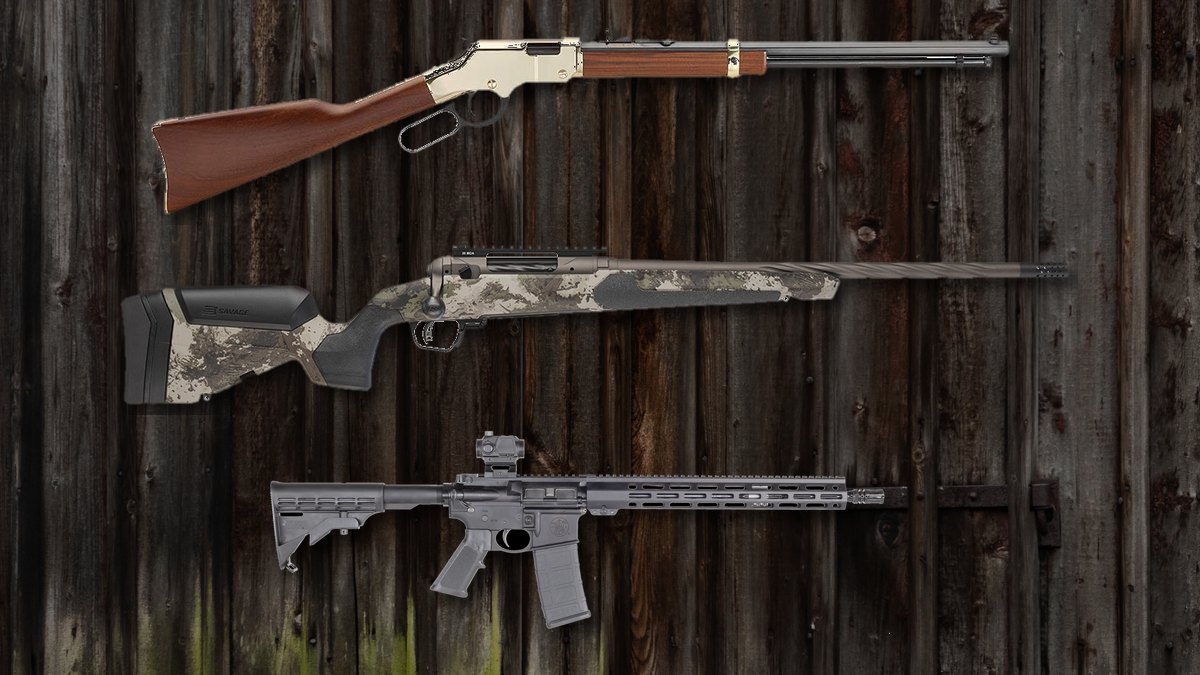
You have decided it is time to buy a rifle, and the first choice is one most new buyers don't realize they are making: the action. Bolt, lever, pump, semi-automatic or single-shot, each one handles differently, and each one is the right choice for someone.
The word "action" sounds technical, but it simply means the set of parts that loads a cartridge, fires it and gets the empty case out of the way for the next one. How a rifle does those three things shapes almost everything else about it: How accurate it tends to be, how fast you can shoot it, how it handles in a tree stand, what cartridges it can chamber and how much care it needs.
By the end you should be able to look at a rifle, name its action, explain what that means for the way it shoots and choose the action that fits what you actually plan to do.
What an action does: Load, lock, fire and clear
Every repeating rifle has to repeat the same cycle. A fresh cartridge moves from the magazine into the chamber. Something locks the chamber closed so the pressure of the shot pushes the bullet forward instead of blowing the action open. The trigger releases a firing pin. Then the action unlocks, pulls the empty case out of the chamber and throws it clear so the cycle can start again.
Think of it like a door with a deadbolt. To get people through the door, someone has to open it, let the next person in, close it and turn the bolt before anything loud happens on the other side. The actions differ mainly in who does that work and how. In a bolt, lever or pump rifle, your hands do it. In a semi-automatic, some of the energy from the shot does it for you. In a single-shot, you do it once per shot and there is no magazine at all.
Two more ideas will help. The first is lockup, which is how firmly the action holds the cartridge in place at the moment of firing. Solid, consistent lockup is one of the foundations of accuracy. The second is the magazine, which is simply where the extra cartridges wait. Some rifles use a detachable box, some a fixed box, and some a tube under the barrel. The magazine type affects what bullet shapes are safe to load, which matters later.
When you look at any rifle, ask who does the work of the cycle and how the action locks. Those two answers predict most of its strengths and weaknesses.
Bolt action: The accuracy standard
A bolt-action rifle has a handle on the side that you lift, pull back, push forward and turn down. Lifting the handle rotates the bolt so its locking lugs, a pair of steel shoulders on the front of the bolt, slide out of matching recesses in the receiver. Pulling it back extracts and ejects the empty case. Pushing it forward strips a new cartridge from the magazine, and turning it down locks the lugs back into place.
That front-locking design is why bolt actions dominate hunting and target shooting. The bolt locks directly behind the cartridge, the action is stiff and simple, and few parts move during the shot. The result is a rifle that tends to shoot small groups even at modest prices. It also handles the widest range of cartridges, from .22 LR to large magnum hunting rounds, and accepts pointed, aerodynamic bullets without any special care because the cartridges sit side by side in a box magazine.
What you give up is speed and a little bulk in the hand. A practiced shooter can run a bolt quickly, but a follow-up shot means breaking your grip, working the bolt and finding the target again. Left-handed shooters also need to pay attention, because most bolts are on the right side. Left-hand models exist, and some shooters simply learn to work a right-hand bolt with their left hand.
Key idea: A bolt action is not accurate because it is old-fashioned. It is accurate because it locks right behind the cartridge and holds still while the bullet is in the barrel.
Bolt actions suit most deer and varmint hunters, anyone interested in precision at longer distances and new shooters who benefit from a slow, deliberate rhythm. Our articles on the Remington 700 and the Ruger M77 show how two classic bolt designs approach the same job differently.
If accuracy, cartridge choice and simplicity matter more than rapid follow-up shots, start with a bolt action.
Lever action: Fast, flat and traditional
A lever-action rifle has a loop of steel behind the trigger guard. Swinging the lever down and forward unlocks the action and ejects the empty case. Bringing it back up feeds a new round and locks the action. Because your shooting hand never leaves the rifle, a lever gun can deliver a fast second shot while staying on the target.
Lever guns are slim, light and handle quickly, which is why they have stayed popular for brush hunting and for carrying around a farm. Many are chambered for straight-walled cartridges such as .45-70 Government, .357 Magnum and .44 Magnum, and newer ones for .350 Legend and .360 Buckhammer, which matters in Iowa because rifles used for deer must fire an expanding bullet from .350 to .500 inch under Iowa Code 481A.48, and these are the cartridges that fit. Our guide to straight-walled cartridges for deer hunting explains those rules.
The tube magazine question
Most traditional lever guns feed from a tube under the barrel, with cartridges lined up nose to tail. That arrangement means the tip of each bullet rests against the primer of the cartridge in front of it. Under recoil, a sharp, hard bullet tip could set off that primer inside the magazine. That is why lever-gun ammunition traditionally uses flat or round-nose bullets, and why products such as Hornady LEVERevolution use a soft, flexible polymer tip designed for tube magazines. Some modern lever guns use a detachable box magazine instead, which removes the concern.
Common mistake: Loading pointed, hard-tipped rifle bullets into a tube magazine because they are "the same caliber." Check the rifle's manual and the ammunition box, and use ammunition made for tube magazines.
The other costs are practical. Lever actions generally lock at the rear of the bolt rather than the front, and the two-piece stock is less rigid than a one-piece bolt-action stock. Most shoot well enough for hunting distances, but they are rarely the most accurate choice at long range. Mounting a scope can also be less straightforward on some models. Our articles on lever-action .45-70 rifles and Hornady LEVERevolution cover the ammunition side in more depth.
Choose a lever action when quick handling, a fast follow-up shot and a classic straight-walled cartridge fit how and where you hunt.
Pump action: Simple and rugged
On a pump-action rifle, the handguard slides back and forth. Pulling it back unlocks and ejects, and pushing it forward feeds and locks. Pump actions are far more common on shotguns, but a few rifles use them, and they appeal to hunters who grew up with a pump shotgun and want the same motion in a rifle.
The appeal is speed without a gas system. You can work a pump without moving your trigger hand, and the action does not depend on the energy of the cartridge to cycle, so light and heavy loads both run. The costs are a smaller selection of models and calibers, and accuracy that is usually good enough for hunting but rarely matches a quality bolt gun.
A pump rifle makes sense if you want quick follow-up shots, prefer a manual action and already shoot a pump shotgun well. Otherwise, a lever or semi-auto usually offers more choices.
Semi-automatic: The rifle does the cycling
A semi-automatic rifle fires one shot each time you press the trigger, and uses energy from that shot to unlock, eject, feed a new round and lock again. Most centerfire semi-autos, including the AR-15, tap off a little of the expanding gas from the barrel. Many rimfire semi-autos, such as the Ruger 10/22, use a simpler blowback system in which the pressure of the shot pushes the bolt back against a spring.
The obvious advantage is that you can stay in position, keep your eye on the target and fire again without doing anything but pressing the trigger. Semi-autos also tend to have mild felt recoil, because part of the energy goes into running the action. That makes them comfortable for new shooters, for long range sessions and for varmint and predator hunters who may need several quick shots.
The costs are complexity, cleanliness and sensitivity to ammunition. A gas system has more parts to understand and keep clean. Some semi-autos run best with certain ammunition and can malfunction with very light loads. Accuracy varies widely by quality and price, although a good modern semi-auto can be very accurate. Our article on how an AR-15 works explains one popular semi-auto system in detail, and our guide to the Ruger 10/22 covers the most common rimfire one.
Good practice: Fast follow-up shots are only useful if you can still hit. Practice slow, accurate shots first. Speed you have not earned turns one miss into three.
Choose a semi-auto when quick follow-up shots, low felt recoil or a modular platform matter to you, and accept that it will ask a little more of you in cleaning and ammunition choice.
Single-shot: One round, full attention
A single-shot rifle holds exactly one cartridge. On a break-action, the barrel hinges open like a shotgun. On a falling-block design, a lever drops a solid steel block below the chamber. Either way, you load one round, close the action, fire and repeat.
It sounds limiting, and it is, on purpose. Single-shots are short, light, simple and very safe to check, because you can see at a glance whether the chamber is empty. Many hunters like them because they enforce discipline: You make the first shot count. They are often chosen for a young shooter's first rifle because a parent can load one round at a time and keep full control. Some single-shots also let you change barrels to shoot different cartridges on the same frame.
What you give up is obvious. A second shot takes time, and that matters if a wounded animal is moving or a predator is coming in with a partner. If you hunt with a single-shot, practice reloading from a pocket or a stock cartridge holder so the second round is ready when you need it.
Pick a single-shot when simplicity, light weight or close supervision of a new shooter matter more than capacity.
Comparing the actions side by side
| Action | Follow-up speed | Typical accuracy | Cartridge range | Best fit |
|---|---|---|---|---|
| Bolt | Moderate | Excellent | Widest | Deer, varmints, precision, first centerfire |
| Lever | Fast | Good | Mostly straight-walled and traditional rounds | Brush and timber hunting, Iowa deer |
| Pump | Fast | Good | Limited | Hunters who already run a pump shotgun |
| Semi-auto | Fastest | Varies by quality | Wide | Predators, range use, low recoil, AR-style platforms |
| Single-shot | Slow | Good to excellent | Wide | Youth, simplicity, light carry |
Treat the table as a starting point, not a verdict. A well-made lever gun can outshoot a cheap bolt action, and a match-grade semi-auto can rival both. The table describes the tendencies built into each design. Notice that no action wins every column. Speed, accuracy and simplicity pull against each other, and each action strikes the balance in a different place.
Matching the action to the job
The easiest way to choose is to start with the job and work backward. Picture three Iowa hunters. The first sits in a tree stand over a food plot where shots may stretch past 150 yards. A bolt action in a straight-walled cartridge with a quality scope gives her the precision she needs. The second still-hunts creek bottoms where shots come fast and close through brush. A light lever gun with a low-power scope or good sights suits him. The third calls coyotes on a neighbor's pasture and often sees a pair come in together. A semi-auto lets him stay on the scope and shoot again quickly.
Range use matters too. If most of your shooting will be at a range, a .22 rimfire in any action is the cheapest way to build skill, and our article on choosing a .22 rifle covers those options. If you want one rifle for several purposes, a bolt action is the most forgiving all-rounder. If you want to learn a modular platform you can adapt over time, the AR-15 is the obvious candidate.
Fit and comfort count as much as mechanics. Try shouldering several types if you can. Notice where your hand falls, whether you can reach the bolt or lever without strain and how the rifle balances. If a rifle will be shared with a smaller shooter or a young hunter, our article on fitting a rifle to a youth or smaller shooter walks through the measurements that matter.
Decide what you will shoot, where and at what distance, and let that choose the action. Do not let the action choose the job.
Safety and handling differences
Every action follows the same basic safety rules, but each one checks a little differently. On a bolt gun, you open the bolt and look into the chamber and magazine. On a lever gun with a tube magazine, a rifle can appear empty while cartridges still sit in the tube, so you must work the action until nothing comes out and then look and feel. On a semi-auto, always remove the magazine first and then lock the action open; doing it in the other order can chamber a new round. On a single-shot, opening the action shows you everything at once.
Safeties also differ. Some are tang switches behind the action, some are cross-bolt buttons, some are levers near the trigger, and many lever guns rely on a hammer that you lower to a safe position. Learn your rifle's safety before you load it, and remember that a safety is a mechanical device that can fail. Muzzle direction and trigger finger discipline are the real safety. Our article on firearm safety for beginners covers the rules that apply to every action.
Learn how to unload and verify your specific action until you can do it without thinking. Each design has one place where an extra round can hide.
Putting it together
An action is the rifle's way of loading, locking, firing and clearing. A bolt action locks strongly and simply, which is why it is the accuracy standard and the most versatile choice. A lever action trades some precision for quick handling and pairs naturally with Iowa's straight-walled deer cartridges. A pump offers manual speed in a familiar motion. A semi-auto does the cycling for you, which buys speed and softer recoil at the cost of more parts and more care. A single-shot gives up capacity for simplicity and control.
None of these is the best action in general. Each is best at something, and once you know what you plan to shoot and where, the right action usually becomes obvious.
Check your understanding
Try answering these before you open the answer. If you can decide what to do and explain why, you have it.
1. A friend wants to load spitzer bullets with hard pointed tips into his tube-fed lever gun because they shoot flatter. What would you tell him?
In a tube magazine, each bullet tip rests on the primer of the cartridge in front of it, and recoil can drive a hard point into that primer. He should use ammunition designed for tube magazines, such as flat-nose, round-nose or soft polymer-tipped loads, unless his rifle uses a box magazine.
2. Why are bolt actions usually more accurate than lever actions at similar prices?
Most bolt actions lock at the front of the bolt, right behind the cartridge, and use a stiff one-piece stock. Most lever actions lock farther back and use a two-piece stock, which allows a little more flex. Both can be accurate enough for hunting, but the bolt design starts with an advantage.
3. You are teaching a 12-year-old to shoot for the first time. Which action gives you the most control, and why?
A single-shot. You can load one round at a time, see at a glance whether it is loaded and keep the pace slow. A bolt action is a good next step once the basics are solid.
4. A coyote hunter often sees two coyotes come in together. Which action helps most, and what still matters more than the action?
A semi-auto lets him fire again without coming off the scope, so it helps with the second coyote. Accurate shooting still matters more. A fast miss does not help, so practice accuracy first and speed second.
5. When unloading a semi-automatic rifle, why must the magazine come out before you open the action?
If you cycle the action with the magazine still in place, it will strip a new cartridge into the chamber. Removing the magazine first, then locking the action open and checking the chamber, makes sure the rifle is actually empty.
Where to go next
You can find bolt-action, lever-action, semi-automatic and single-shot rifles on our website, and anything listed there can be ordered if it isn't in stock.
If a semi-auto caught your interest, our article on how an AR-15 works explains the most popular one part by part. If you hunt deer in Iowa, our guide to straight-walled cartridges for deer hunting explains which rifle cartridges you can use. For what to expect from rifles at different budgets, read out-of-the-box hunting rifle quality. And if you are thinking about a used rifle, our article on buying a used rifle shows what to check in each kind of action.
If this article helped you, we invite you to sign up for email notifications of new blog articles.