
Smith & Wesson Model 1854 in .357 Magnum
Joseph McLain Nov 10, 2026
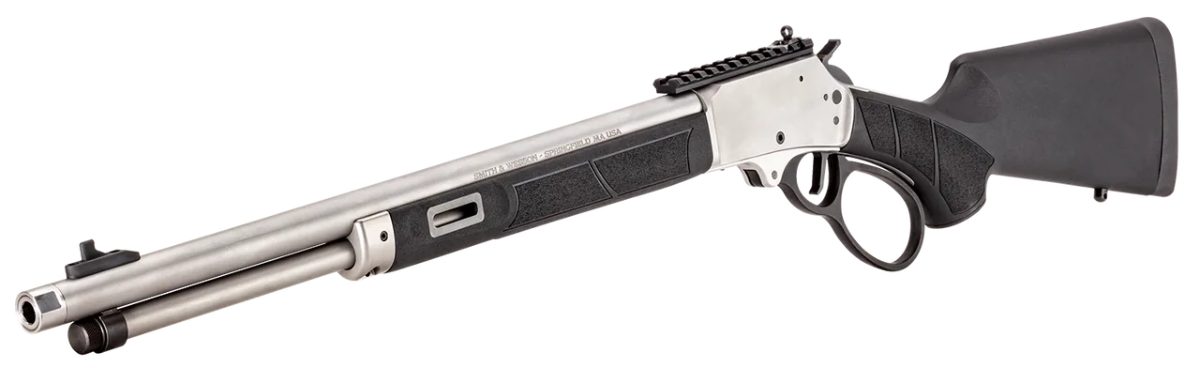
Picture a lever-action rifle that looks like it rode out of a western, yet has a threaded barrel and a modern peep sight. It's a Smith & Wesson Model 1854 in .357 Magnum. Is a .357 lever gun the most useful rifle you could own, or does a pistol cartridge have no business in a rifle?
A .357 rifle is excellent at some jobs and wrong for others, and knowing which is which decides whether it belongs in yours. By the end you should be able to say what the 1854 does well, decide whether a .357 lever gun fits what you'll do, choose between .38 Special and .357 Magnum ammunition for each job, and pick between the 1854 and its rivals.
Why a .357 lever gun is worth owning
A .357 Magnum fired from a rifle-length barrel is a different animal from the same cartridge in a revolver. The longer barrel gives the powder more time to push, so the bullet leaves considerably faster. The rifle's weight and your shoulder absorb the recoil, so it's mild, and a lever gun points and handles quickly. The result is a light, quick, easy-shooting rifle that hits hard at short range and costs little to shoot.
It also fires .38 Special, which is shorter and milder. That's the other half of its appeal: practice with inexpensive, quiet .38s, and load .357 Magnum when you need more. If you already own a .357 revolver, one supply of ammunition feeds both.
What it isn't is a long-range rifle. Pistol bullets are blunt and relatively slow, so they drop steeply past about 100 yards and carry far less energy than a rifle cartridge. Inside that distance, it's one of the handiest rifles you can own.
Key idea: A .357 lever gun is a short-range rifle that's light, quick and pleasant to shoot. Judge it by the jobs that live inside 100 yards.
What the Model 1854 adds
Smith & Wesson built the 1854 as a traditional lever gun with modern touches. The standard .357 has a 19.25-inch barrel threaded at the muzzle for a suppressor or brake, a tube magazine that holds 10 rounds plus one in the chamber, and a peep sight (a rear ring you look through) with a bead front sight. With a peep, your eye naturally centers the front bead in the ring, which makes aiming both fast and accurate. It comes in a black polymer stock with stainless metal, a walnut stock, and a shorter Stealth Hunter version with a 16.3-inch barrel. A rail on top makes mounting a scope or red dot easy.
.38 Special or .357 Magnum?
- If you're practicing, plinking or teaching a new shooter, use .38 Special. It's cheaper, quieter and milder, so you'll shoot more and flinch less.
- If you're hunting small game at close range, .38 Special is enough and damages less meat.
- If you're hunting deer or hogs, or keeping the rifle for defense, use .357 Magnum, with a bullet built to expand at rifle speed, such as Federal HammerDown 170-grain or Hornady LEVERevolution 140-grain FTX.
Never load .357 Magnum into a gun chambered only for .38 Special; it's the reverse that's safe. And check feeding with every load you use. Some lever guns feed the shorter .38 Special less smoothly than .357, so cycle a full magazine of each through the action before you rely on either.
Common mistake: Hunting with revolver ammunition in the rifle. A .357 bullet designed to open at revolver speed can come apart too quickly when the rifle drives it faster. For game, use a load built for rifle-length barrels.
Can you hunt Iowa deer with it?
Often, yes, with the right load. Iowa allows rifles for deer in certain seasons if they fire an expanding bullet from .350 to .500 inch in diameter with a published muzzle energy of at least 500 foot-pounds, under Iowa Code 481A.48. The .357 Magnum's bullet is .357 inch, so the deciding fact is the energy printed on the box. Federal lists HammerDown 170-grain at about 580 foot-pounds, above the line; many .357 loads fall short. Even with a qualifying load, keep deer shots inside about 100 yards and broadside, because the .357 has little margin. If deer are your main purpose, a .44 Magnum lever gun hits considerably harder in the same size rifle.
Model 1854, Henry or Marlin?
All three are dependable .357 lever guns. The Henry Big Boy loads through a tube at the front of the magazine, which many people find slower than a side gate, and has a smooth action and classic look; newer versions add a side gate. The Marlin 1894, now made by Ruger, is the long-standing classic with a side loading gate. The Model 1854 loads through a side gate too and comes with the threaded barrel, peep sight and rail already on it.
- If you want a suppressor-ready, optic-ready lever gun out of the box, choose the Model 1854.
- If you want the most traditional look and feel, choose a Henry Big Boy or Marlin 1894.
Work the lever on each before you buy, with the action open and confirmed empty. A lever gun you enjoy running is one you'll practice with.
Common mistake: Sighting in with one load and hunting with another. Different loads leave the muzzle at different speeds, so they can land at different points on the target. Recheck your zero whenever you change loads, using the steps in our guide to sighting in rifles at different distances.
Check your understanding
Try answering these before you open the answer. If you can decide what to do and explain why, you have it.
1. You own a .357 revolver and want a rifle to share its ammunition for range days and farm pests. Is the 1854 a good choice?
Yes. It fires the same .38 Special and .357 Magnum as your revolver, kicks mildly and handles quickly. Use .38s for practice and pests at close range.
2. A friend plans to deer hunt in Iowa with his 1854 and a box of revolver .357 hollow points. What do you tell him?
Check the box for at least 500 foot-pounds of published muzzle energy, which Iowa requires, and use a bullet built for rifle speed, such as HammerDown 170-grain. Revolver bullets can come apart at rifle velocity. Keep shots close and broadside.
3. Your rifle cycles .357 Magnum perfectly but sometimes hangs up on .38 Special. What's going on, and what do you do?
The shorter .38 case can feed less smoothly in some lever actions. Try a different .38 load, especially one with a flat or round nose of similar overall length, or practice with mild .357 loads instead.
4. You want a rifle for 200-yard coyote shots across a pasture. Is a .357 lever gun the right tool?
No. The .357's blunt, slow bullet drops steeply past about 100 yards, making a 200-yard hit hard. A rifle in a flat-shooting cartridge such as .223 is the better tool.
5. A neighbor is choosing between a .357 and a .44 Magnum 1854 mainly for Iowa deer. Which do you suggest?
The .44 Magnum. It carries considerably more energy and clears Iowa's minimum easily, which gives more margin on deer. Choose the .357 if mild recoil and cheap practice matter more than deer.
Where to go next
You can find Smith & Wesson Model 1854 rifles on our website in .357 Magnum, .44 Magnum, .45 Colt, .45-70, .30-30 and .360 Buckhammer, including walnut and Stealth Hunter versions, and anything listed there can be ordered if it isn't in stock.
To see how revolver-caliber rifles compare with each other, read revolver-caliber rifles. For choosing among lever guns in general, see choosing a lever action. And for loads built for lever-gun speeds, read LEVERevolution vs. HammerDown.
If this article helped you, we invite you to sign up for email notifications of new blog articles.