
How an AR-15 Works: Parts, Gas Systems and Choosing Your First One
Joseph McLain Nov 06, 2026
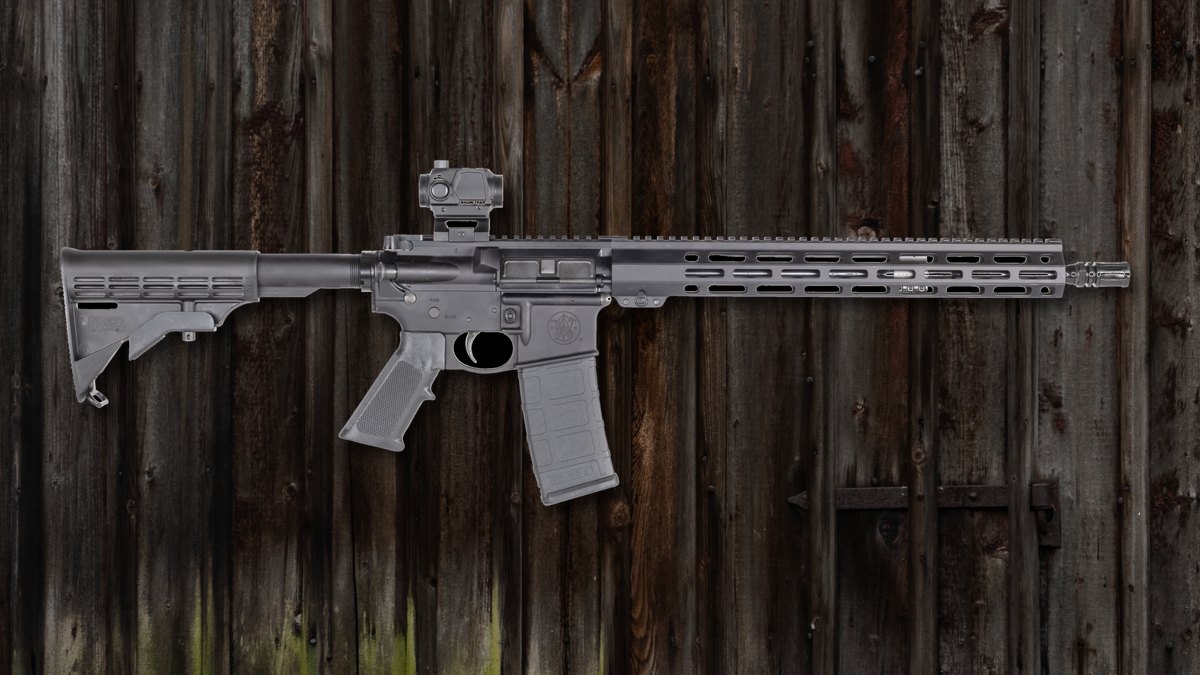
You are looking at AR-15s for the first time and the choices seem endless. Your brother-in-law says buy the cheapest one you can find, because they are all the same parts. A coworker says anything under a certain price is junk. A video you watched spent twenty minutes on gas systems, buffer weights and twist rates, and you finished it more confused than when you started. Each of them is right about something. AR-15s do share a common design, quality does vary and the details do matter, but only some of them matter for you.
The AR-15 is the most popular rifle design in the United States, and for good reason. It is light, accurate, mild in recoil and modular, which means its parts are largely interchangeable and you can change it as your needs change. That modularity is also what makes shopping confusing. A buyer who understands how the parts work together can sort the important choices from the marketing.
This article explains how an AR-15 is put together, how it cycles, which specifications actually change how it shoots and what to look for in your first one. By the end you should be able to name the major parts, explain what happens inside the rifle when you press the trigger and read a spec sheet well enough to choose a rifle that fits your purpose.
The two halves: Upper and lower receivers
An AR-15 comes apart into two main halves joined by two push pins. The lower receiver holds the trigger, hammer, safety selector, magazine well, pistol grip and the buffer tube that the stock slides onto. The upper receiver holds the barrel, handguard, bolt carrier group and charging handle, along with the sights or optic on top.
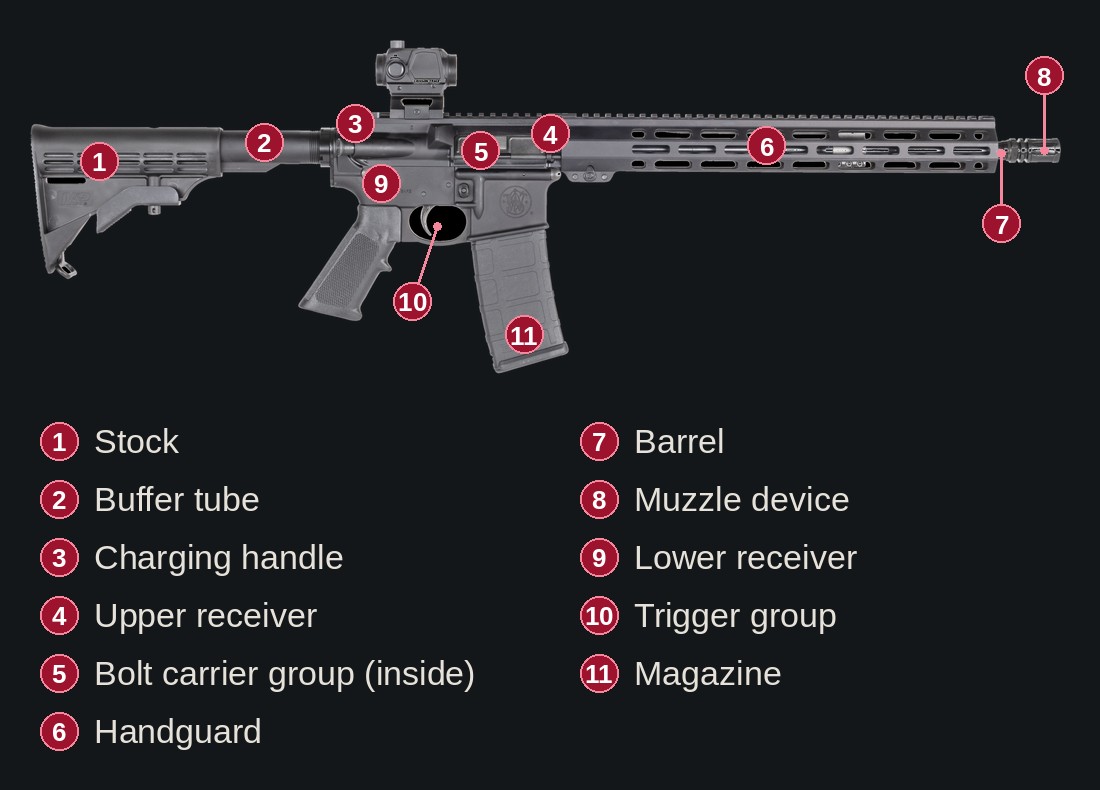
That split matters legally and practically. Under federal law, the lower receiver is the part ATF treats as the firearm, so it carries the serial number. You can buy a complete upper receiver, sometimes chambered for a different cartridge, and pin it onto your existing lower without a background check, because the upper by itself is not a firearm. That is how one lower can serve as the base for a .223 range rifle today and, with a different upper, a straight-walled deer rifle tomorrow.
Think of the lower as the frame of a house and the upper as the rooms you can remodel. The frame stays put and carries the address. The rooms can change.
The rule: When you buy an AR-15, you are really buying a lower you will keep and an upper that defines what the rifle does right now. Put your money where your purpose is, which is usually the upper.
How it cycles: Gas does the work
When you press the trigger, the hammer strikes the firing pin and the cartridge fires. As the bullet travels down the barrel, it passes a small hole called the gas port. A little of the high-pressure gas behind the bullet escapes through that port into a gas block and back toward the action.
In the standard AR-15 design, called direct impingement, that gas travels through a thin tube into the bolt carrier itself. The pressure pushes the carrier backward. As the carrier moves, a cam pin riding in a slot rotates the bolt, unlocking its small lugs from the barrel extension. The carrier keeps moving back, pulling the bolt with it, extracting the empty case and throwing it out the ejection port. Behind the carrier, a spring and a weighted buffer in the buffer tube slow it down, stop it and push it forward again. On the way forward, the bolt strips a new cartridge from the magazine, chambers it and rotates to lock. All of this happens in a fraction of a second.
Some AR-pattern rifles use a piston system instead. The gas pushes a rod that pushes the carrier, so less hot gas and carbon end up inside the action. Piston rifles tend to run cleaner but are usually heavier and more expensive, and their parts are less standardized. For most owners, a well-made direct impingement rifle is reliable and simpler to support.
Key idea: An AR-15 runs on a balance between gas pressure pushing the carrier back and the spring and buffer pushing it forward. Most reliability problems come from something upsetting that balance: Too little gas, too much gas, a weak spring, a dirty or dry bolt, or a bad magazine.
The rule: Keep the bolt carrier group clean and lubricated, use good magazines and leave the gas system alone until you understand it. Those three habits prevent most AR-15 problems.
The parts that matter most
An AR-15 has dozens of small parts, but a handful decide how well the rifle works. Here they are in the order most worth your attention.
- Barrel. It sets the rifle's accuracy potential, its chamber and its twist rate, and it is the single most important part for how the rifle shoots.
- Bolt carrier group. It does the work of unlocking, extracting and feeding, so its materials, finish and staking of the gas key affect reliability.
- Trigger. A clean, consistent trigger makes accurate shooting easier, although a standard trigger is perfectly serviceable while you learn.
- Magazines. Many feeding problems blamed on rifles are really worn or poorly made magazines.
- Sights or optic. The rifle can only be as accurate as your ability to aim it, so the sighting system deserves real budget.
Of these, the barrel and the bolt carrier group do the most to separate a good rifle from a frustrating one, because they are where accuracy and reliability are actually decided. Handguards, stocks, grips and muzzle devices mostly affect comfort and appearance, and they are easy and inexpensive to change later. When comparing two rifles at different prices, look first at what the extra money buys in those two areas.
The rule: Spend on barrel, bolt carrier group and optic first. Accessories can wait.
Reading the spec sheet
Chamber: 5.56 NATO, .223 Remington or .223 Wylde
The 5.56 NATO and .223 Remington cartridges look identical, but 5.56 runs at higher pressure and the chambers differ slightly. A rifle marked 5.56 NATO can safely fire both. A rifle marked .223 Remington should fire only .223. A .223 Wylde chamber is a hybrid designed to fire both safely while keeping .223-like accuracy. Our article on 5.56 NATO and .223 Remington explains the difference in detail. For a first AR, a 5.56 or .223 Wylde chamber gives you the most ammunition choices.
Twist rate
Twist rate, written as 1:7, 1:8 or 1:9, tells you how many inches the rifling takes to spin the bullet one full turn. Faster twist (smaller number) stabilizes longer, heavier bullets. A 1:7 or 1:8 twist handles the widest range of common .223 and 5.56 bullet weights and is a sensible default. Our guide to barrel twist rate explains why.
Barrel length and gas system length
Most AR-15 rifles have 16-inch barrels, which is the federal minimum for a rifle without special registration. Shorter barrels are handier but lose velocity and are louder. Longer barrels add velocity and a longer sight radius but are less handy.
Gas system length describes how far down the barrel the gas port sits: Pistol, carbine, mid-length or rifle length, from shortest to longest. A port closer to the chamber sees higher, sharper pressure, which makes the action cycle harder. On a 16-inch barrel, a mid-length gas system usually gives a smoother, softer-shooting rifle than a carbine-length one, which is why many shooters prefer it. Carbine gas on a 16-inch barrel works too; it just tends to cycle more harshly.
Common mistake: Shortening an AR-15 by cutting or swapping the barrel without thinking about the law. A rifle barrel under 16 inches, or an overall length under 26 inches, makes it a short-barreled rifle under federal law, which must be registered with ATF before you build or own it. A muzzle device only counts toward barrel length if it is permanently attached.
The rule: For a first AR, a 16-inch barrel with a 5.56 or .223 Wylde chamber, a 1:7 or 1:8 twist and a mid-length gas system is a well-rounded starting point.
What an AR-15 is good for, and what it is not
The AR-15 shines as a range rifle, a varmint and predator rifle and a platform for learning rifle fundamentals with little recoil. It is also widely chosen for home defense, a topic with enough trade-offs that it deserves its own discussion. Because of its modularity, one rifle can grow with you: A better trigger, a different optic or a new upper for a different cartridge.
Iowa hunters need to know one limit. The .223 and 5.56 are not legal for deer in Iowa, because deer rifles here are limited to certain straight-walled cartridges. AR-pattern uppers are available in straight-walled cartridges such as .350 Legend and .450 Bushmaster, which can make an AR lower the base of a legal deer rifle. Check the current Iowa DNR regulations and our guide to straight-walled cartridges for deer hunting before you buy for that purpose. For coyotes and other predators, the standard .223 is a common choice.
Other cartridges exist for the AR-15 too. The .300 AAC Blackout fires heavier .30-caliber bullets from standard AR magazines and pairs well with suppressors. If you ever own uppers in two cartridges, keep their ammunition strictly separate. A .300 Blackout round can chamber in a 5.56 rifle and cause a dangerous failure, which our article on wrong-ammunition dangers explains.
The rule: Match the upper to the job. A standard 5.56 upper covers range work and predators; deer hunting in Iowa calls for a straight-walled cartridge.
Choosing your first AR-15
Picture two new owners. One buys the cheapest rifle available, then spends the next two years replacing the trigger, handguard, stock and optic, and ends up spending more than if he had bought a better rifle in the first place. The other buys a solid, plain rifle from an established maker, puts a quality optic on it and spends the rest of her budget on ammunition and practice. A year later, she is the better shooter with the more reliable rifle.
When you compare rifles, look for a reputable manufacturer that supports its product, a barrel with a clearly marked chamber and twist, a properly staked gas key on the bolt carrier and a warranty you can actually use. Fancy finishes and accessory rails add cost without adding much shooting ability. Then budget honestly for the optic. Our article on rifle scopes explains what the numbers on an optic mean, and a red dot is also a popular choice on an AR.
Finally, buy a few quality magazines and a basic cleaning kit, and read the owner's manual cover to cover. The manual explains how to field strip your rifle, which is the most useful skill a new AR owner can learn.
Good practice: Learn to field strip the bolt carrier group with the rifle on a clean towel, and lay the parts out in the order they came off. Taking a picture before you start makes reassembly easier the first few times.
The rule: Buy a plain, well-made rifle, a good optic and good magazines, then spend what is left on practice. Upgrades can come later, once you know what you actually want to change.
Basic care: Keeping the balance right
Because a direct impingement AR-15 vents gas into the bolt carrier, carbon builds up there faster than in most rifles. That does not mean you must scrub it after every trip. An AR runs best wet: A properly lubricated bolt carrier group keeps running even when it is dirty. Clean the bolt, carrier and chamber area regularly, inspect the extractor and gas rings, and apply lubricant where the manual shows before each range trip.
Barrel cleaning follows the same principles as any rifle and is covered in our article on cleaning a rifle. Check that the optic mount and handguard screws are tight, and replace magazines that cause repeated feeding problems. If your rifle starts short-stroking, failing to lock back on an empty magazine or ejecting weakly, start with lubrication and magazines before assuming a part has failed.
The rule: Keep the bolt carrier group lubricated and reasonably clean, and suspect magazines and lubrication first when something goes wrong.
Putting it together
An AR-15 is two halves: A serialized lower that holds the controls and an upper that holds the parts doing most of the work. When you fire, gas from the barrel drives the bolt carrier back, the buffer and spring stop and return it, and the bolt feeds, locks and fires again. The barrel and bolt carrier group decide most of the rifle's accuracy and reliability, so that is where quality matters most. A sensible first rifle has a 16-inch barrel, a 5.56 or .223 Wylde chamber, a 1:7 or 1:8 twist and a mid-length gas system. Iowa deer hunting calls for a straight-walled upper rather than a .223.
Your brother-in-law was right that the parts are standardized. Your coworker was right that quality varies. And the video was right that the details matter. Now you know which details matter for you.
Try this: Read and field strip your own AR-15
- Put all ammunition in another room. Remove the magazine, lock the bolt open, and look and feel to confirm the chamber is empty, keeping the muzzle in a safe direction.
- Find and write down what is marked on the barrel: Chamber (5.56, .223 or .223 Wylde) and twist rate. Note the barrel length and, if you can, the gas system length from the manufacturer's specifications.
- Following your owner's manual, push out the rear takedown pin, tip the upper open and remove the charging handle and bolt carrier group.
- Identify the bolt, cam pin, firing pin, gas key and gas rings, and look at the buffer and spring in the lower.
- Reassemble, then perform the function check from your manual with the rifle still unloaded.
You will know it worked when you can explain what your rifle's markings mean for the ammunition you can use and describe in your own words how the gas key, cam pin and buffer work together to cycle the action.
Check your understanding
Try answering these before you open the answer. If you can explain it in your own words, you understand it.
1. A friend offers to sell you a complete AR-15 upper. Why is that different from buying the whole rifle?
Under federal law, the lower receiver is the serialized part treated as the firearm. An upper on its own is not a firearm, so it can be sold without the background check required for the lower or a complete rifle. Once you pin it to a lower you own, you have a complete rifle.
2. Your rifle is marked .223 Remington. Your friend has a case of 5.56 NATO he wants to share. What do you tell him?
No thank you. 5.56 runs at higher pressure, and a .223 Remington chamber is not designed for it. A rifle marked 5.56 NATO or .223 Wylde can fire both, but a .223-only chamber should fire only .223.
3. Two 16-inch rifles cost the same. One has a carbine-length gas system, the other mid-length. What difference might you feel?
The mid-length gas port sits farther from the chamber, where pressure is lower, so it usually cycles more smoothly and feels softer. The carbine-length rifle will work but tends to cycle more harshly.
4. You want to hunt deer in Iowa with your AR-15 lower. What do you need?
An upper chambered for a straight-walled cartridge that Iowa allows for deer, such as .350 Legend or .450 Bushmaster, used with legal expanding ammunition. A .223 or 5.56 upper is not legal for Iowa deer. Check the current DNR regulations before the season.
5. Your AR starts failing to feed after a long range day. What should you check first?
Lubrication on the bolt carrier group and the magazines. A dry, dirty bolt and a worn magazine cause most feeding problems. Only after ruling those out should you suspect a broken part or a gas problem.
Where to go next
To understand which ammunition your chamber can safely fire, read our article on 5.56 NATO and .223 Remington. For choosing ammunition once you have the rifle, see our guide to 5.56mm ammunition. If you plan to hunt deer with an AR-pattern rifle, our comparison of .350 Legend, .400 Legend and .450 Bushmaster will help you choose a cartridge. And to see how the AR compares with other rifle designs, read rifle action types.
We carry AR-15 rifles, uppers, magazines and cleaning supplies, and anything on our website can be ordered if it is not in stock. Text or call us anytime.
If you found this informative, we invite you to sign up for email notifications of new blog articles.