
Red Dot, LPVO or Scope: Choosing the Right Optic for Your AR-15
Joseph McLain Nov 06, 2026
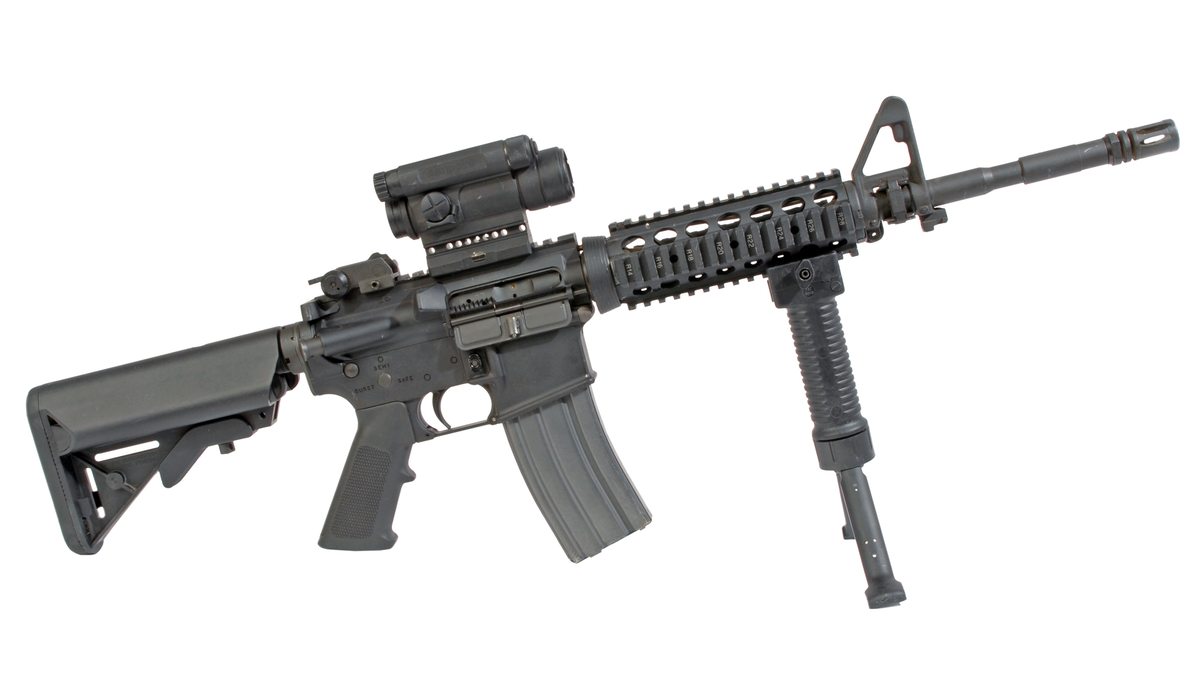
You have an AR-15 with a bare rail on top. The optic choices run from red dots for a couple hundred dollars, to scopes labeled 1-6x24 and 1-8x24, to traditional 3-9x40 scopes that look like they belong on a deer rifle. All of them fit the rail. None of them come with a note telling you which one you need.
The best optic for an AR isn't the most impressive one. It is the one that fits what you ask the rifle to do and how far away you ask it to do it, so the decision starts with the rifle's job, not with the optic.
By the end you should be able to name your rifle's main job and choose the optic that fits it.
Start with the rifle's job
An AR-15 is one of the most adaptable rifles in America, and that is exactly why optics advice conflicts. A rifle kept for home defense works inside a house and maybe across a yard. A range rifle may shoot at 25, 50 and 100 yards. A coyote rifle may see shots from 50 to 300 yards. A varmint rifle used on ground squirrels may need to hit something the size of a pop can far away.
In Iowa, an AR in .223 or 5.56 is not legal for deer, because deer rifles must fire a bullet from .350 to .500 inch in diameter, so most Iowa ARs live on the range, at home or on the coyote stand. Our article on choosing an AR-15 explains the rifle side of the decision. Here, the question is the glass on top.
Write down the closest and farthest shots you realistically expect to take and how fast you need to take them. That list will narrow your options more than any review.
Red dot: Fast and simple up close
A red dot puts a lighted aiming point on the target without magnification. You keep both eyes open, look at the target, and place the dot. That makes it the fastest optic at close range and very forgiving of head position. Red dots are also light and often run for a very long time on one battery.
The limit is distance. A red dot does not make anything look bigger, so at 200 yards you are aiming at a small target with a dot that may cover several inches of it. You can hit at that range with practice, but you cannot see details, such as whether that shape at the edge of the field is a coyote or the neighbor's dog.
Choose a red dot when most of your shooting is inside 100 yards and speed matters most. Our article on red dots, holographic and prism sights explains how to choose between the types.
Red dot with a magnifier: Speed with an option to see farther
A magnifier is a separate small optic, usually 3x, that mounts behind your red dot. Flip it into place and the image is three times bigger. Flip it to the side and you have a bare dot again. This pairing keeps the speed of a red dot while giving you a way to see detail at distance.
The trade-offs come from adding a second optic. The pair is heavier and takes more rail space. The dot grows with the image, so a 2 MOA dot looks like a 6 MOA dot when magnified, which makes precise aim at distance harder. And the magnifier has only one power, so you cannot dial between 1x and 3x.
Choose a magnifier if you already own a good red dot and want occasional help at distance. If you are buying from scratch and expect to need magnification often, compare the cost and weight with an LPVO.
LPVO: One optic for close and far
A low-power variable optic is a scope that zooms from 1x, or nearly 1x, up to a moderate power such as 6x, 8x or 10x. At 1x it behaves somewhat like a red dot, with both eyes open. Turn it up and you have a true scope with a reticle for holding over at distance. Most LPVOs have an illuminated center for fast aiming at low power.
That flexibility is why LPVOs are popular, but it comes with costs. An LPVO is heavier than a red dot and is usually mounted in a long, cantilevered mount that sets it farther forward. At 1x, it is fast but rarely as fast or forgiving as a true red dot, because your eye must be at the correct distance and centered behind the eyepiece. Think of looking through a mail slot compared to an open window. The view through the slot can be clear, but only if you stand in exactly the right place.
LPVOs also come in first focal plane and second focal plane designs. In a first focal plane LPVO, the reticle grows and shrinks with the zoom, so its holdover marks are correct at every power, but the center can get very small at 1x. In a second focal plane LPVO, the reticle stays the same size, which keeps it easy to see at 1x, but the holdover marks are only correct at one power. Our article on rifle scope reticles explains focal planes in detail.
Choose an LPVO when you want one rifle to work from close range to several hundred yards and you can accept more weight and a little less speed up close.
Key idea: An LPVO trades a little close-range speed and some weight for the ability to see and aim precisely at distance. A red dot trades distance for speed. Neither is better in general; each is better at its own job.
Traditional scope: Precision at distance
A traditional variable scope, such as a 3-9x or 4-16x, starts at a higher magnification. That makes it excellent for small targets far away, such as varmints, prairie dogs or slow, deliberate coyote shots across a field. These scopes often have larger objective lenses, which gather more light at dawn and dusk, and many have turrets designed for dialing elevation.
The cost is close range. At 3x or 4x, the field of view inside a room or at 15 yards is narrow, and moving targets are hard to follow. A scope that is perfect for a woodchuck at 250 yards is a poor choice for a rifle you may grab in the dark.
Choose a traditional scope when your AR is mainly a precision or varmint rifle and close-range speed does not matter. Our guide to matching a scope to your rifle walks through magnification and objective size.
Comparing the choices side by side
| Optic | Close-range speed | Seeing detail past 150 yards | Weight and size | Best fit |
|---|---|---|---|---|
| Red dot | Fastest | Poor | Lightest | Home defense, close range, fast practice |
| Red dot and 3x magnifier | Fast with magnifier flipped aside | Fair | Moderate | Mostly close, occasionally farther |
| LPVO (1-6x, 1-8x) | Good | Good | Heavier | General use from close range to several hundred yards |
| Traditional scope (3-9x and up) | Poor | Best | Varies, often heavier | Varmints, precision, deliberate coyote shots |
Think of the table as a slider between speed and precision. As you move down the rows, you give up speed and gain the ability to see and hit small targets far away. The middle rows try to give you some of both. Notice that no row wins every column, which is why the rifle's main job has to break the tie.
Common mistake: Choosing an optic for the rare long shot and making the common close shot harder. If ninety percent of your shooting is inside 100 yards, optimize for that, and treat the occasional long shot as a skill to practice, not a reason to change optics.
Matching the optic to common uses
Home defense
Inside a house, distances are short and speed and target identification matter. A red dot, or a red dot with a weapon light, is the most common choice because it is fast and forgiving. An LPVO set to 1x also works, but it asks for a more consistent head position. Whatever you choose, it must be on when you need it. Our article on weapon-mounted lights covers the light side of the setup.
The range and general use
If you shoot at 25 to 100 yards and enjoy steel targets, a red dot is enough. If your range has 200- or 300-yard targets, an LPVO gives you more information and more confidence about where you hit.
Coyotes
Coyotes come in fast and close in timber or slowly across an open field. An LPVO handles both. A traditional scope at low power works well for open-country stands. At night, Iowa's rules on lights matter, which our article on thermal scopes for coyotes explains.
Varmints
Small targets far away call for magnification. A traditional variable scope with a fine reticle is the right tool.
When one rifle has two jobs, pick the optic for the job where a miss costs the most. For a rifle that guards the house and goes to the range, that is the house.
Mounts, zero and budget
An optic is only as good as its mount. AR-style rifles have a flat-top rail, and optics need the right height to line up with your eye when your cheek is on the stock. Red dots usually sit on a riser, and LPVOs and scopes often use a one-piece cantilever mount that moves the optic forward to set eye relief. Our guide to mounting a rifle scope explains eye relief and leveling.
Many AR owners zero at 50 yards. With common 5.56 loads and a typical optic height, a 50-yard zero puts bullets close to the aiming point again at roughly 200 yards, which is convenient for general use. The exact distances depend on your ammunition, barrel and optic height, so confirm your own drops at the range. Our article on sighting in at different distances explains why.
On budget, remember that the optic, mount and practice ammunition together make the system. A good red dot in a solid mount will serve you better than an expensive LPVO in a cheap one. Budget for the mount and practice ammunition before you stretch for more optic.
Optics worth starting with
These are well-proven starting points in each category, chosen for durability and value rather than brand loyalty. For a red dot, the Sig Sauer Romeo5, Holosun 403 and 503 series, and Aimpoint PRO have long records on hard-used rifles; the Aimpoint costs more and is built to the toughest standard. For a dot with a magnifier, a matched kit such as Sig's Romeo5 with the Juliet3 3x magnifier saves you from mixing heights. For an LPVO, the Vortex Strike Eagle, Primary Arms SLx and Trijicon Credo in 1-6x or 1-8x cover most needs at different prices. For varmints, a 3-9x or 4-12x hunting scope with a fine reticle, such as a Leupold VX-Freedom, does the job. Whatever you choose, put it in a quality mount at the right height.
Putting it together
The right optic for an AR depends on the rifle's main job. A red dot is the fastest and lightest and fits close-range use and home defense. A magnifier adds occasional reach. An LPVO gives you one optic that works from close range to several hundred yards, at the cost of weight and a little speed. A traditional scope gives you precision far away and gives up close-range speed.
Choose by your realistic shots, not by your most ambitious one. Mount the optic at a height that fits your face, zero it carefully, and practice at the distances you actually shoot. An optic that matches the job makes the whole rifle easier to use well.
Check your understanding
Try answering these before you open the answer. If you can decide what to do and explain why, you have it.
1. Your AR is your home-defense rifle and you occasionally shoot it at 100 yards at the range. Which optic fits best?
A red dot. It is fastest and most forgiving at close range, where the rifle's main job is, and it is accurate enough for 100-yard practice.
2. A friend wants one optic for steel targets at 50 to 400 yards. What would you suggest?
An LPVO. It works at low power for closer targets and gives enough magnification and holdover marks for the longer ones.
3. Why might an LPVO at 1x feel slower than a red dot?
Because an LPVO is still a scope. Your eye must be at the right distance and centered behind it to see a full image, while a red dot is very forgiving of head position.
4. You want to hunt deer in Iowa with your .223 AR and an LPVO. What is the problem?
The optic is not the problem; the cartridge is. Iowa deer rifles must use a bullet from .350 to .500 inch in diameter, so a .223 or 5.56 AR is not legal for deer.
5. You have a fixed budget for an optic. Why should you set some aside for the mount and ammunition?
Because a weak mount can make any optic lose zero, and practice ammunition is what makes the optic useful. The system works only as well as its weakest part.
Where to go next
You can find Sig Sauer Romeo5 red dots, including the Romeo5 and Juliet3 magnifier kit, and Aimpoint mounts on our website, and anything listed there can be ordered if it isn't in stock.
To compare the non-magnified sights in more depth, read red dots, holographic and prism sights. If you are choosing an LPVO or scope, rifle scope reticles explains focal planes and holdover marks. To set your zero and learn your drops, see sighting in at different distances. And if you are still deciding on the rifle itself, start with choosing an AR-15.
If this article helped you, we invite you to sign up for email notifications of new blog articles.