
Winchester’s .350 Legend and .400 Legend Ammunition: A Comprehensive Guide
Joseph McLain Nov 07, 2026
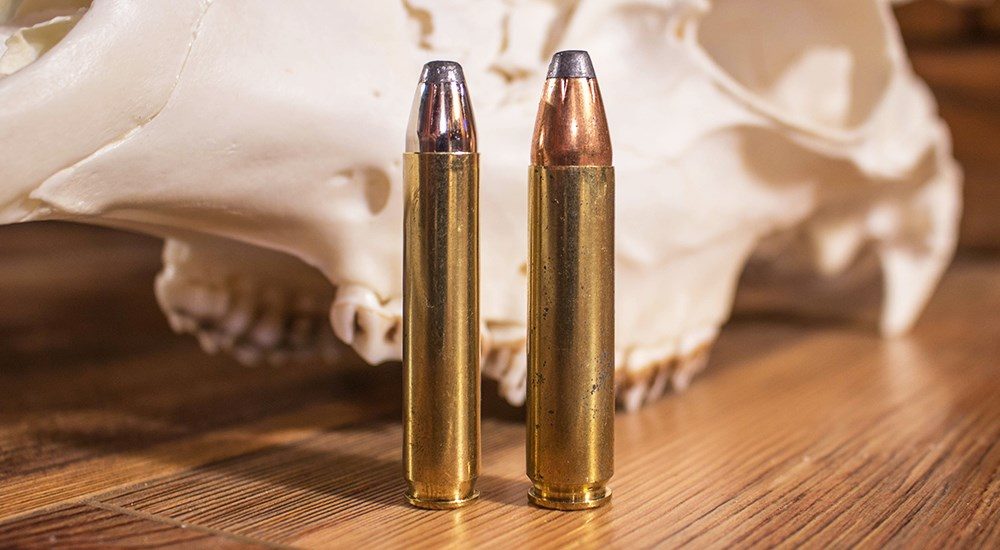
You bought a .350 Legend or a .400 Legend for Iowa's shotgun seasons, and the Winchester boxes for it carry five different names: Deer Season XP, Power-Point, Power Max Bonded, Copper Impact and a white box marked USA. Which one belongs in your rifle for deer, and which one for practice?
Each box puts a different bullet in front of the deer, and the bullet is what decides how the shot ends. By the end you should be able to choose the Winchester hunting load that fits where and how you hunt, choose a practice load that goes with it, and understand what the step from .350 to .400 Legend actually changes.
Why these cartridges exist
Iowa lets hunters use rifles for deer only in certain seasons, and only with an expanding bullet from .350 to .500 inch in diameter that carries at least 500 foot-pounds of published energy, under Iowa Code 481A.48. Several other Midwest states have similar straight-wall rules. Winchester designed the .350 Legend in 2019 for exactly those hunters: a straight-wall cartridge, meaning a case with straight sides instead of a narrow neck, that fits an AR-15-size or bolt-action rifle and recoils lightly. Winchester says it kicks about 20 percent less than a .243. The .400 Legend followed in 2023 with a wider, heavier bullet. Both are legal for Iowa deer.
Both cartridges are short-range deer rifles by design. Their bullets are relatively blunt and slow compared with a .308, so they drop quickly past about 200 yards. Inside that distance, which covers nearly every Iowa deer shot, they kill cleanly with the right bullet in the right place.
How the bullets differ
Every deer bullet has two jobs that pull against each other: open up wide, so it makes a large wound, and hold together well enough to reach the heart and lungs. Winchester's .350 and .400 Legend loads each strike that balance differently.
Deer Season XP (150 grains in .350, 190 in .400) has a large red polymer tip, which Winchester calls Extreme Point. On impact the tip drives into the bullet and opens it fast and wide. That makes a big wound on a broadside deer and tends to drop deer quickly. The trade is that a fast-opening bullet spends itself early; it is less suited to a hard quartering shot through a shoulder.
Power-Point (180 grains in .350, 215 in .400) is Winchester's traditional soft point, with lead exposed at the nose and notches in the jacket so it opens evenly. It opens more slowly than Deer Season XP and, being heavier, tends to drive deeper. It's the load for bigger deer, steeper angles and hogs, and it costs less.
Power Max Bonded (160 grains in .350) is a hollow point whose core is bonded, or fused, to its jacket, so it can't separate on bone. It sits between the other two: it opens well and holds together.
Copper Impact (150 grains in .350) is a solid copper bullet with a red tip. It holds nearly all its weight and is lead-free, which matters to hunters who don't want lead fragments in their venison. Copper needs more speed to open than lead, so keep shots moderate with it.
- If you hunt from a stand over a field edge and take broadside shots out to about 200 yards, choose Deer Season XP, because it opens fast and wide on a broadside deer and its tip helps it fly a little flatter.
- If you hunt timber or deer drives, where shots come quick and at any angle, choose Power-Point or Power Max Bonded, because a bullet that holds together is more forgiving when the shot isn't broadside.
- If you want lead-free venison, choose Copper Impact and keep shots inside about 150 yards.
If you're not sure, start with Deer Season XP in either cartridge and pass on hard quartering shots.
Key idea: The cartridge decides how much bullet you throw and how fast. The bullet's design decides what that bullet does when it gets there. Choose the bullet for the shots you'll actually take.
.350 Legend or .400 Legend?
The .400 Legend fires a wider and heavier bullet, about .403 inch against the .350's .355. It carries more energy and makes a bigger hole, at the cost of more recoil and fewer choices on the shelf. The .350 Legend's mild recoil is its main virtue: most people shoot it well, and a well-placed shot beats a bigger bullet in the wrong place.
- If you, or a young or recoil-shy hunter, will be shooting the rifle, choose the .350 Legend, because accurate shots matter more than a bigger bullet.
- If you hunt big-bodied deer and want more margin on angled shots, and recoil doesn't bother you, the .400 Legend gives you a heavier bullet that drives deeper.
For whitetail at Iowa distances, the .350 Legend with a good bullet is enough. Our guide to the .400 Legend covers the larger cartridge in more detail.
Practice ammunition that goes with it
Hunting loads are expensive enough that many hunters shoot only a few before the season, which is the wrong place to save money. Winchester's USA line has a 145-grain flat-nose full metal jacket (FMJ) load in .350 Legend for practice. An FMJ bullet doesn't open, so it's never for deer, and it's illegal for Iowa deer, which requires an expanding bullet. Its job is to let you practice cheaply.
A practice load is only useful for aiming practice if it hits close to your hunting load. The 145-grain FMJ is close in weight to the 150-grain Deer Season XP, so the two usually land near each other, but "usually" isn't good enough when you're aiming at a deer. Sight in with your hunting load, then shoot a group of each at your longest likely shot, on the same target, from a steady rest, with eye and ear protection on. If the centers of the groups are within an inch or two, practice away. If they're farther apart, the practice load is still good for learning the rifle and its recoil, but always confirm your zero with the hunting load before the season.
Winchester also sells Super Suppressed loads, a very heavy bullet loaded below the speed of sound for shooting with a suppressor. A bullet that slow drops steeply and can't be counted on to open, so treat these as suppressed practice loads, not deer loads.
Common mistake: Sighting in with cheap practice ammunition and hunting with something else. Different bullets hit different places, even from the same rifle at the same distance. Your last sight-in shots before the season should be with the box you'll carry to the stand.
Check your understanding
Try answering these before you open the answer. If you can decide what to do and explain why, you have it.
1. You hunt a deer drive in Iowa timber with a .350 Legend, and shots come fast at running and angling deer. Which Winchester load?
Power-Point 180 or Power Max Bonded 160. On angling shots the bullet may have to go through a shoulder, and a heavier or bonded bullet holds together and keeps going where a fast-opening Deer Season XP might spend itself early.
2. Your 13-year-old is starting deer hunting with your .350 Legend. Would you trade up to a .400 Legend for more power?
No. The .350 Legend's light recoil helps a new hunter shoot well, and an accurate shot with the .350 does more than a flinching shot with the .400. Give the youngster Deer Season XP and plenty of practice with the 145-grain FMJ.
3. You sight in with the USA 145-grain FMJ and plan to hunt with Deer Season XP 150 without checking it. What's the risk?
The two bullets may hit inches apart. Shoot both on the same target; if they don't land within an inch or two, your practice zero isn't your hunting zero. Always finish sighting in with the hunting load.
4. A friend wants to hunt Iowa deer with Super Suppressed because his rifle wears a suppressor. What do you tell him?
Use a regular hunting load. The subsonic load drops steeply and is too slow to count on it opening. A suppressor still reduces the noise of a regular hunting load a great deal, even though it can't remove the crack of a supersonic bullet.
5. A friend with a .450 Bushmaster asks whether the same bullet reasoning applies to him. Does it?
Yes. The cartridge is different, but the choice is the same: a fast-opening tipped bullet for broadside shots at field-edge distances, a heavier or bonded bullet for angled shots in timber, and a practice load that he's confirmed hits with his hunting load.
Where to go next
You can find Winchester .350 Legend ammunition on our website, including Deer Season XP, Power-Point, Power Max Bonded, Copper Impact and USA FMJ, along with Winchester .400 Legend Deer Season XP and Power-Point, and anything listed there can be ordered if it isn't in stock.
To compare Winchester's loads with Federal's and Hornady's, read .350 Legend hunting and practice ammo. If you're still choosing a cartridge, choosing a straight-wall deer rifle lays out the options. And for shot placement and knowing your limits, see hunting ethics.
If this article helped you, we invite you to sign up for email notifications of new blog articles.