
A Guide to Pheasant Hunting Ammunition: 12-Gauge and 20-Gauge Options
Joseph McLain Nov 07, 2026
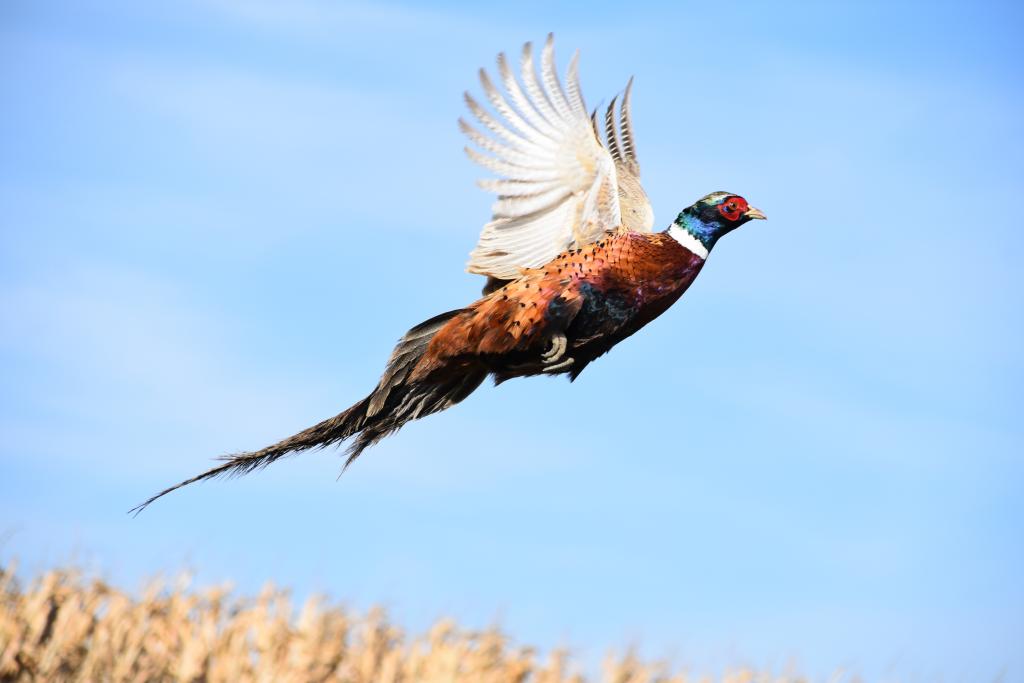
A rooster cackles up out of the fence-row, and you have about a second to decide. Whether he folds or sails on to the next section is often settled long before that, by the gauge, shell length, shot size, shot material and choke you chose. A 12-gauge with #4s, a 20-gauge with #6s, and a tighter or more open choke can each be right for some birds, because most of those choices pull against each other.
By the end you should be able to build a 12-gauge or 20-gauge setup for the way and the season you hunt, and know how to confirm it before opening day.
What a pheasant asks of your shell
Pheasants are large, fast-flying birds with dense plumage and sturdy muscle tissue. That means your load has to do three jobs at once.
- Penetrate. Pellets must get through heavy feathers to reach vital organs.
- Pattern. The pellet cloud must be dense enough to catch a quick-moving target.
- Adapt. The load must handle varied terrain and weather, from open fields to thick brush.
The first two jobs compete. Imagine tossing a handful of gravel at a barn door, then a handful of walnuts. The gravel covers more of the door, but each stone hits softly. The walnuts leave gaps, but each one hits hard. Shot works the same way. Too large a shot size gives you fewer pellets, a sparser pattern and a greater risk of a clean miss. Too small a shot size may not have the penetrating power to drop a bird cleanly at moderate or long range.
Key idea: Every choice in this article moves you along one line, between more pellets (a denser pattern) and heavier pellets (more penetration). Your hunting conditions decide where on that line you should stand.
Shot size: #4, #5 or #6
Shot sizes run backward from what you might expect. The number tells you the pellet diameter, so a bigger number means a smaller pellet. For pheasant hunting, #4, #5 and #6 are the go-to sizes.
| Shot size | Best for | Advantage | Drawback |
|---|---|---|---|
| #4 | Longer shots or late-season birds with heavier plumage | Heavier pellets give better knockdown through cover | Fewer pellets can mean a sparse pattern, which is tough if birds flush close |
| #5 | All-around use, ideal for mid-to-late season hunts | Balances penetration (similar to #4) with pattern density (closer to #6) | Slightly fewer pellets than #6, so place shots carefully at very close range |
| #6 | Early-season hunts or close-range shots over pointing dogs | Dense patterns with more pellets, excellent for faster, closer flushes | Limited knockdown power beyond about 40 yards, especially on mature birds with thick feathers |
Each row is a trade, and the "Best for" column is your starting point. Think about where the bird will be when you shoot. Over a pointing dog in early season, the flush is close and fast, so pattern density is worth more than reach. On a windy late-season day with wild birds flushing far, penetration matters more, so #4 or #5 gives you more downrange power. If you cannot predict the day, #5 is the compromise.
Wind adds one more factor. In gusty conditions, heavier payloads and larger shot can help keep your pattern intact.
12-gauge or 20-gauge: Matching the gun to the way you hunt
Both gauges are effective. The right choice depends on your hunting style, your recoil tolerance and the terrain.
The 12-gauge carries heavier payloads, which means more pellets and denser patterns at extended range. It is more versatile for mixed hunts such as pheasants and waterfowl, and it helps in wind or when you expect shots over 40 yards, as with late-season birds that flush farther away. The price is heavier recoil and a heavier gun, which can cause fatigue over an all-day hunt. There is also more risk of "overkill" at close range, which can damage meat.
The 20-gauge is lighter to carry all day and gives less recoil for quick follow-up shots. It has sufficient power for early-season pheasants or closer shots, and it is a great option for youth, smaller-framed hunters or anyone who prioritizes a nimble setup. It is still effective at the average shot distance of 25 to 35 yards, and it is perfect for smaller fields or areas with close flushes. Its limit is a smaller payload, which can mean reduced pattern density or range. For more on young shooters and the 20-gauge, see 20-gauge shotguns for youth trap and skeet shooters.
Choose the gun you will carry comfortably and shoot well all day. Distance should tip the decision toward the 12-gauge, and comfort should tip it toward the 20-gauge.
Shell length: 2.75, 3 or 3.5 inches
A longer shell holds more shot. A 2.75-inch shell has manageable recoil and is perfect for most 20-gauge setups, though it holds fewer pellets than longer shells. A 3-inch shell gives more shot for denser patterns and extended range, and it is common in 12-gauge for pheasant, but it brings more recoil and weight. A 3.5-inch shell is typically unnecessary for pheasants, because it is designed for heavy waterfowl loads.
Most pheasant hunters find 2.75-inch or 3-inch shells sufficient. Choose 3-inch if you need a bit more reach or pattern density, especially in a 12-gauge. Whatever you choose, never use a shell longer than the length marked on your barrel or chamber. See our guide to shotgun ammunition for duck hunting if you are curious about those heavy waterfowl loads.
Shot material: Lead, steel, bismuth and tungsten
The metal in the pellets controls how much energy a given pellet size carries. Denser metals hold their energy better, which is why material and size must be chosen together.
| Material | Strengths | Limits |
|---|---|---|
| Lead | High density, excellent energy retention, affordable and widely available | Environmental concerns and potential lead exposure for wildlife; banned on some public lands |
| Steel | Non-toxic, often cheaper than other non-toxics, legal on public lands requiring lead-free | Lighter than lead, so it needs bigger shot sizes (#2 or #3 for pheasants); loses energy quickly past 30 to 35 yards |
| Bismuth | Denser than steel, performs more like lead; softer, so safer for older shotguns | Pricier than lead or steel, but cheaper than tungsten |
| Tungsten | Extremely dense, often outperforms lead at distance; suits hunters wanting long-range performance | Expensive, which can deter high-volume shooters |
Steel is the surprise in this table. Because it is lighter, you need a bigger pellet for equivalent knockdown, which is why steel loads for pheasants run #2 or #3 instead of #4 to #6. Lead is the affordable standard, but if you hunt public land or near waterfowl roosts, bismuth or tungsten can be a strong lead replacement. Federal law has required nontoxic shot for waterfowl since 1991, and many states, Iowa included, also require it on certain public areas, so check the regulations for the area you hunt before you buy, and read the legalities of hunting in Iowa and neighboring states for a starting point. If your shotgun is older, ask the maker or a gunsmith which shot is safe in it. For a look at newer pellet designs, see innovative shot designs for bird hunting.
Recommended loads and how to choose among them
- Federal Premium Prairie Storm. A flight-control wad is designed for dense patterns at longer range. It comes in 12-gauge and 20-gauge in shot sizes #4 to #6, and its high velocity helps compensate for wind and quick flushes.
- Winchester Super Pheasant. It uses plated lead shot for more uniform pellets, which gives consistent patterns and reliable knockdown. It is great for mid- to late-season hunts.
- HEVI-Shot upland loads. HEVI-Shot pellets are a tungsten alloy, so they are lead-free but denser than lead. It offers extended range and is an ethical choice in lead-restricted areas, for hunters who need non-toxic with performance closer to or better than lead.
- Kent Fasteel 2.0 upland loads. Kent's steel-shot line includes loads aimed at upland birds. It is non-toxic and well priced, for hunters restricted to steel or wanting a budget-friendly, lead-free load.
Sort these by your first question. If lead is allowed and you want long-range consistency, look at Prairie Storm or Super Pheasant. If you must go lead-free and want the best performance, a tungsten-alloy load such as HEVI-Shot is the high-performance option, and if you must go lead-free on a budget, Kent's Fasteel 2.0 is the steel choice. Remember to size up with steel. You can learn more about Winchester's Super-X line in our in-depth article.
Choke: How your shotgun shapes the pattern
A choke is a narrowing at the muzzle that controls how tightly the pellets spread. A tighter choke keeps the pattern dense farther out, and an open choke spreads it faster, giving better coverage up close. For pheasant hunting, Modified is the common sweet spot, though specifics vary.
| Choke | Best for | Pattern |
|---|---|---|
| Improved Cylinder (IC) | Early-season, close-range | More open, ensuring better coverage up close |
| Modified (MOD) | Most pheasant hunts, a balance of spread and range | Tight enough for mid-range kills, but not too tight for close flushes |
| Full | Late-season or wild birds that flush far | Dense at distance, but with a risk of over-concentration up close |
The table follows the same logic as shot size. Open chokes help when birds flush close, and tight chokes help when they flush far. Many hunters carry two guns, or use a double-barrel with IC in one barrel and MOD in the other, to cover a range of flush distances. Our guide to shotgun chokes explains how they work in more detail. Check that your choke is rated for the shot you plan to use, especially steel.
Putting your pheasant setup together
A balanced pheasant setup trades pattern density against pellet energy to drop these wily birds cleanly. Use these starting points and adjust for your hunt.
- Gauge. 12 if you want longer range or more versatile hunts, 20 if you prefer a lighter gun and less recoil.
- Shell length. 2.75 inches often suffices, and 3 inches can add a bit more punch if you need it.
- Shot size. #6 for early season or close flushes, #4 for late season or windy hunts, and #5 for a great all-around compromise.
- Shot material. Lead for affordability and high energy, and non-toxic if required or by personal preference.
- Choke. Modified is the standard, improved cylinder can excel early in the season, and full helps if you are really stretching shots.
Gauge and choke matter most, because they set how much shot you can throw and how it spreads. Shot size then fine-tunes the pattern for conditions. One more adjustment is worth remembering. If you are hunting close hedgerows, a heavy 12-gauge #4 shell may do excessive damage, so moderate loads such as #5 or #6 will preserve more meat.
Patterning your shotgun
A pattern board shows what your load and choke actually do. Choose two loads that are safe for your gun, such as #4 and #6 in the same shell length, and one choke. With eye and ear protection on and a safe backstop, fire one shell at a large sheet of paper from 25 yards, then fresh sheets at 35 and 40 yards. Draw a circle about the size of a pheasant's vital zone on each and count the pellet holes inside it, looking for gaps. Repeat with the second load, and a second choke if you can. The best combination is the one that puts a dense, even spread on the vital zone at the distance you expect to shoot, and the sheets also show where the pattern starts to thin out.
Check your understanding
Try answering these before you open the answer. If you can decide what to do and explain why, you have it.
1. You hunt early season over a pointing dog and keep missing close flushes with #4 shot. What happened, and what could you change?
#4 has fewer, heavier pellets, so the pattern can be sparse up close. Try #6 shot, which has more pellets for a dense pattern on close flushes, and consider a more open choke such as Improved Cylinder.
2. You hunt a public area in Iowa that requires nontoxic shot, and you usually shoot lead #5s. What do you change, and why?
Go up a size or two in steel, such as #3 or #4. Steel is lighter than lead, so a steel pellet of the same size carries less energy; a larger pellet restores it. Check that your gun and choke are rated for steel, or use bismuth or tungsten, which carry energy closer to lead's at higher cost.
3. A smaller-framed hunter plans an all-day hunt in small fields with close flushes. Which gauge fits, and why?
A 20-gauge. It is lighter to carry, has less recoil for quick follow-up shots, and its power is still effective at the average shot distance of 25 to 35 yards.
4. It is late season, windy, and the wild birds flush far. How would you set up?
A 12-gauge, possibly with 3-inch shells for more reach and pattern density, with #4 or #5 shot and a tighter choke such as Modified or Full. Heavier payloads and larger shot help keep the pattern intact in wind.
5. A hunting partner is buying 3.5-inch 12-gauge shells for pheasants. Will they help?
Usually not. Pheasants are rarely shot at the long distances where the extra payload would matter, and 3.5-inch shells add recoil and cost. A good 2.75- or 3-inch load with the right shot size and choke does the job.
Where to go next
You can find pheasant loads on our website, including Winchester and Remington pheasant loads, Fiocchi Golden Pheasant and lead-free steel, and anything listed there can be ordered if it isn't in stock.
Since the choke decides so much of what you see at the target, Demystifying Shotgun Chokes is the logical next read. If you are considering non-toxic loads, Innovative Shot Designs shows what is new in high-density pellets. For a hunt that ends in the freezer, Hunting Ethics reinforces why clean, confident shots matter.
If this article helped you, we invite you to sign up for email notifications of new blog articles.