
.350 Legend vs .400 Legend vs .450 Bushmaster: Ballistics Compared
Joseph McLain Nov 16, 2026
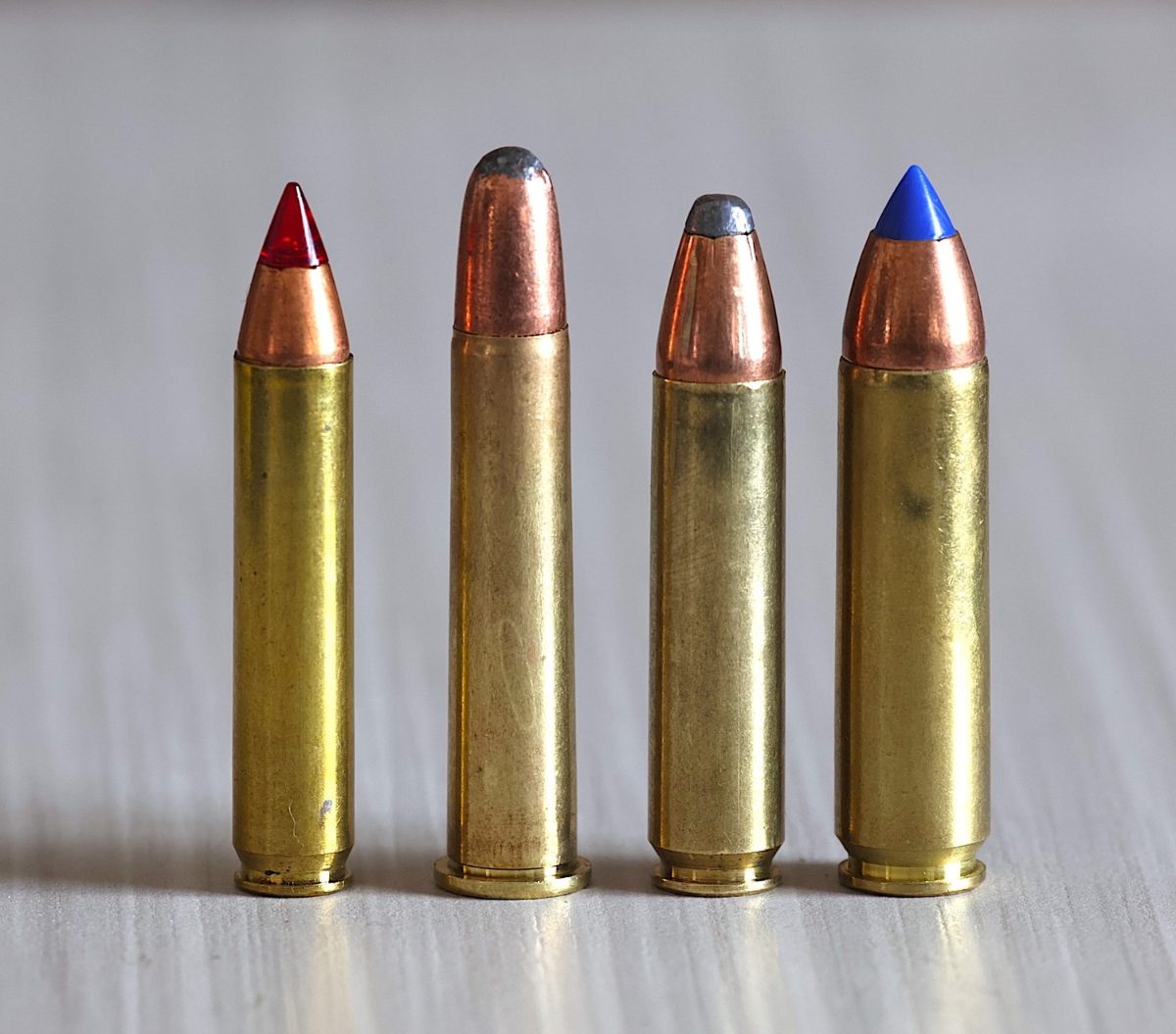
The three cartridges fly alike. Load each to about the same speed and they land within a tenth of an inch of each other at 200 yards. What separates them is the bullet: how heavy it is, how much energy it carries to the deer, and how hard the rifle pushes back on the way out. Choosing among them is really choosing how much bullet you can shoot well.
In Iowa, all three are legal for deer in the seasons that allow straight-wall rifle cartridges. In the youth and disabled-hunter season and the first and second shotgun seasons, a deer rifle must fire an expanding bullet from .350 to .500 inch in diameter with at least 500 foot-pounds of muzzle energy. In the January antlerless-only seasons, centerfire rifles from .223 inch up are allowed. All three clear the shotgun-season rule with room to spare.
What the three actually are
| Cartridge | Bullet diameter | Factory bullet weights | Muzzle velocity | Muzzle energy |
|---|---|---|---|---|
| .350 Legend | .357 inch | 145 to 180 grains | 2,100 to 2,325 fps | About 1,690 to 1,830 ft-lb |
| .400 Legend | .400 inch | 190 to 215 grains | 2,200 to 2,400 fps | About 2,260 to 2,430 ft-lb |
| .450 Bushmaster | .452 inch | 245 to 300 grains | About 2,200 fps for the 245 and 250 grain loads | About 2,630 to 2,690 ft-lb for those loads |
Read the table as three steps up in bullet weight. Speeds are close. Energy rises with the bullet's weight, so each step up carries more energy to the deer and pushes harder on the shooter.
Why a heavier bullet does not shoot flatter or drop more
Gravity pulls every bullet down at the same rate, whatever it weighs. Two bullets leaving the muzzle at the same speed fall the same amount over the same time. Heavier bullets do hold their speed a little better, which is the only reason a .450 would ever land higher at distance, and it is a small effect.
Hornady's published figures show it. A .350 Legend 170 grain bullet and a .450 Bushmaster 250 grain bullet, both at 2,200 feet per second, with a 100-yard zero:
| .350 Legend, 170 gr | .450 Bushmaster, 250 gr | |
|---|---|---|
| Energy at the muzzle | 1,827 ft-lb | 2,687 ft-lb |
| Energy at 100 yards | 1,281 ft-lb | 1,868 ft-lb |
| Energy at 200 yards | 882 ft-lb | 1,274 ft-lb |
| Energy at 300 yards | 609 ft-lb | 874 ft-lb |
| Drop at 200 yards | 8.9 in | 9.0 in |
| Drop at 300 yards | 32.8 in | 33.3 in |
Key idea: At equal speed, a heavier bullet does not shoot flatter. It carries more energy and kicks harder.
That drop is big for every one of these cartridges. At 200 yards each is about 9 inches below a 100-yard zero, more than the whole 8-inch vital area of a deer. None of them stretches further because its bullet weighs more, so the reason to pick one is never range. Whatever the cartridge, know your holdover, and read the .350 Legend ballistics article if you want the distances laid out.
What the extra weight buys
Energy and momentum. The .450's 250 grain bullet still carries about 1,274 foot-pounds at 200 yards, more than the .350 Legend's 170 grain carries at 150 yards. That matters on a big-bodied deer, a quartering shot, or a bullet that has to push through a shoulder bone before it reaches the vitals. A heavier bullet at the same speed keeps going.
It also matters for the other half of the choice: the rifle gets the same push back. Recoil follows the same arithmetic as the bullet's momentum, its weight times its speed, plus the push from the gas that leaves with it. Compare a .350 Legend 150 grain at 2,325 fps with the others, using bullet momentum alone:
- .400 Legend 190 grain at 2,400 fps: about 1.3 times the .350's.
- .450 Bushmaster 250 grain at 2,200 fps: about 1.6 times the .350's.
A rifle's weight, its pad, and a muzzle brake change how that feels, but they do not change the ordering. Winchester says its .400 Legend load recoils 55 percent less than a 12-gauge slug and 20 percent less than a .450 Bushmaster. The .400 sits between the other two, and a threaded barrel with a muzzle brake, which some .400 rifles come with, lowers the push further.
Bone, quartering shots and big deer
This is where the extra weight earns its keep. A bullet meeting a shoulder bone or travelling a long, slanting path through the chest loses speed fast, and a heavy bullet loses a smaller share of what it has. At the same speed, the .450's 250 grain bullet has about 47 percent more weight than the .350's 170 grain, so it has about 47 percent more momentum to spend getting through. The .400 Legend's 190 to 215 grain bullets sit in the middle.
Weight is only half of it. A bullet that comes apart on the bone stops short whatever its weight, and one that never expands gives a narrow wound. Which bullet you load, and whether it is built for deer, matters as much as which cartridge you choose, and the article on knock-down power explains why. For deer-weight animals at typical Iowa distances, any of the three with a deer bullet does the job. The heavier ones make more room for a shot that is not ideal.
Three hunts, three choices
- A 12-year-old's first season, from a ground blind at 60 yards. The .350 Legend. Everything about this hunt rewards a rifle the hunter can shoot comfortably and often, and a heavier cartridge adds nothing at that distance.
- An adult hunter in a treestand over a field edge, shots out to about 100 yards. The .400 Legend if the push is comfortable, the .350 Legend if it is not. Both kill deer at that distance, so the deciding factor is which one the hunter shoots better.
- Thick river-bottom timber and big-bodied deer, with a shot that may have to go through a shoulder. The .450 Bushmaster for a hunter who shoots it well. The cover keeps shots short, which suits the cartridge, and the bullet's weight is the reason to carry it.
Choosing among the three
The question is not which cartridge is best. It is which is the heaviest bullet you will shoot accurately, from the position you will actually hunt from, in the rifle you will actually carry.
- The .350 Legend is the one for a young hunter, a small-framed shooter, or anyone who flinches when the rifle kicks. At typical Iowa shots it kills deer cleanly, and a hunter who shoots it well will outperform the same hunter shooting a .450 badly. Hunters who shoot it well also get to practice more, because it is easy on the shoulder.
- The .400 Legend is the one for most adult hunters who can handle a little more push, and who want more bullet for quartering shots and heavy-boned deer. A threaded barrel with a brake, or a soft recoil pad, brings the feel closer to the .350's.
- The .450 Bushmaster is for the hunter who expects heavy cover, big-bodied deer, or a shot that has to break bone, and who shoots a hard-kicking rifle accurately without fear of it. If the recoil makes you rush the shot, it is the wrong rifle however much energy it carries.
Common mistake: Picking the cartridge with the most energy. A shot that misses the vitals kills nothing. Energy only helps a bullet that goes where you aimed it.
How to tell which one you shoot well
Three signs show you are over-gunned: you close your eyes or tense just before the shot, your groups open up after the third round, or you stop wanting to practice. A hunter who stops practicing is a worse shot by season. Any one of those is a reason to drop down a step, and none of them is a reason to feel bad about it. A well-placed .350 Legend does what a poorly placed .450 cannot.
Check your understanding
Try answering these before you open the answer. If you can decide what to do and explain why, you have it.
1. At 2,200 fps, a .350 Legend 170 gr and a .450 Bushmaster 250 gr drop almost the same amount at 200 yards. What does the .450 give you for its extra recoil?
More energy and a heavier bullet: about 1,274 ft-lb at 200 yards against 882. The bullet does not fly flatter. Both are about 9 inches below a 100-yard zero at 200 yards.
2. A friend says a .450 Bushmaster "drops more" than a .350 Legend, so you should buy a .350 if your shots might pass 200 yards. What is wrong with that?
At the same speed they drop the same amount. A shot past 200 yards is long for any of these, and the cartridge you choose should come from the energy and recoil you want, not from a drop difference that is not there.
3. A new adult hunter is deciding between a .350 Legend and a .400 Legend. How do you decide?
For most adults the .400 is the better first rifle. It gives about a third more energy for the shot that is not perfect, and with a brake or a good pad it kicks only a little more than the .350. Shoot both if you can. If the .400's push makes you flinch or open your groups, the .350 is the better choice, because the cartridge you shoot best wins.
4. A different cartridge, not covered here, fires a 200 grain bullet at 2,300 fps. Using what you learned, how do you decide whether it will kick harder than a .350 Legend 150 grain at 2,325 fps?
Compare weight times speed. 200 times 2,300 is about 460,000, and 150 times 2,325 is about 349,000, so it carries about 1.3 times the bullet momentum and will kick noticeably harder, about like the .400 Legend.
Where to go next
You can find ammunition on our website.
Since a cartridge only helps once the rifle is zeroed for it, read sighting in rifles at different distances next. For the .350 Legend alone, the guide to .350 Legend deer ammunition compares the loads. For the middle step, the .400 Legend and .350 Legend comparison goes deeper on recoil. And to see how expansion and penetration are tested, read the article on ballistic gelatin.
If this article helped you, we invite you to sign up for email notifications of new blog articles.