
Hornady LEVERevolution vs Federal HammerDown Ammunition
Joseph McLain Nov 07, 2026
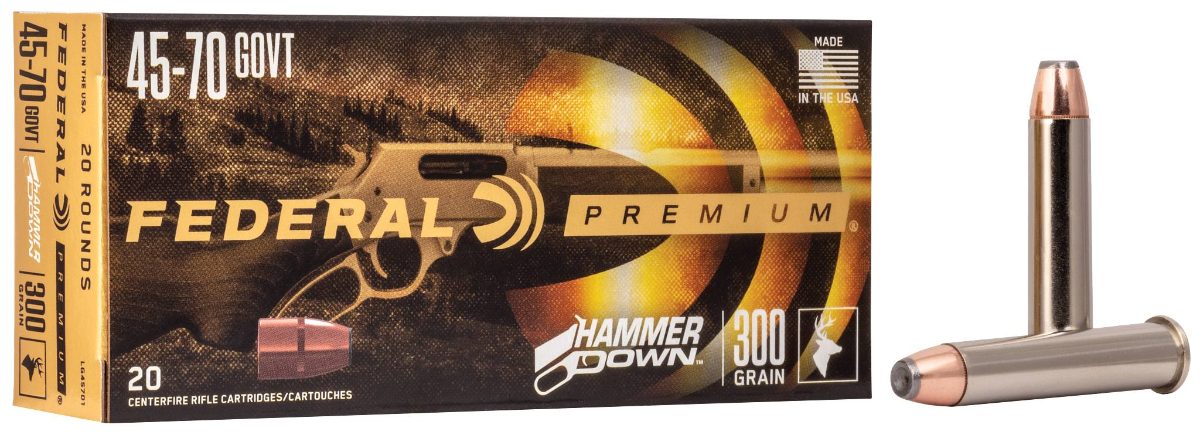
You have a lever-action rifle and two boxes in mind: Hornady LEVERevolution, with its pointed, red-tipped bullet, and Federal HammerDown, with a blunt soft point and nickel cases. Both are built for lever guns, both cost more than traditional loads, and they solve different problems.
By the end you should be able to explain the difference between them, predict which suits your hunting, and confirm the choice with your own rifle instead of a label.
The problem both loads set out to solve
Most traditional lever-action rifles carry cartridges in a tubular magazine under the barrel, lined up nose to tail. Each bullet's nose rests against the primer of the cartridge ahead of it, and recoil jolts the whole column. For safety, lever-gun ammunition was loaded for generations with flat-nosed or round-nosed bullets that spread the contact over the primer instead of concentrating it at a point.
Those blunt bullets were safe, but they left room for improvement in two areas. They push a lot of air aside, so they slow down and drop quickly as distance grows. And some older bullet designs were built for the speeds of black-powder days rather than modern loads, so their expansion and penetration at today's velocities could vary. Lever guns also have their own feeding quirks, because cartridges must slide through a loading gate, along a tube and up a lifter before they reach the chamber.
Hornady and Federal both set out to modernize lever-gun ammunition. They simply attacked different parts of the problem, and that difference is the whole comparison.
Key idea: LEVERevolution mainly improves how the bullet flies. HammerDown mainly improves how the bullet holds together on impact and how the cartridge feeds. Neither is automatically better; different hunts reward different strengths.
Hornady LEVERevolution: Improving the flight
Hornady's approach was to make a pointed bullet safe in a tube magazine. Its FTX bullet has a soft, flexible polymer tip that gives under pressure instead of acting like a firing pin on the primer ahead of it. Our article on Hornady LEVERevolution explains the design in depth.
The pointed shape lowers drag, measured by a number called the ballistic coefficient. A bullet with less drag holds its speed better and drops less, so you need less holdover, which is aiming above the target to make up for drop. On impact, the soft tip is driven back into the bullet to help start expansion. LEVERevolution's strength is reach: It widens your margin for error when a deer stands at the far side of a field and you are not sure of the distance.
The cost is that a fast-expanding tipped bullet is built to open readily, which suits deer but is not designed around maximum weight retention the way a bonded bullet is. LEVERevolution also typically costs more than traditional flat-nosed loads.
Federal HammerDown: Improving the impact and the feeding
Federal developed HammerDown with Henry Repeating Arms, specifically for lever-action rifles, and introduced it for 2020. It keeps a traditional-looking soft-point profile and changes two other things.
The first is the bullet. HammerDown uses a bonded soft point. Bonding fuses the lead core to the copper jacket so the two cannot separate as the bullet expands. Picture a bolt with its nut welded on versus one with a loose nut: Under force, the welded one stays one piece. A bonded bullet keeps more of its weight as it passes through the animal, which supports deep, straight penetration on larger deer and through heavy bone. Federal says it tuned the bullet construction for the velocities these cartridges actually reach.
The second is the case. HammerDown cases are nickel-plated and chamfered, meaning the edges are slightly beveled, and Federal says it modified the case geometry to feed smoothly through side loading gates and tubular magazines. Nickel plating also resists corrosion in a damp blind or truck. HammerDown's strength is dependability in the action and on the animal; its limit is that the blunter bullet does not fly as flat as a pointed one.
The HammerDown line includes rifle cartridges such as the .30-30 Winchester and .45-70 Government and pistol cartridges common in lever guns, such as the .357 Magnum, .44 Magnum, .327 Federal and .45 Colt. If you own a lever gun and a revolver in the same pistol chambering, one load can serve both, though you should still test it in each.
Side by side
| Question | LEVERevolution | HammerDown |
|---|---|---|
| Main design idea | Soft-tipped pointed bullet for lower drag | Bonded soft point plus feed-friendly case |
| Best at | Flatter trajectory and reach at field-edge distances | Holding together for deep penetration; smooth feeding |
| Gives up | Some weight retention compared with a bonded bullet | Some trajectory compared with a pointed bullet |
| Overlapping cartridges | .30-30 Winchester, .45-70 Government and several pistol cartridges; check current listings | |
The first three rows describe the trade: Flight against impact and handling. The last row tells you where you can compare the two directly. Outside that overlap, your rifle's chambering may decide for you, because one line may simply not be made in your cartridge. Check the current listings from each maker, since both add and drop loads over time.
Iowa rules come first
Before choosing between the two, make sure your cartridge is legal for the animal and season. In Iowa, rifles used for deer must fire a bullet at least .350 inch and no more than .500 inch in diameter. That rules out the .30-30 for Iowa deer in either brand, while the .45-70 meets the rule. Some lever-gun pistol cartridges, such as the .44 Magnum, also fall in the legal diameter range; check the Iowa DNR's current Hunting and Trapping Regulations for the full list of requirements, which can change, and the rules of any other state you hunt.
Settle legality first, then choose between the brands among the loads that remain.
Deciding between them
Start with the distances you hunt. If your shots often stretch across fields or food plots, or you find distances hard to judge, LEVERevolution's flatter flight gives you a more forgiving margin. If your shots are mostly close in timber and brush, trajectory matters little, and HammerDown's bonded bullet and feed-focused case address the things that matter more there.
Then consider the animal. For larger-bodied deer, or where a bullet may have to break heavy bone, a bonded bullet's weight retention is reassuring. For typical whitetails at moderate distances, both lines are designed to expand and penetrate well when the shot is placed correctly. Our article on hunting ethics explains why shot placement matters more than either bullet design.
Finally, let your rifle vote. Every lever gun has its own quirks, and two good loads can group and feed differently in the same rifle. The load that feeds smoothly and groups well in your rifle is the right one, whatever the label says.
Common mistake: Switching loads without re-zeroing. Two good loads can land in different places in the same rifle, so zero with the exact ammunition you plan to hunt with.
A head-to-head test in your own rifle
Two boxes and one range trip settle it. Check that the barrel marking matches both boxes. With eye and ear protection on and the muzzle downrange, load the magazine fully with the first load and cycle every round through the action, watching for any hesitation, then do the same with the second. From a steady rest, shoot a three-shot group with each at the distance of your most likely shot, letting the barrel cool between groups. The load that feeds smoothly and groups well is the one to zero with.
Putting it together
Both lines modernize lever-gun ammunition, from opposite directions. LEVERevolution improves the bullet's flight, which pays off at longer woods and field-edge distances. HammerDown improves how the bullet holds together and how the cartridge feeds, which pays off in reliability and penetration, especially at close range. Confirm your cartridge is legal where you hunt, decide which strength your hunting needs most, and then test both in your own rifle before you commit.
Check your understanding
Try answering these before you open the answer. If you can decide what to do and explain why, you have it.
1. You hunt deer across a 180-yard food plot with a .45-70 and often have to guess the distance. Which line's design helps you more, and why?
LEVERevolution. Its soft-tipped, pointed bullet holds speed and drops less, which gives you a bigger margin for error when you misjudge the distance. HammerDown's strengths, holding together and feeding smoothly, matter more at close range in heavy cover.
2. A big-bodied buck may give you only a quartering shot through the shoulder. Why might a bonded bullet like HammerDown's be reassuring there?
Bonding fuses the lead core to the copper jacket, so the bullet stays in one piece and keeps more of its weight as it breaks bone. That supports deep, straight penetration to the vitals on a hard angle.
3. You hunt Iowa deer in thick timber with a .45-70. Which line might you lean toward, and what would you still do?
HammerDown's bonded bullet and feed-focused case suit close-range timber hunting, but you would still test both loads in your rifle and confirm current Iowa rules.
4. A friend says the flatter-shooting load is automatically better. How would you respond?
Trajectory matters most at longer distances. Feeding reliability, penetration for the animal and how your rifle groups each load also decide the choice.
5. Can you use a .30-30 with either brand for Iowa deer?
No. Iowa allows deer rifles only with expanding bullets .350 to .500 inch in diameter and at least 500 foot-pounds of muzzle energy, which rules out the .30-30.
Where to go next
You can find Hornady LEVERevolution and Federal HammerDown ammunition on our website, including .30-30, .35 Remington, .357 Magnum, .44 Magnum and .45-70 loads, and anything listed there can be ordered if it isn't in stock.
For the full story on each line, Hornady LEVERevolution explains the Flex Tip and its calibers, and Federal HammerDown covers the bonded-bullet approach. If a big-bore lever gun interests you, lever-action .45-70 rifles for deer hunting is the next stop, and sighting in rifles at different distances shows how to turn your test results into a reliable zero.
If this article helped you, we invite you to sign up for email notifications of new blog articles.