
Hornady LEVERevolution: Revolutionizing Lever-Action Ammunition
Joseph McLain Nov 07, 2026
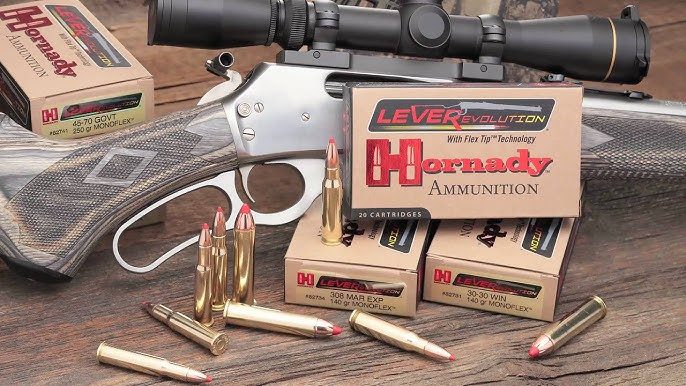
You inherited your grandfather's lever-action and want to hunt with it this fall. You've heard you should never put a pointed bullet in a tube magazine, because the tip can set off the round in front of it. Then you see Hornady LEVERevolution, with a sharp, red-tipped bullet on the box and a promise of flatter shooting than anything your grandfather had. Is it safe in your rifle, and is it better than the flat-nosed loads that have killed deer for a hundred years?
By the end you should be able to decide whether LEVERevolution suits your rifle and your hunting, and to prove it at the range.
Why lever guns used flat-nosed bullets
Most traditional lever-action rifles carry their cartridges in a tubular magazine, a metal tube under the barrel. The cartridges line up nose to tail, so the front of each bullet rests directly against the primer of the cartridge ahead of it. The primer is the small cup of impact-sensitive compound in the center of the case base that lights the powder when the firing pin strikes it.
When the rifle fires, recoil slams the whole column of cartridges back against the magazine spring. A hard, sharp bullet point pressed into a primer under that jolt could, in rare cases, set it off inside the magazine. That is why lever-gun ammunition was loaded for generations with flat-nosed or round-nosed bullets, which spread the contact over a broad area of the primer.
Picture a stack of thumbtacks pressed point-first into the backs of the tacks in front of them, then shaken. You would want blunt tips, not sharp ones. The flat nose solved the safety problem neatly, but it created a different one: A blunt bullet pushes a lot of air out of its way, so it slows down quickly and drops steeply as distance grows.
Key idea: The flat nose was a safety solution that cost performance. LEVERevolution's soft polymer tip keeps the safety while giving back much of the performance.
How the Flex Tip solves both problems
Hornady's answer, introduced in 2005, is the FTX (Flex Tip eXpanding) bullet. Its point is a soft, flexible polymer tip rather than hard metal or exposed lead. Pressed against the primer ahead of it, the tip gives instead of concentrating force, so the cartridges can ride safely in a tube magazine. Hornady designed the line specifically for that use.
The tip does two more jobs. Its pointed shape, together with the long curved profile of the bullet's nose, lowers drag, which is measured by a number called the ballistic coefficient. A higher ballistic coefficient means the bullet holds its speed better and drops less as it travels. Our article on rifle bullet shapes explains how nose shape affects flight. On impact, the tip is driven back into the bullet like a wedge, which helps start expansion even at the modest speeds lever guns produce.
LEVERevolution typically costs more per box than traditional flat-nosed hunting loads, and some rifles group or feed one better than the other, so it earns its price where its reach matters, and only after you've seen it run in your rifle.
What "flatter" means at real distances
A flatter trajectory does not let a .30-30 compete with a long-range rifle. What it does is widen the margin for error at the distances lever guns are actually used. If you misjudge a deer at 175 yards as 140, a bullet that drops less still lands closer to your aim. In timber and brush where most shots are under 100 yards, the difference is small; at the edge of a field or across a creek bottom, it starts to matter.
Think of two people throwing a ball to the same catcher, one with a high lob and one with a flatter throw. At close range both arrive fine. As the distance grows, the high lob needs more and more careful judgment of distance to land in the glove, while the flatter throw is forgiving. LEVERevolution is the flatter throw for a lever gun.
So LEVERevolution extends your comfortable range somewhat, but your rifle's sights, your shooting position and your practice still set the limit. A lever gun with open iron sights rarely allows precise aim beyond about 150 yards no matter what bullet you use.
The main LEVERevolution calibers
LEVERevolution is offered in many lever-action cartridges, including some newer ones such as the .308 Marlin Express. These four are the ones lever-gun hunters ask about most.
| Cartridge | FTX bullet | Listed muzzle velocity | Approximate muzzle energy | Typical role |
|---|---|---|---|---|
| .30-30 Winchester | 160 grains | About 2,400 fps | About 2,050 ft-lbs | Deer at woods and field-edge distances |
| .35 Remington | 200 grains | About 2,225 fps | About 2,200 ft-lbs | Deer and black bear in heavy cover |
| .444 Marlin | 265 grains | About 2,325 fps | About 3,180 ft-lbs | Larger game at moderate range |
| .45-70 Government | 325 grains | About 2,050 fps | About 3,030 ft-lbs | Large game at moderate range |
Velocities are typical listed figures from a test barrel; your rifle's barrel length will change them, so confirm with the box or Hornady's data. Energy is calculated from bullet weight and speed. The four fall into two pairs. The .30-30 and .35 Remington are traditional deer cartridges with moderate recoil, and LEVERevolution gives them better reach. The .444 Marlin and .45-70 throw much heavier bullets with far more energy and much more recoil, which suits larger animals and hunters who can handle the kick. More energy is not automatically better for deer; a load you shoot accurately and comfortably will serve you better than one that makes you flinch.
For Iowa hunters, legality comes first. In the seasons that allow rifles, Iowa Code 481A.48 requires an expanding bullet from .350 to .500 inch in diameter with at least 500 foot-pounds of published muzzle energy, so the .30-30 is not legal for Iowa deer. The .35 Remington, .444 Marlin and .45-70 all fire bullets in Iowa's legal range of .350 to .500 inch. Check the current Iowa Hunting and Trapping Regulations, or the rules where you hunt, before you choose. Our guide to lever-action .45-70 rifles for deer hunting covers the big-bore option in depth.
Older rifles and the .45-70
The .45-70 deserves a special caution. It has been chambered in rifles made across nearly 150 years, from original 1870s trapdoor single-shots to modern lever-actions built for much higher pressures. Ammunition makers load .45-70 to different pressure levels for that reason. Before firing any modern .45-70 load in an older or replica rifle, check the rifle manufacturer's guidance and the ammunition box, and ask a qualified gunsmith if you are unsure about an antique.
The same principle applies to any older lever gun. Have it inspected before you hunt with it, and confirm the cartridge stamped on the barrel matches the box exactly. A .30-30 and a .30 Remington, or a .444 Marlin and a .45-70, are different cartridges even though they sound related.
Common mistake: Assuming any box marked for your caliber suits any rifle in that caliber. Check the rifle maker's guidance, especially for older .45-70 rifles, and match the cartridge stamped on the barrel exactly.
When a flat-nosed load still makes sense
LEVERevolution is not the only good answer. Traditional flat-nosed soft points and bonded loads such as Federal's HammerDown have taken deer for generations, often cost less and may group better in a particular rifle. If all your shots are inside 100 yards in thick timber, the flatter trajectory buys you very little, and a load your rifle groups well with is the better choice.
So choose by the distance of your shots and by what your rifle likes.
- If your shots stretch to 150 or 200 yards across a field edge or creek bottom, choose LEVERevolution, because its flatter flight keeps a misjudged distance from turning into a miss.
- If nearly every shot is inside 100 yards in timber, choose whichever load your rifle groups best, a traditional flat point or Federal HammerDown, because drop doesn't matter at that range and HammerDown's bonded bullet holds together better through bone.
- If your rifle shoots open iron sights, keep shots inside about 150 yards with any load, because the sights, not the bullet, are the limit.
If you're not sure, try LEVERevolution and one flat-nosed load, and hunt with the one that feeds smoothly and groups best in your rifle. Our comparison of LEVERevolution and Federal HammerDown goes into that choice in more detail.
Proving it in your rifle
Before the season, confirm the load feeds and hits where you aim. At the range, with eye and ear protection on and the muzzle downrange, load the magazine full and work every round through the action with a full stroke of the lever, watching for any hesitation. A full tube is how you'll hunt, and it's the hardest feeding test. Then shoot a few three-shot groups from a steady rest at the distance of your most likely shot and adjust your sights until the group is centered. When you're done, unload the tube completely and check the chamber; a tube magazine can hold a round you've forgotten.
Check your understanding
Try answering these before you open the answer. If you can decide what to do and explain why, you have it.
1. A friend found pointed, hard-tipped .30-30 handloads at a gun show and wants to use them in his Marlin's tube magazine. What do you tell him?
Don't. In a tube magazine each bullet's nose rests on the primer of the round ahead, and a hard point can concentrate the jolt of recoil on that primer. If he wants a pointed bullet in a tube, LEVERevolution's soft, flexible tip is designed to be safe there.
2. You hunt a creek bottom where a deer could cross at 175 yards, with a .45-70 and a peep sight. LEVERevolution or a flat-nosed load?
LEVERevolution. At 175 yards a blunt bullet drops steeply enough that misjudging the distance by 30 yards can mean a miss or a wound. The flatter-flying FTX bullet gives you more margin. Confirm it feeds and groups in your rifle first.
3. Your grandfather's lever gun is a .30-30 and you want to hunt Iowa deer with it this fall. Can you?
Not for Iowa deer. Iowa requires an expanding bullet of at least .350 inch, and the .30-30 fires a .308-inch bullet, whatever the brand. It's a fine deer rifle where bottleneck cartridges are allowed. In Iowa, a .45-70 or .444 Marlin lever gun would qualify.
4. All your shots are under 80 yards in heavy timber, and your rifle groups a plain flat-nosed soft point tighter than LEVERevolution. Which do you hunt with?
The flat-nosed load. At 80 yards the flatter trajectory gains almost nothing, and accuracy in your rifle matters more. If you want a tougher bullet for close shots through bone, Federal HammerDown is worth trying too.
5. You inherit an 1880s-era .45-70 single-shot. Can you shoot LEVERevolution 325-grain in it?
Not until a gunsmith has inspected it and you've confirmed the load is safe for that rifle. Old .45-70 actions were built for low pressure, and some modern loads are hotter than they can take. Use only ammunition labeled safe for older rifles.
Where to go next
You can find Hornady LEVERevolution ammunition on our website in .30-30, .35 Remington, .444 Marlin, .45-70, .44 Magnum, .357 Magnum and more, and anything listed there can be ordered if it isn't in stock.
To see how LEVERevolution compares with its closest rival, read Hornady LEVERevolution vs. Federal HammerDown, and then Federal HammerDown for the bonded-bullet approach. If a big-bore lever gun interests you, lever-action .45-70 rifles for deer hunting is the next stop, and straight-walled cartridges for deer hunting explains the rules that shape which cartridges you can use.
If this article helped you, we invite you to sign up for email notifications of new blog articles.