
The Hornady Frontier Product Line in Detail
Joseph McLain Nov 07, 2026
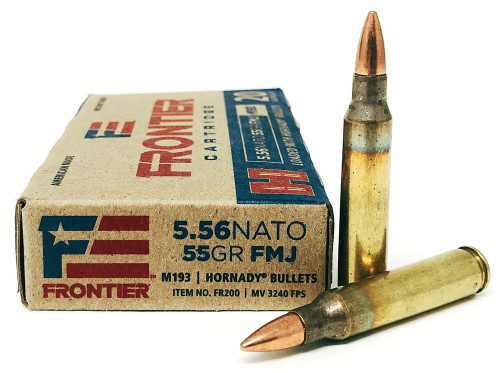
You are planning a long day of AR-15 practice and looking at Hornady Frontier: a 55-grain FMJ, a 62-grain "Green Tip," a 68-grain boat-tail hollow point and a box marked .223. Is the cheapest FMJ by the case all practice needs? Will the boat-tail load shrink your groups enough to be worth the extra money? And will your range let you shoot Green Tip at its steel targets, when many ranges don't?
By the end you should know what Frontier is and what each load is built to do, why the 5.56 and .223 labels are not interchangeable, what Lake City brass means for reloaders, and when to step up to a more refined line, so you can match a Frontier load to your rifle, your range and your goal.
What Hornady Frontier is
Frontier is a Hornady line of centerfire rifle ammunition aimed at high-volume, budget-conscious shooting, mainly in 5.56 NATO and .223 Remington. It was built around a partnership with the Lake City Army Ammunition Plant in Independence, Missouri, which has produced U.S. military small-arms ammunition since 1941. Frontier used Lake City cases and military-style production with Hornady bullets and specifications. Availability of the line has changed over time, so check current listings for which loads are in production.
"Mil-spec" means built to a military specification. For Frontier's 5.56 loads that means military-style brass with crimped primers and loads that mirror the familiar M193 and M855 cartridges. Think of a good pair of work boots: Built to a standard and meant to be used hard, not a pair of dress shoes.
Key idea: Frontier's value is consistency at volume. You are paying for dependable, military-style ammunition you can shoot a lot of, not for the last bit of precision.
Buy Frontier when you will shoot many rounds and want reliable function, and to look elsewhere when every fraction of an inch matters.
The three 5.56 loads
| Load | Bullet | What it is for | What to watch |
|---|---|---|---|
| 55-grain FMJ (M193 type) | Full metal jacket | Training, drills and plinking | Least precise of the three |
| 62-grain FMJ (M855 type, "Green Tip") | Full metal jacket with a steel penetrator | Military-style practice | Many ranges ban it on steel targets or indoors |
| 68-grain BTHP | Boat-tail hollow point | Better groups for practice and casual matches | Costs more; not a hunting bullet |
The table is a ladder of precision with one side branch. The 55-grain FMJ is plain "ball" ammunition, a lead core fully enclosed in a copper jacket. It is the cheapest and runs well in most ARs, and its accuracy is adequate for practical drills at typical carbine distances. M193-type ammunition is commonly listed at about 3,200 feet per second from a 20-inch barrel; it will be slower from a 16-inch carbine.
The 62-grain Green Tip has a small steel penetrator in the front of the bullet. That steel can damage steel targets and some range backstops and can spark, which is why many ranges restrict it. Check your range's rules before you buy it.
The 68-grain BTHP has a boat-tail, a tapered base that reduces drag, and an open hollow point at the tip. Bullets like this usually group more tightly than FMJ, because they are made with more attention to uniformity. It is a step up for practice, but it is not a match bullet and was not designed for hunting, so do not assume it will expand reliably on game. Barrel quality and twist rate affect all three loads, so measure groups in your own rifle. Our article on barrel twist rate explains why heavier bullets need a faster twist.
5.56 or .223: match the label to your chamber
The chamber is the section at the rear of the barrel where the cartridge sits when it fires. The 5.56 NATO and .223 Remington cartridges look almost identical, but they are not the same. 5.56 ammunition can run at higher pressure, and 5.56 chambers have a longer throat, the space in front of the cartridge before the rifling begins. Firing 5.56 ammunition in a chamber made only for .223 Remington can raise pressure beyond what the rifle was designed for.
Think of it like fuel for an engine: A vehicle built for one fuel may run on another for a while, but you are working outside the design. Read the marking on your barrel and check your manual. If it says .223 Rem only, buy .223-labeled ammunition. If it says 5.56 NATO or .223 Wylde, a chamber designed to handle both, either label is appropriate. If you cannot tell, ask a qualified gunsmith before you shoot.
Common mistake: Assuming 5.56 and .223 are the same because they look alike. Never fire 5.56-labeled ammunition in a .223-only chamber. Our article on 5.56 NATO and .223 Remington explains the differences in detail.
Lake City brass, crimped primers and reloading
Lake City brass is well regarded among reloaders for durability. Military-style ammunition, though, uses a primer crimp, a ring pressed around the primer pocket that holds the primer firmly so it cannot back out in harsh conditions. If you reload, that crimp must be removed by swaging or reaming the pocket before a new primer will seat properly. It is a one-time step per case; after that, the brass behaves like any other.
Crimped brass is worth saving if you reload and are willing to do the extra step once; if you do not reload, the crimp does not matter to you at all. If you do reload, use published load data from a reputable source and check its notes on military brass, which can have less internal capacity than commercial cases.
Where Frontier fits, and when to step up
Frontier fits best in high-volume practice, carbine classes and casual matches, where reliable function and a reasonable price matter more than small groups. It is a good choice for building a supply of practice ammunition. Store it cool and dry; our article on storing ammunition explains how.
It is not the right choice for hunting. FMJ bullets do not expand, and the BTHP is not designed as a hunting bullet. For coyotes and other predators, choose a load built for varmints, and check Iowa DNR rules for legal methods. For precision work, Hornady's Black and Match lines and other premium loads use bullets designed for accuracy, at a higher price; our article on Hornady BLACK ammunition covers the next step up.
If your fundamentals are still developing, practice will improve your groups more than a premium box will, so buy volume. When you can consistently see a difference between loads, step up. Our article on ammunition quality from cheap to match grade helps you decide where to spend.
Matching your load, then testing it
The right Frontier load starts with your chamber and your range. With the rifle unloaded, the magazine out, the action locked open and the chamber checked by sight and touch, the barrel marking and manual tell you whether it is .223 Rem, 5.56 NATO or .223 Wylde, and your range's rules tell you whether steel-core Green Tip is allowed. With matching loads, such as the 55-grain FMJ and the 68-grain BTHP, five-shot groups from a rest at 100 yards, with eye and ear protection, show what each does in your rifle; at that distance one inch is about one MOA. Whether the BTHP's tighter groups are worth its price is then a decision based on your own targets.
Putting it together
Frontier is practice ammunition built around military-style components: A 55-grain FMJ for cheap volume, a 62-grain Green Tip that many ranges restrict, and a 68-grain BTHP for better groups. Match the label to your chamber, with .223 Rem only meaning .223 ammunition and 5.56 or .223 Wylde accepting either. Save the brass if you reload and plan on removing the primer crimp. Use Frontier for training, not hunting, and step up to a precision line only when your shooting can show the difference.
Check your understanding
Try answering these before you open the answer. If you can decide what to do and explain why, you have it.
1. Your range posts a "no steel core" rule. Which Frontier load should you avoid, and why?
The 62-grain M855-type Green Tip, because it has a steel penetrator that can damage steel targets and backstops.
2. Your barrel is marked .223 Rem only. Which label should you buy?
The .223-labeled ammunition. 5.56 can run at higher pressure and belongs only in rifles chambered for 5.56 or .223 Wylde.
3. Your 68-grain BTHP groups noticeably tighter than the 55-grain FMJ from the same rifle. Why?
Its boat-tail shape reduces drag, and it is made with more attention to uniformity, so shot-to-shot variation is smaller. It still isn't a match bullet, but it is a step up from plain ball.
4. You've saved a bucket of Frontier brass for reloading. What extra step will it need?
Removing the primer crimp by swaging or reaming the primer pocket. It is a one-time step per case, after which the brass reloads like any other.
5. A friend wants to hunt coyotes with the 55-grain FMJ. What would you suggest?
A load designed for varmints that expands reliably, used where it is legal, because FMJ bullets do not expand.
Where to go next
To see how Frontier fits among Hornady's other 5.56 loads, read a complete guide to Hornady's 5.56mm ammunition. 5.56 NATO and .223 Remington explains the chamber question in depth, Hornady BLACK ammunition covers the step up in accuracy, and FMJ and TMJ bullets explains what you get with plain ball ammunition.
If this article helped you, we invite you to sign up for email notifications of new blog articles.