
A Deep Dive Into Hornady American Whitetail Ammunition
Joseph McLain Nov 07, 2026
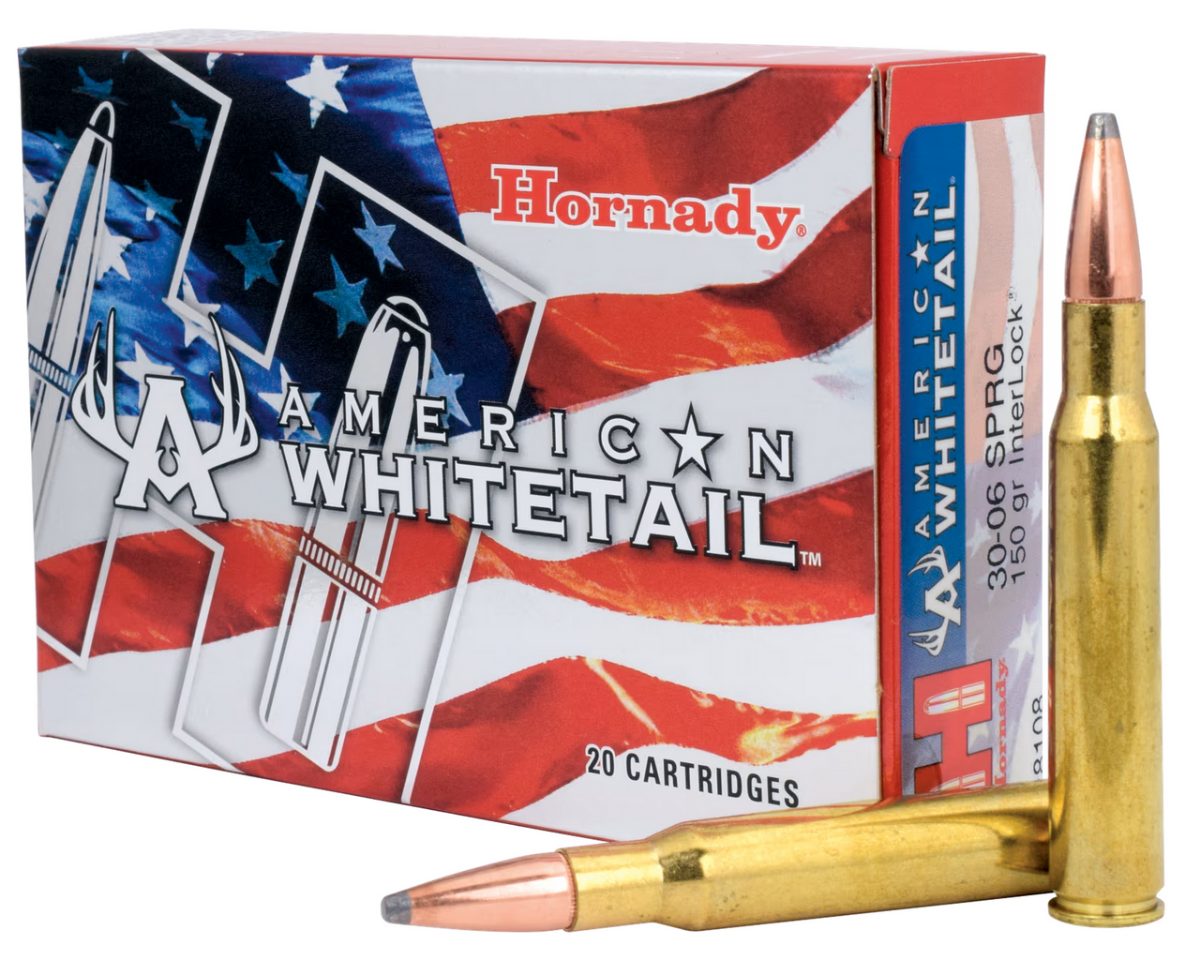
It is a few weeks before opening day, and you are holding a box of Hornady American Whitetail. Is inexpensive ammunition enough for deer, or does an ethical shot call for a premium bonded bullet? The box lists several calibers and talks about something called InterLock. Which caliber is right for your rifle, your woods and your shoulder, and what does the bullet actually do when it reaches a deer?
By the end you should understand what the InterLock bullet does and why it suits whitetails, be able to match a caliber to your terrain and recoil tolerance, and know where American Whitetail sits among Hornady's other lines.
What a deer bullet has to do, and how InterLock does it
A hunting bullet has two jobs that pull against each other. It has to expand, meaning open up on impact to create a wide wound channel. It also has to penetrate, meaning stay together and drive deep enough to reach the vital organs. A bullet that opens too easily or breaks apart may stop short. A bullet that never opens just punches a small hole. The art is controlled expansion, where the bullet opens reliably and still holds together.
Hornady developed the InterLock bullet at the core of every American Whitetail cartridge to solve two problems, core-jacket separation (the lead core and the copper jacket coming apart) and unreliable expansion. Think of a jacket and the body inside it. If the coat tears away on impact, the part doing the work is lighter and may not go as deep.
| Feature | What it is | What it does in the field |
|---|---|---|
| Internal locking ring | A raised ring inside the jacket that physically locks the lead core in place | Greatly reduces the chance of core-jacket separation, so the bullet keeps more of its weight and makes a more predictable wound channel |
| Tapered jacket | Thicker near the shank, thinner toward the tip | Reliable expansion across a range of velocities, whether the shot is a close 50 yards or a longer 200-yard poke |
| Secant ogive profile | A curved, pointed nose shape that reduces drag | A flatter trajectory and more consistent accuracy at varying engagement distances |
| One-piece core | A solid lead core that retains its mass during expansion | Deep penetration, so the bullet can reach the vital organs for a quick, humane kill |
The table shows three problems and three answers. The ring and the one-piece core keep the bullet together, the tapered jacket makes it open, and the nose shape gets it to the target on a flat path. The tapered jacket is worth a second look. A bullet hits harder and faster at close range and slower at long range, and a bullet that only worked at one speed would either blow apart up close or fail to open far away. A thick base paired with a thin tip is a way to handle both. For more on nose shapes and why they matter, see our guide to understanding bullet shapes for rifle rounds.
Key idea: Good deer ammunition does not just expand. It expands in a controlled way and keeps enough of its weight to reach the vitals. Features like the locking ring and tapered jacket exist to make that happen at the speeds you will actually see in the woods.
Matching the caliber to your terrain and your shoulder
American Whitetail comes in a wide array of popular deer-hunting calibers, so you can pick the cartridge that suits your rifle and your hunting ground. Before you choose, confirm which cartridges are legal for deer in the state, season and area you hunt, because some places restrict the type of rifle cartridge you may use. Our articles on straight-walled cartridges for deer hunting and hunting licenses, tags and firearm restrictions in Iowa and neighboring states are good places to start, and your state wildlife agency has the current rules.
| Caliber | Best for | What to know |
|---|---|---|
| .350 Legend | States that limit deer rifles to straight-walled or .35-caliber and larger cartridges, including Iowa | Hornady lists a 170-grain InterLock American Whitetail load at about 2,200 fps. Mild recoil; best inside about 200 yards |
| .243 Winchester | Youth hunters and the recoil-sensitive | Adequate muzzle energy for deer if shot placement is solid |
| .270 Winchester | Open fields and flatter trajectories | Excellent for medium-to-long-range shots on whitetails |
| .30-06 Springfield | All-around use, from thick woods to open plains | Balances power with moderate recoil, which makes it very versatile |
| 6.5 Creedmoor | Hunters who want high ballistic coefficients and long-range precision | Known for accuracy, with less recoil than bigger .30 calibers |
| .300 Winchester Magnum | Large-bodied deer, extended distances, or extra energy on tap | Higher recoil. It is not necessary in most typical whitetail scenarios but is advantageous in wide-open country |
For Iowa hunters, the table works differently. During Iowa's youth and disabled and first and second shotgun deer seasons, Iowa Code section 481A.48 allows rifles only with expanding bullets from .350 to .500 inch in diameter and at least 500 foot-pounds of muzzle energy. That rules out the .243, .270, .30-06, 6.5 Creedmoor and .300 Win Mag for deer in those seasons, however well they work elsewhere. In Iowa, the American Whitetail load that matters for deer is the .350 Legend; the others are for hunts in other states.
The table is really two questions. How far do you usually shoot, and how much recoil can you handle while still shooting accurately? A ballistic coefficient is a number for how well a bullet resists air, and a higher one means a flatter, wind-resistant flight. It is why the 6.5 Creedmoor appears in the long-range row. Our article on how ammunition affects your accuracy explains what that number does, and the 6.5 Creedmoor comparison covers that cartridge in depth.
Picture three hunters. The first sits in a tree stand along a creek in thick cover, where shots are short. Outside Iowa, good choices there are the .30-06, .308 or .243, and in Iowa the .350 Legend, because short distances mean higher impact velocities, and the InterLock bullet is built to handle that without blowing apart or separating its core and jacket. The second watches a bean field from the edge of a timber line, where shots may stretch to 200 to 300 yards or more. The .270 Win, 6.5 Creedmoor or .300 Win Mag fit this setting, and the bullet's aerodynamic shape and controlled expansion help when velocity has dropped somewhat. The third is a youth hunter or anyone sensitive to recoil, for whom the .243 Winchester or 6.5 Creedmoor are often recommended. Lower recoil helps maintain accuracy, and accuracy is what produces effective hits and quick kills.
Distance changes what the bullet does, so it helps to know the three common zones.
- Close range (under 50 yards). American Whitetail loads maintain structural integrity, so bullet blow-up and over-expansion are minimized.
- Mid-range (100 to 200 yards). These are very common whitetail distances, and the bullet's flat trajectory helps you hold on target without excessive drop compensation.
- Extended range (200+ yards). Calibers like the 6.5 Creedmoor or .270 Win can excel here, with the InterLock bullet still expanding effectively as long as velocity remains sufficient.
That last clause matters. Expansion depends on speed, and a bullet that is too slow when it arrives may not open as intended. If your longest honest shot is 150 yards, the farther-reaching calibers give you margin you may not need.
Common mistake: Choosing the biggest cartridge "just in case." The .300 Win Mag is a fine round for open country, but its extra recoil is not necessary for most typical whitetail scenarios, and a hunter who flinches will miss more than a hunter who shoots a milder load well. Recoil and flinching are discussed in the role of mental focus in shooting.
Consistency and what to expect from the box
Hornady is known for tight quality control, and two details matter for you. Uniform powder charges mean consistent muzzle velocities from shot to shot, and a consistent velocity means each bullet follows the same path. Precise bullet seating ensures the bullet is aligned in the case neck, which aids accuracy. Together they are why a good factory load groups predictably, and why a box of ammunition can be a part of your accuracy plan.
Once the bullet arrives, the design goes to work. The InterLock bullet mushrooms reliably, creating a wide wound channel. High weight retention thanks to the locking ring drives it through the vital organs, and the energy it transfers on impact supports a quick, ethical kill when the shot is well placed. The tough construction also deals with bone or angled shots, and the load's consistent ballistics aid shot placement even in wind or rain.
Good practice: No bullet makes up for a poor shot. American Whitetail is built to perform when you put it in the right place, so spend your effort on shot placement. Our article on hunting ethics explains why.
Why hunters choose American Whitetail, and how it compares
Some hunting ammunition lines are general-purpose for several species, while American Whitetail is optimized for deer-sized game. Its bullet expands at typical deer-hunting velocities, and its caliber selection covers the whitetail's habitat across North America. With controlled expansion and deep penetration, a well-placed shot can humanely take a deer, which reduces suffering. Hornady also has a long track record in hunting ammunition.
Price is part of the case. Some premium bonded or monolithic bullets can be pricey, but American Whitetail is often sold at a competitive price point, delivering excellent performance without breaking the bank. That matters more than it sounds, because affordability means more practice, and more practice leads to better shot placement. For a look at how price relates to quality across ammunition types, see ammunition quality, from cheap to match grade.
Hornady has other lines, and it helps to know when you might step up.
| Hornady line | What it offers | When to consider it |
|---|---|---|
| American Whitetail | InterLock bullet, standard design, adequate for typical deer hunts | Most whitetail hunting, with the best price-to-performance balance |
| Loads with SST or ELD-X bullets (for example Superformance or Precision Hunter) | Polymer-tipped bullets with higher ballistic coefficients | When you want extra long-range help. For basic whitetail tasks, InterLock is more than enough |
| Outfitter | Lead-free GMX bullets in sealed, nickel-plated cases built for harsh weather | Wet or cold hunts, or where lead bullets are not allowed |
| Custom | A long-running line offering a range of Hornady bullets, often at a higher cost | When the specific bullet you want comes in that line and you accept the cost |
The pattern is a ladder of specialization. Each step up buys you something specific, such as a higher ballistic coefficient or a premium construction, and costs more. For most deer hunts, American Whitetail remains the price-performance sweet spot, so a step up makes sense only if you can name what you are buying. You can read more about the premium end in the Hornady Custom line.
Proving your deer load before the season
A box of the load you will hunt with, shot from the rifle you will carry, tells you what the ballistics chart can't. Confirm the caliber on the box matches your rifle, and with eye and ear protection on and the muzzle downrange, shoot several groups from a steady rest. Zero the rifle, then shoot at 100 and 200 yards, the common whitetail distances, and note how far the bullet drops at each. Your honest maximum distance is the farthest one at which you can put every shot inside a paper-plate-sized circle from the position you will actually hunt from. Our guide to sighting in rifles at different distances walks through the zeroing step in detail.
Putting it together
Inexpensive versus premium is the wrong argument. A traditional cup-and-core bullet like InterLock and a premium bonded bullet both kill deer cleanly when they hit the vitals at a velocity they were designed for; the premium bullet earns its price mainly on very close, very fast impacts, on bigger animals, and on hard angles through heavy bone. For most whitetail hunting the order of decisions is simple. First, what is legal where and when you hunt; in Iowa's shotgun seasons that means .350 inch or larger. Second, how far your longest honest shot is from your real position. Third, how much recoil you can handle without flinching. Choose the caliber that answers all three, buy enough of one load to zero and practice, and prove it on paper before the season. If you can name a specific problem American Whitetail does not solve for your hunt, that is the time to step up a line, not before.
Check your understanding
Try answering these before you open the answer. If you can decide what to do and explain why, you have it.
1. A friend's cheap cup-and-core bullets broke apart on a close-range buck. How does InterLock address that?
Its internal locking ring holds the lead core to the jacket, which greatly reduces core-jacket separation. The bullet keeps more of its weight, penetrates deeper and makes a more predictable wound channel, even on fast close-range impacts.
2. You may get a 40-yard shot from your stand or a 200-yard shot across a cut field. How does InterLock's jacket help it work at both?
The jacket is thick near the shank and thin at the tip, so the nose opens reliably at the lower velocity of a long shot while the thicker rear holds the bullet together at the higher velocity of a close one.
3. A hunter who is recoil-sensitive is deciding between .243 Winchester and .300 Winchester Magnum. Which would you suggest and why?
The .243 Winchester. It has lower recoil, which helps maintain accuracy, while the .300 Win Mag is not necessary in most typical whitetail scenarios.
4. Your longest realistic shot is 150 yards, and a friend says you need a long-range round. What would you tell them?
Mid-range distances of 100 to 200 yards are very common for whitetail, and the bullet's flat trajectory lets you hold on target without excessive compensation. You can choose a caliber for your own typical distance and recoil comfort.
5. You hunt Iowa's first shotgun season and own a .270 and a .350 Legend. Which American Whitetail box do you buy, and why?
The .350 Legend. Iowa Code 481A.48 allows rifles in that season only with expanding bullets from .350 to .500 inch, so the .270 is not legal for deer then, however good the load is.
Where to go next
You can find Hornady American Whitetail ammunition on our website, including .350 Legend, .400 Legend and .450 Bushmaster loads for Iowa, and anything listed there can be ordered if it isn't in stock.
Start with hunting ethics, which explains how shot placement and bullet choice work together to bring a clean, humane kill. Then read sighting in rifles at different distances so your zero is ready before opening day. If you hunt where rifle cartridges are restricted, straight-walled cartridges for deer hunting shows what the options are. And if you are curious about a premium step up, the Hornady Custom line is the logical next read.
If this article helped you, we invite you to sign up for email notifications of new blog articles.