
Federal Terminal Ascent Ammunition: Behind the Technology and Performance
Joseph McLain Nov 10, 2026
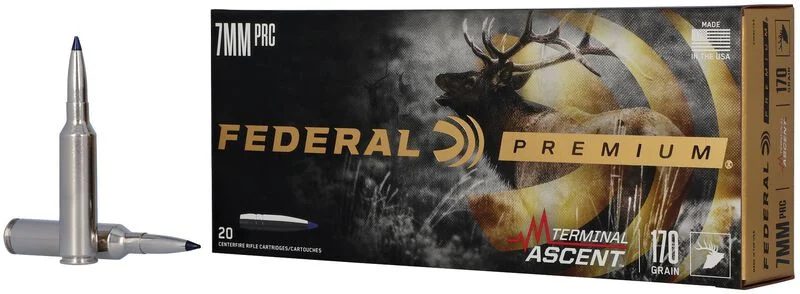
You've drawn a western elk or mule deer tag, or you're planning a pronghorn hunt, and the country is open enough that a shot could come at 80 yards in the timber or 400 yards across a basin. A box of Federal Terminal Ascent costs a good deal more than a box of ordinary soft points. Is it worth it, when well-placed soft points have killed elk for a century?
By the end you should be able to explain what Terminal Ascent does that a cheaper bullet doesn't, work out how far your own load can be trusted to open, decide whether your hunt needs it or a competitor, and know where the bullet stops being the limit and you become it.
The short answer
Terminal Ascent earns its price on hunts where the shot could be long, past about 300 yards, on big animals like elk. Its bullet opens at lower speed than most and holds together at high speed, so one load covers both the close and the far shot. For whitetail inside 200 yards, a good conventional soft point does the job for less money. And for Iowa deer it doesn't apply at all, because every Terminal Ascent cartridge fires a bullet smaller than Iowa's .350-inch minimum for deer rifles.
The problem a long-range hunting bullet has to solve
A bullet slows down all the way to the target. A .308 Winchester load that leaves the muzzle at 2,600 feet per second arrives at 400 yards doing under 2,000. That matters because a hunting bullet opens, or expands, only when it hits hard enough. If it's going too slow, it punches a narrow hole like a solid and the animal may run a long way. If it's going very fast, as it does up close, a soft bullet can break apart before it reaches the vitals.
So one bullet that does both jobs has to open at low speed without coming apart at high speed. Think of a door latch: set it too light and it flies open at the first bump, too stiff and it won't open when you push. Most bullets are set for one end of that range. Terminal Ascent is built to cover more of it.
Key idea: A hunting bullet's range limit isn't how far it can fly. It's how far it can go and still be moving fast enough to open on the animal.
How Terminal Ascent does it
The tip, which Federal calls the Slipstream tip, is a polymer point with a hollow core. In flight its pointed shape cuts drag, so the bullet keeps its speed and drifts less in the wind. On impact the tip is driven back into a cavity in the bullet's nose and pries it open, which is what lets it start expanding at lower speed than a plain soft point. Federal says the bullet expands to nearly twice its diameter at impact speeds as low as about 1,900 feet per second, and still opens measurably at about 1,400.
The core is lead bonded (fused) to the copper jacket, and the back half of the bullet is solid copper. At close range, where the bullet hits hardest, the bond keeps the jacket and core from separating and the copper shank keeps it driving. That's what keeps it from coming apart up close. In one independent test of the 6.5 Creedmoor load, the bullet opened to about 2.4 times its diameter and went 24 inches into test media at 100-yard speed, and still opened to more than 2.2 times its diameter at a simulated 300-yard speed.
The grooves around the bullet, called AccuChannel, and the nickel-plated case are details. They help the bullet fly and the case resist corrosion, but they aren't the reason to buy it.
How far your load can be trusted to open
Here's where the principle turns into a number you can use. Federal publishes the speed of each load at each distance. Compare those speeds with the roughly 1,900 feet per second at which Federal says the bullet still opens fully.
| Load | Muzzle | 300 yards | 400 yards | 500 yards |
|---|---|---|---|---|
| 6.5 Creedmoor 130 gr | 2,800 fps | 2,305 fps | 2,152 fps | 2,005 fps |
| .308 Winchester 175 gr | 2,600 fps | 2,116 fps | 1,967 fps | 1,824 fps |
The 6.5 Creedmoor load is still above 1,900 at 500 yards, so the bullet isn't what limits that rifle at any distance most hunters should shoot. The .308 load drops below 1,900 a little past 400 yards. It still opens past that point, just less, so for the .308, think of 400 yards as the edge of full performance. Your own rifle may be a little faster or slower than Federal's test barrel, so treat these as close, not exact.
This is also why the bullet alone doesn't let you shoot farther. A bullet that opens at 500 yards does no good if your shot lands a foot off at 500 yards. Your limit is the shorter of two distances: how far the bullet opens reliably, and how far you can put every shot into an 8-inch circle, about the size of an elk's or deer's vitals, from a hunting position. For most hunters, the second distance is the shorter one.
Common mistake: Buying a long-range bullet and treating it as permission to take long shots. The bullet widens what's possible; your practice at distance sets what's ethical. If you haven't hit an 8-inch target at 400 yards from a field position, 400 yards isn't your range yet.
Terminal Ascent or one of its rivals?
Three other bullets are built for the same job, and each makes a different trade.
Hornady ELD-X (in Precision Hunter ammunition) has a heat-resistant tip and a very sleek shape, so it flies flat and drifts little. It isn't bonded; a ring inside the jacket helps hold it together, and it typically keeps about half to 60 percent of its weight on a fast, close hit. It's an excellent bullet for open-country deer and pronghorn where most shots are long. On elk at close range, the bonded Terminal Ascent holds together better.
Barnes all-copper bullets (TSX, TTSX and the VOR-TX ammunition that uses them) are a single piece of copper. They hold nearly all their weight and penetrate deeply, and they are lead-free, which some places require. A copper bullet needs more speed to open than a lead-core bullet, so it suits hunts where shots stay at moderate range.
Nosler AccuBond Long Range is the closest match to Terminal Ascent in design: bonded, sleek and built to open at low speed. Either is a sound choice.
- If you're hunting elk, moose or big-bodied deer where shots may be close or far, choose Terminal Ascent or AccuBond Long Range, because you need a bullet that holds together up close and still opens at distance.
- If you're hunting pronghorn, open-country mule deer or whitetail where most shots are long, Hornady ELD-X is an excellent choice, because flat flight matters more than maximum toughness on lighter animals.
- If you must use lead-free ammunition, or want the deepest penetration on heavy game at moderate range, choose a Barnes copper bullet.
- If you hunt whitetail in timber or along field edges inside 200 yards, a conventional soft point such as Federal Power-Shok or Remington Core-Lokt does the job, and you can spend the difference on practice ammunition.
If you're not sure and your hunt involves elk, start with Terminal Ascent.
Sighting in and choosing a weight
Terminal Ascent comes in one or two weights per cartridge, close to the standard hunting weight for each: 130 grains in 6.5 Creedmoor, 136 in .270 Winchester, 155 in 7mm magnums, 175 in .308 and .30-06, and 200 in .300 magnums. Its bullets are long for their weight, and long bullets need more spin to fly point-first. That spin comes from your barrel's twist rate. If your groups are round and tight, the twist is fine. If the holes in the target are oval or sideways, the bullet is tumbling; stop using that load in that rifle.
Changing to Terminal Ascent from another load will move where your rifle hits, so sight in again with the box you'll hunt with, with eye and ear protection on and from a steady rest. Then shoot at the longer distances you might take a shot, if you have a range that allows it, and write down how much the bullet actually drops there. A printed chart is a prediction; your own holes on paper are the truth for your rifle.
Group size depends on the rifle. Many shooters see 1 MOA or better, about an inch at 100 yards, in well-bedded rifles, and some rifles prefer heavier or lighter weights depending on twist rate. In warm conditions, watch for velocity shifts or vertical stringing as the barrel heats up; the consistent bullet design typically limits the extremes. Ballistic gelatin is one way to see how the bullet expands, and our article on ballistic gelatin explains what such tests do and don't tell you. In the field, hunters report pass-throughs on elk with wide wound channels and little fragmentation, preserving more edible shoulder and rib meat, and some report that elk and large deer rarely run far after a well-placed shot. Their experience is a good sign, not a guarantee, because shot placement still decides the outcome.
Check your understanding
Try answering these before you open the answer. If you can decide what to do and explain why, you have it.
1. You hunt whitetail with a 6.5 Creedmoor on a Missouri farm, where shots are under 200 yards. Is Terminal Ascent worth the money?
Probably not. At 200 yards your bullet is still going fast enough for an ordinary soft point to open well, and a whitetail doesn't demand a bonded bullet. A good conventional soft point does the job, and the money saved buys practice.
2. Your elk hunt is in Colorado with your .308. A guide says shots run 100 to 450 yards. What do you tell yourself about the 450-yard shot?
Your .308 Terminal Ascent drops below about 1,900 feet per second, where Federal says it opens fully, a little past 400 yards. It still opens past that point, but less. At 450 the bullet is near its edge, and the real question is whether you can put every shot into 8 inches at that range from a field position. If you haven't proven that, pass on the shot or get closer.
3. A friend says Terminal Ascent will let him take 600-yard shots with his .30-06. What's wrong with that reasoning?
The bullet's ability to open is only one limit. At 600 yards his .30-06 bullet will have slowed below where it opens fully, and, more importantly, very few hunters can place a shot within 8 inches at 600 yards in field conditions. The bullet doesn't add skill.
4. You're hunting pronghorn in Wyoming with a 6.5 PRC, and nearly every shot will be 250 to 450 yards. Terminal Ascent or Hornady ELD-X?
Either works well, and ELD-X is an excellent fit. Pronghorn are light-bodied, so maximum toughness matters less than flat flight and good expansion at distance, which is what the ELD-X was built for.
5. A new long-range bullet claims it opens at "extended ranges" but gives no speed number. How do you judge it?
Ask for the lowest impact speed at which it opens reliably, then compare that with the load's published speed at the distances you'll shoot. A bullet's range is set by where its speed falls below that number, not by how far it can fly. Without the number, you can't know, so choose a bullet whose maker publishes it.
Where to go next
You can find Federal Terminal Ascent ammunition on our website in 6.5 Creedmoor, 6.5 PRC, .270 Winchester, .280 Ackley Improved, 7mm Backcountry, .300 WSM and .300 PRC, and anything listed there can be ordered if it isn't in stock.
To understand why impact speed decides how a bullet behaves, read hunting bullets and impact velocity. For the rest of the elk-load decision, see choosing elk ammunition. And if your groups show oval holes, barrel twist rate explains why and what to do about it.
If this article helped you, we invite you to sign up for email notifications of new blog articles.