
Federal HammerDown: The Ultimate Hunting Ammunition for Lever-Action Rifles
Joseph McLain Nov 06, 2026
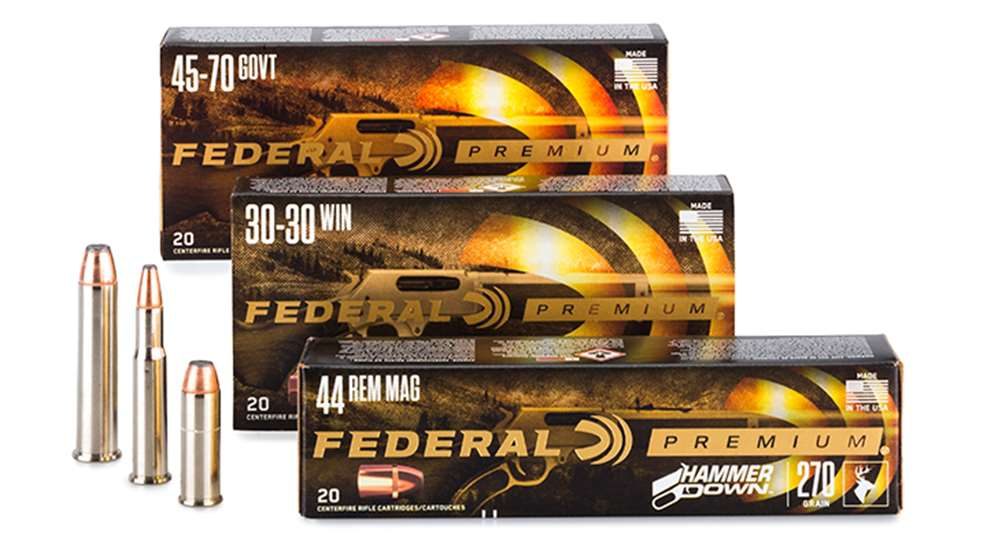
You have a lever-action rifle, maybe your grandfather's .30-30 or a new Henry in .45-70, and deer season is coming. Will any soft point do, or is it worth paying more for Federal HammerDown, which was made for lever guns, or for Hornady LEVERevolution with its red tip and promise of a flatter shot?
By the end you should be able to say which of those three your rifle and your hunt actually call for, know whether your cartridge is legal for Iowa deer, and know how to confirm a load works in your own rifle before you climb into the stand.
The short answer
If you hunt in timber or brush where shots are under about 100 yards, a traditional soft point works, and HammerDown is the better choice when you want a bullet that holds together on a big deer or a hard quartering shot, or when you shoot a handgun cartridge like the .44 Magnum from a rifle. If your shots stretch across fields past 150 yards, choose Hornady LEVERevolution, because its pointed bullet drops less. In every case, the load has to feed smoothly in your rifle.
Why lever guns are particular about ammunition
Most lever-action rifles carry their cartridges in a tube under the barrel, lined up nose to tail. Each bullet's nose rests on the primer of the cartridge in front of it, and every shot jolts the whole column. A sharp, pointed bullet in that line is like a nail resting on a detonator. That is why lever-gun bullets have always been flat-nosed or round-nosed: the blunt nose spreads the push across the primer instead of focusing it on one point.
Blunt bullets have a cost. A flat nose pushes more air, so the bullet slows and drops faster than a pointed one. Traditional lever-gun loads hit hard close in and fall off quickly past 150 yards.
The cartridge also has a long trip through a lever gun. It goes in through a loading gate on the side, slides down the tube, gets lifted by a carrier and pushed into the chamber as you close the lever. A case edge that catches anywhere along the way causes a hang-up, right when you want a second shot.
What HammerDown changes
Federal designed HammerDown with Henry Repeating Arms for exactly this kind of rifle, and it changes three things.
The case. Federal reshaped the case and chamfered (slightly beveled) its edges so it slides through the loading gate, tube and carrier with less chance of catching.
The bullet. HammerDown uses a bonded soft point. In an ordinary soft point, a lead core sits inside a copper jacket, and on a hard hit, especially into heavy bone, the two can separate. The bullet then loses weight and stops short. A bonded bullet has its core fused to its jacket, so it opens into a mushroom and keeps most of its weight, which keeps it driving deep. Think of a cupcake sitting loose in a paper cup next to one baked solidly into its pan. Knock both hard and only the loose one comes apart.
The speed it was built for. This matters most for handgun cartridges fired from rifles. A .44 Magnum bullet made for a revolver is built to open at revolver speed, around 1,300 to 1,500 feet per second. Fired from a lever gun's longer barrel, it can leave a few hundred feet per second faster, and a soft handgun bullet can come apart too quickly at that speed. Federal built the HammerDown bullets to expand properly at the speeds lever-gun barrels actually produce; its .44 Magnum load, a 270-grain bullet, is listed at about 1,715 feet per second.
Key idea: A hunting bullet works only within the speeds it was designed for. A handgun bullet pushed faster from a rifle, or a rifle bullet going slower than designed, may not open the way you expect.
HammerDown, LEVERevolution or a plain soft point?
These three answer different questions, so the choice starts with where you hunt.
Traditional soft points, such as Winchester Super-X or Remington Core-Lokt, are the loads that filled lever guns for a century. At woods distances on average deer, a well-placed shot with one kills cleanly. They are not bonded, so on a big-bodied deer, a quartering shot or heavy shoulder bone, they are more likely to break up before they reach the far side.
HammerDown keeps the blunt, tube-safe shape and adds a bonded bullet and a case shaped for smooth feeding. It doesn't shoot any flatter than a traditional load. What it buys you is a bullet that holds together and goes deep at close range.
Hornady LEVERevolution solves the drop problem instead. Its pointed bullet has a soft, flexible polymer tip that can't set off the primer ahead of it in the tube, so it can be shaped like a modern rifle bullet. It flies flatter and carries more speed at distance. It isn't bonded, so it isn't built for maximum weight retention.
- If you hunt timber, river bottoms or brush and most shots are under 100 yards, choose HammerDown, because at that range drop doesn't matter and a bullet that holds together through bone does.
- If you hunt from a field edge where shots can stretch to 150 or 200 yards, choose LEVERevolution, because a blunt bullet drops fast enough at 200 yards to turn a good hold into a miss.
- If you shoot a .44 Magnum or .357 Magnum lever gun, choose HammerDown, because its bullet was built for rifle-barrel speed and a revolver bullet may not hold together at it.
- If you hunt average deer at close range on a budget, a traditional soft point is still a sound choice.
If you're not sure, start with HammerDown and keep your shots inside 150 yards. Our article comparing LEVERevolution and HammerDown goes deeper on that choice.
Is your cartridge legal for Iowa deer?
HammerDown is made in .30-30 Winchester, .45-70 Government, .44 Magnum, .357 Magnum, .45 Colt, .327 Federal, .35 Remington, .444 Marlin and .360 Buckhammer. Not all of them can be used for Iowa deer.
Iowa allows rifles for deer only in certain seasons, and under Iowa Code 481A.48 the rifle must fire an expanding bullet from .350 to .500 inch in diameter with a published muzzle energy of at least 500 foot-pounds. Bullet diameter is what usually decides it. The .30-30 fires a .308-inch bullet and the .327 Federal a .312, so neither is legal for Iowa deer, however well they work in other states. The .45-70, .44 Magnum and .360 Buckhammer qualify. The .357 Magnum's bullet is .357 inch, and the HammerDown load is listed at about 580 foot-pounds, above the minimum, but many .357 loads fall short, so read the energy on the box. Rules change, so check the current Iowa DNR deer rules before the season, especially for the less common cartridges.
Older rifles and the .45-70
The .45-70 has been chambered for nearly 150 years, from the Trapdoor Springfield of the 1870s to modern lever guns built for much higher pressure. Standard factory .45-70 ammunition is kept to low pressure so the old guns can fire it, but some modern loads are hotter and are marked for modern rifles only. If your .45-70 is a Trapdoor, a replica of an old design or a rifle you can't identify, fire only ammunition the box says is safe for it, and have a gunsmith look the rifle over first. Federal's HammerDown page doesn't say whether its .45-70 load is safe in a Trapdoor, so don't assume it is.
Common mistake: Assuming a box that says ".45-70" is right for every .45-70 rifle. The name on the box is the same for a 150-year-old single-shot and a new Henry. The pressure the rifle can take is not.
Prove it in your rifle before the season
The best bullet on paper is worthless if your rifle hangs up on it. At the range, with eye and ear protection on and the muzzle downrange, load the magazine full and work every round through the action with a full, firm stroke of the lever. If any round hesitates or catches, try it again; if it happens twice with the same load, use a different load or have a gunsmith check the rifle. A full tube is the way you'll hunt, and the most rounds pressing on the follower is the hardest test.
Then shoot a few groups from a steady rest at the longest distance you expect to shoot, and set your sights so the load hits where you aim there. Changing from one load to another, even in the same caliber, can move where the rifle hits by several inches, so sight in with the exact box you'll hunt with. When you're done, unload the tube completely and check the chamber; a lever gun's magazine tube can hold a round you've forgotten about.
Check your understanding
Try answering these before you open the answer. If you can decide what to do and explain why, you have it.
1. You hunt Iowa timber with a .44 Magnum carbine and the box of revolver hollow points you've used for years. What would you change, and why?
Switch to HammerDown .44 Magnum. A revolver bullet is built to open at revolver speed, and your carbine pushes it a few hundred feet per second faster, so it may break apart before it goes deep. HammerDown was built for carbine speed, and its 270-grain load is well over Iowa's 500 foot-pound minimum.
2. Your stand overlooks a picked bean field where a deer could step out at 200 yards. You shoot a .45-70. HammerDown or LEVERevolution?
LEVERevolution. A blunt bullet drops quickly past 150 yards, which makes a 200-yard shot much harder to hold for. The pointed, flexible-tipped bullet flies flatter and is still safe in your tube magazine.
3. Your grandfather's .30-30 is the rifle you most want to hunt with in Iowa. Can you?
Not for deer in Iowa. The .30-30 fires a .308-inch bullet, and Iowa requires at least .350 inch. It's a fine deer rifle in states that allow bottleneck rifle cartridges, so it can still go on an out-of-state hunt, but in Iowa you'll need a legal cartridge such as the .45-70 or .44 Magnum.
4. You inherit a .45-70 single-shot with no maker's name you recognize. What do you feed it?
Nothing until a gunsmith has identified and inspected it. If it's a Trapdoor or similar old design, fire only ammunition labeled safe for those rifles. Some modern .45-70 loads are hotter than an old action can take, and the cartridge name on the box doesn't tell you that.
5. A friend wants to put pointed, spitzer-style bullets from a bolt-action load into his lever gun's tube magazine because they shoot flatter. What do you tell him?
Don't. In a tube magazine each bullet's nose rests on the primer of the round ahead, and recoil can drive a hard point into it. That's exactly why lever loads use blunt noses, and why LEVERevolution uses a soft, flexible tip. If he wants a flatter shot, LEVERevolution is the safe way to get it.
Where to go next
You can find Federal HammerDown ammunition on our website in .30-30, .45-70, .44 Magnum, .357 Magnum, .45 Colt, .327 Federal, .35 Remington, .444 Marlin and .360 Buckhammer, and anything listed there can be ordered if it isn't in stock.
For the heavy end of the lever-gun world, choosing .45-70 deer loads compares the main options. If you're still choosing a rifle, choosing a lever action walks through calibers and models. And to see how other straight-wall cartridges compare for Iowa deer, read choosing a straight-wall deer rifle.
If this article helped you, we invite you to sign up for email notifications of new blog articles.