
Federal ELD‑X Ammunition: Advanced Long‑Range Performance for the Modern Hunter
Joseph McLain Nov 06, 2026
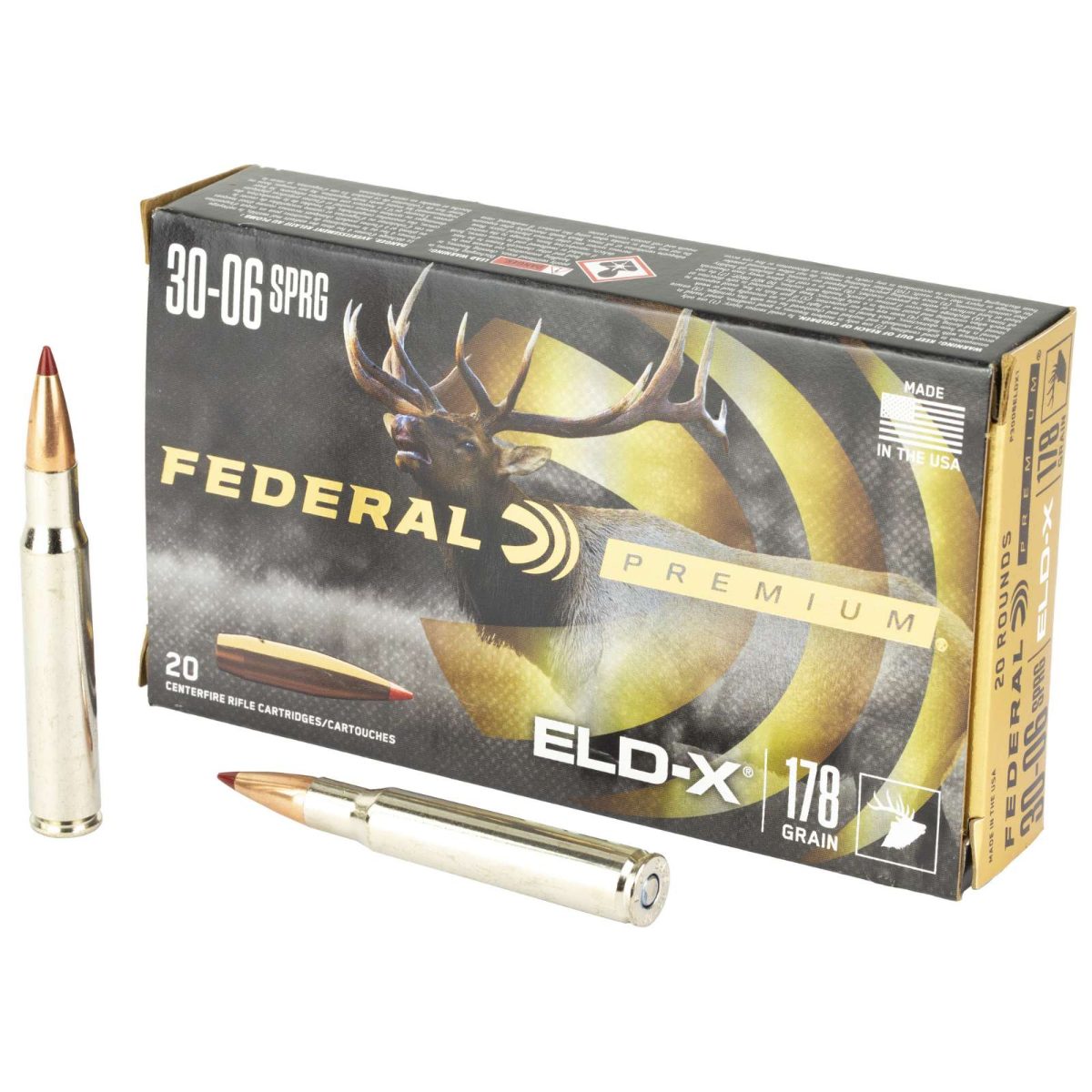
You're glassing across an open basin, and the animal you came for is farther away than any shot you've taken. Does a long shot need a special bullet, or will any good deer bullet do if you hold right? Federal now loads Hornady's ELD-X bullet in its Premium line, alongside its own Terminal Ascent, and you're trying to decide which box goes in your pack.
By the end you should be able to explain what a long shot asks of a bullet, say when the ELD-X is the right one and when a tougher bullet is better, choose between Federal's ELD-X and Hornady's own, and know the limit the bullet can't fix.
Two jobs a long-range bullet has to do
A long shot gives a bullet two separate jobs. The first is flight: over hundreds of yards, air slows the bullet, gravity pulls it down and wind pushes it sideways. A sleek bullet, one with a high ballistic coefficient, holds its speed better, so it drops less and drifts less. The second is impact: by the time it arrives, the bullet is going much slower than at the muzzle, and it still has to open up and drive deep. Many bullets do one of those jobs well. A long-range hunting bullet has to do both.
The ELD-X (Extremely Low Drag, eXpanding) is Hornady's answer. Its long, sleek shape and pointed tip give it a very high ballistic coefficient. The tip is made of a heat-resistant polymer, because ordinary plastic tips can soften and lose shape from air friction at long-range speeds, which changes how the bullet flies. Inside, a ring in the jacket (Hornady's InterLock) grips the lead core to help keep the two together on impact. Hornady designs it to open at the lower speeds of a long shot while still holding together up close.
The ELD-X is not bonded, though. In testing it typically keeps about half to 60 percent of its weight on a fast, close hit, opening wide and shedding fragments. That's excellent for deer and pronghorn and less ideal for driving through an elk's shoulder at 75 yards.
Key idea: The ELD-X is built to fly flat and open at distance. Choose it when your shots may be long and your animal is deer-size; choose a tougher bonded bullet when you expect big animals at close range.
ELD-X or Terminal Ascent?
Federal sells both, and they answer slightly different questions. Terminal Ascent is bonded with a solid copper shank, so it holds together better on a close, hard hit; the ELD-X flies a little flatter and opens a little more readily on lighter animals.
- If you hunt pronghorn, mule deer or open-country whitetail where most shots are long, choose ELD-X, because flat flight and easy expansion matter more than maximum toughness on those animals.
- If you hunt elk or moose where shots may be close or far, choose Terminal Ascent, because it holds together through heavy bone up close and still opens at distance.
- If you hunt whitetail in timber or along field edges inside 200 yards, neither is necessary. A good conventional soft point does the job for less money.
If you're not sure and your hunt is open-country deer or pronghorn, start with ELD-X.
Federal ELD-X or Hornady Precision Hunter?
Both use the same ELD-X bullet. Federal's version, introduced in 2023 and loaded in Minnesota, comes in nickel-plated cases in common hunting cartridges from .243 Winchester to .300 Winchester Magnum. Hornady's Precision Hunter has been loading the ELD-X longer and comes in more cartridges. Because the bullet is the same, the choice comes down to which your rifle groups better and which is offered in your cartridge. If your rifle shoots both well, buy whichever is easier to find, and stick with it so your scope settings stay true.
Weights and cartridges
Federal's ELD-X loads use the standard hunting weight for each cartridge: for example, 90 grains in .243 Winchester, 143 in 6.5 Creedmoor and 6.5 PRC, 145 in .270 Winchester, 162 in 7mm Remington Magnum and 178 in .308 and .30-06. Choose the cartridge first, for the animal and the distance, and let the weight follow.
Iowa hunters should know that none of these cartridges is legal for Iowa deer, which requires an expanding bullet of .350 to .500 inch from a rifle under Iowa Code 481A.48. Federal ELD-X is for hunts in other states.
The limit the bullet can't fix
A bullet that flies flat and opens at 500 yards doesn't make you able to hit at 500 yards. Your range is the shorter of two distances: how far the bullet arrives fast enough to open, and how far you can put every shot inside a deer's 8-inch vital area from a field position, in the wind you'll actually have. For most hunters, the second is the shorter one.
Before a long-range hunt, sight in with the exact load you'll carry, with eye and ear protection on and from a solid rest, then shoot it at the longer distances you might take, from the positions you'll really use, and write down how much it drops. That card, not the box, sets your limit.
Common mistake: Buying a long-range bullet and treating it as permission for long shots. The ELD-X widens what's possible; your practice at distance decides what's ethical.
Check your understanding
Try answering these before you open the answer. If you can decide what to do and explain why, you have it.
1. You're hunting Wyoming pronghorn with a 6.5 Creedmoor, and shots will run 250 to 400 yards. ELD-X or Terminal Ascent?
ELD-X. Pronghorn are light-bodied, so flat flight and easy expansion at distance matter more than maximum toughness.
2. Your Colorado elk hunt is in dark timber where shots are 50 to 150 yards, with a .300 Win Mag. Which?
Terminal Ascent, or another bonded bullet. A fast magnum hitting an elk at close range is where the unbonded ELD-X is most likely to fragment before it gets deep; a bonded bullet holds together.
3. Your rifle groups Hornady Precision Hunter tighter than Federal's ELD-X. Is that strange, since the bullet is the same?
No. Different cases, powders and seating can make the same bullet group differently in a given rifle. Hunt with the one your rifle shoots best.
4. A friend plans 600-yard shots on mule deer because "ELD-X is built for it." What should he ask himself?
Whether he has proven he can put every shot inside 8 inches at 600 yards from a field position in real wind. The bullet may still open there; his skill is the question. If he hasn't proven it, he should get closer.
5. You hunt whitetail in Missouri with a .308, and your shots are about 150 yards. Do you need ELD-X?
No. At 150 yards a good conventional soft point opens well and costs less. ELD-X earns its price at long range.
Where to go next
You can find ELD-X ammunition on our website, including Federal Premium ELD-X and Hornady Precision Hunter loads, and anything listed there can be ordered if it isn't in stock.
For the bonded alternative, read Federal Terminal Ascent. To understand why impact speed decides how a bullet behaves, see hunting bullets and impact velocity. And to measure what your rifle can do, understanding MOA walks through it.
If this article helped you, we invite you to sign up for email notifications of new blog articles.