
Hunting with Suppressors: Enhancing the Deer Hunting Experience
Joseph McLain Oct 24, 2026
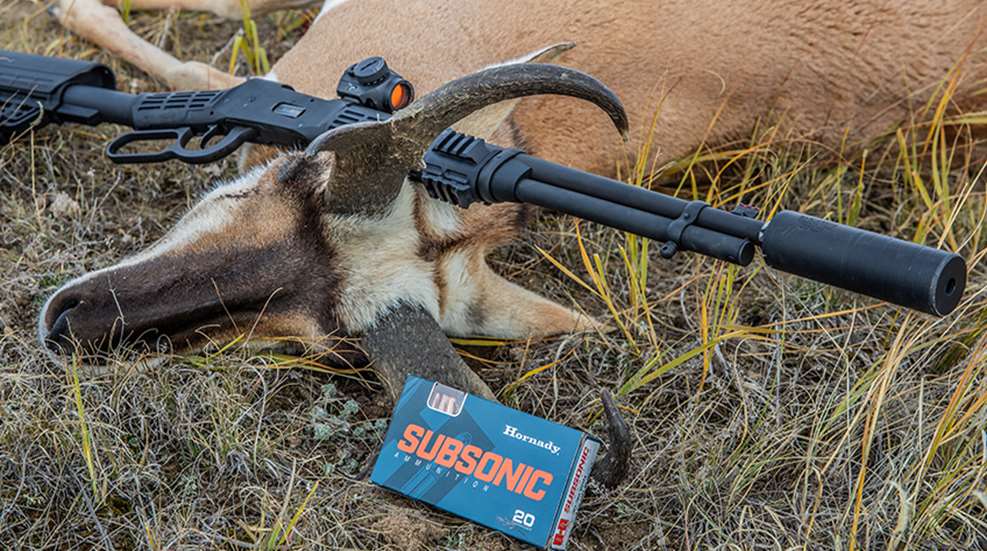
It is first light, you are in the stand, and a good buck steps out at ninety yards. You make the shot, and the report rolls through the whole timber. Every deer nearby is gone, your ears are ringing, and any hope of a second chance went with the sound. One hunting partner says a suppressor would have saved the morning. Another says the deer would have run anyway and suppressors are more paperwork than they are worth. Many hunters wonder which of them is right. This article explains what a suppressor really does for a deer hunter, how to match it to a caliber and a style of hunting, and how to prepare so it helps instead of surprising you in the field.
What a suppressor changes for a deer hunter
A suppressor works a bit like the muffler on a truck. A rifle shot is loud largely because the hot, high-pressure gas behind the bullet bursts out of the muzzle all at once. A suppressor gives that gas room to expand, slow down and cool before it escapes. Suppressors commonly cut firearm noise by 20 to 35 decibels, and the redirected gas also reduces felt recoil. For a closer look at the mechanics, see What Are Suppressors and How Do They Work?
Those two changes, less noise and less recoil, lead to four practical benefits.
- Quieter shots. Hunters keep better hearing health, and the shot is less likely to spook game. Fewer disturbances to other animals nearby can preserve follow-up opportunities.
- Easier follow-up shots. Less felt recoil helps, particularly with heavier calibers like the .450 Bushmaster or .308.
- Better shot placement. Many shooters flinch, which means they tense up in anticipation of the blast and the kick. With less of both, you can focus on precision and an ethical one-shot kill.
- Easier communication. Quieter shots help you talk with hunting partners or guides, especially in team hunts.
Notice how the benefits connect. When the rifle is quieter and kicks less, you are less likely to flinch, and when you flinch less, you place the shot better. That chain, and not the noise alone, is why many hunters think of a suppressor as a shot-placement tool.
Think about how this plays out. From a tree stand, a quieter shot is less likely to send everything nearby running. When stalking, reduced recoil helps you stay accurate on an offhand or braced shot, and a quieter rifle makes it easier to stay undetected when several animals are present. On a long-range hunt, the reduced recoil can support precision, and the lower noise causes less disruption across a large area, preserving future opportunities.
Common mistake: Expecting a suppressed rifle to be silent. It is quieter, not quiet. Keep hearing protection in your range bag and use it whenever you practice.
Legal and ethical considerations
Suppressors are legal for hunting in most states, but regulations vary, so check the specific rules for your area with your state wildlife agency before you hunt. Iowa legalized owning suppressors and using them for hunting in 2016 (House File 2279); see our guide to hunting licenses, tags and firearm restrictions in Iowa and neighboring states. Federally, suppressors are regulated under the National Firearms Act (NFA). Since January 1, 2026, the federal tax on a suppressor transfer has been $0, but the ATF application, fingerprints and approval process has still applied; a 2026 federal court ruling has challenged that registration requirement, so the rules may be changing. A licensed dealer can tell you exactly what applies on the day you buy.
On the ethical side, suppressors support ethical hunting by reducing stress on surrounding wildlife and by enabling precise shot placement. You will sometimes hear the myth that suppressors are for poachers. The best answer is to hunt openly and responsibly, with the same license, the same tag, the same season and the same standard of a clean, humane kill described in our article on hunting ethics. A suppressor does not change any of those obligations.
Why your cartridge matters as much as the suppressor
A suppressor can only quiet the muzzle blast. It cannot quiet a bullet that is moving faster than the speed of sound, roughly 1,100 feet per second, because that bullet makes its own sharp crack in flight. This gives you a real choice. Subsonic rounds travel below that speed and are the quietest, but they limit range and energy. Supersonic rounds keep their energy and range, but they produce a noticeable crack. Our article on choosing the right ammunition for suppressors goes deeper.
Key idea: The suppressor handles the muzzle blast, and the ammunition decides whether the bullet adds its own crack. Choose the caliber and load first, then the suppressor to match.
Before the caliber notes, one Iowa reminder. During Iowa's youth and disabled and first and second shotgun deer seasons, rifles must fire an expanding bullet of .350 to .500 inch with at least 500 foot-pounds (Iowa Code section 481A.48). Of the cartridges below, only the .350 Legend and the .450 Bushmaster meet that rule; the .308, 6.5 Creedmoor and .300 Blackout are for hunts in other states or other game.
.308 Winchester: Medium to long range
The .308 is versatile and widely available, with excellent accuracy and energy for ethical kills. It is suppressor-friendly thanks to manageable pressure levels and the availability of subsonic loads, and it balances noise reduction with performance. The catch is that subsonic .308 rounds have limited range and energy compared with supersonic loads. For more on the cartridge, see .308 Winchester and 7.62x51mm NATO.
6.5 Creedmoor: Precision and low recoil
This precision-focused round has a flat trajectory and excellent ballistic coefficients, and a suppressor adds to its already low recoil and accuracy. It is ideal for long-range deer hunting with minimal recoil, even with supersonic loads. The supersonic crack stays noticeable without subsonic ammunition. Our Creedmoor comparison explains how it stacks up.
.350 Legend: Straight-wall states and dense woods
The .350 Legend is a straight-walled cartridge popular in states with caliber restrictions for deer hunting. Its low recoil, together with reported compatibility with subsonic ammunition, makes it suppressor-friendly. It is effective within 200 yards, which suits dense woodlands, and it is affordable and widely available. Compared with a bottleneck cartridge like the .308 it has limited range and stopping power. See our guide to straight-walled cartridges for the regulations.
.300 AAC Blackout: Close range and quiet
Designed specifically with suppressor use in mind, the .300 AAC Blackout thrives with subsonic loads and is extremely quiet with them. It is excellent for close-range hunting in wooded or brush-heavy areas and is effective within 150 yards, but it lacks the energy for longer-range shots. See Understanding the .300 AAC Blackout for more.
.450 Bushmaster: Heavy hitter at close range
The .450 Bushmaster brings serious power for large-bodied deer or hogs and exceptional terminal performance at close ranges. A suppressor tames its significant recoil and makes it more manageable, and it is reliable in states that require straight-walled cartridges. It is still fairly loud even with a suppressor, and subsonic options are limited. Our comparison of the .350 Legend, .400 Legend and .450 Bushmaster shows where it fits.
To choose among these, start with your typical shot distance. Under 150 yards in thick cover, the .300 Blackout and .350 Legend make quiet, manageable choices. For bigger bodied animals at close range, look at the .450 Bushmaster. When shots stretch out, the .308 and 6.5 Creedmoor carry the energy and trajectory you need, with the understanding that supersonic loads will crack.
Choosing the right suppressor for deer hunting
- Caliber compatibility. Make sure the suppressor is rated for your specific caliber. Multi-caliber models, such as the SilencerCo Omega 300, offer versatility across different firearms.
- Weight and length. Lightweight suppressors, such as titanium models, suit hunters who carry a rifle over long distances. Shorter suppressors reduce overall length and are easier to handle in dense terrain.
- Durability. Stainless steel or Inconel handles high pressures and extended shooting sessions. Aluminum is lighter but better suited to low-pressure rounds like the .300 AAC Blackout.
- Mounting system. Direct thread is simple, lightweight and ideal for hunting rifles. Quick-detach lets you attach and remove the suppressor fast, which is useful for switching between firearms.
The first factor is the one that cannot be negotiated. A suppressor must be rated for the pressure of your cartridge, and its bore must be larger than your bullet; a bullet wider than the bore will strike the baffles, which can destroy the suppressor and endanger you. This matters most with the larger straight-wall cartridges, such as the .350 Legend, that will not fit a .30-caliber can. The other three are trade-offs. A stalking hunter should weigh weight and length heavily, a stand hunter can accept a heavier can, and a hunter with more than one rifle should look hard at quick-detach. The suppressors below are the models named for each caliber, so use them as starting points for a conversation with a dealer.
| Caliber | Suppressors named |
|---|---|
| .308 Winchester | Dead Air Nomad-Ti, SilencerCo Harvester 300 |
| 6.5 Creedmoor | SureFire SOCOM 7.62, Banish 30 |
| .350 Legend | A rifle suppressor whose bore and maker's rating cover .35-caliber rifle cartridges, often a .45 or .46 rifle-rated model; a .30-caliber (7.62) suppressor is too small for the .357-inch bullet |
| .300 AAC Blackout | SilencerCo Omega 300, Q Trash Panda |
| .450 Bushmaster | SilencerCo Hybrid 46, Banish 46 |
Read the table as a list of examples, not a ranking. Match your caliber in the left column, then compare the weight, length, material and mount of the models on the right against how you hunt.
Ammunition, maintenance and practice
Your ammunition choice is a trade between noise and performance. Subsonic rounds maximize noise suppression but may limit range and energy, while supersonic rounds maintain energy and range at the cost of a noticeable crack. Choose based on how far your shots really are.
Clean your suppressor regularly to remove carbon and lead fouling, and pay special attention to rimfire suppressors, which are more prone to buildup. If you use a muzzle device, pair the suppressor with a compatible flash hider or muzzle brake for better recoil management and attachment stability, and follow the suppressor maker's mounting instructions. Always unload the rifle and open the action before you attach or remove a suppressor.
Finally, practice. Adding a suppressor changes the weight at the muzzle, which can shift where the rifle shoots, so spend time at the range with your suppressor and hunting ammunition to learn its effect on accuracy, trajectory and shot placement.
Putting it together
Both hunting partners had a point. A suppressor will not make a rifle silent, and with supersonic ammunition the bullet still cracks, so deer may still run. But it does cut the muzzle blast that damages your hearing, it reduces recoil and flinch, and it makes the shot less startling to everything around you. Whether it is worth the process depends on how much you shoot and hunt. If you decide to buy one, choose the cartridge first, legal for the game and the state, then a suppressor whose bore and rating match that cartridge, then zero and practice with the can on. And keep the same license, tag, season and clean-kill standard you would hold yourself to without it.
Try this: Find out what your suppressor does to your zero
- With the rifle unloaded and the suppressor off, shoot a three-shot group with your hunting load at 100 yards from a steady rest, wearing eye and ear protection, and note the center of the group.
- Unload, mount the suppressor securely following its instructions, and shoot another three-shot group at the same target.
- Compare the two group centers and note how far and in which direction they differ.
- If the group moved, adjust your zero with the suppressor mounted, then confirm it with another group.
You will know it worked when you can say, in inches, how the suppressor changes your point of impact, and your hunting load is zeroed with the suppressor you will carry. Our guide to sighting in rifles covers the adjustments.
Check your understanding
Try answering these before you open the answer. If you can explain it in your own words, you understand it.
1. Why will a suppressed 6.5 Creedmoor firing supersonic ammunition still make a noticeable noise?
A suppressor quiets the muzzle blast, but a bullet traveling faster than sound makes its own crack in flight. Only subsonic ammunition avoids that crack, and it comes with limited range and energy.
2. You hunt thick woods and expect shots under 150 yards. Which caliber might you consider, and what is the trade-off?
The .300 AAC Blackout is designed with suppressors in mind and is extremely quiet with subsonic loads, effective within 150 yards. The trade-off is that it lacks energy for longer shots. The .350 Legend, effective within 200 yards, is another option.
3. How does reduced recoil connect to better shot placement?
With less recoil and noise, the shooter is less likely to flinch in anticipation of the shot, so they can concentrate on aiming and ethical shot placement.
4. You want to put your .30-caliber suppressor on your new .350 Legend. What do you tell yourself?
Do not. The .350 Legend fires a .357-inch bullet, which is wider than a .30-caliber suppressor's bore, so it would strike the baffles. Use a suppressor whose bore and maker's rating cover .35-caliber rifle cartridges.
5. You carry your rifle across long distances on a spot-and-stalk hunt. Which suppressor features matter most?
Light weight, such as a titanium model, and short length. Both help in dense terrain. Choose a material and rating that match the caliber's pressure.
6. After mounting a suppressor, what should you do before the season, and why?
Shoot your hunting ammunition with the suppressor mounted and re-zero if needed, because the added muzzle weight can change accuracy, trajectory and point of impact.
Where to go next
To understand why suppressors work the way they do, read What Are Suppressors and How Do They Work? Then Choosing the Right Ammunition for Suppressors shows how to pick between subsonic and supersonic loads. If you hunt in a state with caliber limits, straight-walled cartridges for deer hunting explains the regulations and popular choices, and hunting ethics keeps the focus on a clean, humane harvest.
If you found this informative, we invite you to sign up for email notifications of new blog articles.