
Best .350 Legend Ammo for Deer: How to Choose the Right Load for Your Hunt
Joseph McLain Nov 06, 2026
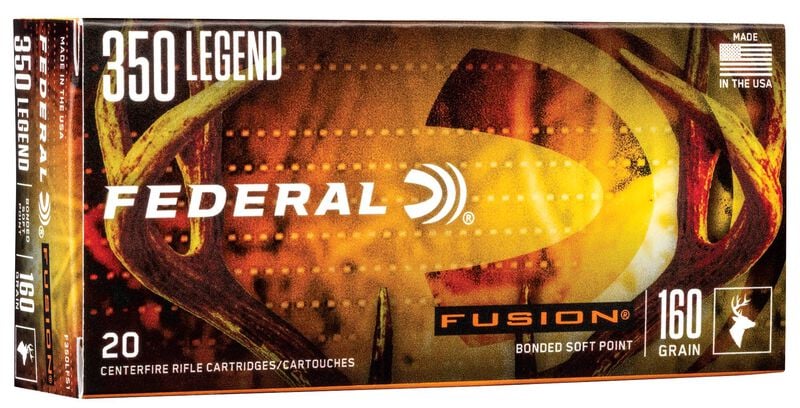
Deer season is a few weeks off, and the .350 Legend shelf holds boxes from five companies, bullets from 145 to 255 grains, plain soft points, plastic tips and solid copper, at prices from bargain to premium. Which box belongs in your rifle?
The answer is simpler than the shelf suggests. A well-placed soft point kills deer cleanly at .350 Legend distances. A tougher bullet earns its price on a bad angle or a big buck. And copper has real advantages, along with one limit people rarely mention.
By the end you should be able to explain what separates the boxes and choose the one that fits your shots, your deer and your rifle for a reason you understand.
What a deer bullet has to do: Open up and keep going
A hunting bullet has two jobs that pull against each other. It has to expand, opening into a mushroom shape that makes a wide wound and gives up its energy inside the deer. It also has to penetrate, holding together long enough to reach the heart and lungs, sometimes through a shoulder. A bullet that opens very fast spends its energy early and may not reach the far side. A bullet that barely opens goes deep but makes a narrow hole.
Think of a hammer and a nail. Hit a board with the flat face and you dent it widely; hit it with the nail and you go deep but narrow. A good deer bullet starts like the nail and finishes like the hammer, and every design on the shelf is a different way of striking that balance.
Two terms help. The jacket is the copper skin around the bullet, and the core is the lead inside. Weight retention is how much of the bullet is still in one piece after it stops. A bullet that keeps more of its weight keeps more of its push, and goes deeper.
So the harder the shot you expect, through bone or at a steep angle, the more you should favor a bullet that holds together.
Bullet designs on the .350 Legend shelf
Almost every .350 Legend hunting load uses one of four designs.
- Cup-and-core soft point. An exposed lead nose flattens on impact; the jacket is not attached to the core, so the bullet opens quickly and can shed weight on heavy bone.
- Locked-core soft point. A ring inside the jacket grips the core, so the bullet opens like a soft point but holds together better through a shoulder.
- Polymer-tipped lead core. A plastic tip makes the bullet sleeker in flight and is driven back into the bullet on impact to start expansion quickly.
- Solid copper. One piece of copper with no lead core to separate, so it keeps nearly all its weight and penetrates deeply, but it needs more impact speed to open than a lead-core bullet.
The list runs from quick and inexpensive to tough and costly. The cup-and-core soft point is the simplest, and on a broadside deer behind the shoulder it does everything you need. Each step down the list solves a problem the one above it has: holding together, flying flatter, or penetrating deeper. Each step usually costs more, so pay for a tougher design only when your hunting gives the bullet a harder job than a broadside chest shot.
The .350 Legend loads hunters use most, side by side
These are the makers' own published figures for the loads hunters use most. The last column is where the bullet lands at 200 yards with a 100-yard zero, calculated the same way for every load.
| Load | Design | Muzzle (fps / ft-lb) | 200 yd (fps / ft-lb) | At 200 yd, 100-yd zero |
|---|---|---|---|---|
| Winchester Deer Season XP 150 gr | Polymer-tipped | 2,325 / 1,800 | 1,647 / 903 | -7.6 in |
| Winchester Copper Impact 150 gr | Solid copper, tipped | 2,250 / 1,686 | 1,595 / 847 | -8.2 in |
| Hornady American Whitetail TIPPED 165 gr | Polymer-tipped (FTX) | 2,200 / 1,773 | 1,612 / 952 | -8.3 in |
| Hornady American Whitetail 170 gr | Locked-core soft point | 2,200 / 1,827 | 1,529 / 882 | -8.9 in |
| Federal Power-Shok 180 gr | Cup-and-core soft point | 2,100 / 1,762 | 1,520 / 924 | -9.4 in |
| Remington Core-Lokt 180 gr | Soft point | 2,100 / 1,762 | 1,520 / 924 | -9.4 in |
| Winchester Power-Point 180 gr | Cup-and-core soft point | 2,100 / 1,762 | 1,466 / 859 | -9.9 in |
The Barnes VOR-TX 170 gr TSX is a solid copper load too; Barnes does not publish its factory velocity on its product page, so it is not in the table.
The surprise in this table is how little separates the loads at deer distances. At 200 yards they land within 2.3 inches of each other and all carry roughly 850 to 950 ft-lb. A cold hand or a rushed trigger moves a shot more than that. So the choice between them is mostly not about reach. It is about the second column, the design, and how that design behaves on the kind of shot you get. For full drop and energy figures at every distance, see our .350 Legend ballistics and drop chart.
The faster, sleeker loads buy you a couple of inches at 200 yards and usually cost more. Unless your shots are long, choose by bullet design first and speed second.
Key idea: At .350 Legend distances, how a bullet is built matters more than how fast it leaves the barrel.
Soft points: Proven, affordable and right for most shots
The 180-grain soft points from Federal, Remington and Winchester are the traditional deer loads, and they are the slowest of the full-power loads at 2,100 fps. On impact their exposed lead noses open quickly, which suits a broadside deer at timber distances. Because the jacket is not attached to the core, a hard hit on a shoulder can strip some of the lead away and shorten penetration. Inside about 150 yards, on a deer standing broadside, that rarely matters.
Hornady's American Whitetail 170 gr adds a ring inside the jacket that locks it to the core. Picture a nail with a washer under its head: it still drives in, but it does not pull apart as easily. That small change gives you a soft point that holds together better on a quartering shot, at about the same price as the plain ones. It is also a little faster than the 180-grain loads, so it lands about half an inch higher at 200 yards.
If your shots are broadside and inside 150 yards, any of these soft points is sound. If you want one soft point for everything, choose the locked-core American Whitetail, because it holds together better when a shot isn't perfect.
Tipped bullets: Flatter flight and fast expansion
Winchester's Deer Season XP 150 gr and Hornady's American Whitetail TIPPED 165 gr both use a plastic tip in front of a lead core. The tip does two jobs. In flight it gives the bullet a sharper nose, so it holds speed better; on impact it is pushed back into the bullet like a wedge, starting expansion immediately. Hornady sold the same 165-grain bullet for years as Custom FTX; it now ships in American Whitetail TIPPED boxes under the same item number.
Deer Season XP is the fastest hunting load in the table and the flattest-shooting. That makes it the natural pick for a stand overlooking a long field edge or food plot. The same quick expansion that helps at 200 yards can open the bullet violently on a close shot and damage more meat, and on a big shoulder at 40 yards it may not reach as deep as a tougher bullet.
If your longest realistic shot is 150 to 200 yards, choose a tipped load. If most of your shots are close, stay with a soft point.
Solid copper: Toughest, with one condition
Winchester Copper Impact 150 gr and Barnes VOR-TX 170 gr TSX are solid copper. With no lead core to separate, a copper bullet keeps nearly all its weight and pushes deep, which is exactly what you want on a quartering-away shot or a heavy-bodied buck. They are also the choice where lead-free ammunition is required or preferred.
The condition is speed. Copper is harder than lead, so a copper bullet needs to arrive faster to open fully. Close in, that is no problem. Far out, a .350 Legend bullet is slowing toward the point where a copper bullet may open less than it was designed to. Makers that publish a minimum expansion speed print it on their website or box; when they do not, keep your shots to distances where the bullet is still moving briskly, such as inside about 150 yards.
If you hunt big-bodied deer, expect tough angles or want lead-free venison, choose copper and keep the distance moderate.
Special jobs: Subsonic and practice ammunition
Two more boxes on the shelf are not general deer loads. Winchester Super Suppressed 255 gr is a subsonic load for suppressed rifles. It leaves the muzzle at 1,060 fps with 636 ft-lb, about a third of the energy of a full-power load, and drops about 36 inches at 200 yards with a 100-yard zero. It belongs on close, carefully chosen shots and needs its own zero.
Winchester's USA 145 gr full metal jacket is practice ammunition. A full metal jacket does not expand, so it makes a narrow hole and can pass through a deer without doing its job, and Iowa requires an expanding bullet for deer. It is inexpensive and useful for learning your rifle, as long as you confirm your zero with your hunting load before the season.
Use the subsonic load only with a suppressor and only on close shots, and keep full metal jacket for the range.
Common mistake: Zeroing with practice ammunition and hunting with something else. Two loads can group well and still land inches apart, so confirm your zero with the box you will carry.
Choosing your load: Four questions
Instead of memorizing the table, answer four questions in order. Each one narrows the shelf.
How far is your longest realistic shot?
If it is inside 150 yards, any full-power load will do the job, so speed should not decide. If it is 150 to 200 yards across open ground, the tipped loads give you a couple of inches of margin. Beyond 200 yards, the .350 Legend is past its comfortable range, whatever the box.
What kind of shot and what kind of deer?
A broadside shot behind the shoulder asks little of a bullet. A quartering shot through the far shoulder, or a heavy-bodied buck, asks for a bullet that holds together: the locked-core American Whitetail or solid copper.
What does your rifle shoot well?
Two good loads can group very differently in the same rifle. If your rifle shoots one load into a tight group and another into a scattered one, take the tight one, even if it was not your first choice.
How much will you practice?
The load you practice with most is the one you will shoot best. If cost limits practice, a load you can afford to shoot a few boxes of, like American Whitetail or a 180-grain soft point, may serve you better than a premium load you fire once a year.
Picture a hunter with a bolt-action rifle, a stand at a timber edge, shots of 50 to 130 yards and mostly broadside deer. Distance says any load; the shot says nothing special; practice says something affordable. American Whitetail 170 gr fits all four. Now picture a hunter in a ground blind on a 190-yard bean field. Distance points to a tipped load, and Deer Season XP fits, as long as the rifle groups it well. When your answers point to different loads, let your hardest realistic shot decide, because that is where the wrong choice costs the most.
Where to start
If you want a starting point after all of that, here is how the reasoning above sorts the shelf.
- Most deer hunters. Hornady American Whitetail 170 gr, because its locked core holds together better than a plain soft point at a soft-point price.
- Long field edges. Winchester Deer Season XP 150 gr, because it is the fastest and flattest of the hunting loads.
- A tipped bullet that holds speed. Hornady American Whitetail TIPPED 165 gr, because its sharp nose keeps it nearly as fast as Deer Season XP at 200 yards.
- Budget and close shots. Federal Power-Shok, Remington Core-Lokt or Winchester Power-Point 180 gr, because a simple soft point is all a broadside deer inside 150 yards requires.
- Big deer, tough angles or lead-free. Barnes TSX 170 gr or Winchester Copper Impact 150 gr, because solid copper holds its weight and penetrates deeply.
Whichever load you choose, your rifle has the last word. Two good loads can group very differently in the same rifle, and every load hits a little differently. At the range, with eye and ear protection on and from a solid rest at 100 yards, shoot a three-shot group with each load you're considering on its own target, letting the barrel cool between groups and leaving the scope alone. Hunt with the load that groups tightest among those that fit your hunt, zero your rifle with it, and don't change boxes after that without zeroing again.
Check your understanding
Try answering these before you open the answer. If you can decide what to do and explain why, you have it.
1. A friend says Deer Season XP is the best .350 Legend load because it's the fastest. He hunts timber where shots are under 100 yards. What do you tell him?
Speed barely matters at his distances. The loads in the table land within about 2.3 inches of each other even at 200 yards. What matters for him is how the bullet is built, how his rifle groups it and how much he practices. A locked-core soft point like American Whitetail suits close timber shots better than a fast-opening tipped bullet.
2. Your shots are 50 to 120 yards in timber and almost always broadside. Why might a premium bullet be money you do not need to spend?
A broadside chest shot asks little of a bullet, and at those distances a simple soft point opens reliably and reaches the vitals. Toughness pays off on bone and steep angles.
3. A friend plans to use copper bullets for a 190-yard shot across a field. What should he check first?
Whether the bullet will still be fast enough at 190 yards to open as designed. Copper needs more impact speed than lead; check the maker's minimum or keep shots closer.
4. You have half a box of Winchester USA 145-grain FMJ left after sighting in, and the season opens tomorrow. Can you hunt with it?
No. A full metal jacket doesn't expand, so it makes a narrow wound and can pass through a deer without doing its job, and Iowa requires an expanding bullet for deer. Hunt with your hunting load, and confirm your zero with it before you go.
5. Your rifle groups Deer Season XP into 3 inches and American Whitetail into 1 inch at 100 yards, and your shots are inside 150 yards. Which do you hunt with?
American Whitetail. Its accuracy in your rifle matters more than Deer Season XP's flatter path, which you do not need inside 150 yards.
Where to go next
You can find .350 Legend hunting and practice ammunition on our website, including Hornady American Whitetail, Winchester Deer Season XP, Power-Point, Copper Impact and Super Suppressed, Federal Power-Shok, Remington Core-Lokt and Barnes TSX, and anything listed there can be ordered if it isn't in stock.
Once you have a load, our .350 Legend ballistics and drop chart shows where it lands at every distance and how to choose your zero. To set that zero correctly, sighting in rifles at different distances walks through it step by step. If you want to understand how shot angle and placement decide what a bullet must do, hunting ethics covers it. And if you are still choosing a cartridge, the .350 Legend, .400 Legend and .450 Bushmaster compared shows what a bigger bullet changes.
If this article helped you, we invite you to sign up for email notifications of new blog articles.