
.350 Legend Ballistics: Where Your Bullet Lands and Where to Hold on a Deer
Joseph McLain Nov 16, 2026
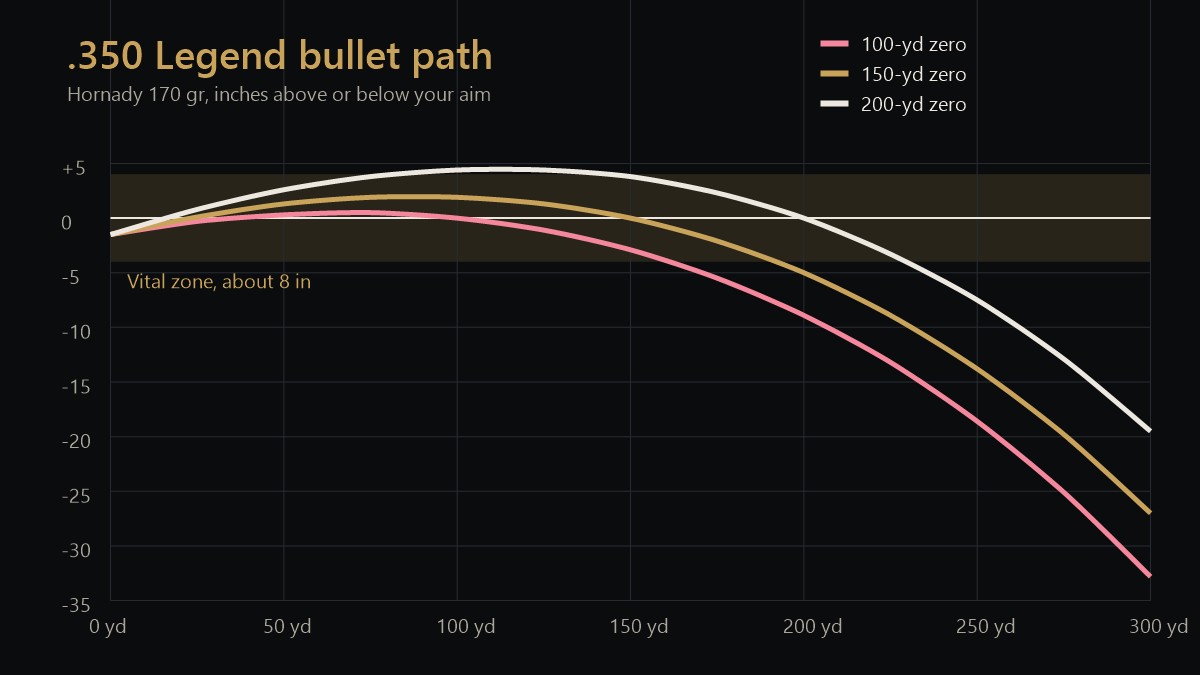
Your stand looks out over a cut cornfield, and the far fence line is about 180 yards away. Your rifle is a .350 Legend, sighted in at 100 yards last fall, and you have never shot it past that. If a buck steps out by the fence, where do you hold?
The .350 Legend does drop quickly compared with a .270 or a .30-06, and with a 100-yard zero a deer at 200 yards is at real risk of a low hit. But with the right zero, you can hold on the middle of a deer's chest out to about 200 yards without guesswork. The difference lies in understanding what the zero does to the bullet's path.
By the end you should be able to read a .350 Legend ballistics chart, choose the zero that fits the shots you really take, and know where to hold on a deer at any distance out to 200 yards.
Why a bullet rises and then falls: The line of sight and the zero
Your scope sits about an inch and a half above the barrel, so your eye and the bullet start in different places. To make them meet downrange, the barrel is tilted very slightly upward when the scope is on target. The bullet leaves the muzzle below your line of sight, climbs up through it, reaches the top of its arc, and falls back across it. That second crossing is your zero.
Think of a garden hose aimed at a bucket across the yard. To hit the bucket you tip the nozzle up a little, and the water climbs, then curves down into it. If the bucket were closer, the water would hit high; farther, and it would hit low. A bullet does the same thing on a much flatter curve.
This is why a single word, "drop," can mean two different things. To a ballistics engineer it is how far gravity has pulled the bullet. To a hunter it is how far above or below the crosshair the bullet lands, which depends entirely on where the rifle is zeroed. Every drop chart in this article uses the hunter's meaning: inches above (+) or below (-) your aiming point.
The farther you zero, the higher the bullet climbs above your line of sight on the way out. So choose your zero for your longest realistic shot, then learn how high the bullet runs at closer distances.
Velocity and energy: What the numbers mean downrange
The table shows the makers' published speed and energy for the .350 Legend loads hunters use most. Each cell reads velocity in feet per second (fps) / energy in foot-pounds (ft-lb).
| Load | Muzzle | 100 yd | 200 yd | 300 yd |
|---|---|---|---|---|
| Winchester Deer Season XP 150 gr | 2,325 / 1,800 | 1,968 / 1,289 | 1,647 / 903 | 1,373 / 628 |
| Winchester Copper Impact 150 gr | 2,250 / 1,686 | 1,909 / 1,214 | 1,595 / 847 | 1,332 / 591 |
| Hornady American Whitetail TIPPED 165 gr | 2,200 / 1,773 | 1,890 / 1,309 | 1,612 / 952 | 1,371 / 689 |
| Hornady American Whitetail 170 gr | 2,200 / 1,827 | 1,843 / 1,281 | 1,529 / 882 | 1,271 / 609 |
| Federal Power-Shok or Remington Core-Lokt 180 gr | 2,100 / 1,762 | 1,793 / 1,284 | 1,520 / 924 | 1,292 / 668 |
| Winchester Power-Point 180 gr | 2,100 / 1,762 | 1,762 / 1,240 | 1,466 / 859 | 1,230 / 604 |
Across each row, every load loses roughly 27 to 30 percent of its speed by 200 yards, and its energy falls by roughly half, because energy depends on the square of speed. Down the 200-yard column, the loads that started fastest are not always the ones still fastest at 200 yards: Hornady's tipped 165-grain bullet starts slower than Deer Season XP but nearly catches it, because its pointed shape slips through the air better.
That ability to hold speed is called ballistic coefficient, or BC. Picture holding your hand out of a car window. Flat against the wind it gets shoved back hard; turned edge-first it slices through. A blunt soft point is the flat hand and a sharp polymer tip is the edge. The difference is small at 100 yards and grows with every yard after.
Energy gets most of the attention, but a hunting bullet also needs enough speed when it arrives to open up as designed. Bullet makers publish a minimum speed for reliable expansion for some of their designs. A bullet below its maker's minimum still carries energy, but it may punch through like a solid instead of mushrooming. Iowa sets a 500 ft-lb muzzle minimum for rifles in the shotgun seasons, and every load here clears it by more than three times.
Faster, sleeker bullets keep their speed better but often cost more. Judge a load by its velocity at your longest shot, not at the muzzle, and check that it stays above the maker's minimum expansion speed if one is published.
Key idea: The muzzle numbers sell the box. The numbers at your longest shot are the ones that matter on a deer.
The drop chart with a 100-yard zero
Here is where each load lands with the rifle zeroed at 100 yards and the scope 1.5 inches above the bore. Numbers are inches above (+) or below (-) your aim.
| Load | 50 yd | 100 yd | 150 yd | 200 yd | 250 yd | 300 yd |
|---|---|---|---|---|---|---|
| Deer Season XP 150 gr | +0.2 | 0 | -2.4 | -7.6 | -15.9 | -28.1 |
| Copper Impact 150 gr | +0.3 | 0 | -2.7 | -8.2 | -17.2 | -30.2 |
| American Whitetail TIPPED 165 gr | +0.3 | 0 | -2.7 | -8.3 | -17.2 | -30.2 |
| American Whitetail 170 gr | +0.3 | 0 | -2.9 | -8.9 | -18.6 | -32.8 |
| Power-Shok or Core-Lokt 180 gr | +0.4 | 0 | -3.1 | -9.4 | -19.5 | -34.1 |
| Power-Point 180 gr | +0.4 | 0 | -3.2 | -9.9 | -20.5 | -36.0 |
Notice how the numbers grow. From 100 to 150 yards the bullet falls about 3 inches; from 150 to 200 it falls another 5 to 7; from 200 to 250, another 8 to 11. Drop does not grow evenly, because the bullet is slowing down and gravity has more time to work on it every yard. That growing gap is why a hold that works at 150 yards fails at 200.
A deer's heart and lungs fill an area about 8 inches across, so you have roughly 4 inches of room above or below the center. With a 100-yard zero, every load stays inside that room out to 150 yards. At 200 yards every load is 7.6 to 9.9 inches low, enough to hit the bottom edge of the chest or miss it.
If nearly all your shots are inside 150 yards, a 100-yard zero is simple and sound, because it's the easiest to set and check. If a deer could appear past 150, either hold higher, at the top of the back line at 200, or choose a longer zero.
The drop chart with 150- and 200-yard zeros
Moving the zero farther out tilts the barrel up a little more, so the bullet climbs higher early and comes back down later. Here is how far each load lands from your aim at 100 and 200 yards with a 150-yard zero, and across the whole range with a 200-yard zero.
| Load | 150-yd zero: at 100 yd | 150-yd zero: at 200 yd | 200-yd zero: at 50 yd | at 100 yd | at 150 yd | at 250 yd | at 300 yd |
|---|---|---|---|---|---|---|---|
| Deer Season XP 150 gr | +1.6 | -4.3 | +2.1 | +3.8 | +3.3 | -6.4 | -16.7 |
| Copper Impact 150 gr | +1.8 | -4.7 | +2.3 | +4.1 | +3.5 | -6.9 | -17.9 |
| American Whitetail TIPPED 165 gr | +1.8 | -4.7 | +2.4 | +4.2 | +3.5 | -6.8 | -17.6 |
| American Whitetail 170 gr | +1.9 | -5.0 | +2.6 | +4.5 | +3.8 | -7.5 | -19.4 |
| Power-Shok or Core-Lokt 180 gr | +2.1 | -5.3 | +2.8 | +4.7 | +4.0 | -7.7 | -20.0 |
| Power-Point 180 gr | +2.2 | -5.6 | +2.9 | +4.9 | +4.2 | -8.2 | -21.3 |
Start with the 150-yard zero. No load rises more than about 2 inches above your aim on the way out, and at 200 yards they land 4.3 to 5.6 inches low. That is right at the edge of the vital area: a center hold still works for the faster loads, and a hold just above center covers the slower ones.
Now the 200-yard zero. The bullet runs 3.8 to 4.9 inches high at 100 yards, which is the price of having it back on your crosshair at 200. Only Deer Season XP, at +3.8 inches, stays inside the 4-inch room. Copper Impact and the 165-grain tipped bullet run 0.1 to 0.2 inch over, and the 170- and 180-grain loads run 0.5 to 0.9 inch over, so a hold a little low on the chest is safer at 100 yards with those.
A longer zero buys you a flatter-feeling rifle at 200 yards and costs you a high hit at 100. Pick the zero whose highest point and whose drop at your longest shot both stay within about 4 inches of your aim. For most .350 Legend hunters with shots out to 200 yards, that is a 150-yard zero.
Good practice: Write your zero and your hold at 200 yards on a strip of tape on the stock. In the moment a deer steps out, you will not remember a table, but you will read a piece of tape.
Subsonic loads: A different tool with a different chart
Subsonic loads, such as Winchester Super Suppressed 255 gr, are built to stay below the speed of sound so a suppressed rifle stays quiet. Winchester lists it at 1,060 fps and 636 ft-lb at the muzzle, about a third of the energy of a full-power load. Because the bullet travels at less than half the speed, gravity has more than twice as long to work on it. With a 100-yard zero it lands about 13 inches low at 150 yards and 36 inches low at 200.
That is not a flaw; it is the cost of being quiet. It does mean a subsonic load needs its own zero and its own short range, and you cannot switch between it and a full-power load without re-zeroing. Treat a subsonic load as a separate rifle setup for close, carefully chosen shots.
Wind: The drift the drop chart does not show
A crosswind pushes the bullet sideways the whole time it is in the air, so slower bullets drift more. Federal publishes wind drift for its Power-Shok 180 gr in a 10 mph wind blowing straight across: 2.0 inches at 100 yards, 8.9 at 200 and 21.6 at 300. Picture a ten-mile-per-hour breeze as enough to keep a flag standing out from its pole. On a day like that, a 200-yard shot can be pushed about 9 inches sideways, more than the whole 8-inch vital area.
You can hold into the wind, but judging wind is harder than judging distance, especially across an open field where it can blow differently near you than near the deer. The real choice is between taking the shot with a hold you have never tested and waiting for a closer chance. In a steady crosswind, keep your shots inside 150 yards unless you have practiced holding for wind with your own rifle.
Why your rifle will not match the chart exactly
The charts here are calculated for a scope 1.5 inches above the bore, at sea level on a 59°F day, using each maker's published velocity and ballistic coefficient. They match the makers' own published drops within a tenth of an inch. Your rifle can still differ in four ways.
- Barrel length. Makers test in barrels from 16 to 24 inches, and a shorter barrel usually means a slower bullet and a little more drop.
- Scope height. A taller mount changes how high the bullet runs at close range and shifts the zero numbers slightly.
- Temperature. Cold, dense November air slows a bullet a little more than a warm range day in August.
- Your rifle and lot. Every barrel and every batch of ammunition has its own small personality, which is why two rifles of the same model rarely shoot exactly alike.
Of these, barrel length usually makes the biggest difference, because a .350 Legend carbine can easily run 100 fps slower than the box. The chart gets you close quickly; confirming takes range time and ammunition. Use the chart to choose your zero and get on paper, then trust only the numbers you confirm with your own rifle.
Common mistake: Using the drop chart for one load with a different load in the rifle. Two loads of the same weight can land inches apart at 200 yards, so the chart and the box in your pocket have to match.
Making your own drop card
The chart gets you on paper; your rifle gives the final numbers. With eye and ear protection on and from a solid rest, zero at 100 yards first with the exact load you'll hunt with. If you chose a 150- or 200-yard zero, adjust the scope so the 100-yard group lands as high as the chart shows for your load, then confirm at the longer distance if your range allows. Shoot a three-shot group at each distance you can reach, out to your longest realistic shot, holding dead center each time, and note where each group lands. Write the load, the zero and those measured numbers on a strip of tape on the stock. When a deer steps out at 180 yards, that strip is what you'll trust.
Check your understanding
Try answering these before you open the answer. If you can decide what to do and explain why, you have it.
1. Your rifle is zeroed at 100 yards with American Whitetail 170 gr, and a deer stands broadside at 200 yards. Where does the bullet go with a center hold, and what should you do?
About 9 inches low, likely at or below the bottom of the chest. Hold at the top of the back line, or better, wait for the deer to come closer.
2. A friend zeros at 200 yards and is surprised to hit high on a deer at 100. Why did that happen?
With a 200-yard zero the bullet is still above the line of sight at 100 yards, about 4 to 5 inches high for most loads. Nothing went wrong; the zero did what it was set up to do.
3. Deer Season XP starts at 2,325 fps and the tipped 165-grain Hornady starts at 2,200. Why are they nearly the same speed at 200 yards?
The Hornady bullet's pointed shape holds its speed better, so it loses less on the way out. A higher ballistic coefficient matters more the farther the bullet travels.
4. Your shots are mostly 60 to 120 yards in timber, but once a season a deer crosses a field at 180. Which zero would you choose, and why?
A 150-yard zero. It keeps the bullet within about 2 inches of your aim at timber distances and within about 5 inches at 200, so the occasional long shot is still a center or slightly-high hold.
5. You switch from a 180-grain soft point to a subsonic load for a suppressed rifle. What must you do before hunting?
Re-zero with the subsonic load and learn its much steeper drop. With a 100-yard zero it lands about 3 feet low at 200 yards, so keep shots close.
Where to go next
You can find ammunition on our website.
If you are still choosing which box to buy, the best .350 Legend ammo for deer explains how bullet design, not just speed, decides how a load performs. To set the zero you picked here, sighting in rifles at different distances walks through the scope adjustments step by step. If you want to turn inches of drop into clicks on your turret, understanding MOA shows how. And if you are deciding between cartridges, the .350 Legend, .400 Legend and .450 Bushmaster compared shows what a bigger bullet changes and what it does not.
If this article helped you, we invite you to sign up for email notifications of new blog articles.