
Taurus TX22 Lineup: How to Read the Catalog and Pick the Right Model
Joseph McLain Nov 06, 2026
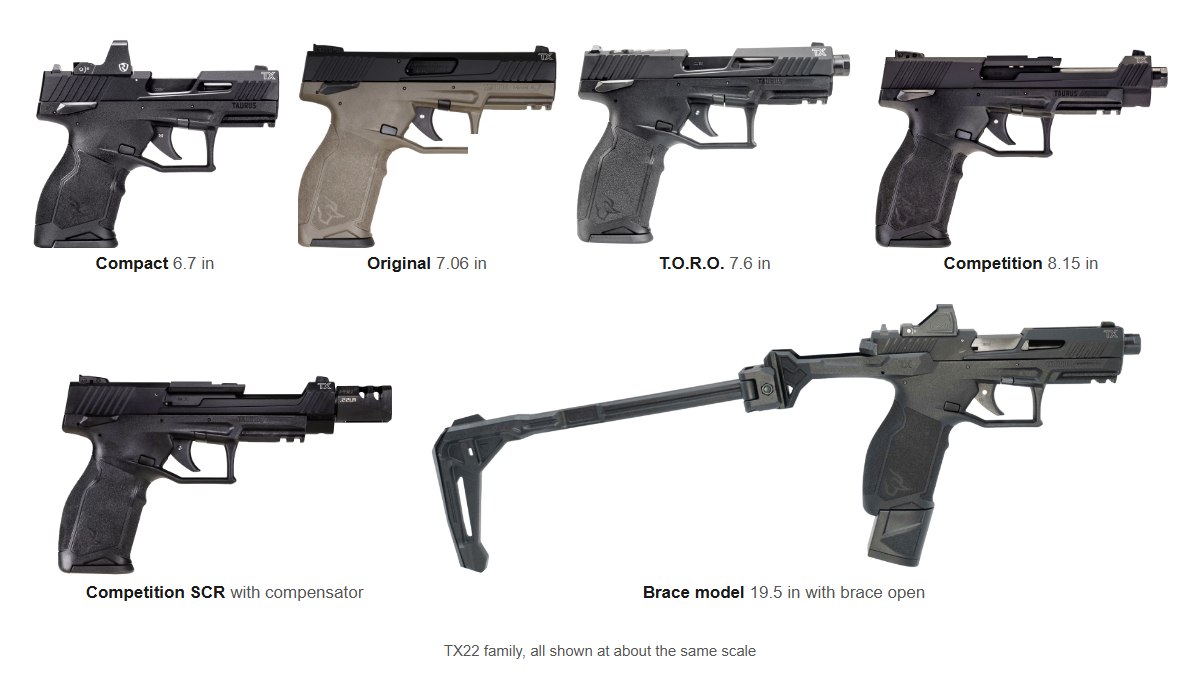
Picture sitting down one evening to shop for a Taurus TX22. You decided on the pistol weeks ago, so this should take five minutes. Instead the search returns dozens of listings, with names like "TX22C 22LR BK/FLAG 10+1 NOTHRD" and "TAU TX22G3 TORO 22LR 22R TB B." A coworker told you to get the Gen 2. Your brother-in-law says there is no such thing as a Gen 2. Someone at the range says the only one worth buying is the T.O.R.O., and a neighbor says that is the same gun as the Gen 2.
Each of them is right about something. Those names come from different sources: Taurus, distributors and dealers all label the same pistols in their own ways. Behind the noise is a much simpler family, a handful of pistols with a short menu of options, and once you can see that structure the listings stop being confusing.
This article maps the whole lineup, explains the names and item numbers, and shows what each size, barrel and option really changes. Our companion guide to the TX22 covers how the pistol works, plus ammunition, takedown and suppressors, so we will not repeat those here. By the end you should be able to read any TX22 listing, tell which pistol it really is, and decide which options are worth paying for.
The lineup: Six pistols, not seventy
When we checked in October 2026, Taurus's own site listed 22 TX22 configurations, and our catalog, which also draws on distributor editions, listed more than 70. That sounds like a lot to compare, but nearly all of them are variations on six pistols. Think of a pickup truck. The dealer's lot may hold seventy trucks, but the real choices are cab and bed, and the rest is trim and paint.
| Pistol | Barrel | Overall length | Unloaded weight | Standard magazines | List price |
|---|---|---|---|---|---|
| Original | 4.1 in | 7.06 in | 17.3 oz | Two 16-round | $349 |
| T.O.R.O. | 4.6 in | 7.6 in | 17.3 oz | One 16-round, one 22-round | $417 |
| Compact | 3.6 in | 6.7 in | 16.5 oz | Two 13-round | $452 |
| Competition | 5.25 in | 8.15 in | 23 oz | Three 16-round | $617 |
| Competition SCR | 5.25 in, with compensator | About 9.4 in | About 26 oz | Three 16-round | $678 |
| Brace-Ready | 4.6 in | 10 in without a brace, 19.5 in with the brace open | 17.3 oz without a brace, 24.9 oz with it | One 16-round, one 22-round | $417 without a brace, $508 with it |
Read the table as a map rather than a shopping list. The figures come from Taurus's product pages, except the SCR's length and weight, which come from Shooting Sports USA because they include the compensator. List prices move, and dealers commonly sell well below them, so use them to compare one model with another, not to predict what you will pay. Notice what stays the same across the family: The caliber, the trigger system and a full-size grip on everything but the Compact. Most of what you are choosing is length, weight and how a red dot attaches.
Key idea: Sort any TX22 listing into one of the six pistols first. Everything else in the name, including safety, threads, capacity, color and bundled gear, is an option on that pistol.
That sorting is the first decision, and it matters most, because options can often be worked around later while the pistol itself cannot. Pick the pistol before you compare prices on variations of it.
The names: Gen 2, T.O.R.O. and G3
Most of the arguments about TX22 names come from one fact: Taurus does not use all the names you will see. Its own pages call the 2024 pistol an enhanced TX22 with T.O.R.O., short for Taurus Optic Ready Option. Many distributors and retailers call the same pistol the Gen 2. So your coworker and your brother-in-law can both be right, one going by the store listing and the other by the Taurus website.
The newest name works the same way. In October 2026 Taurus added models it calls Brace-Ready, and some distributors list them as TX22G3. Taurus's pages do not describe them as a third generation. They are built on the T.O.R.O. idea, with a slide cut for the same optic footprint, plus a mount at the rear of the frame for a folding brace.
T.O.R.O. itself deserves care, because it does not mean only one thing. On the pistol that many people call the T.O.R.O., the slide is cut for optics with the Shield RMSc footprint, the pattern of screw holes on an optic's base. Taurus also uses the term on the Compact, whose slide fits both RMSc and Holosun K optics, and on the Competition SCR, where the dot sits on the barrel using adapter plates.
Common mistake: Seeing "T.O.R.O." in a listing and assuming a small carry optic will bolt directly to the slide. On the Competition SCR the optic mounts to the barrel, so the fit and the feel are different. Check where the optic mounts and which footprint it takes.
The trade-off is that nicknames are quick but imprecise, and the two names on one pistol can make it look like two different choices. The rule: Trust the features in the description over the name in the title, and use the item number to settle any doubt.
Original vs. Gen 2: What actually changed
Whatever you call it, the 2024 pistol is more than a new label, though it changes less than "second generation" suggests. Go back to the pickup truck: This is a new bed and hitch on the same engine. The trigger system and controls carry over, and nearly everything that changed sits in the top half of the gun.
| Feature | Original (1-TX22) | Gen 2 (1-2TX22) |
|---|---|---|
| Barrel | 4.1 in, ends even with the slide | 4.6 in bull barrel, extends past the slide |
| Threads, on threaded models | Recessed in the slide, used with the included adapter | Exposed 1/2-28 threads, no adapter needed |
| Optic cut | None | Shield RMSc on T.O.R.O. (P) models, none on the others |
| Slide | Front and rear serrations | T.O.R.O. adds forward lightening cuts |
| Rear sight | Fully adjustable white dot | Serrated, drift-adjustable square notch |
| Standard magazines | Two 16-round | One 16-round, one 22-round |
| Listed weight | 17.3 oz | 17.3 oz |
Those changes were built around two uses: a red dot and a muzzle device. A dot adds weight to the slide, and a .22 LR has little pressure to push that slide back, so the lightening cuts are there to offset the optic's weight and keep the pistol cycling. The longer barrel puts the threads out in the open, so a suppressor or compensator goes on without the adapter. The 22-round magazine is the same 16-round body with a longer base, which is handy at the range but does not change how the pistol shoots.
The trigger is where the name misleads people most. Some listings present the Gen 2 trigger as an upgrade, but the original already used the Taurus trigger system, with its short, spring-assisted reset, and the measurements do not show a meaningful change. The Firearm Blog measured about 4.5 pounds on an original, and American Rifleman measured 4 pounds, 9 ounces on a T.O.R.O. Those are single pistols, so they cannot prove the two are identical, but do not pay extra expecting a different trigger. The rear sight is a change that runs the other way: A drift-adjustable sight moves sideways in its dovetail, with a punch or sight tool, while the original's fully adjustable sight also moves up and down. If you plan to shoot iron sights with different loads, that may matter more to you than the new slide.
Common mistake: Buying an original and planning to add Taurus's T.O.R.O. upper kit later. Taurus lists the kit, about $200, as compatible only with item numbers 1-2TX22141 and 1-2TX22P141. A Gen 2 without the optic cut can take it, but an original cannot. Confirm the item number before you count on that upgrade.
One caution when shopping: Some listings for 1-2TX22 pistols still show a 4.1-inch barrel, even though Taurus's upper kit for those same pistols uses a 4.6-inch barrel, so check the barrel length with the seller. The trade-off is that the Gen 2 gives you a direct path to a dot and exposed threads, in exchange for a longer pistol and a simpler rear sight. The rule: If you want a red dot or a muzzle device, start with the Gen 2. If you will shoot only iron sights and you value the shorter pistol and the fully adjustable sight, the original still does the job it was built for.
Reading the item number
A listing's title is written by whoever typed it, but the item number comes from Taurus and travels with the pistol. Our table below shows the patterns we see across the catalog. Taurus does not publish this as a code, and an occasional listing breaks the pattern, so use it to narrow your search and then confirm on the product page.
| Piece of the number | Example | What it usually means |
|---|---|---|
| 1-TX22 | 1-TX22141 | The original family, which also includes the Compact and Competition |
| 1-2TX22 | 1-2TX22141 | The enhanced pistol that retailers call the Gen 2 |
| P after the 22 | 1-2TX22P141 | Optic-ready T.O.R.O. slide; without the P, a Gen 2 usually has no optic cut |
| 1-3TX22 | 1-3TX22P141 | Brace-Ready |
| 141, 241, 341 | 1-TX22241 | 141 has a manual safety and threaded barrel, 241 has no manual safety, and 341 has a manual safety and an unthreaded barrel |
| 131, 231, 331 | 1-TX22231 | The same safety and barrel pattern on the Compact |
| C151, C151-T | 1-TX22C151-T | Competition, and Competition SCR |
| -10, -15 | 1-TX22141-10 | Ships with 10-round or 15-round magazines |
| F, O, C or P at the end | 1-TX22141F | Frame color: FDE, OD green, cyan or purple |
| -MB | 1-3TX22P141-MB | Brace installed |
| RI, VL, RD | 1-TX22131-RI | Comes with a factory optic or laser, such as Riton or Viridian |
| 5X | 1-2TX22141-5X10 | A kit with five magazines |
Read the table from left to right along the number, the way you would read an address from city to street. Take 1-TX22231: The original family, then a 2 for no manual safety, then 31 for the Compact. The name "TX22 COMPACT NON MAN SAF" says the same thing, but not every listing spells it out that well. Note that P means two different things depending on where it falls, T.O.R.O. in the middle and purple at the end.
The trade-off is a little homework in exchange for certainty. The rule: When two listings look alike but differ in price, compare item numbers before assuming one is a better deal. They may not be the same pistol.
Size: What the Compact really changes
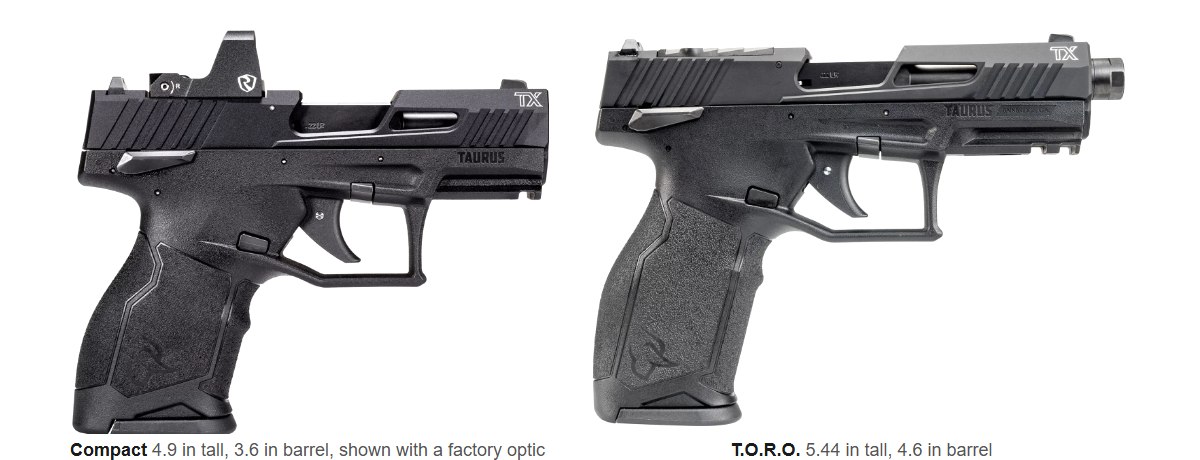
Most people assume a compact pistol is mainly a lighter pistol. Look at the numbers and that turns out to be the smallest change. Compared with the T.O.R.O., Taurus lists the Compact as 0.9 inch shorter, 0.54 inch lower in height and only 0.8 ounce lighter. On a pistol this light, you would be hard pressed to feel that weight difference in your hand.
What you feel is the grip. The Compact's 4.9-inch height leaves less room for your hand, which is exactly what someone with smaller hands wants and what someone with large hands may not. The shorter barrel and sight radius, the distance between the front and rear sights, also make small aiming errors look bigger on the target, and Lucky Gunner found it noticeably jumpier than the full-size pistol. It costs more at list than the T.O.R.O. too, so it is not the budget choice that its size suggests.
Think of a shorter wheelbase on a car. It fits tighter spaces, but it rides less steadily. The trade-off: A better fit for smaller hands and a closer match to a small carry pistol, in exchange for some steadiness. The rule: Choose the Compact because it fits your hand or matches the pistol you carry, not because you expect it to be lighter.
Barrels: Why the line grows longer and heavier
Moving up the lineup, the barrel gets longer and thicker. The original's 4.1-inch barrel sits flush with the slide. The T.O.R.O. uses a 4.6-inch bull barrel, meaning a thick barrel with little or no taper. The Competition stretches that to 5.25 inches, and its pistol weighs 23 ounces against the T.O.R.O.'s 17.3. Extra weight near the muzzle resists the hop of each shot, the way a heavier hammer swings more steadily than a light one.
American Rifleman reported 25-yard averages for three of them, based on five 5-shot groups: 2.98 inches for the original, 2.45 for the T.O.R.O. and 2.17 for the Competition. Separate testing by Lucky Gunner saw 1.6-inch averages from a T.O.R.O. and 2.9 from a Compact. Those two sets of numbers used different ammunition and shooters, so compare within each test and not between them.
Look at the size of the gaps. From the original to the Competition, you gain about eight-tenths of an inch at 25 yards, and the list price rises by more than $250. The Competition earns that money on a timed steel course, where a steady dot and fast follow-up shots add up. For someone plinking at 10 yards, the same gain will hardly show. The SCR takes one more step, adding a TandemKross compensator that vents gas at an angle to tame muzzle rise, plus an upgraded extractor. Taurus built it for Steel Challenge shooters, and that is the job it suits.
The trade-off is steadiness against bulk and a pistol less like what you carry. The rule: Pay for a longer, heavier barrel when you will use it, as in competition or serious accuracy work. If the pistol's job is everyday practice, the T.O.R.O. already captures much of the gain.
Brace models: The newest branch
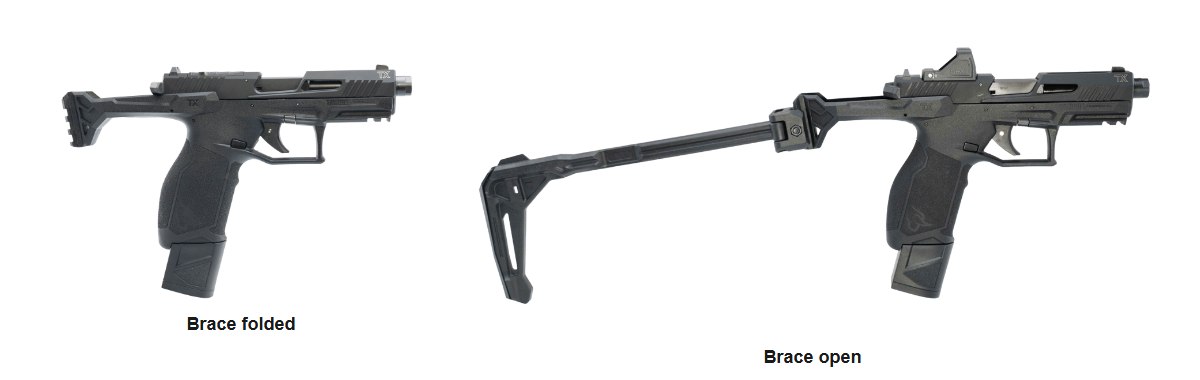
The Brace-Ready pistols are the biggest change the family has seen, because they change how you hold the gun. A stabilizing brace is an arm support attached to the rear of a pistol's frame. Taurus installs a Strike Industries FSA Lite folding brace on the With Brace models, and the Brace-Ready models carry the mount alone so you can choose your own. At list, the brace adds about $91. It also adds 7.6 ounces, and with the brace open the pistol measures 19.5 inches.
Picture a beginner who keeps seeing the front sight dance on the target. A third point of support steadies a pistol the same way a tripod steadies a camera, and that is the real appeal here. The cost is bulk. A braced pistol is wider, at 2.03 inches, and even folded it no longer behaves like a compact handgun in a case or range bag. It also trains you less directly for carrying an ordinary pistol, because the hold is different.
The law deserves a plain word. A brace and a shoulder stock are not the same thing. A handgun fitted with a true shoulder stock and a barrel under 16 inches is a short-barreled rifle under federal law, which requires federal registration, so do not fit a stock to any TX22 on your own. ATF's 2023 rule on braces has been enjoined, stayed or vacated by several courts, and in May 2026 ATF proposed removing it from its definitions. Since that is a proposal, check the current status before you buy. This is education, not legal advice. Laws change, so check ATF and the current Iowa Code, or ask an Iowa attorney.
The trade-off is more stability in exchange for more size, and a setup that is further from a carry pistol. The rule: Buy a brace model when steadier shooting is the goal in its own right. If you are unsure, the Brace-Ready gives you the mount now and leaves the brace decision for later.
The smaller options: Safety, threads, capacity and color
Once you have chosen the pistol, these options finish the decision. They do not all deserve equal attention, so take them in order of how hard they are to change later.
- Manual safety. Taurus lists no-safety versions of the original and Compact, so match your carry pistol if practice is the goal, because the habit of working a lever is what you are training.
- Threaded barrel. Threads add options later, for a suppressor or a compensator, and they do little harm if you never use them.
- Capacity. Taurus offers 10-round models for states that limit magazines, and some editions come with 15-round magazines.
- Color. FDE, OD green, cyan, purple, splatter finishes and flag slides change how the pistol looks and nothing about how it shoots.
Of these, the manual safety does the most work, because it changes how you handle the pistol every time you shoot it. Capacity matters less in Iowa than some shoppers think, because Iowa does not regulate magazine capacity. Other states do. Illinois restricts handgun magazines, and its law has been through court challenges, so check before you travel or move. An Iowa shooter who picks a 10-round model gets fewer rounds per loading and no legal benefit, though it can be handy for a shooter who wants slower, more deliberate practice.
The rule: Settle safety and threads first, take the capacity your state allows, and let color be the last and least serious decision.
Packages: Factory dots and magazine kits
Some of the longest listings are ordinary pistols with extras in the box. Taurus lists a Compact with a Riton optic at about $50 more than the plain Compact, and distributors carry versions with Viridian green dots, Viridian lasers, or five magazines. These are not different pistols, so judge them the way you would judge a stereo package on a car: Is it the one you would have chosen?
A bundled dot is convenient, and it saves the small job of matching a footprint. It also makes the choice of optic for you. If you carry a pistol with a particular red dot, a matching optic on your .22 gives you better practice than whatever came in the box, and our guide to choosing pistol optics explains what to look for. A five-magazine kit is easier to justify. Loading .22 magazines by hand is slow, and more magazines mean less time at the loading bench and more time shooting.
Good practice: Before you compare prices, write down what you would buy if the package did not exist. Then add up the pistol, the optic and the extra magazines separately. A package is only a bargain if you wanted everything in it.
Try this: Decode three listings
- Pick three TX22 listings that look similar, and write down each item number.
- Use the table above to sort each one into one of the six pistols, and note its safety, barrel, capacity and any bundled gear.
- Confirm those details against the product description. If a title and a description disagree, trust the description and ask before ordering.
- Add the cost of anything missing that you would still need, such as an optic or extra magazines, and compare the totals.
- If you own a carry pistol, compare its size with the table. Unload it first with the action open, keep ammunition in another room and the muzzle in a safe direction, then measure its height and length.
You will know it worked when you can say in one sentence what separates the three listings, and when you can name which of the differences you would actually pay for.
Choosing in the right order
People usually get stuck by starting from the listings and working backward. Start with the job and work forward, and most of the lineup drops away quickly.
First, decide whether this pistol is mainly for practice, fun or competition. Practice for a carry pistol points toward the T.O.R.O. or Compact, depending on your hand and your carry gun. Timed steel matches point toward the Competition or SCR. Learning sight alignment points toward the original, with its iron sights and no optic to distract from them. Steadiness above all points toward a brace model. Second, choose the options that are hard to change: Safety and threads. Third, consider packages. Finally, pick a color if you care.
The trade-off is that a pistol chosen for one job is rarely the best at another, and no TX22 does everything. The rule: If you truly cannot decide, the T.O.R.O. sits nearest the middle of the family, since it is full size, ready for a dot and threaded. That makes it a sensible default, as long as it fits your hand. For worked examples of matching a person to a version, see our companion guide.
Putting it together
All of the voices from the opening were right about something. Your coworker's Gen 2 is real on store listings, and your brother-in-law is right that Taurus does not call it that. The T.O.R.O. really is a strong choice for many shooters, and your neighbor's claim that it is the same gun as the Gen 2 is usually true when the item number has a P in it. None of them was wrong, because each was describing a piece of the same family.
So read a TX22 listing in layers. Sort it into one of six pistols, using the item number when the name is unclear. Weigh length, weight and optic mounting against the job, keeping in mind that the Compact mostly changes the grip and the Competition mostly adds steadiness. Then settle safety and threads, treat capacity and color as minor, and judge packages by whether you wanted what is in them. Do that, and seventy listings become a short decision.
Check your understanding
Try answering these before you open the answer. If you can explain it in your own words, you understand it.
1. Two listings show nearly identical pistols, but one says "Gen 2" and the other says "T.O.R.O." Are they different guns?
Possibly not. Many retailers call the enhanced TX22 the Gen 2, while Taurus calls it T.O.R.O. Compare item numbers. A 1-2TX22P number with a P has the optic-ready slide, while a 1-2TX22 number without the P usually has no optic cut.
2. You see item number 1-TX22331-10. What do you expect to find?
A Compact, because of the 31, with a manual safety and unthreaded barrel, because of the 3, shipping with 10-round magazines. Since the pattern is not an official Taurus code, confirm it in the product description.
3. A friend wants a Compact because a full-size TX22 "must be heavy." What would you point out?
Taurus lists the Compact only 0.8 ounce lighter than the T.O.R.O. The real differences are the shorter grip and shorter sight radius. If the full-size grip fits, the friend may shoot it more steadily and lose almost nothing in weight.
4. A shooter plans to add a store-bought shoulder stock to a TX22 because brace rules were thrown out in court. What is wrong with that thinking?
The court fights concerned ATF's 2023 rule about braces. A true shoulder stock on a handgun with a barrel under 16 inches makes a short-barreled rifle under federal law, which requires registration. Brace and stock are not interchangeable.
5. An Iowa shopper picks a 10-round TX22 because it is the same price as the 16-round version and seems safer legally. What would you say?
Iowa does not regulate magazine capacity, so the 10-round model brings no legal benefit there. It makes sense if you live in or move to a state that limits magazines, or if you want slower practice. Otherwise you are simply loading more often.
Where to go next
Now that you know the family, our guide to understanding the TX22 explains how it works, plus its ammunition preferences, takedown and care. If you are not yet sure a training-style .22 is the right type at all, Choosing a .22 Pistol compares it with target pistols and revolvers. For an optic on a T.O.R.O. or Compact, Mounting and Sighting in Pistol Optics walks you through installing and zeroing it. And if a threaded barrel is part of your plan, how suppressors work explains what you would be threading it for.
You can see our original, T.O.R.O., Compact, Competition, Competition SCR and brace listings, and anything on our website can be ordered if it isn't in stock.
Product photographs: Taurus USA.
If you found this informative, we invite you to sign up for email notifications of new blog articles.