
Handgun Sights: Iron Sights, Night Sights and Lasers Explained
Joseph McLain Nov 07, 2026
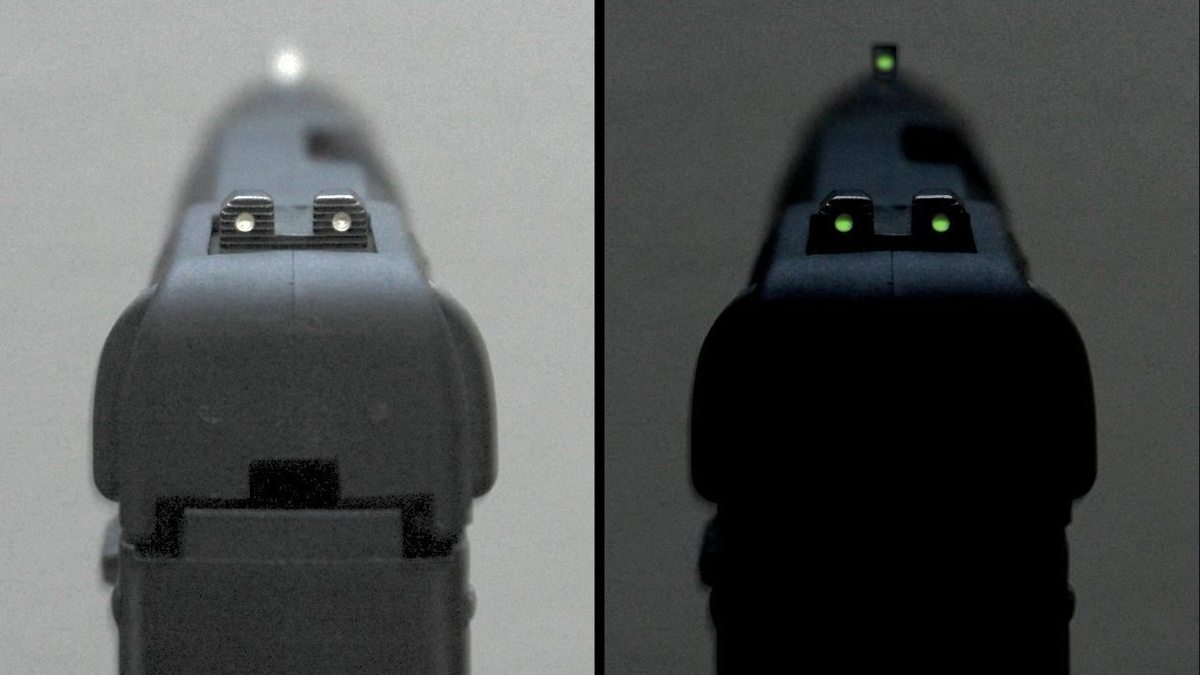
You have a new handgun and the sights that came on it. They are plain black, or they have three white dots, or a little green fiber-optic rod up front. You start wondering whether you should replace them, add glowing night sights, put a laser on the gun or skip all of that and buy a red dot.
No sight is best at everything. Each one balances speed, precision, visibility in different light and how much you depend on a battery, so the right choice depends on the light you will shoot in and the job the gun will do. And under stress, the sights that draw your eye fastest are the ones you will actually use.
By the end you should be able to look at a handgun's sights, explain what they are designed for, and choose a sight setup that fits how and where you will use the gun.
How iron sights work
Most handgun iron sights are a notch at the rear and a post at the front. You line up the top of the front post with the top of the rear notch, with equal light on each side, and place that on the target. That alignment is called the sight picture. Your eye can only focus at one distance, so you focus on the front sight, and the target and rear sight look slightly blurry.
Think of it like threading a needle at arm's length while looking at a distant wall. The needle and thread are close, the wall is far, and you cannot see all three sharply at once. The front sight is the one that tells you where the gun is pointed, so that is where your focus belongs. Our article on pistol shooting fundamentals explains sight alignment and trigger control in more depth.
Focus on the front sight. Sights that help you find and see the front sight quickly are doing their job.
Common iron sight styles
Handgun makers use several patterns, and each puts the emphasis in a slightly different place.
- Plain black. No dots or colors, which gives a clean, precise sight picture in good light but is hard to see in dim light or against a dark target.
- Three-dot. A white dot on the front and one on each side of the rear notch; you line up the three dots in a row, which is fast and familiar.
- Blacked-out rear with a bright front. The rear is plain and serrated to cut glare, and the front has a bright dot or color, which draws your eye straight to the front sight.
- U-notch or "dot-the-i". The front dot sits inside a U-shaped rear notch, so the sight picture looks like a lowercase letter i, which some people find quicker.
Of these, the blacked-out rear with a bright front sight does the most to help a shooter under pressure, because it sends the eye to the front sight, where focus belongs. Three-dot sights work well too, but under stress some shooters line up the dots incorrectly. Plain black sights suit precise target shooting in good light. Choose sights that draw your eye to the front sight in the light where you will use the gun.
Fiber-optic and tritium: Brighter sights for different light
Two kinds of bright sights are common, and they solve different problems.
Fiber-optic sights
Fiber-optic sights use a small plastic rod that collects light along its length and glows brightly at the ends. In daylight, a red or green fiber-optic front sight is very easy to see, which is why they are popular for competition and for older eyes. The catch is that they need light to glow. In darkness, they are no brighter than a plain sight. The rods can also break with hard use, so look for designs that protect them.
Tritium night sights
Tritium sights contain tiny sealed glass vials of tritium, a radioactive form of hydrogen that makes a coating glow without any light or battery. They glow in complete darkness. Tritium has a half-life of about 12.3 years, so the glow gradually fades. Many makers expect usable brightness for around ten years or more, depending on how bright the vials were to start. The vials are sealed and safe to carry, and they are commonly used on carry and duty handguns.
Many tritium sights also have a white or bright-colored ring around the vial, which makes them easy to see in daylight. Some combine fiber optic and tritium in one sight.
Night sights help you see where your gun is pointed in low light. They do not help you see the target. In the dark, you still need to identify what you are looking at, which requires a light. Our article on lumens and candela explains choosing a light that helps you see.
Key idea: Night sights show you where your gun is pointed. They do not show you what you are pointing at. Identifying a target in the dark still takes a light.
Choose fiber optics for bright-light visibility, tritium for low-light visibility, and a combination if your gun will be used in both.
Replacing sights: Dovetails, heights and a gunsmith
Most handgun sights fit into a dovetail, a slot cut across the slide. Replacing them usually requires a sight pusher, a tool that slides the old sight out and the new one in without damaging the slide. Some front sights are held by a screw from inside the slide. Each handgun model has its own dovetail sizes and sight heights, so sights must be ordered for your exact model.
Sight height matters. The front and rear must be the right heights for each other, or your shots will land high or low. Taller "suppressor-height" sights are made to be seen over a suppressor or through a red dot, a setup called co-witnessing. If you put a red dot on a handgun, your current sights may be too short to see through the window.
Unless you have the tools and experience, sight replacement is a job for a gunsmith. After any sight change, confirm where the gun hits at the range. Our article on when a firearm needs a gunsmith explains when to get help.
Common mistake: Hammering sights in and out with a punch and a hammer. It is easy to damage the sight, mar the slide or install the sight off center. A proper sight pusher and correct technique protect the gun.
Lasers: What they do well and not so well
A laser sight projects a dot onto the target. When the laser is adjusted to match where the gun shoots, the dot shows roughly where the bullet will go at that distance. Lasers attach in several ways: Built into a grip, mounted on the trigger guard, mounted on the rail, or combined with a weapon light.
What lasers do well
A laser lets you aim when you cannot get your eyes behind the sights, such as from an awkward position, around cover or when your eyes cannot focus on a front sight. Lasers are also excellent training tools. In dry fire, a laser shows every wobble and every jerk of the trigger, which teaches trigger control quickly. Our article on dry firing explains how to do it safely.
What lasers do not do well
In bright sunlight, a red laser dot can be hard to see at all. Green lasers are more visible in daylight but use more battery power. Lasers need batteries, so they can fail. And because the dot is projected on the target, it shows anyone watching where you are aiming, and it can lead some shooters to stare at the dot and chase it around instead of pressing the trigger smoothly.
A laser does the same thing as any sight attached to the gun: Wherever the dot goes, the muzzle goes. Using a laser to look at something or someone means pointing a gun at it. A handheld light is the right tool for searching and identifying.
Lasers also have legal limits for hunters. Iowa's hunting regulations say sights that project a light beam, including laser sights, are not legal for hunting. Check the current regulations each season, because rules can change.
If you use a laser, treat it as an addition to sights you can use well without it, not a replacement.
Good practice: If you use a laser, train with it turned off too. If the battery dies or the dot disappears in bright light, you need to be able to aim with your sights without hesitating.
Where red dots fit
Many handguns now come ready for a small red dot optic. A dot puts the aiming point on the same plane as the target, so you can focus on the target instead of the front sight. That helps people whose eyes struggle with front sights and many people who want faster, more precise shots. Our articles on choosing optics for pistols and astigmatism and red dots cover that choice.
Dots have their own trade-offs: Cost, a learning curve to find the dot quickly and the need for a holster that fits the optic. Iron sights, especially good night sights, remain a reliable, battery-free choice. If iron sights work well for your eyes, good night sights may be all you need. If the front sight has become blurry with age, a dot may help more than any iron sight.
Matching sights to how you use the gun
Your choice depends on the light you shoot in and what the gun is for. A handgun used mainly for target shooting in daylight benefits from crisp black sights or a bright fiber-optic front. A carry or home-defense handgun may be needed at night, so tritium night sights or a combination of tritium and fiber optic are the common choice. For most carry guns, the best all-around setup is a tritium front sight with a bright orange or yellow ring, which grabs your eye in daylight and glows in the dark, over a rear that does not compete with it. Trijicon HD and HD XR, AmeriGlo and XS sights are well-proven examples. A hunting handgun used in daylight at longer distances may benefit from a scope or red dot, and lasers are not legal for hunting in Iowa.
Whatever you choose, it must work with your holster. Lasers and lights change the shape of the gun, and the holster must fit that exact combination and fully cover the trigger. Our article on holster retention levels explains what a good holster does.
Putting it together
Iron sights work by lining up the front and rear sights while you focus on the front sight. Sight styles that draw your eye to the front sight help most under pressure. Fiber optics glow brightly in daylight but need light; tritium glows in darkness and slowly fades over about a decade. Lasers help in awkward positions and in training, but they can be hard to see in sunlight, depend on batteries and are not legal for hunting in Iowa.
Choose sights for the light you will shoot in and the job the gun will do, make sure your holster fits, have sights installed properly and confirm your zero. And whatever you put on the gun, the fundamentals of grip, sight alignment and trigger control still make the shot.
Check your understanding
Try answering these before you open the answer. If you can decide what to do and explain why, you have it.
1. Your carry gun has fiber-optic sights. Why might you consider tritium?
Fiber optics need light to glow, so they are no brighter than plain sights in darkness. Tritium glows without light, which helps you see your sights at night.
2. You bought a used carry pistol, and in a dark closet its night sights barely glow. The seller said they were "lifetime" sights. What's going on, and what should you do?
Tritium fades: its half-life is about 12.3 years, so sights that are a decade or more old can be too dim to help. If you'll rely on the gun at night, have new tritium sights installed for your exact model, and confirm your zero afterward.
3. Why should you not use a laser to check a noise in your backyard?
Because the laser is attached to the gun, so looking with it means pointing your gun at whatever you are looking at. Use a handheld light to search and identify.
4. A friend wants a laser on his deer handgun for Iowa's pistol season. What do you tell him?
Iowa's hunting regulations say sights that project a light beam, including laser sights, are not legal for hunting. He should use iron sights, a red dot or a scope.
5. You put a red dot on your pistol and cannot see your iron sights through it. What might you need?
Taller suppressor-height sights that can be seen through the optic's window, if you want to co-witness them.
Where to go next
You can find handgun night sights on our website, including Trijicon HD and HD XR, AmeriGlo and XS, for many popular pistols, and anything listed there can be ordered if it isn't in stock.
If you are thinking about a red dot instead of iron sights, read choosing optics for pistols. If sights look blurry to you, astigmatism, eye dominance and red dots explains why. To add a light to your handgun safely, read weapon-mounted pistol lights. And to make any sight work better, practice with dry firing.
Photo: "FN57SIGHTS03" by ROG5728, via Wikimedia Commons, licensed CC BY-SA 3.0; cropped.

If this article helped you, we invite you to sign up for email notifications of new blog articles.