
Hammer-Fired vs. Striker-Fired Pistols: How They Work and How to Choose
Joseph McLain Nov 07, 2026
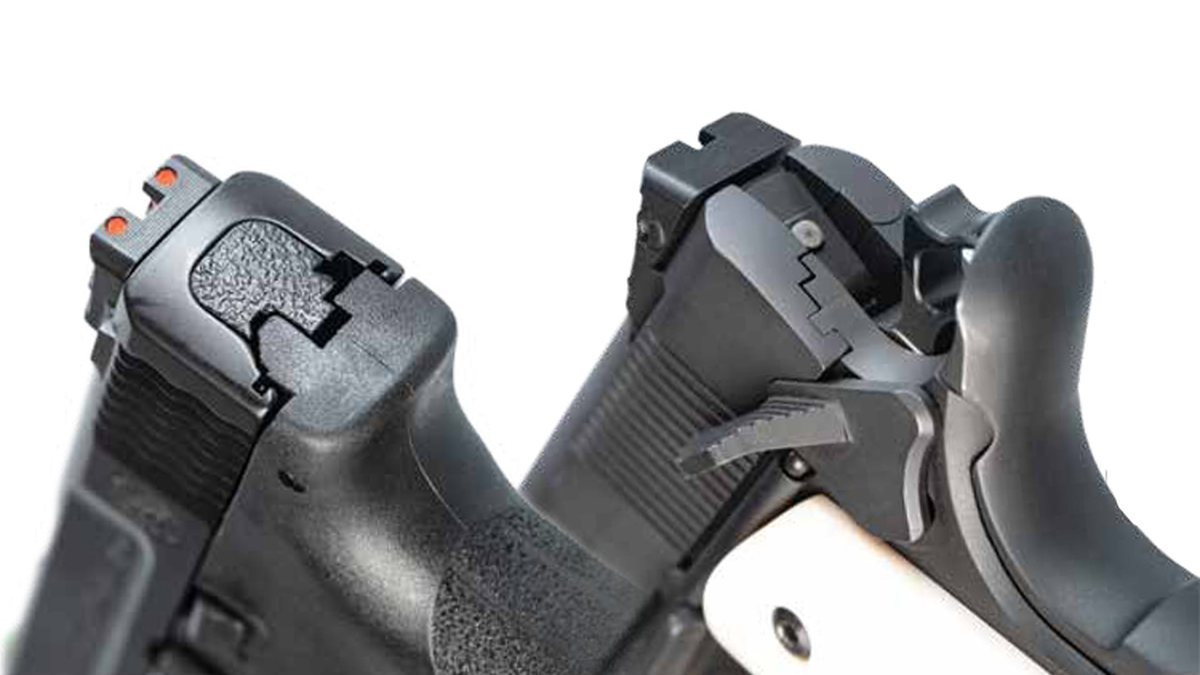
Two pistols sit side by side. One has a hammer at the back of the slide; the other has a smooth, squared-off rear and is called striker-fired. Does the striker gun have any safety? Does the hammer gun have the better trigger? Without seeing inside either pistol, it's hard to know.
Opening both pistols up in plain words shows what the hammer, sear, striker, and firing pin do, and how single-action, double-action, and striker triggers differ. Then you will see how those differences change trigger feel, safeties, holsters, cleaning, and dry-fire practice. By the end you should be able to sort out the common myths and choose the system that fits the way you shoot and carry.
The four parts that fire a pistol
Every pistol has the same basic job. Something has to strike the back of the cartridge hard enough to ignite its primer. The primer lights the powder, and the burning powder drives the bullet down the barrel. Hammer-fired and striker-fired pistols differ in how they store the energy for that blow and how they deliver it.
Four parts do the work, and it helps to learn their names now.
- Firing pin. This is the small rod in the slide that actually strikes the primer. In a hammer-fired pistol, the hammer hits the back of the firing pin and drives it forward.
- Hammer. This pivoting part is pushed by a strong spring, often called the hammer spring or mainspring. When it is released, it swings forward in an arc and hits the firing pin.
- Sear. This small catch holds the hammer or striker back against its spring. Pressing the trigger moves the sear out of the way, and that is what fires the shot.
- Striker. This is a firing pin with its own spring behind it. Nothing hits it. Instead, it is drawn back, held by the sear, and then released to snap straight forward into the primer.
A mousetrap is a good picture of a hammer system. The spring-loaded bar swings in an arc, and a small catch holds it until something trips it. That catch plays the part of the sear. A striker is more like the plunger on a pinball machine. You draw it back against a spring, let it go, and it drives straight forward.
Key idea: A hammer swings and hits the firing pin. A striker is the firing pin, driven straight forward by its own spring. Almost everything else in this article follows from that difference and from one more question. How much of the cocking work is left for your trigger finger?
Single action, double action, and striker: What your trigger has to do
To cock a pistol is to draw the hammer or striker back against its spring, where the sear holds it. The labels on a pistol's box mostly tell you what does that work. If the slide or your thumb has already cocked the pistol, the trigger only has to release the sear, so the press can be short and light. If the trigger has to do the cocking too, the press is longer and heavier, because your finger is compressing the spring as it goes.
Single action: The trigger only releases the hammer
In a single-action (SA) pistol, the hammer must already be cocked before the trigger will do anything. Racking the slide cocks it for the first shot, and the slide re-cocks it after every shot. With only one job to do, the trigger can be short and crisp. The best-known example is the 1911 pattern, adopted by the U.S. Army in 1911. Many .22 target pistols, such as the Browning Buck Mark, are single action for a similar reason. A light, clean release is easier to shoot accurately.
Because a cocked hammer needs only a light press, a single-action carry pistol needs a manual safety. The 1911 has a thumb safety and a grip safety, and it is carried with the hammer cocked and the thumb safety on. Shooters call this "cocked and locked." It can look alarming to newcomers, but it is the standard way to carry this design.
Double action/single action: Two different presses
A double-action (DA) trigger cocks the hammer and then releases it, all in one press. A DA/SA pistol uses both modes. With the hammer down, the first press is double action, long and heavy. The slide then re-cocks the hammer, so every shot after that is single action, short and light.
The difference is easy to feel. One independent test of a stock Beretta 92FS measured about 12.5 pounds for the double-action press and about 7.5 pounds in single action. Your finger meets two different triggers in the first two shots. Until you practice both, the first and second shots can land in different places.
When you finish shooting, a DA/SA pistol normally goes back to double-action mode before it is holstered. Many do this with a decocker, a lever that lowers the hammer without firing. The Beretta 92FS, adopted by the U.S. military as the M9 in 1985, and the SIG Sauer P226 both work this way. The CZ 75 B takes a different path. It has a manual safety instead of a decocker, so it can also be carried cocked and locked like a 1911.
Double action only: The same long press every time
A double-action-only (DAO) pistol never rests with the hammer cocked. Every press cocks and releases it, so every shot feels like the first shot from a DA/SA pistol. The press is long, but it never changes, and there is no decocker or mode to remember. The original Ruger LCP, introduced in 2008, is a well-known DAO pistol. Our comparison of the Ruger LCP and LCP Max shows how Ruger changed that trigger in later models.
Striker-fired: Cocked by the slide, released by your finger
Striker-fired pistols have no hammer. When the slide cycles, it draws the striker back against its spring, and the sear holds it there. Designs differ in how far the slide takes it.
In a partially pre-cocked system, the slide leaves the striker only partly cocked. Your trigger press finishes cocking it and then releases it. Glock's Safe Action design works this way. Glock says the system gives a consistent trigger pull from the first round to the last. That makes sense, because the trigger does the same work on every shot. Our article on the Glock 17 and Glock 19 traces how that design shaped the Glock line.
Other designs have the slide cock the striker fully, so the trigger only releases it, much like a single-action hammer. The Taurus G3c is described this way, as a striker pistol with a single-action trigger. Either way, a striker pistol gives you one press to learn. The Smith & Wesson M&P M2.0, the SIG Sauer P365, and the Springfield Hellcat are also striker-fired. Your owner's manual tells you exactly how yours works.
| System | What the first press does | What later presses do | Before holstering | Well-known examples |
|---|---|---|---|---|
| Single action (hammer) | Releases a hammer that is already cocked | The same short, light release | Apply the manual safety | 1911 pattern, Browning Buck Mark |
| DA/SA (hammer) | Cocks and releases the hammer (long and heavy) | Release only (short and light) | Decock, or apply the safety on designs like the CZ 75 B | Beretta 92FS, SIG Sauer P226, CZ 75 B |
| Double action only (hammer) | Cocks and releases the hammer | The same long press | No mode to change | Original Ruger LCP |
| Striker, partially pre-cocked | Finishes cocking and releases the striker | The same press every time | No lever to set | Glock pistols |
| Striker, fully cocked by the slide | Releases the striker | The same short release | Apply the safety if the model has one | Taurus G3c |
Left to right, the table tells the story. The second and third columns show how much work your finger does, and that predicts how the trigger will feel. The fourth column is what you must remember every time the pistol goes back in the holster. A system with nothing to do in that column is simpler to run, but it leaves your finger discipline and your holster as the main protection. Notice, too, that "hammer-fired" covers three very different triggers.
What changes for you as the shooter
The mechanism matters because it shapes five parts of owning the pistol.
Trigger feel and reset
Most trigger presses have the same stages. First comes take-up, or slack, the light movement before you feel resistance. Next is the wall, where resistance builds. Then comes the break, when the sear lets go and the shot fires. After the shot, the trigger travels forward until it resets with a small click, ready for the next press.
Each system arranges those stages differently. A single-action press is usually short, with little take-up before the wall. A double-action press is long and heavy because the hammer is being cocked along the way, and it rewards one smooth, steady roll from start to finish. A striker trigger often has a light take-up and then a wall, and it feels the same on every shot. Glock says its trigger resets with only limited forward movement.
Reset matters for follow-up shots. If you let the trigger forward only to the reset click instead of all the way, the next press is shorter. The best trigger for you is the one you can press without disturbing the sights, and that depends on your hand as much as on the pistol. Our trigger control tips show how to build that press.
What safeties do, and what they do not do
A safety is any feature that blocks the pistol from firing until it is deliberately released. Pistols use three broad kinds.
- Manual safeties are levers you move with your thumb. The 1911 and the CZ 75 B have them, and Smith & Wesson sells M&P M2.0 striker pistols both with and without a thumb safety.
- Grip safeties block the pistol unless your hand is squeezing the back of the grip. The 1911 is the classic example.
- Automatic internal safeties work without any action from you. Glock pistols have three. A lever in the trigger, a firing pin safety, and a drop safety all disengage in sequence as the trigger is pressed, and they re-engage when it is released. Many hammer-fired pistols have internal firing pin blocks too, including the CZ 75 B and Colt's Series 80 1911s.
Decockers deserve their own mention. A decocker lowers the hammer safely, but it does not always lock the pistol. On the standard SIG Sauer P226, which has no manual safety, the decocker lowers the hammer and the next double-action press will fire the pistol. On the Beretta 92FS, the same lever lowers the hammer and, while it stays down, disconnects the trigger as a safety. Raising it returns the pistol to double action. Both are DA/SA pistols, yet their levers do very different jobs.
Every owner should take the next point to heart. No safety replaces safe handling. Iowa's hunter education course says it plainly. Safeties are mechanical devices that can wear out, fail, or be bumped off, and they are only a backup to safe gun-handling habits. Glock's trigger safety shows the limits well. It keeps the trigger from moving unless the safety lever and the trigger are pressed together. A finger or a jacket drawstring pressing straight back on the trigger does exactly that.
Common mistake: Some shooters lower a hammer by hand on a loaded chamber while pressing the trigger. If your thumb slips, the pistol can fire. If your pistol has a decocker, use it exactly as the manual describes, with the muzzle pointed in a safe direction.
Holsters and carry
Holstering deserves more attention than it gets. As the pistol goes back in, the holster's edge, a fold of clothing, or your own finger can reach the trigger. Whatever system you choose, the holster should be made for your exact model and should cover the trigger guard completely. Longtime trainer Massad Ayoob advises holstering slowly, watching the pistol go in while you are learning, and keeping drawstrings and key rings away from the holster.
Hammer-fired pistols offer one extra check here. If you keep your thumb on the hammer as you holster, a cocked hammer cannot fall and a lowered hammer cannot rise. If something presses the trigger, you feel the hammer push against your thumb before anything happens. On a striker pistol, a thumb on the back of the slide keeps the slide closed, but it cannot block the striker. That puts more weight on a clear holster mouth and a straight trigger finger.
Each system also changes how the pistol is carried. A single-action pistol rides cocked with the safety on, so you must practice until sweeping the safety off during the draw, and back on before holstering, happens without thought. A DA/SA pistol with a decocker is decocked before it goes in the holster, and its first shot is the long double-action press. A DAO pistol, or a striker pistol without a manual safety, has no lever to forget. The trade is that nothing stands between a pressed trigger and a shot except your finger and the holster. Carry laws differ from state to state, so confirm the rules with your state's agency or a qualified attorney before you carry.
Cleaning and maintenance
Neither system is hard to care for if you follow the owner's manual, but the details differ. Read the manual's lubrication instructions before you add a single drop of oil. Striker channels show why. Glock's armorer guidance says never to lubricate the firing pin channel, because oil or solvent left there can contaminate primers and cause a failure to fire. On a hammer-fired pistol, the hammer and sear sit in the frame, so its manual will point you to different cleaning and oiling spots.
Field stripping, the basic takedown for cleaning, is an owner's job on both types. Taking apart the parts that control firing, such as the sear, hammer, or striker assembly, is work for an armorer or gunsmith unless your manual walks you through it. After any reassembly, run the function check in your manual with the pistol verified unloaded. Glock's manual, for example, includes a check of the firing pin safety and warns not to load or fire the pistol if it fails.
Dry-fire practice
Dry fire means practicing your trigger press with an unloaded pistol. It is one of the best ways to learn any trigger, and each system behaves a little differently when you do it.
- Single action: After one press, the hammer is down. You must re-cock it, by racking the slide or by thumbing back an exposed hammer, before the next press.
- DA/SA and DAO: You can press the double-action trigger again and again without touching the slide, because each press re-cocks the hammer. On a DA/SA pistol, cock the hammer when you want to practice the single-action press.
- Striker: On many striker pistols, the trigger stays dead after one press until you rack the slide to reset the striker. Some designs differ. The Taurus G3c's restrike feature, for example, lets you press again without cycling the slide.
Snap caps are dummy cartridges that cushion the firing pin. Shooting Sports USA advises always using one when dry-firing a rimfire pistol, such as a .22. For a centerfire pistol, your owner's manual says whether you need one. If your striker pistol needs a rack between presses, put that moment to work. Rack, re-grip, re-aim, and press. That is not wasted time. It is grip practice.
Six myths worth retiring
Each of these six claims starts with something true and stretches it too far.
- "Striker-fired pistols have no safety." Many have no manual lever, but that is not the same as no safety. Glock pistols have three automatic safeties, and some striker models, such as certain M&P M2.0 versions, add a thumb safety.
- "If the safety is on, the pistol is safe." A safety is a backup that can wear, fail, or be bumped off. Muzzle direction and finger discipline still do the real work.
- "Hammer-fired pistols always have better triggers." That depends on which press you mean. A double-action press is long and heavy by design, and single-action presses vary too. The Beretta test mentioned earlier found about 7.5 pounds in single action. Judge the trigger on the pistol in your hand, not the category.
- "No visible hammer means it is striker-fired." Some hammers are hidden. The Ruger LCP MAX is hammer-fired, with a recessed hammer that the slide cocks fully every time it cycles. Check the manual, not the silhouette.
- "Striker-fired is a new, unproven idea." The FN Model 1900, based on John Browning's 1897 patents, drove its firing pin with a spring. Its recoil spring did double duty as the firing pin spring, and about 724,500 were made by 1914. The Glock 17 arrived in 1982, so even the modern polymer striker pistol has decades behind it.
- "A decocker is a safety." On some pistols, such as the SIG Sauer P226, it only lowers the hammer. On others, such as the Beretta 92FS, the lever also works as a safety. Know which kind you own.
If you remember only two of these, make them the first two. They are the same truth seen from opposite directions. A pistol without a lever is not unsafe, and a pistol with a lever is not safe by itself. Either way, your habits carry the load.
How to choose between hammer-fired and striker-fired
There is no best system, only the best fit for you. These five questions will narrow it down.
- How many trigger presses do you want to learn? A striker or DAO pistol gives you one. A DA/SA pistol gives you two, and you will need to practice the change from the first to the second.
- Will you train with a manual safety? A single-action pistol depends on one, and some striker models offer one. If you choose a safety, practice until working it on the draw is automatic.
- How will you carry and holster? If you want the thumb-on-hammer check while holstering, a hammer-fired pistol gives it to you. If you choose a striker pistol, pair it with a rigid holster made for that model and a slow, deliberate holstering habit.
- Can you reach and control the trigger? On many DA/SA pistols, the trigger sits farther forward when the hammer is down. Check your reach and control in both modes before you decide.
- How will you practice? If daily dry fire is part of your plan, notice whether your choice needs a slide rack between presses.
Usually the first and third questions carry the most weight, because they decide how you will train and carry every day. Here is how they play out for two shooters.
The first shooter is new to handguns and wants one pistol for home defense and occasional carry, with limited time to practice. A striker or DAO pistol keeps the learning simple, because there is one press to master. Her biggest jobs after buying it are choosing a good holster and building the habit of a straight trigger finger.
A second shooter has shot for years, practices weekly, and carries close to the body. He values the thumb check when holstering, so a DA/SA pistol with a decocker suits him. He accepts the heavier first press and sets aside dry-fire time for the switch to single action. Both choices are sound, because each one matches how that person will actually train and carry.
Choose the system you will practice with, carry correctly, and shoot well. If you can, shoot both kinds before you buy, because your own targets settle the question better than any opinion.
Meeting your trigger system with an unloaded pistol
A short dry-fire session teaches you your trigger better than any description. Choose a room and a direction with a backstop that would stop a bullet if you were wrong, and move every live round out of the room, including loaded magazines. Unload the pistol, remove the magazine, lock the slide open and check the chamber and magazine well by sight and with a fingertip, keeping the muzzle toward the backstop. Say "Beginning dry fire," close the slide, aim at a small spot and press slowly, noticing the take-up, the wall and the break. Hold the trigger back, rack the slide and let the trigger forward slowly until it clicks; that is the reset. On a DA/SA pistol, decock as the manual directs and compare the two presses; on a striker, notice that the trigger stays dead after a press until you rack. Ten slow presses while watching the front sight finish the session, and saying "Dry fire complete," then waiting a few minutes before loading, keeps the change back to live ammunition deliberate. If you practice with a .22, use a snap cap. Our guide to firearm safety for beginners covers the rules behind every step.
Check your understanding
Try answering these before you open the answer. If you can decide what to do and explain why, you have it.
1. A friend says, "Glocks have no safety." How would you answer accurately?
Glocks have no manual safety lever, but they do have three automatic safeties. A lever in the trigger, a firing pin safety, and a drop safety all disengage as the trigger is pressed. None of them stops a finger or an object from pressing straight back on the trigger, so finger discipline and a good holster still matter most.
2. With your DA/SA pistol, the first shot keeps landing away from the rest of the group. What is the likely cause, and how would you fix it?
The first shot is the long, heavy double-action press, and the shots after it are light single-action presses. If that heavy first press moves the sights, the shot lands away from the others. Practice slow double-action presses in dry fire until the front sight stays still through the break, and then practice the change from the first press to the second.
3. You holster a decocked DA/SA pistol with your thumb on the hammer. What is the thumb doing, and why does the same habit do less on a striker pistol?
Your thumb keeps the hammer from rising and falling, and you would feel it move if something pressed the trigger. A striker pistol has no hammer to hold. A thumb on its slide keeps the slide closed, but it cannot block the striker.
4. During dry fire, your striker pistol's trigger feels dead after the first press. Is something wrong?
Probably not. On many striker pistols, the slide has to cycle to reset the striker, so you rack the slide between presses and use the rack as grip practice. If the trigger still does not reset after racking, have the pistol checked.
Where to go next
If you are still choosing a first pistol, Choosing the Right Pistols as a Beginner Shooter adds size and caliber to the decision. Once you own one, How to Master Pistol Shooting Fundamentals covers the grip, stance, and sight work that let any trigger system shoot well. And if the pistol is for carry or home defense, our personal protection caliber comparison helps you decide what it should fire.
If this article helped you, we invite you to sign up for email notifications of new blog articles.