
Firearm Safety for Beginners: Rules Every Gun Owner Should Know
Joseph McLain Nov 07, 2026
At the range, someone hands you a rifle with the words "Don't worry, it's unloaded." What do you do next? If your answer is "check it myself," you already understand the most important idea in firearm safety.
Whether you're a new gun owner, a parent or simply someone who wants to handle firearms with confidence, by the end you should be able to explain the four universal rules and why each one works, choose storage and safety devices that fit your home, handle rifles, shotguns and handguns correctly, and behave safely at a range.
The four universal rules of firearm safety, and why each one works
At the heart of every responsible gun owner's habits are four rules. They have been passed down through generations of shooters, and they are simple on purpose. Think of them as layers of protection. If one habit slips, another is still there to prevent an injury, which is why you should follow all four every time, not just the ones that seem important in the moment.
1. Treat every firearm as if it is loaded
Even if you are certain a firearm is unloaded, always assume it is loaded. This mindset prevents complacency and keeps you alert. The reason is that "I thought it was unloaded" is a belief, and a belief is not a check. Back to the rifle at the range. Even if someone else has already cleared it, perform your own check when a firearm is handed to you, so that what you know comes from your own eyes and not from someone's word.
2. Keep your finger off the trigger until you are ready to shoot
Many accidental discharges happen when a shooter places a finger on the trigger too early. The solution is a habit you can see. Keep your finger along the side of the gun, resting outside the trigger guard, and move it to the trigger only when your sights are aligned with your target and you have made a conscious decision to fire. Waiting until you have clearly identified the target minimizes the risk of unintended shots. If you stumble or get startled, a finger that is outside the trigger guard cannot fire the gun. Keeping it there also reinforces discipline, because it makes the moment you decide to fire a deliberate step.
3. Never point the muzzle at anything you do not intend to destroy
The direction a firearm points is critical. The safest practice is to always aim the muzzle in a direction that would cause no harm if the gun were to discharge accidentally. That means never pointing it at yourself, at another person or at any object you would not want damaged. At the range, a safe direction is often down or toward the designated backstop. In a home defense scenario, it means being acutely aware of your surroundings. Keep watching where the muzzle is directed, especially when you are moving in confined spaces or when other people are present.
Key idea: The rules back each other up. A gun that goes off while pointed in a safe direction harms no one, which is why muzzle control is the habit to guard most carefully.
4. Be sure of your target and what is beyond it
Before you fire, confirm your target and what lies beyond it. This is vital because bullets can travel long distances, and an unexpected obstacle, or a person you did not see, could turn a safe shot into a dangerous one. In farm country, picture a shot at a pest in a pasture. The target may be clear, but what is on the far side of the next rise? That question is exactly what this rule trains you to ask.
Three checks make the rule practical. Identify your target clearly and confirm it is something you intend to shoot. Make sure there is a proper backstop behind it, meaning a barrier that safely stops the bullet and prevents unintended damage. And assess the whole environment, whether you are on a range, in the field or at home, because understanding your surroundings is crucial for safety.
Making the rules automatic
The four rules become habits through repetition, and a quiet walkthrough at home builds them. In a room with a safe direction and no ammunition, check the firearm yourself by opening the action and looking into the chamber and magazine well; if you don't know how on that model, the manual or a qualified instructor will show you. Then pick it up with the muzzle in a safe direction and your finger along the frame, and say out loud where the muzzle points, where your finger is, what your target would be and what is behind it. When you can answer all four without thinking, every time you pick up a firearm, the rules have become yours.
Legal responsibilities of gun ownership
Handling a gun safely covers the physical side of ownership. Owning one also carries legal responsibilities, and you need to be aware of the laws that govern firearm possession, storage and transportation where you live. Laws differ by state and locality and they change, so confirm the current rules with the relevant state agency or a qualified professional.
- Background checks: Federal law requires a background check when you buy a firearm from a licensed dealer. Whether a private sale between two people needs one depends on state law; some states require it for nearly all transfers and others, including Iowa, do not require it for most private sales between residents. Federal law still makes it a crime to sell or give a firearm to someone you know or have reason to believe is prohibited from having one, so many private sellers ask to see a carry permit or use a dealer for the transfer.
- Safe storage laws: Many states have specific laws about storing firearms safely, particularly in homes where minors are present. In Iowa, Code section 724.22(6) makes it a serious misdemeanor to leave a loaded firearm unsecured where you know or have reason to believe a child under 14 is likely to get it, if the child then gets it and exhibits it unlawfully in public or uses it to injure or kill someone. Storing firearms securely, ideally in a gun safe or with a trigger lock, helps prevent unauthorized access. Even where laws are not strict, safe storage is a best practice, so keep firearms in locked containers and consider cable locks or chamber flags as additional safety measures.
- Transporting firearms: A firearm being transported should be unloaded and stored in a case or locked container. Know the local, state and federal regulations, which matters most when you cross state lines or travel to areas with strict firearm laws.
- Concealed carry: If you carry a firearm, be fully compliant with the concealed carry laws in your area, including proper licensing and safe storage when it is not in use.
The common thread is that storage and transport are where good intentions can turn into legal trouble. Our guides to proper gun storage and to safely transporting your firearms for hunting and target shooting take each one further.
Safety devices: What each one does and what it cannot do
Safety devices add another layer on top of the four rules. Each one solves a particular problem, so the right choice depends on what you are trying to protect against.
| Device | What it does | What to look for |
|---|---|---|
| Gun safe | Offers the highest level of security of the four when firearms are not in use, keeping them away from children and intruders | Biometric access, as on models like the Vaultek VT20i, which offer quick access through biometric scanning and suit self-defense situations where time is critical. Choose a size that fits your current collection with room to expand |
| Trigger lock | Prevents the trigger from being engaged, rendering the firearm inoperable when not in use, which is especially useful in households with children | Ease of use, as with the Master Lock 94DSPT, designed for universal fit and either key or combination access. It should be robust enough to prevent tampering but simple enough for quick removal by authorized users |
| Cable lock | Passes through the action so the firearm cannot be loaded or fired, and is a cost-effective, widely available measure | Approval by local or state authorities (such as those approved in California) and clear instructions with a simple locking mechanism |
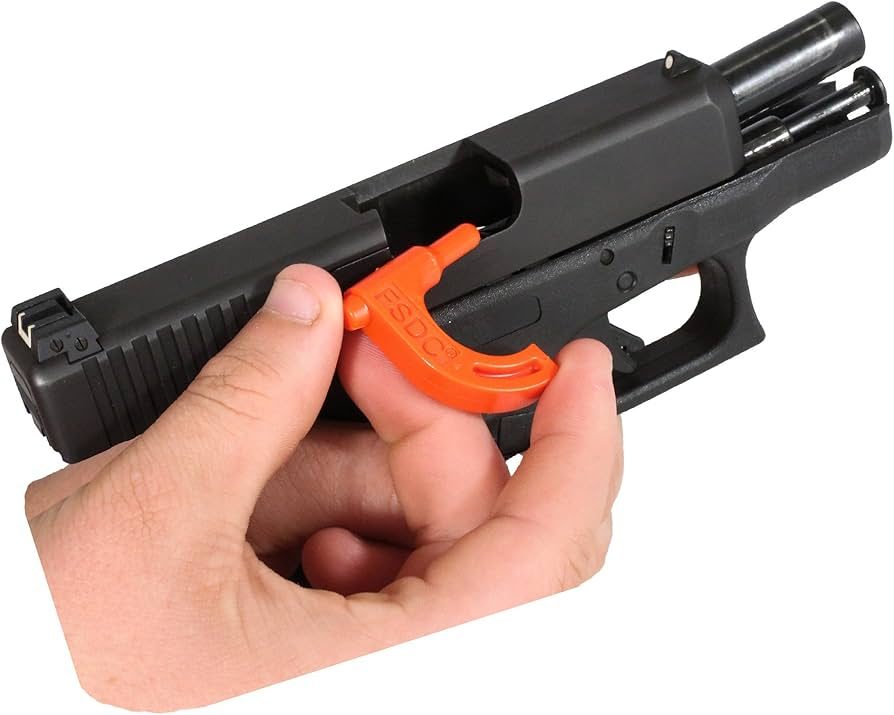
| Chamber flag | A brightly colored indicator inserted in the chamber to show the firearm is unloaded, often used at ranges to signal range officers that the gun is safe | High visibility, easy insertion and removal, and a fit for the specific firearm type (handgun, rifle or shotgun) |
The first three devices are about keeping the wrong person from using a firearm. The safe is the strongest of them, and it is the one to build your plan around. Trigger locks and cable locks are lower-cost ways to add protection, especially where children live. The chamber flag is a different kind of device because it is about communication. It shows other people at a glance that a gun is safe.
Common mistake: Treating a device as proof. A lock keeps a firearm from being used, but it does not unload it, so unload and verify the firearm before you install one. A chamber flag shows the chamber is empty, but it does not replace your own check.
Safety habits for rifles, shotguns and handguns
The four rules never change, but each type of firearm has its own handling challenges. Knowing the reason behind each habit makes it easier to remember.
Rifle safety
A rifle is long, so its muzzle swings farther than you expect when you turn around, which makes muzzle awareness extra important when moving in confined spaces or through the field. When a rifle is not in use, keeping the bolt or action open is a good practice, because it makes it immediately apparent that the rifle is unloaded. Store rifles in a secure, locked cabinet or safe, especially if you have children or unauthorized users in your home.
Shotgun safety
Shotguns fire multiple projectiles at once, so make sure you have a safe backdrop and that the area in front of the firearm is clear before you shoot. Unload a shotgun immediately when you move between shooting areas or when it is not actively in use. Because of their size and spread, shotguns should be transported unloaded and in a secure case to prevent accidental discharge.
Handgun safety
Whether you carry concealed or open, use a holster that covers the trigger guard. That protection keeps anything from reaching the trigger as the gun goes in and out, and models like the Alien Gear Cloak Tuck 3.5 offer both safety and comfort. Always check the chamber to confirm a handgun is unloaded before you clean it or hand it to someone else. And practice trigger discipline, keeping your finger off the trigger until you are ready to shoot, because this discipline is critical in preventing accidental discharges.
Range safety and etiquette
At a shooting range you share space with other people, so you need additional safety rules and good etiquette to protect yourself and everyone around you.
The range officer (RO) is responsible for the safety of everyone on the range. Listen carefully and always heed their instructions, especially during ceasefire or cold range calls. When the range goes cold, shooting stops and nobody handles firearms until the RO says it is safe. Familiarize yourself with the range's rules before you shoot, including designated shooting areas, reload zones and emergency procedures.
Protective gear is part of the safety system. Wear ANSI Z87.1-rated safety glasses to protect your eyes from flying debris, powder residue, hot brass and fragments. Use quality hearing protection, such as the Howard Leight Impact Sport Electronic Earmuffs, which let you hear range commands while reducing noise levels. Being able to hear the RO is what makes the commands work. Wear both even if you are shooting only a few rounds. Our guide to eye and ear protection explains why.
- Know your firearm and the range's rules: Some ranges have specific rules about the caliber or type of ammunition allowed, so verify that yours is permitted. Before shooting, make sure your firearm is in good working order and that all safety mechanisms are engaged when required.
- Keep good positions: Maintain proper shooting positions and stay aware of your surroundings to avoid accidental discharges.
- Respect others: Keep a safe distance from other shooters and avoid actions that could distract or endanger them.
- Clean up after yourself: Keep your area tidy, and dispose of spent brass and targets responsibly.
- Share the range: Wait your turn and adhere to the range's pace, which ensures safety and makes shooting more pleasant for everyone.
Of these, knowing the range's rules and your own firearm matters most because it prevents problems before they start. The rest keep the range pleasant and predictable for everyone. For a fuller picture of what to expect, see Shooting Range Etiquette for New Shooters.
Putting safety above all
Firearm safety is an ongoing commitment that runs from the moment you pick up a gun until it is stored away. Following the universal rules, understanding your legal responsibilities and using appropriate safety devices create a safe environment for you, your family and those around you. The more you understand why each rule exists, the less you need to rely on worry, because knowledge replaces fear with confidence. Keep these four in your head.
- Treat every firearm as if it is loaded
- Keep your finger off the trigger until you are ready to shoot
- Never point the muzzle at anything you do not intend to destroy
- Always be sure of your target and what is beyond it
Beyond the rules, safe storage, proper transportation and diligent maintenance reinforce your overall safety. Whether you are handling a rifle, shotgun or handgun, each type has its own challenges, but the principles stay the same. Firearm safety is not just a set of rules to follow. It is a mindset that respects the power of the tools we handle, and when you follow it you set a positive example for responsible gun ownership. Safety is the foundation of all other skills, and regular practice and ongoing education keep it strong.
Check your understanding
Try answering these before you open the answer. If you can decide what to do and explain why, you have it.
1. A friend hands you a rifle and says it is unloaded. What should you do, and why?
Perform your own check, even if someone else has already cleared it. Treat the firearm as loaded until you have verified it yourself, because "I thought it was unloaded" is a belief and not a check.
2. You pick up a shotgun with your finger already on the trigger, but the muzzle is pointed at a safe backstop when it fires unexpectedly. Why did no one get hurt, and what does that show?
The muzzle rule held even though the trigger-finger rule slipped. The four rules work as layers: when one habit fails, another can still prevent an injury, which is why you follow all four every time.
3. You are about to shoot at a target in an open field. Besides identifying the target, what else must you confirm?
Confirm there is a proper backstop behind the target and know what lies beyond it, because bullets can travel long distances and an unexpected obstacle can turn a safe shot into a dangerous one.
4. A cable lock is installed on a rifle in your closet. Does that mean you can skip the safe-handling rules the next time you pick it up? Why or why not?
No. A device keeps a firearm from being used, but it does not tell you whether the firearm is loaded. Always check the firearm yourself and follow all four rules every time.
5. You are taking a shotgun across state lines to a shoot. How should it travel, and what else should you do?
It should be transported unloaded and in a secure case or locked container. Also check the local, state and federal regulations, which matters most when crossing state lines or traveling to areas with strict firearm laws.
Where to go next
If you are headed to the range soon, read Shooting Range Etiquette for New Shooters to learn what to expect and how to fit in. Then read Proper Gun Storage, which takes the safe and lock choices here and helps you build a plan for your own home. If you travel with firearms, How to Safely Transport Your Firearms covers the habits that keep you both safe and legal. And when you are ready to turn safe handling into good shooting, How to Master Pistol Shooting Fundamentals is the natural next step.
If this article helped you, we invite you to sign up for email notifications of new blog articles.