
When Does Touching a Gun Become a Crime? Carrying, Threatening, Drawing and Shooting Under the Law
Joseph McLain Nov 10, 2026
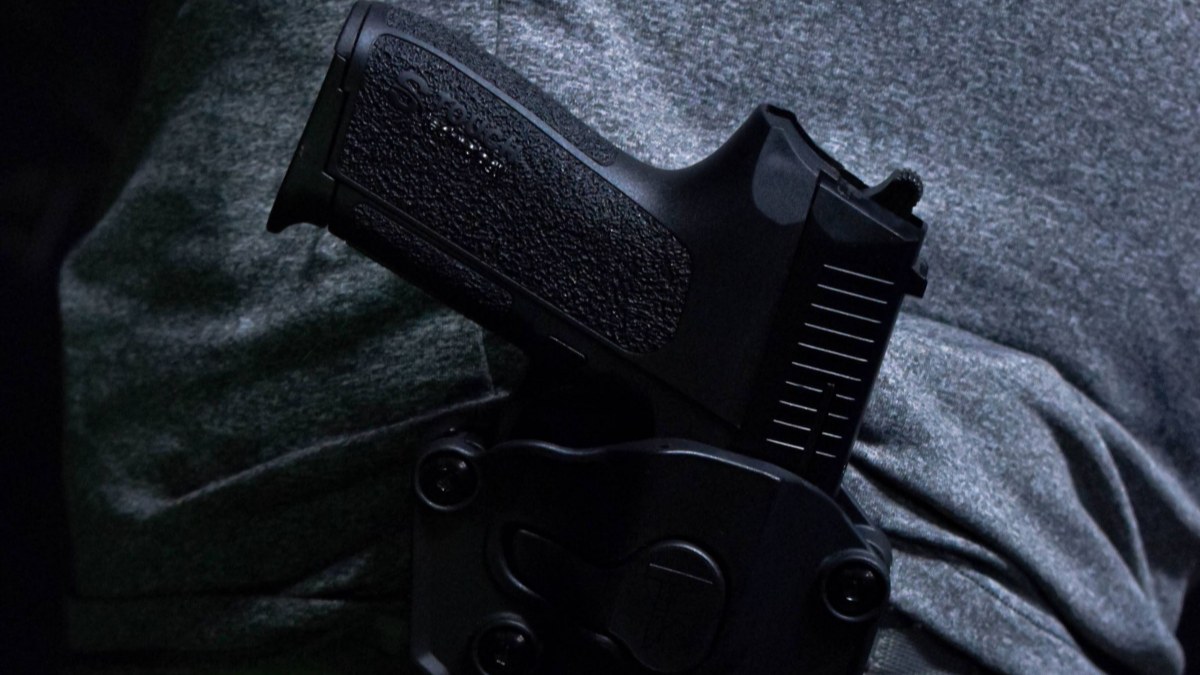
Two drivers are arguing beside their cars in a convenience store lot after a fender bender. One of them carries a pistol, lawfully, in a holster under a light jacket. Picture five versions of what happens next. In the first, the jacket falls open and the gun shows, and nothing else changes. In the second, the carrier deliberately sweeps the jacket back and says, "You might want to think about what you say next." In the third, the carrier puts a hand on the holstered pistol. In the fourth, the carrier draws and holds the gun pointed at the pavement. In the fifth, the carrier points it at the other driver.
At which moment did a crime happen? Is nothing illegal until the gun is pointed at someone, or is touching a gun during an argument automatically brandishing? Neither line matches how the law works. It doesn't measure inches of draw. It looks at what you did, what you communicated, what you intended, and whether a real threat justified it.
By the end you should be able to explain how Iowa law treats showing, touching, drawing, pointing and firing a gun, why a gun does not have to be aimed or even drawn to be part of an assault, why a justified display is not the same as using deadly force, and what questions investigators and juries ask about an armed confrontation.
This is education, not legal advice. Laws differ by state, and every case turns on its facts.
Carrying a gun is not threatening anyone with it
Start with the first version. Where you are allowed to carry, a holstered gun that happens to be visible is not, by itself, an assault. Someone nearby may be uncomfortable, but discomfort is not a crime. The gun is simply equipment you are lawfully carrying.
Now take the second version. The holster has not moved, but you deliberately exposed the gun in the middle of an angry argument and paired it with a warning. The gun's role has changed. It is no longer just something you have. It has become a message.
Iowa's assault statute, Iowa Code 708.1, covers more than punches. It includes any act meant to put another person in fear of immediate painful or offensive contact, when the person has the apparent ability to carry it out. It also specifically includes intentionally pointing any firearm toward another person and displaying a dangerous weapon toward another "in a threatening manner." Under Iowa Code 708.2(3), an assault in which the person uses or displays a dangerous weapon is an aggravated misdemeanor, punishable by up to two years in prison.
Words alone can do the same work. Telling an officer during a traffic stop that you are carrying is a safety disclosure. Telling an angry stranger, "I've got a gun, and you're about to find out what that means," is a threat. The information is identical. What it does is completely different.
The line between incidental and intentional depends on context, witnesses and sometimes video, which you cannot control after the fact. Never use your gun, by showing it, touching it or mentioning it, to make a point in an argument.
Hand on the gun, partial draw, full draw
Many people assume that resting a hand on a holstered gun is legally safer than drawing it. There is no such rule. A hand near a holster while you adjust your belt communicates nothing. The same hand gripping the pistol as you step toward someone and tell them to back off can be strong evidence of a threat. How far the gun came out of the holster is evidence of what happened. It is usually not a separate legal element.
The same goes for the positions taught in training. Low ready, high ready and holding the gun at your side describe how a gun is handled. Criminal codes generally do not adopt them as steps on a ladder. A gun held at your side can intimidate. A gun pointed at the ground can threaten. Even a gun held toward the sky can be a threatening display.
That last point comes from a real Iowa case. In State v. Meisheid, decided by the Iowa Supreme Court on October 24, 2025, two Washington County deputies went to a home in Kalona to investigate a report of illegal fireworks. The resident came out angry and told them to leave. Then he pulled a handgun from his waistband, pointed it straight up, and said, "I'll show you a firework: Boom, boom, boom, boom!" The deputies backed away. He was convicted of two counts of assault by displaying a dangerous weapon in a threatening manner, with an enhancement for assault on a peace officer, and he received a prison sentence with a five-year mandatory minimum.
On appeal, he argued that he never displayed the gun "toward" the deputies, because he never aimed it at them. The court disagreed. Under the jury instructions used at trial, the jury could find that showing the gun so the deputies would become aware of it was a display toward them, even though the muzzle pointed at the sky.
Key idea: "I never pointed it at him" is not a defense to a threatening-display charge in Iowa. A gun can be displayed toward a person without ever being aimed at them. What matters is that it was shown to them, in a threatening way, without justification.
The case involved peace officers, which added the enhancement, and the court decided only the narrow question raised under unchallenged instructions. But its lesson applies to anyone. A gesture you think is harmless may look like a threat to the person in front of you and to a jury later. Until there is a lawful reason to draw, keep your hands off your gun and your gun out of the conversation.
Pointing a gun is a line of its own
Pointing a gun at someone carries special weight. Iowa's assault statute names it directly: Intentionally pointing any firearm toward another is an assault unless justified. Other states treat it just as seriously in different words. Texas, for example, presumes recklessness and danger when someone knowingly points a gun at or toward another person, under its deadly conduct statute.
The reason is simple. A pointed gun puts a person one trigger press from death, whatever the person holding it says they intended. That is why trainers teach that you point a gun only at something you are willing to destroy, and why the law treats an unjustified pointing as an assault even if the gun is never fired.
That brings up the most important idea in this whole subject. Doing something that fits the definition of assault is not the end of the legal question. A justification can make lawful conduct that would otherwise be a crime. In Iowa, once self-defense is raised, the State must prove beyond a reasonable doubt that the force was not justified.
The same act, pointing a gun at a person, is either a serious crime or lawful self-defense, depending entirely on the circumstances. Point a gun at a person only when you reasonably believe that it is necessary to defend yourself or someone else from an imminent unlawful threat that justifies deadly force.
A justified display is not the same as using deadly force
Consider someone facing a real and imminent attack. They draw. The attacker sees the gun and runs. No shot is fired. Did they use deadly force?
Iowa answers that question in its statutes. Under Iowa Code 704.2(2), deadly force does not include a threat to cause serious injury or death by producing, displaying or brandishing a deadly weapon, as long as the conduct is limited to creating an expectation that deadly force may be used to defend oneself or another, or as otherwise authorized by law. In plain terms, drawing to stop a threat is measured as a threat of force, not as deadly force itself. Texas and Florida draw similar distinctions in their own laws.
This matters because the standard for a threat of force can be lower than the standard for actually using deadly force. It recognizes that showing a gun can end a dangerous encounter without anyone getting hurt. But it does not mean drawing is always allowed. The display still has to be justified by a real threat. Fear, anger or a bad feeling about someone is not the same thing.
Justification also has a time limit. Suppose you lawfully draw on a man coming at you with a tire iron. He drops it and backs away. If you keep the gun on him while you shout at him, or follow him to make sure he knows not to come back, the threat that justified your draw is over. What you do next is judged on what is happening next.
Common mistake: Treating a justified draw as permission to stay in control of the scene. Once the threat stops, holster or lower your gun as soon as it is safe, move away if you can, and call 911. Keeping someone at gunpoint after they have stopped can turn a lawful defense into a new assault.
The gun comes out only for a real, imminent threat, and it goes away as soon as that threat ends.
Firing creates new questions
Firing a gun adds new facts: A bullet leaves the barrel, something or someone may be hit, and other people may be in danger. But firing does not automatically mean murder, and missing does not automatically mean attempted murder. What you intended and what you caused both matter.
Compare four discharges. Someone handling a gun carelessly fires a round that narrowly misses a family member. Someone fires into the air to scare off a person they are arguing with. Someone fires at a person and misses. Someone fires at an attacker in a situation where deadly force is legally justified. The trigger press is the same. The law treats them as four very different things: Negligence or recklessness, an unlawful threat, possibly attempted murder, and lawful self-defense.
Iowa has a separate crime for reckless shooting. Under Iowa Code 724.30, intentionally discharging a firearm in a reckless manner ranges from a simple misdemeanor if nobody is hurt and nothing is damaged, up to a class C felony if someone is seriously injured.
Why a "warning shot" is not a gentler option
Many people imagine a warning shot as a middle ground between drawing and shooting someone. The law does not see it that way. Under Iowa Code 704.2, deadly force includes firing a gun toward a person you know is there, even if you did not mean to hurt them, and firing at a vehicle you know is occupied. A bullet fired "as a warning" still travels somewhere, may hit someone you did not see, and may violate discharge laws. Calling it a warning does not change what it is.
Most trainers teach that a warning shot is either unjustified, because deadly force was not warranted, or a waste of time and ammunition, because it was. If deadly force is not justified, do not fire at all, and if it is, do not fire anywhere except at the threat.
Other crimes that do not involve the confrontation itself
Some charges have nothing to do with what you did during the argument. Carrying while prohibited from having guns, carrying where guns are banned, or violating a protective order can each be a separate crime.
One Iowa law looks at what you intended before you ever arrived. Under Iowa Code 708.8, going armed with intent, it is a class D felony to carry a dangerous weapon intending to use it against someone without justification. The statute itself protects lawful carriers: The intent cannot be inferred just from carrying or concealing a weapon, even a loaded gun in a car. But facts like driving to someone's house to "settle things" with a gun on your hip can change that.
The status of the other person can matter too. Threatening a peace officer, as in Meisheid, brings enhancements that do not apply to an argument between two civilians. And one act can sometimes support more than one charge, though legal rules limit how many convictions and sentences can stand for a single event.
Never carry a gun to a confrontation you expect, and if you know a situation is heading toward trouble, stay away from it.
What investigators and juries are really asking
Instead of memorizing holster positions, it helps to know the questions that investigators, prosecutors and juries work through after an armed confrontation.
First, was the person allowed to have and carry the gun there at all? Second, what did their words and actions communicate? Was the gun visible by accident or shown on purpose? Did a hand movement come with a threat? Third, what was the person's state of mind? The law treats an intentional threat, a reckless shot and an attempt to kill as different offenses. Fourth, was the conduct justified at that exact moment, based on a reasonable belief that force was necessary against an imminent unlawful threat? Iowa's self-defense law, including Iowa Code 704.3, focuses on that reasonable belief. Fifth, what happened afterward? Did the other person back off? Was the gun put away when the danger ended? Was anyone else put at risk?
Those questions explain why witness statements, store cameras, phone video, 911 calls and the timeline matter so much. They also explain why two encounters that sound alike in a one-sentence summary can end in completely different outcomes.
Good practice: Before you ever carry, think through how you would answer each of those five questions about any time you might touch your gun. If the honest answer to "what did my actions communicate?" is "I wanted him to know I was armed," you are describing a threat, not a defense.
Act in a way you could explain truthfully, step by step, to people who were not there and do not know you.
Back to the parking lot
Return to the five versions of the fender bender. In the first, the jacket fell open by accident. That is lawful carrying, not a crime. In the second, sweeping the jacket back with a warning is very likely a threatening display under Iowa Code 708.1, an aggravated misdemeanor if charged as an assault with a dangerous weapon. The third, a hand on the gun during a heated argument, can be the same crime, depending on what came with it. The fourth, a drawn gun pointed at the pavement, is a display toward the other driver under the reasoning of Meisheid, unless justified. The fifth, pointing the gun at the other driver, is an assault in its clearest form, unless justified.
Now change one fact. The other driver pulls a knife and comes at the carrier. Suddenly, the fourth and fifth versions may be lawful self-defense, and drawing to stop the attack is a threat of force under Iowa Code 704.2(2), not deadly force. Same gun, same motions, completely different legal result. The difference is the threat.
Check your understanding
Try answering these before you open the answer. If you can decide what to do and explain why, you have it.
1. Is it a crime in Iowa if your holstered gun becomes visible by accident?
Generally no, if you are lawfully carrying. Assault under Iowa Code 708.1 requires intentional threatening conduct, such as a threatening display or pointing a gun toward someone. An accidental glimpse of a holstered gun is not that.
2. A man you've told to leave your farm stands in the yard arguing but makes no move toward you. You draw your pistol, point it at the sky and say, "Time to go." Since you never aimed at him, are you in the clear?
No. In State v. Meisheid (2025), the Iowa Supreme Court upheld assault convictions for a man who held a gun pointed straight up while threatening deputies, because showing the gun so they'd be aware of it could be a threatening display toward them. Without a real threat that justifies it, a gun shown to make a point is likely an assault with a dangerous weapon, whichever way the muzzle points.
3. A man raises a tire iron and charges you. You draw, and he drops it and runs. A friend says you "used deadly force" and will be judged as if you'd fired. Is that right?
No. Under Iowa Code 704.2(2), producing or displaying a weapon only to create an expectation that deadly force may be used in defense is a threat of force, not deadly force. It still has to be justified by a real, imminent threat, which a charging man with a raised tire iron likely is. Once he ran, the justification ended, so the gun goes away and you call 911.
4. A stranger is pounding on your car window in a parking lot and yelling, but he has no weapon you can see. You think a shot into the ground would scare him off without hurting anyone. Why is that a bad plan?
Under Iowa Code 704.2, firing toward a person you know is present counts as deadly force even without intent to injure, and any shot can hit an unseen person or violate discharge laws, including reckless use of a firearm under 724.30. If deadly force is not justified, do not fire at all.
5. You lawfully drew on an attacker, who then dropped his weapon and backed away. What should you do?
Lower or holster your gun as soon as it is safe, move away if you can and call 911. Justification lasts only as long as the threat. Continuing to hold someone at gunpoint or following them after they stop can become a new, unjustified assault.
Where to go next
For how to stay out of these situations in the first place, read walking away is self-defense. To understand when deadly force is justified in Iowa, see stand your ground in Iowa and the limits of stand your ground. For carrying openly versus concealed and the display rules that come with each, read open versus concealed carry. And for what to say and not say to police afterward, see the Fifth Amendment after a shooting.
If this article helped you, we invite you to sign up for email notifications of new blog articles.