
Choosing the Right Pistols as a Beginner Shooter: A Guide to Building Skill, Confidence, and Control
Joseph McLain Nov 07, 2026
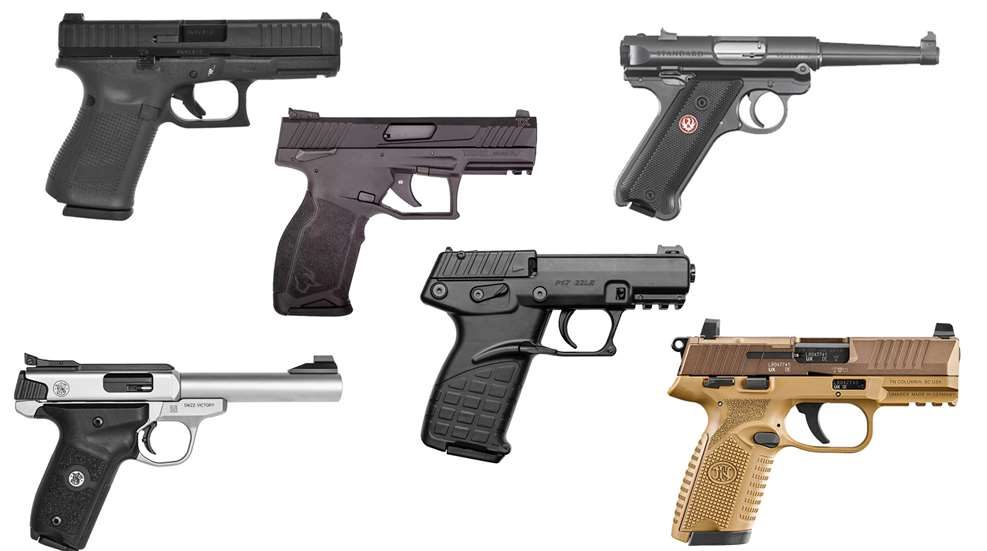
You are about to buy your first pistol, and the choices pull in different directions. A 9mm is the most common handgun cartridge, a bigger caliber sounds more serious, and the smallest, lightest pistols look the most appealing. A step-by-step path sorts it out.
By the end you should be able to explain why a .22 LR is a good place to start, find a pistol that fits your hands, know when you are ready for more recoil, and decide what a third pistol should do for you.
Why a .22 LR pistol is the best place to start
Every shot asks you to hold the sights steady, press the trigger without moving the gun and stay relaxed while it fires. A .22 LR keeps the "fires" part small. Low recoil (the push you feel) and low noise let you concentrate on stance, grip, trigger control and sight alignment.
The deeper reason is the flinch, also called recoil anticipation. Your body tenses or shoves the muzzle down as the shot breaks because it expects a hard push and a loud bang. Once that habit forms, it can hurt your accuracy for a long time. Learning on a gentle round is like learning to swim in the shallow end, because your body has nothing to brace against.
Key idea: Recoil is not the real problem. Expecting recoil is, and a gentle pistol gives your body nothing to fear while your technique forms.
One legal note before you shop: Federal law prohibits licensed dealers from selling a handgun to anyone under 21, even though Iowa has allowed adults 18 and older to obtain a carry permit since July 1, 2025. Check the current rules for your situation with the dealer.
Cost matters too. Bulk .22 LR ammunition is available at relatively low prices, so you can shoot hundreds of rounds without blowing your budget, and frequent practice cements muscle memory faster. For more, see why the .22 LR is ideal for building and refining shooting skills.
Choosing among three proven .22 LR pistols
- Ruger Mark IV: Known for simple takedown, which makes it excellent for learning maintenance. The comfortable grip and crisp trigger make fundamentals easier, and its tight grouping potential gives immediate positive feedback.
- Smith & Wesson SW22 Victory: Interchangeable barrels and a modular design let you adapt as your skills grow. It is reliable out of the box, with a great factory trigger and consistent cycling that minimize frustration.
- Browning Buck Mark: The grip fits a wide range of hand sizes, and many models have adjustable sights for dialed-in accuracy. Many advanced shooters still enjoy it for casual target competition, a sign of its longevity.
All three teach well, so choose by what you want from the pistol. Pick the Mark IV if learning to clean and maintain matters, the SW22 Victory if you want a pistol that grows with you, and the Buck Mark if you have larger hands or want casual target competition. Tight groups keep a new shooter practicing, which is why that positive feedback counts. Each has its own guide, including The Ruger Mark IV, the SW22 Victory and The Browning Buck Mark.
Matching the pistol to your hands
Your hand is your connection to the pistol, so fit matters more than most beginners expect. A well-fitted grip returns the pistol to the same place after each shot, which keeps your sight alignment consistent and stops the gun from shifting in recoil. It also reduces fatigue and builds confidence, because a pistol that feels natural means less "fighting the gun." Trigger reach is easy to overlook, since stretching for the trigger can pull your shots to one side.
- Smaller hands: Look for a shorter trigger reach and a slimmer grip more than a shorter pistol. Some full-size .22 pistols have slim grips, while some compact pistols are thick. The Glock 44 (.22 LR), which is about the size of a Glock 19, is worth trying if you plan to move to a Glock later, but let the fit test below decide.
- Larger hands: Full-size pistols or extended grips help. The Browning Buck Mark and certain Ruger Mark IV models have bigger or thicker grips, and some pistols let you swap backstraps or add grip sleeves for a thicker profile.
A fit test before you buy
A minute with each pistol shows whether it fits. With the pistol confirmed unloaded, and treated as loaded anyway, keep the muzzle in a safe direction and your finger outside the trigger guard. Take your normal two-handed grip and raise the pistol toward a safe spot, close your eyes, lower it, raise it again and open your eyes. If the sights come up nearly lined up and you can reach the trigger without rolling the pistol in your hand, it fits; compare two or three models the same way. Our guide to pistol shooting fundamentals shows what a good grip looks like.
Stepping up in caliber: How to ease into more recoil
Once your .22 LR grip, trigger press and sight tracking are steady, consider .380 ACP or 9mm. Think of them as a steppingstone. Each step adds a little recoil, and you let your technique absorb it before the next one. Their recoil is more manageable and less intimidating than .40 S&W or .45 ACP, yet they still deliver effective power for self-defense if needed, and 9mm is one of the most common and cost-effective centerfire calibers. If the jump from rimfire to centerfire is new to you, read Rimfire vs. Centerfire Cartridges.
Common mistake: Choosing a caliber because it sounds powerful. A pistol you can shoot well and often beats a bigger round you flinch away from.
| Pistol | Caliber | What stands out |
|---|---|---|
| Smith & Wesson M&P Shield EZ | .380 ACP | Easy-to-rack slide for beginners who struggle with slide manipulation, plus a grip safety that adds an extra layer of safety without complicating controls |
| Glock 42 | .380 ACP | Slim profile for small or medium hands, lightweight carry or practice option, and familiar Glock controls that transfer to bigger Glock models |
| Glock 19 | 9mm | The most popular all-rounder, comfortable in size and recoil for new shooters, with an endless aftermarket |
| Sig Sauer P365 | 9mm | Compact but manageable for smaller hands, with mild recoil (snappier than a full-size 9mm) and a fit for everyday carry if that becomes a goal |
The two .380 ACP pistols differ mainly in their controls. Choose the Shield EZ if racking a slide is hard for you, and the Glock 42 if you plan to move to larger Glocks later. Of the 9mm pistols, the Glock 19 sits in the middle on size and recoil, while the P365 trades some comfort for a smaller package. For more detail, see Glock 17 vs Glock 19 and Exploring Popular 9mm Semi-Auto Pistols.
Weight matters too. Heavier steel frames absorb recoil better but can be tiresome to hold for long periods, while lighter polymer frames are more portable but produce sharper recoil impulses. Shoot both before you decide.
Safety mechanisms: Choose the ones you will use without thinking
- Grip safety: Found on pistols like the M&P Shield EZ and the 1911 platform, an extra layer without manual steps
- Thumb safety: The traditional approach on many 1911s, some Berettas and some Sigs
- Trigger safety: Found on Glock and other striker-fired pistols
Grip and trigger safeties work on their own as you grip and press, while a thumb safety is a control you must operate, so it takes training. Choose intuitively. If a safety seems complicated or non-intuitive, keep shopping.
Safety: A mechanical safety is a backup, never a substitute for safe handling. Keep the muzzle in a safe direction and your finger off the trigger until you are ready to shoot. See firearm safety for beginners.
Choosing a third pistol for a specific job
After a .22 LR and a mid-caliber pistol, you may want a third pistol for a specific role such as home defense or competition, or simply for variety. The useful question is "What job must this one do?"
- Full-size for home defense: Reliability and capacity come first, and larger frames often hold more rounds and handle recoil better. Examples are the Beretta 92FS, known for smooth cycling and a classic design, and the Sig Sauer P320, a modular platform with multiple grip frame sizes and a proven track record.
- Revolver for simplicity or field use: Revolvers are straightforward to operate and very dependable, with fewer things that can go wrong than a semi-auto. The Smith & Wesson Model 617 (.22 LR) trains double-action fundamentals, and .38 Special or .357 Magnum offer a blend of ease and power.
- Competition pistol: Look for light triggers, adjustable sights, flared magwells or custom grips. 9mm is often favored for IPSC and USPSA, while some prefer .40 S&W or .45 ACP for major power factor scoring, though those add recoil complexity.
If you want protection at home, choose for reliability and capacity (see our caliber comparison for personal protection). If you want simplicity, look at a revolver. If you want to score points, choose for trigger, sights and a caliber you can shoot fast.
Practice that makes every pistol shoot better
Practice works in three layers. Dry-fire drills use snap caps (inert dummy rounds) to practice trigger press and sight alignment safely at home, with no recoil to distract you. Unload the pistol, check it, keep live ammunition out of the room and aim at a safe wall. Routine live fire reinforces muscle memory through consistent stance, grip pressure and recoil control. Incremental challenges such as timed drills, or friendly competition with a friend, build comfort under mild pressure. Your dry-fire is working when the front sight stays still as the trigger breaks.
Putting it all together: Building skill step by step
- Begin with .22 LR. Low recoil and noise help you build stance, trigger control and alignment without a flinch.
- Transition to an intermediate caliber. Move to .380 ACP or 9mm for a mild increase in recoil, which cements recoil management.
- Select a third pistol for a specialized role. Choose a full-size home defense pistol, a revolver or a competition pistol to match your goals.
- Focus on fit and safety throughout. Make sure you have grip comfort, appropriate weight and a safety mechanism you trust.
Think of this as a path, not a shopping list. The idea is to add challenge in small steps so your skills keep up. Three habits help along the way.
- Try before you buy: Borrow or rent different models at the range.
- Attend classes or seek mentors: Professional instruction accelerates good habits and fosters confidence.
- Stay curious: Exploring sports from bullseye pistol to action shooting broadens your perspective on pistol handling.
Check your understanding
Try answering these before you open the answer. If you can decide what to do and explain why, you have it.
1. A friend's first pistol is a .45, and after a few range trips he jerks every shot low. How would starting with a .22 LR have helped?
The .22's low recoil and noise give your body nothing to brace against, so it doesn't learn to anticipate the shot. That flinch can hurt accuracy for a long time; a .22 lets you build a smooth press first, then carry it to bigger calibers.
2. You have smaller hands and want a .22 LR pistol. What should you look for?
A short trigger reach and a grip slim enough that you can press the trigger straight back without shifting your hand. Overall size matters less than those two measurements, so do the fit test on several models.
3. You shoot your .22 well and feel ready to move up. Why step to a .380 ACP or 9mm rather than straight to a .45 ACP?
Stepping up adds recoil gradually so your technique can absorb it. The .380 and 9mm are more manageable and still effective for self-defense, and once you control them, a larger caliber is a smaller jump.
4. You want a pistol for IPSC or USPSA. Which features and caliber fit?
A light trigger, adjustable sights, a flared magwell or custom grips, and often 9mm. .40 S&W and .45 ACP are sometimes chosen for major power factor scoring, but they add recoil complexity.
Where to go next
Start with How to Master Pistol Shooting Fundamentals, because a well-fitted pistol only pays off when your stance, grip and aiming are sound. Then read Trigger Control Tips to turn dry-fire practice into a smooth, repeatable press. If you are leaning toward home defense, the personal protection caliber comparison weighs the options against each other. And if you have not yet read the rules that come before every other skill, begin with Firearm Safety for Beginners.
If this article helped you, we invite you to sign up for email notifications of new blog articles.