
Scoping a .22 Rifle: Rimfire Scopes, Parallax and the 50-Yard Zero
Joseph McLain Nov 06, 2026
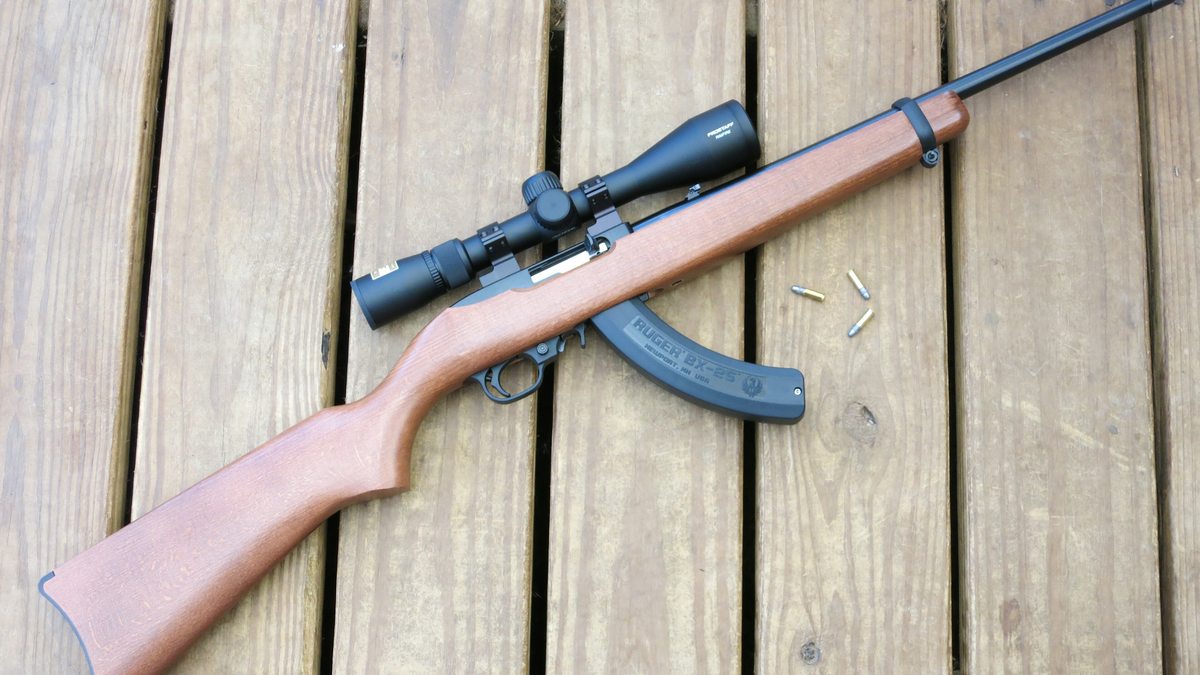
You have a .22 rifle that has been in the family for years, or a new one you bought to teach the kids, and you want to put a scope on it. You find a used deer scope in the closet and think it should work. Then you look online and see people arguing about rimfire scopes, parallax and dovetail mounts, and you wonder whether a .22 scope is really any different.
The advice you get is mixed. Your father says any old scope will do on a .22 because it does not recoil. A coworker says you need a scope made for rimfire, or your groups will wander at 50 yards. A friend who shoots small-bore matches says you need an adjustable objective and the most expensive glass you can afford. Each of them is right about something. A .22 is the most forgiving rifle there is for a scope, but it is shot at shorter distances than most scopes are designed for, and that changes what works best.
This article explains why a scope helps on a .22, how rimfire scopes differ from centerfire scopes, what parallax is and why it matters at 50 yards, how to mount a scope on a .22, how to zero it and what drop to expect at longer distances. By the end you should be able to choose and mount a scope that suits your .22, zero it sensibly and know where your bullets will land from 25 to 100 yards.
Why scope a .22
A .22 rifle is the best way to build shooting skills. It is quiet compared with centerfire rifles, has almost no recoil and is inexpensive to shoot. Our article on the .22 LR as a skill-builder explains why. A scope adds precision. It lets you see small targets clearly, aim at exactly the right spot and see where your shots land. That helps new shooters understand what they are doing and helps hunters place shots on small game like squirrels and rabbits.
A scope also brings the same skills you use on a deer rifle: Setting eye relief, leveling the reticle, zeroing and adjusting turrets. Practicing those on a .22 is much cheaper than practicing them with centerfire ammunition.
The trade-off is that a scope adds weight and bulk, and it can make a light, handy rifle less handy. The rule: Scope a .22 when precision and learning the skills of a scoped rifle matter more than carrying the lightest possible rifle.
Rimfire scopes and centerfire scopes: What is different
The main difference is not recoil. A .22 barely recoils, so almost any decent scope will hold up on one. The difference is the distance the scope is designed for.
Most centerfire riflescopes are set at the factory to be free of parallax at 100 or 150 yards, because that is where most centerfire rifles are zeroed. Most .22 shooting happens at 25 to 75 yards. Scopes designed for rimfires are usually set for 50 yards. They also tend to be smaller and lighter, which keeps the rifle balanced, and many have lower magnification that suits shorter distances.
Your father's deer scope will work, and many people use one on a .22 with good results. But at 25 or 50 yards, you may see a small shift in the reticle when you move your head, which is parallax. A rimfire scope or a scope with an adjustable objective solves that problem.
The rule: For casual plinking and small game, a decent centerfire scope will do. For precise shooting at 25 to 50 yards, choose a scope set for rimfire distances or one with adjustable parallax.
Parallax: Why your reticle seems to move
Parallax happens when the image of the target and the reticle are not in the same focal plane inside the scope. When that is the case, moving your eye behind the scope makes the reticle appear to move across the target. Hold your finger up in front of your face and look at something across the room. Close one eye, then the other. Your finger appears to jump. That is the same effect.
Scopes are designed to be parallax-free at one distance. A centerfire scope set at 100 yards will show some parallax at 50 yards. If your head position is the same every shot, the effect is small, but if your cheek moves on the stock, your shots can spread by a fraction of an inch at 50 yards. That might not matter for cans, but it can matter for a squirrel's head or a tight target group.
Some scopes have an adjustable objective, a ring on the front of the scope, or a side focus knob. You turn it until the target and reticle are sharp and the reticle stops moving when you move your head. That removes parallax at any distance within its range.
To check your own scope, rest the rifle on a solid support, unloaded, with the action open and the muzzle in a safe direction. Look at a target at the distance you shoot most. Without moving the rifle, move your head slightly. If the crosshair seems to slide across the target, you have parallax at that distance.
Key idea: Parallax is not a defect; it is a matter of distance. A scope is free of parallax at one setting, and the shorter distances of .22 shooting are why rimfire scopes are set closer or have parallax adjustment.
Mounting a scope on a .22
Many .22 rifles, especially older ones, have small grooves cut into the top of the receiver called a dovetail. These grooves are often about 3/8 inch wide, and they take rings made for them, sometimes called rimfire or tip-off rings. Many newer rifles use a Weaver or Picatinny-style base or rail. Some, such as many Ruger 10/22 models, include a base or adapter that accepts more than one ring style. Check your rifle's manual or ask before you buy rings, because the wrong rings will not hold.
Ring height matters. The scope should clear the barrel and the rifle's action, and its eyepiece should line up naturally with your eye when your cheek is on the stock. Low rings are typical on a .22, because rimfire scopes are small. Set eye relief so you see a full, round image without moving your head forward or back, and level the reticle so the vertical line is straight up and down when the rifle is upright. Our guide to mounting a rifle scope covers these steps in detail, and the same principles apply to a .22.
A .22 does not recoil much, but rings still need to be tight and even. A scope that moves in its rings will not hold zero. Follow the ring maker's torque recommendations.
Common mistake: Putting a long, heavy scope with a large objective on a light .22. It overwhelms the rifle, makes it awkward to carry and often requires tall rings that lift your cheek off the stock. A smaller scope usually fits the rifle and the job better.
Zeroing at 50 yards
The most common zero for a .22 LR is 50 yards. It suits most small-game and plinking distances and keeps the bullet close to the line of sight from about 20 yards out to around 60. Start at 25 yards to get on paper, then move to 50 to fine-tune. Our guide to sighting in a rifle scope explains the step-by-step method.
Use the ammunition you will shoot most, because different .22 loads can hit in different places. Many .22 rifles are particular about ammunition, and one load may group much tighter than another. Our article on choosing .22 LR ammunition explains why.
The rule: Zero at the distance you shoot most, with the ammunition you shoot most, and confirm it when you change either one.
Where the bullet goes at other distances
The .22 LR is slow compared with centerfire rifles, so it drops quickly past 50 yards. The table shows typical results for common ammunition with a scope about 1.5 inches above the bore and a 50-yard zero. These are calculated estimates, so your own rifle and ammunition will differ, and you should confirm them on paper.
| Distance | High-velocity 40-grain (about 1,200 fps) | Standard-velocity 40-grain (about 1,070 fps) |
|---|---|---|
| 25 yards | About on target | About on target |
| 50 yards | Zero | Zero |
| 75 yards | About 2 inches low | About 2.5 inches low |
| 100 yards | About 6 inches low | About 7 inches low |
Read the table as a curve that bends faster with distance. From 25 to 50 yards, the bullet hardly moves relative to your aim. From 50 to 100 yards, it drops several inches, more than the head of a squirrel. That is why many .22 shooters keep their small-game shots inside 50 or 60 yards and learn their holdovers carefully before shooting farther.
Wind matters too. The light .22 bullet drifts noticeably in a steady crosswind at 75 and 100 yards, which is one reason the .22 is such a good teacher of wind reading.
Good practice: Shoot a group at 25, 50, 75 and 100 yards with your zero, and write down where each group lands relative to your aim point. A small card taped inside your stock or on your scope cap with those numbers is worth more than any calculator.
Safety: A .22 travels farther than people think
Because a .22 is small and quiet, people sometimes treat it casually. But a .22 LR bullet fired at an upward angle can travel more than a mile, and it can ricochet off water, rocks and hard ground. A scope does not change that. It can, however, give you tunnel vision, so you see the squirrel and not the house beyond the trees.
Before you shoot, look around the target with your bare eyes or binoculars and know what is behind it. Make sure you have a backstop, such as a dirt bank, especially when shooting at targets in trees. Never shoot at a target on the skyline. The rule: Treat a .22 with the same respect as any other rifle, because it deserves it.
Putting it together
A scope makes a .22 more precise and teaches the same skills you use with any scoped rifle. Rimfire scopes are set for shorter distances than centerfire scopes, usually 50 yards, which keeps parallax from moving your point of impact at typical .22 distances. Mount the scope on the right rings for your rifle's base, at a height that fits your face, and set eye relief and level the reticle.
Zero at 50 yards with the ammunition you shoot most, and learn how much the bullet drops at 75 and 100. Keep small-game shots at distances where you know your hold, and always know what is beyond your target.
Try this: Learn your .22's drop
- At a range, with eye and ear protection, set targets at 25, 50, 75 and 100 yards.
- With your rifle zeroed at 50 yards, rest it on a solid support and aim at the center of each target.
- Fire a five-shot group at each distance, keeping the muzzle downrange and following the range's commands.
- Measure how far above or below the aim point each group lands.
- Write the results on a small card for your rifle and ammunition.
You will know it worked when you can finish this sentence: "With my rifle and this ammunition, at 75 yards I hold ___ and at 100 yards I hold ___."
Check your understanding
Try answering these before you open the answer. If you can explain it in your own words, you understand it.
1. Your old deer scope is set to be parallax-free at 100 yards. Can you use it on your .22?
Yes, and it will work for casual shooting. At 25 to 50 yards, it may show some parallax, so keep your head position consistent. For precise shooting at those distances, a rimfire scope or one with adjustable parallax is better.
2. You move your head slightly behind the scope and the crosshair seems to slide across the target. What is happening?
Parallax. The target's image and the reticle are not in the same focal plane at that distance. Adjust the parallax if your scope allows it, or keep your head in the same position every shot.
3. Your rifle has grooves on top of the receiver but no rail. What rings do you need?
Rings made for a rimfire dovetail, often about 3/8 inch wide, unless you install a base that accepts other ring types. Check your rifle's manual to confirm.
4. You zeroed your .22 at 50 yards and want to shoot a squirrel at 75. What do you need to know?
How much your bullet drops at 75 yards, typically about 2 inches with common ammunition, so you can hold slightly high. Confirm it on paper with your own rifle and ammunition first.
5. Why should you use the ammunition you shoot most when you zero?
Because different .22 loads can hit in different places and group differently in the same rifle. A zero is only good for the ammunition you set it with.
Where to go next
If you are still choosing the rifle, read choosing a .22 rifle. For the most popular .22 rifle and its accessories, see the Ruger 10/22 guide. To find the ammunition your rifle shoots best, read choosing .22 LR ammunition. And for the full step-by-step method of zeroing, see sighting in a rifle scope.
We carry rimfire scopes, rings and .22 ammunition, and anything listed on our website can be ordered if we do not have it in stock. Text or call us with questions.
Photo: "Ruger 10-22" by James Case, via Wikimedia Commons, licensed CC BY 2.0; cropped.

If you found this informative, we invite you to sign up for email notifications of new blog articles.