
Rifle Scope Reticles: Understanding Types, Uses, and Considerations
Joseph McLain Oct 27, 2026
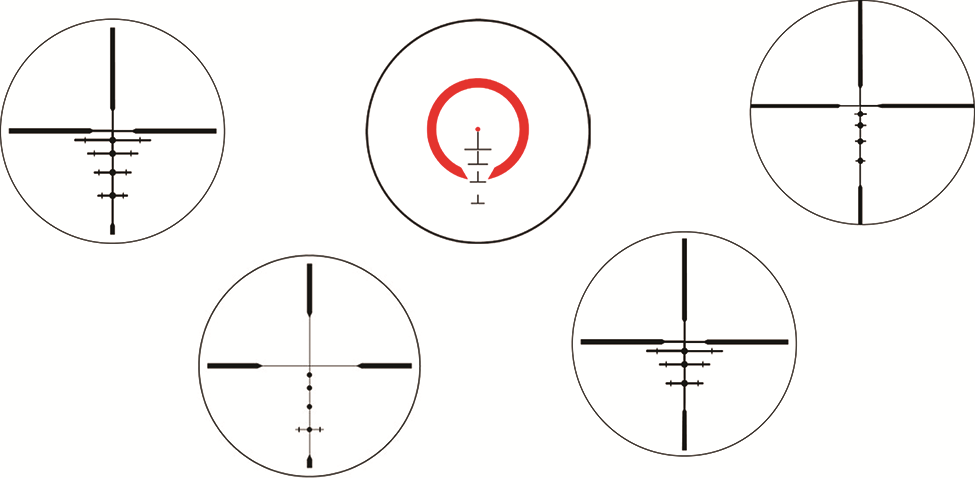
You are comparing two rifle scopes at the counter. The magnification and price are close, but one has a plain crosshair and the other is covered in dots and hash marks. Your deer-hunting neighbor says the plain crosshair is all anyone needs. A friend who shoots steel at long range says you will outgrow it in a season and should buy the busy one. The salesperson mentions "first focal plane" as if you already know what it means. Each of them is right about something. This article explains what a reticle is, the three separate choices hidden inside the word, how each reticle pattern helps or hinders at different distances, what illumination and focal plane actually change, and why your reticle and turrets should speak the same units. By the end you should be able to look through any scope, name its reticle, say what it is good for, and choose the one that fits the way you shoot.
What a reticle is, and the three choices hiding in the word
A reticle is the aiming pattern you see inside a scope. People often call it the crosshair, though many reticles are far more than two crossed lines. At its simplest, it marks where the bullet will land at the distance you zeroed for. Many reticles add marks that help you aim at other distances, correct for wind or estimate how far away a target is.
Scope listings often sort reticles into a long list of "types," which makes the choice look harder than it is. Those types actually answer three different questions. The first is the pattern: What marks are drawn, such as a plain duplex, bullet drop marks, or a grid in mils or minutes of angle. The second is the lighting: Whether the reticle can glow. The third is the focal plane: Whether the reticle changes size when you change magnification. Every scope has an answer to all three, and taking them one at a time makes the decision much easier.
A useful way to think about it is buying a watch. The pattern is the face, from a plain dial to one covered in sub-dials. The lighting is whether the hands glow in the dark. The focal plane is a technical detail of how the face is built, which matters a great deal if you use the sub-dials and very little if you only read the time.
Reticle patterns, from plain to busy
| Pattern | What you see | Best for | Main limitation |
|---|---|---|---|
| Duplex | Thick outer posts tapering to a fine center crosshair | General hunting at ordinary distances | No marks for holdover or wind |
| BDC (bullet drop compensating) | Extra marks below the center, each meant for a longer distance | Hunters who shoot at several known distances | Marks match only the load they were designed around |
| Mil or mil-dot | Dots or hashes spaced in milliradians | Long-range shooting, ranging and wind holds | Takes practice to read; can feel cluttered |
| MOA | Hash marks spaced in minutes of angle | Shooters who already think in MOA and use MOA turrets | Same learning curve as a mil reticle |
Read the table from top to bottom as a trade between simplicity and information. Each step down gives you more to work with at long range and more to look at when you only want to aim.
A duplex reticle's thick outer posts catch your eye in dim light and guide it toward the center, where fine lines cover very little of the animal. That is why it has been the standard hunting reticle for decades. Beyond the distance you zeroed for, though, it gives you nothing to aim with, so you must either hold over by feel or adjust the turrets. If most of your shots are inside a distance where your bullet stays within a few inches of your aim, a duplex is all you need. Our guide to sighting in rifles at different distances explains how to find that distance.
A BDC reticle adds aiming points below the center. Think of it as a ruler printed for one particular bullet at one particular speed. If your load matches the design, each mark lines up with a distance and you can aim without touching a turret. If your load is different, the marks fall at different distances than the label says. Some manufacturers publish which loads their BDC marks suit, and many shooters simply confirm each mark at the range and write down the real distance for their own load.
Mil and MOA reticles are grids of evenly spaced marks in angular units. One mil spans about 3.6 inches at 100 yards, and one MOA spans about 1 inch at 100 yards. Because the marks are a known size, they let you hold for drop and wind precisely, and they let you estimate distance. A 36-inch target that fills 10 mils is about 100 yards away; if it fills only 5 mils, it is about twice as far. See understanding MOA for how angular units work.
The decision rule for patterns is to choose the simplest reticle that covers the longest shot you will realistically take. Extra marks you never use are only clutter.
Common mistake: Trusting BDC marks without checking them with your own load. Confirm each mark at the range and write down the distance it actually matches for your rifle and ammunition.
Match the reticle to the turrets
Most scopes made for precision have adjustable turrets, the knobs that move the reticle up and down or left and right. Turrets are marked in either mils or MOA. If your reticle is in mils and your turrets are in mils, a hold of 2 mils on the reticle equals 2 mils of turret adjustment. You can measure a miss on the reticle and dial exactly that correction.
Mismatched units break that link. A mil reticle with MOA turrets makes you convert every correction, which is slow and error-prone when the wind is changing. Neither system is better; they are like inches and centimeters, and both work when you stick to one. The rule is simple: Pick mils or MOA and keep the reticle and turrets in the same unit. If you shoot with a partner who calls corrections, use the same unit they do.
Illuminated reticles: When the crosshair disappears
At dawn and dusk, a black reticle can disappear against a dark animal or a shadowed tree line. An illuminated reticle lights part or all of the pattern, usually in red or green, so you can still see the aiming point. Illumination can come with any pattern, from duplex to mil grid.
Illumination has costs. It uses a battery that eventually dies, so the reticle should still be usable when it is off. At too high a setting, a glowing reticle blooms into a fuzzy blob that hides small targets and spoils your night vision. The rule is to turn it up only until you can see it against the target, and to choose a scope with low brightness settings if you hunt at the edges of the day. Check your state's rules on legal shooting hours, too, because illumination does not change when you may legally shoot; in Iowa, legal shooting hours for deer are set by the Iowa DNR.
First or second focal plane: Why the reticle sometimes changes size
Inside a variable-power scope, the reticle can sit in one of two places. Imagine the reticle printed on a photograph that you zoom in on: As the picture grows, the lines grow with it. That is a first focal plane (FFP) reticle. Now imagine the reticle as a sticker on the screen while the photo zooms behind it: The picture changes and the sticker stays the same size. That is a second focal plane (SFP) reticle.
| Question | First focal plane | Second focal plane |
|---|---|---|
| Does the reticle change size as you zoom? | Yes, it grows and shrinks with the image | No, it stays the same size |
| Are the holdover marks correct at every power? | Yes | Only at one power stated by the maker, often the highest |
| How does it look at low power? | Can be small and hard to see | Stays bold and easy to see |
| Typical use | Long-range precision with holds at any power | Hunting and general shooting |
The table comes down to one question: Do you use the marks, or just the center? If you hold over, hold for wind or estimate distance at different magnifications, FFP keeps every mark honest at any power. If you mostly aim with the center crosshair, SFP gives you a bolder, cleaner picture at low power and usually costs less. An SFP scope still works for holdovers if you set it to the power the maker specifies whenever you use the marks, so check the manual for that power. To see how magnification and the other scope numbers fit together, read understanding rifle scopes.
Key idea: Pattern, lighting and focal plane are three separate decisions. Choose the pattern for the distances you shoot, illumination for the light you shoot in, and the focal plane by whether you use the marks or only the center.
Choosing a reticle for how you shoot
Most shooters fall into one of a few groups, and each points to a sensible starting reticle.
The whitetail hunter. Shots are usually within a couple hundred yards, often in poor light. A duplex or a simple BDC in a second focal plane scope, with low illumination settings if you hunt at the edges of the day, keeps the picture uncluttered when it matters.
The open-country hunter. Shots can stretch farther and the wind matters. A BDC confirmed with your own load, or a simple mil or MOA reticle with matching turrets, gives you holds without hunting for the right mark.
The long-range target shooter. Holds for drop and wind are part of every string. A first focal plane mil or MOA grid with matching turrets lets you measure and correct a miss at any power.
The new shooter. A plain duplex lets you focus on fundamentals. You can learn holdover later, and you will know by then whether you need a busier reticle.
Whichever group you are in, the rule is to buy for the shooting you actually do most, not the shooting you might do someday.
Putting it together
A reticle is three decisions in one. Choose the pattern by the longest shot you will realistically take: A duplex for ordinary hunting distances, a BDC or angular grid when you need holds. Choose illumination if you shoot in dim light, and keep it turned down. Choose the focal plane by how you use the marks: First focal plane if you hold at different powers, second focal plane if you mostly use the center. Then make sure the reticle and turrets use the same unit, and confirm every mark you plan to use with your own rifle and ammunition.
Try this: A reticle test at the counter or range
- Write down how far you realistically shoot, what light you shoot in, and whether you are comfortable reading marks in the field.
- Look through several demonstration scopes at the same distant object, pointing them only in directions the store or range allows. Do not look through a scope mounted on a firearm unless the firearm has been checked and confirmed unloaded.
- Change the magnification on each variable scope and watch whether the reticle grows or stays the same size.
- Note which reticle you find and hold on fastest, and which feels cluttered.
- Check whether the turrets on each scope use the same unit as its reticle.
You will know it worked when you can say in one sentence which pattern, lighting and focal plane fit your use, and why.
Check your understanding
Try answering these before you open the answer. If you can explain it in your own words, you understand it.
1. A new hunter wants a scope for deer within 200 yards. Which reticle should they consider first, and why?
A duplex in a second focal plane scope. It is simple, easy to see in poor light and uncluttered, which suits ordinary hunting distances and lets the shooter focus on fundamentals.
2. Your BDC reticle was designed around a different load than the one you shoot. What should you do?
Shoot each mark at the range with your own load and write down the distance it actually matches. The printed distances may not apply to your bullet and speed.
3. What changes when you zoom on a first focal plane scope compared with a second focal plane scope?
A first focal plane reticle changes size with the image, so its marks stay correct at every power. A second focal plane reticle stays the same size, so its marks are correct only at the power the maker specifies.
4. Why should the reticle and turrets use the same unit?
So a correction measured on the reticle can be dialed directly on the turret without converting between mils and MOA.
5. Your illuminated reticle looks like a fuzzy red blob at dusk. What is wrong?
The brightness is set too high. Turn it down until the reticle is just visible against the target.
Where to go next
To see how magnification, objective size and the other scope numbers work with your reticle, read understanding rifle scopes. Once you have a scope, how to mount a rifle scope shows how to install it level so the reticle's marks line up with gravity, and the ultimate guide to sighting in a rifle scope takes you through zeroing it. To put real drop and wind numbers to your marks, read the role of ballistics in long-range shooting.
Browse our optics and sights, and if there's a scope you'd like that we don't have on the website or in stock, let us know and we'll get it for you.
If you found this informative, we invite you to sign up for email notifications of new blog articles.