
Red Dot or Green Dot? How to Choose the Color That Fits Your Eyes
Joseph McLain Nov 07, 2026
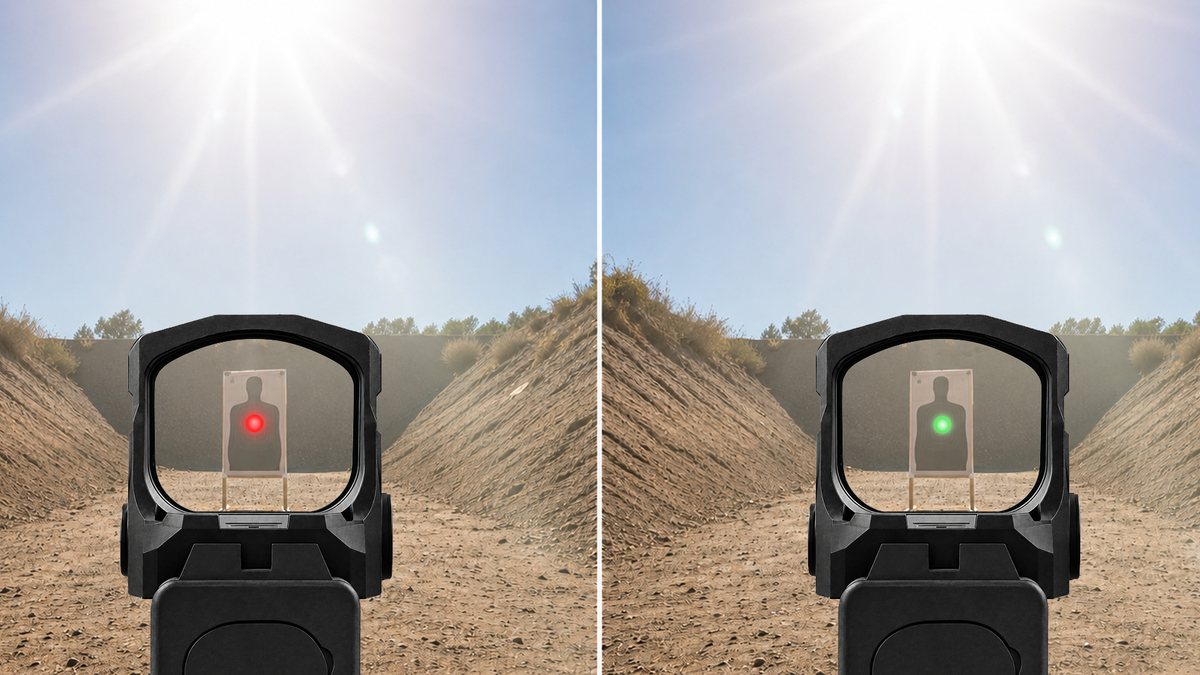
Two versions of the same compact optic sit side by side, one with a red dot and one with a green. The red dot looks a little smeared. The green one looks sharper, or maybe just brighter, or maybe it's only the lighting. It's hard to tell whether you're judging the optic, the room or your own eyes.
Choosing a dot color comes down to three questions. Is the dot sharp for your eyes? Can you find it quickly against the things you aim at, in the light you shoot in? Will it be on when you need it? By the end you will understand how your eye responds to red and green light, why some shooters see a starburst instead of a dot, and how the battery fits into the choice. You will also have a fair way to test both colors yourself. We will not name a winner, because the right answer depends on your eyes, your light, and what you shoot.
How your eye responds to red and green light
Most compact dot sights, often called red dots or reflex sights, work the same basic way. A tiny LED (light-emitting diode) shines onto a curved lens. A coating on that lens reflects the LED's color back toward your eye and lets most other light pass through. The optic is built so this light reaches your eye as if it came from far away. That is why the dot seems to float out on the target instead of sitting on the glass. Whatever color the LED produces is the color of your dot.
Your eye does not respond to every color equally. In daylight it relies on cells called cones, and scientists have measured how strongly they respond to each wavelength of light. Wavelength is measured in nanometers (nm), and it is what sets a color. Blue light has short wavelengths, and red light has long ones. The International Commission on Illumination (CIE) publishes the standard curve for this daylight response. It peaks at 555 nm, a yellow-green. Green sits close to that peak, while red sits far down the slope.
| Color of light | Wavelength | Daylight response compared with the peak |
|---|---|---|
| Green | 525 nm | About 79 percent |
| Yellow-green (the peak) | 555 nm | 100 percent |
| Lighter red | 635 nm | About 22 percent |
| Red | 650 nm | About 11 percent |
| Deep red | 670 nm | About 3 percent |
Suppose a 525 nm green light and a 650 nm red light give off the same amount of light energy. A typical eye in daylight judges the green one to be about seven times as bright. Against the lighter 635 nm red, green's advantage shrinks to a little under four times. Notice how steep the red side of the curve is. Moving from 635 nm to 650 nm cuts the eye's response roughly in half, and moving on to 670 nm cuts what remains by about 70 percent. These shades are real choices, not textbook examples. One company that makes LEDs for sight builders lists red emitters at both 635 and 650 nm and green emitters at 525 and 570 nm. Two dots that are both called "red" may not be the same red.
Do not stretch the table too far. It describes an average eye under standard conditions, not any particular optic. Each maker decides how much power its LED gets and how its brightness steps are spaced, so a red dot on a high setting can easily outshine a green dot on a low one. Bright is also not the same as easy to see. What matters is how well the dot stands out from whatever is behind it, and we come back to that below.
Key idea: At equal power, a typical eye reads green as several times brighter than red. That is a fact about your eye, not a ranking of optics. Whether it helps you depends on focus, contrast, and battery life, and you can test all three.
If you have a color vision deficiency
The National Eye Institute reports that about 1 in 12 men have some form of color vision deficiency. The most common kind makes red and green hard to tell apart. In one form, called protanomaly, certain shades of red look more green and less bright. A dot that looks vivid to a friend might look weak to you. Do not assume green is the fix, though. These conditions vary from person to person, so test both colors and tell your eye doctor that you shoot with a dot sight.
Why a dot can look like a starburst
If you have ever seen spikes or smears around headlights on a dark road, you already know this problem. A dot sight places a tiny, bright point of light in the middle of your view. For some eyes, that is the same challenge as a streetlight at night.
The most common cause is astigmatism. The American Optometric Association describes it as an irregular shape of the cornea (the clear front surface of the eye) or of the lens inside the eye. Instead of being evenly curved like a basketball, the surface is curved more like a football. As a result, the eye cannot bring light to a single point of focus. A point of light, such as your dot, gets stretched into a streak, doubled, or surrounded by rays. Astigmatism is common and is usually present from birth. It can also increase or decrease over time, often in adulthood, so a dot that looked crisp ten years ago can start to smear.
Pupil size changes how bad the smear looks. Your pupil shrinks in bright light and opens wider in dim light. A wider pupil lets light pass through more of the eye's optics, imperfections included. A 2022 study of nearsighted adults found that larger pupils went with larger halos around a light in dim conditions. Picture a shooter who sees a comet-shaped dot at a dim indoor range. Outside at noon, the same optic looks like a tidy point. The optic did not change. The working conditions of the eye did.
Is it your eye or the optic?
Two free checks can tell you where the smear comes from.
- The rotation test: Look through the optic and slowly rotate it a quarter turn around its own axis. If it is mounted, turn the unloaded firearm instead and keep the muzzle pointed in a safe direction. At least one sight maker publishes this check. If the ragged parts of the dot turn with the optic, the optic is the cause. If they stay put while the optic turns, your eye is the cause.
- The camera test: Take a photo through the optic with your phone. The camera lens does not share your eye's shape. If the photo shows a clean dot while your eye sees a smear, the smear is coming from your eye.
Where dot color might help
Different colors of light come to focus at slightly different depths inside the eye, an effect called chromatic aberration. Blue light bends the most and focuses farthest forward. Red light bends the least and focuses farthest back. In adults, the spread from blue to red is about one diopter, the unit eye doctors use for lens strength. A well-corrected eye puts yellow light in sharpest focus, with green slightly in front of it and red slightly behind.
Eye doctors use this effect on purpose. In the red-green part of an eye exam, you compare letters on a red background with letters on a green one. The two colors are chosen to sit about a quarter diopter on either side of yellow, so a well-corrected eye sees both sides equally sharp. If the red side looks sharper, the doctor adds a little minus power, the kind of lens that corrects nearsightedness. If the green side looks sharper, the doctor adds a little plus power.
The same physics applies to your dot. Suppose you are slightly nearsighted at distance, either without glasses or with glasses that are a little weak. A red dot may then look crisper to you than a green one. If your glasses for nearsightedness are a little too strong, green may look crisper. That is one reason two shooters can look through the same pair of optics and honestly disagree. The effect has nothing to do with seeing color, so it applies to shooters with color vision deficiency too.
You will often hear that green dots help with astigmatism. We could not find a controlled study that tested this in shooters, only explanations from optics makers and sellers, plus personal reports. The focus difference between a red and a green dot is a fraction of a diopter, so color alone is unlikely to cure a dramatic starburst. Treat it as a good reason to try green, not a promise.
Fixes, from cheapest to most thorough
Work through these in order. The first steps cost nothing and rule out simple problems before you spend money on a different optic.
- Lower the brightness. Step the dot down until it is just easy to see against your target. A dot brighter than it needs to be makes any smear worse.
- Clean the optic. Wipe the lens and the small window over the LED with a soft lens cloth. A smudge or fingerprint can streak the dot too.
- Check each eye alone, then both together. Each eye has its own prescription, so one eye may smear the dot while the other does not.
- Wear what you shoot in. Test with the glasses or contacts you actually use, because your correction changes what the dot looks like.
- Run the rotation and camera tests. If the flaw follows the optic, contact the maker about service. If it stays with your eye, keep going.
- Try the other color. Compare at settings that feel equally comfortable, and keep the dot size the same so you change only one thing.
- See an eye doctor. Say that you shoot with a dot sight, and bring a sketch of what you see. Astigmatism is usually corrected with glasses that carry a cylindrical prescription or with toric contact lenses.
The first two steps matter most at the start because they are free and remove look-alike problems. The last step is the only one that treats the cause, so do not skip it if the smear persists. The American Academy of Ophthalmology notes that glare and starbursts can also come from dry eye, cataracts, and other conditions, so any new or worsening change deserves an exam. If the smear remains even with good correction, a prism sight is worth a look later. It uses a reticle etched into glass instead of a projected dot, and some makers market prism sights to shooters with astigmatism.
Common mistake: It is tempting to turn the dot up to make it look sharper. Extra light passing through an imperfect eye usually adds glare instead. Step down, not up.
How daylight, dusk, and backgrounds change what you see
Seeing a dot quickly is a contrast problem. The dot has to stand out from the small patch of scene behind it by being brighter, by being a different color, or both. That patch changes every time you move the gun, so no color wins everywhere.
Bright daylight
In bright sun, the dot competes with a brightly lit scene. A color your eye reads as bright has an advantage here, and that is green's head start from the table. Even so, a pale, sunlit target can wash out a dot of either color, so the optic's top brightness setting matters as much as its color. Color contrast is the other half of the story. A green dot over leafy green cover has less color difference to work with, and one LED maker notes that red may be the better choice against a similar shade of green. A red dot over red clay, rust, or a reddish-brown hide has the same problem in reverse. You always see the dot against whatever sits directly behind it, so test it over the surfaces you will really aim at.
Dusk and dim light
Dusk adds a second effect. As light fades, your eye shifts more of the work from cones to rods, the cells built for dim light. Peak sensitivity moves from about 555 nm toward about 507 nm, a blue-green. This is called the Purkinje effect. Red objects in the scene look darker than they did at noon, and the whole scene fades toward gray because rods do not sense color. Rods are also nearly blind to deep red. On the CIE's standard curve for night vision, their response at 650 nm is less than a tenth of one percent of their peak. That is why dim red light has long been used for reading maps and instruments without spoiling night vision.
It is tempting to conclude that a red dot must fade at dusk, but the dot is a special case. The center of your vision, a small spot called the fovea, contains only cones and no rods. When you look straight at the dot, your cones are the cells that see it, even at dusk. What dusk changes most is the background. As color drains from the scene, the dot stands out mainly by being brighter than its surroundings, so the brightness setting starts to matter more than the color. A dot set for noon will glare at dusk and can hide the very target you are trying to see, so turn it down until it is just visible. Whether red's gentleness on night vision gives a red dot a real edge in dim light is a fair question, but we found no test that settles it.
If you hunt at dawn and dusk with a scope, our article on rifle scope reticles applies the same thinking to illuminated reticles.
| Situation | What changes for your eye | What to check in your test |
|---|---|---|
| Bright sun, pale or sunlit target | The dot must stand out against a bright scene, and your pupil is small | Can you find the dot at once, and at what setting? |
| Green cover such as summer timber or a bean field | A green dot has less color contrast over green surfaces | Hold the dot over leaves, grass, and a dark target |
| Brown, tan, or reddish surfaces such as dried stalks, bare dirt, or rust | A red dot has less color contrast over these surfaces | Hold the dot over each surface you will aim at |
| Dawn, dusk, shade, or indoors | The pupil opens wider, colors fade, and any smear grows | Find the lowest setting you can see, and check whether the dot stays crisp |
Use the table by picking the row that worries you most and testing there first. If a color fails in the situation you care about, how it does elsewhere matters less. If you shoot in several settings, favor the color that holds up best in the hardest one.
What the battery and emitter mean for your choice
The emitter is the LED that makes the dot, and it runs on a small battery, often a coin cell. If the battery dies, the dot disappears, so runtime belongs in your decision.
As one example, Leupold's published specifications for its DeltaPoint Pro reflex sight list a CR2032 coin cell, eight brightness settings, and rated runtimes of 1,600 hours on low, 1,000 on medium, and 300 on high. The sight also has a motion sensor that turns the dot off after five minutes without movement and back on when it senses motion. Run the arithmetic. At 300 hours, a dot left on around the clock would last about 12 days. At 1,600 hours, it would last a little over two months. These are the maker's ratings, not independent tests, but they show why brightness is one of the biggest levers you control.
Color raises a second question. The sensitivity table suggests a green LED needs less power than a red one to look equally bright. However, engineers have long struggled to make green LEDs as efficient as red ones, a problem researchers call the "green gap." Published ratings show how those two effects net out for a given sight. Trijicon sells its RMR Type 2 in both colors with the same dot size. It rates the red version for over four years of continuous use at setting 4 of 8 and the green version for two years at that same setting. The same setting number may not look equally bright in both colors, and if green lets you run a lower setting, the gap may shrink. The lesson is not that green always drains faster. It is to read the runtime line for the exact model and color you are considering, at the brightness you expect to use.
Also check where the battery goes. Leupold describes the DeltaPoint Pro's battery as loading from the top of the sight, so you can change it without removing the optic or re-zeroing. On sights where the battery sits underneath, changing it means unmounting the optic, so plan to confirm your zero afterward. Our guide to mounting and sighting in pistol optics walks through how.
Treat the battery as a maintenance item. Write the install date on a piece of tape or in a notebook. Replace the battery on a schedule you set instead of waiting for the dot to dim, and keep a fresh spare of the right type with your gear. Check that the dot comes on before every range trip or hunt. Trijicon also notes that extreme heat or cold affects lithium battery performance, so a battery that seemed fine in September may struggle on a frigid December morning.
A fair test of red against green
A fair comparison is easy to run at a range or at home with the optic in your hands. If a firearm is involved, unload and check it, treat it as loaded, keep the muzzle in a safe direction and your finger off the trigger, and never look at the sun through any optic. Use the same model in both colors and the same dot size if you can (dot size is given in minutes of angle; our guide to understanding MOA explains the unit), wearing the glasses or contacts you shoot in. Against a plain indoor wall, start at the lowest setting and step up, noting where the dot first becomes easy to see and where it starts to glow or smear, then check each eye alone and both together. Outdoors, repeat over bright, dark, tan and green backgrounds, and in shade or dim light if that's where you'll shoot. The color with the wider working window, the range of settings where its dot is both crisp and quick to find, is the one for your eyes for now; if both look the same, color isn't your deciding factor. Tinted shooting lenses filter light, so test with the lenses you'll wear, and repeat the comparison on a second day, because eyes tire and light changes.
Check your understanding
Try answering these before you open the answer. If you can decide what to do and explain why, you have it.
1. At an indoor range, a shooter sees the dot as a comet with a tail. Outside in bright sun, the same optic looks like a neat point. What would you try before blaming the color?
Lower the brightness, clean the lens and the LED window, and test with the glasses or contacts the shooter actually wears. The pupil is wider indoors, so more of the eye's imperfections come into play. The rotation and camera tests show whether the eye or the optic is the source. If the smear persists, an eye exam is the next step.
2. The table puts green near the eye's peak and red far down the slope. Why does that not prove a green dot will be easier to see on a given optic?
The table compares equal light energy for an average eye. Real optics differ in LED power, brightness steps, and the exact shade of the emitter, and a lighter red sits much higher on the curve than a deep red. Visibility also depends on contrast with the surface behind the dot. Only a test with your own eyes settles it.
3. A friend's distance glasses are a little weak, so he is slightly nearsighted when he shoots. Which dot color might look crisper to him, and why?
Red may look crisper. Red light focuses farther back in the eye than green. A slightly nearsighted eye focuses distant light a bit in front of the retina, so the red light lands closer to sharp focus. If he updates his glasses, his preference may change, so he should test again.
4. A hunter wants the dot to last all season. Why does brightness matter so much, and what habits protect the battery?
A brighter dot draws more power. In the Leupold example, the high setting is rated at 300 hours against 1,600 hours on low. Use the lowest setting you can see clearly, let a motion sensor turn the dot off if the optic has one, and check the maker's runtime for the exact color you buy. Replace the battery on a schedule, remember that cold weakens lithium cells, and carry a fresh spare.
Where to go next
Once you know the dot color your eyes prefer, the next question is what kind of optic suits the gun and the job. Our guide to choosing the right optics for pistols compares the main types of pistol optics and the features worth weighing on each.
If this article helped you, we invite you to sign up for email notifications of new blog articles.