
Choosing the Right Optics for Pistols: Enhancing Accuracy and Speed
Joseph McLain Nov 07, 2026
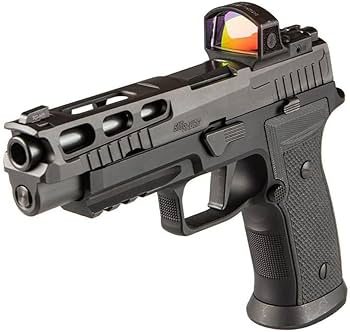
Your pistol's slide is cut for an optic, and the choices include small red dot sights from Holosun, Trijicon, Aimpoint, Vortex and SIG. Some shooters say a red dot made them better shots overnight. Others spent their first month hunting for the dot every time they raised the gun.
Both experiences are common, and understanding why is what lets you choose well. By the end you should be able to say what a red dot changes about aiming, pick one that will actually mount on your pistol, choose between an open and an enclosed design, pick a model for carry, duty or competition, and know what to expect while you learn it.
What a red dot changes
Iron sights ask your eye to line up three things at three distances: rear sight, front sight and target. Your eye can focus on only one distance at a time, so something is always blurry, and lining them up takes time. A pistol red dot puts a single lit dot on a small window, and the dot appears to sit on the target itself. You keep your focus on the target, which is where it naturally goes under stress, and put the dot on it. That's why a dot is faster once you've learned it, and why it's easier for eyes that struggle to focus on a front sight.
The catch is finding the dot. With iron sights, a bad grip shows you the sights out of line and you correct. With a dot, a bad presentation means the dot simply isn't in the window, and new users waste time searching for it. The cure is practice raising the pistol the same way every time, which is why many shooters find their first month frustrating. Iron sights tall enough to see through the window (co-witness sights) help, because they guide your eye to the dot and back you up if it fails.
Key idea: A red dot doesn't fix a grip or trigger problem; it shows you one more clearly. Its advantage is that you aim while looking at the target, and that advantage arrives after you've practiced finding the dot.
First, will it fit? The footprint
Every optic has a footprint, the pattern of screw holes and recesses on its base, and it must match your slide cut directly or through an adapter plate. Most mistakes happen here. The common footprints are:
- RMR. The most widely used, named for the Trijicon RMR. Holosun 407C, 507C and 508T, and Trijicon SRO and RCR use it. Many full-size and compact optics-ready pistols take it, directly or with a plate.
- RMSc (Shield). A smaller footprint for micro-compacts such as the SIG P365 and Smith & Wesson Shield. The Holosun 507K uses a modified version, which may not fit every Shield-pattern cut, so confirm before buying.
- ACRO. For enclosed optics such as the Aimpoint ACRO P-2; usually needs a specific plate or slide cut.
- DeltaPoint Pro. Used by Leupold's DeltaPoint Pro and some other makers' optics.
Find your pistol's footprint from its maker, then buy an optic with that footprint or the plate that converts it. If your pistol came with several plates, the one that matches your optic is the one to use.
Open or enclosed emitter?
The dot is projected by a tiny LED, the emitter, at the back of the optic. On an open optic the emitter is exposed, so rain, snow, lint or mud can cover it and the dot disappears. An enclosed optic seals the emitter inside a box with glass at both ends, so debris can't block it, and the closed housing tends to survive drops and knocks better. Enclosed optics are a little larger and cost more.
- If the pistol rides inside your waistband under clothes every day, or you're in rain, dust or snow often, choose enclosed, because lint and weather are what take an open emitter out of action.
- If the pistol lives in a nightstand or at the range, an open optic is fine and gives you a bigger window for the money.
Which optic
These recommendations draw on long-term reviews, including Recoil magazine's buyer's guide to pistol dots.
- If you want the best value for a full-size or compact pistol, choose the Holosun 507C. It has an aluminum housing, a battery that changes from the side without removing the optic, a long battery life and a choice of a dot or a circle around a dot.
- If you want the proven benchmark for hard use, choose the Trijicon RMR. Its durability record is the longest of any pistol dot. Its drawback is that the battery is underneath, so you remove the optic and re-zero to change it.
- If you want enclosed and can afford the best, choose the Aimpoint ACRO P-2. If you want enclosed for less, choose the Holosun 509T.
- If you carry a micro-compact such as a P365 or Shield, choose the Holosun 507K or a Vortex Defender CCW, after confirming it fits your slide cut.
- If you shoot competition and want the biggest window, choose the Trijicon SRO. It's easier to find the dot through, but it's less durable than the RMR and not built for carry or duty.
If you're not sure, start with the Holosun 507C, or the 507K for a micro-compact.
Dot size
Dot size is given in MOA, an angle; a 3 MOA dot covers about 3/4 inch at 25 yards. A bigger dot is easier to find quickly but covers more of a small target. For most pistol shooters, 2 to 3 MOA is the sweet spot: small enough for a precise shot at 25 yards and big enough to pick up fast. A circle-dot reticle, a large circle around a small dot, helps new users find the dot during the presentation and still gives a precise aiming point.
Common mistake: Buying an optic first and finding out later that it doesn't fit the slide. Confirm the footprint, and which plate it needs, before you pay.
Mounting it so it stays put
Mount the optic with the pistol unloaded, the magazine out and ammunition in another room. Use the screws that came with your plate or optic, since the wrong length can bottom out or reach the firing pin channel, tighten them to the maker's torque with a small torque driver, and use the thread locker the maker recommends. A loose optic loses its zero. Then zero it at the range at the distance you'll shoot most, commonly 15 to 25 yards, with eye and ear protection on. Our guide to mounting and sighting in pistol optics walks through each step.
After that, change batteries on a schedule rather than waiting for the dot to die; once a year on a carry pistol is a sensible habit, and many shooters do it on a birthday so they don't forget. Check the screws now and then; a dot that suddenly shoots somewhere new often has a loose screw.
What about magnified pistol scopes?
Magnified scopes on handguns serve one narrow job: handgun hunting with a long-barreled revolver or single-shot pistol, where a deliberate shot at 75 or 100 yards needs a clearer view of the target. They're bulky, need careful eye placement and slow you down up close, so they have no place on a carry or home-defense pistol. If you hunt Iowa deer with a handgun, our guide to handgun deer hunting in Iowa covers what's legal.
Check your understanding
Try answering these before you open the answer. If you can decide what to do and explain why, you have it.
1. You carry a SIG P365 inside your waistband every day. Which kind of optic, and what do you check first?
Check the footprint first: the P365 takes the smaller RMSc-pattern optics, so confirm the model fits your cut. Then lean toward an enclosed optic, or at least one you keep clean, because lint and sweat are what blind an open emitter on an everyday carry gun.
2. You put a dot on your pistol and keep losing it when you raise the gun. Is the optic the problem?
Almost certainly not. Your presentation isn't putting the pistol in the same place each time. Practice raising it slowly with the unloaded pistol, focusing on the target, until the dot appears without searching. Co-witness iron sights help guide you to it.
3. A friend's Trijicon RMR battery died, and he's annoyed that he has to re-zero. What would you suggest for his next optic?
One with a side or top battery that changes without removing the optic, such as the Holosun 507C. And for the RMR, change the battery on a schedule, so it never dies at a bad time.
4. You shoot USPSA Carry Optics and want the dot that's easiest to find quickly. Which one?
The Trijicon SRO, because its large window makes the dot easiest to pick up. It's less durable than the RMR, which is fine for competition and the reason not to carry it.
5. Your zero shifted after a range session, and the optic wiggles slightly when you push on it. What happened, and what do you do?
The screws have loosened. Unload the pistol, remove the screws, clean the threads, apply the recommended thread locker, torque to the maker's specification and re-zero.
Where to go next
You can find Holosun 507C optics and RMR-pattern mounting plates on our website, and anything listed there can be ordered if it isn't in stock.
To install and zero your optic, read mounting and sighting in pistol optics. For more on choosing a dot, see pistol optics. And because a dot shows every grip and trigger mistake, pistol shooting fundamentals is worth reviewing as you learn it.
If this article helped you, we invite you to sign up for email notifications of new blog articles.