
Proper Gun Storage: Safeguarding Your Firearms and Ammunition
Joseph McLain Nov 07, 2026
You just brought home a new handgun, inherited your grandfather's rifles, or learned the grandkids are coming to the farm for a week. Does Iowa leave storage up to you? Does every gun belong in a big safe? Is a home-defense pistol locked in a safe useless when you need it?
By the end you should know what federal and Iowa law actually say and why the law is only a starting point, how layered storage works, how to choose among a full-size safe, a cabinet and a quick-access safe, how to store ammunition, and how to balance a home-defense handgun's readiness against keeping it from children and visitors, so you can decide how each firearm in your home should be stored and why.
What the law says
Federal law does not tell gun owners how to store firearms in their homes. It does place a duty on sellers: A licensed dealer selling a handgun must provide a secure gun storage or safety device, such as a lockable case or a cable or trigger lock, with it. That is why most new handguns come with a lock in the box.
Iowa law addresses children in particular. Under Iowa Code section 724.22, it is a serious misdemeanor to store or leave a loaded firearm that is not secured by a trigger lock, placed in a locked box or container, or kept somewhere a reasonable person would consider secure from a child under 14, when you know or have reason to believe a child under 14 is likely to get to it, and the child then gets the firearm without permission and displays it unlawfully in public or uses it unlawfully to injure or kill someone. The law does not apply if the child got the firearm through someone's unlawful entry. Iowa law also sets rules on when minors may possess firearms and under whose supervision. This is general information, not legal advice; for your situation, check the current Iowa Code or ask a qualified attorney.
The law sets a floor, and it focuses on the worst outcomes after the fact. Good storage aims to prevent the situation from arising at all.
Key idea: The law sets a minimum. Good storage answers a broader question: Who can reach this firearm right now, and who should not be able to?
Storage in layers
Any single safeguard can fail. A key gets left in a lock, a code gets shared, a safe door is left ajar, a child watches you dial the combination. Layers mean one lapse does not leave a firearm both loaded and reachable.
Picture the way a bank protects cash: A locked vault, inside a locked building, with an alarm, and cash counted out only when needed. Each layer makes up for the others' weaknesses. For firearms, the usual layers are storing them unloaded, locking them in a container or with a lock, keeping ammunition separately locked, and controlling who knows the code or has the key.
Not every firearm needs every layer. A deer rifle used twice a year can be unloaded, locked in a safe, with ammunition locked elsewhere. A home-defense handgun is a deliberate exception covered below. Give each firearm as many layers as its purpose allows.
Choosing a safe or cabinet
Before you shop, answer three questions: How many and what kinds of firearms you need to store, how quickly you need to reach them, and how much protection from theft and fire you want.
| Container | Good for | Strengths | Trade-offs |
|---|---|---|---|
| Full-size gun safe | Several long guns and handguns, plus valuables | Most theft resistance; many offer fire ratings | Heavy, expensive, slower to open |
| Steel gun cabinet | A few rifles and shotguns on a budget | Keeps children and casual visitors out; affordable; easier to move | Thin steel; little theft or fire protection |
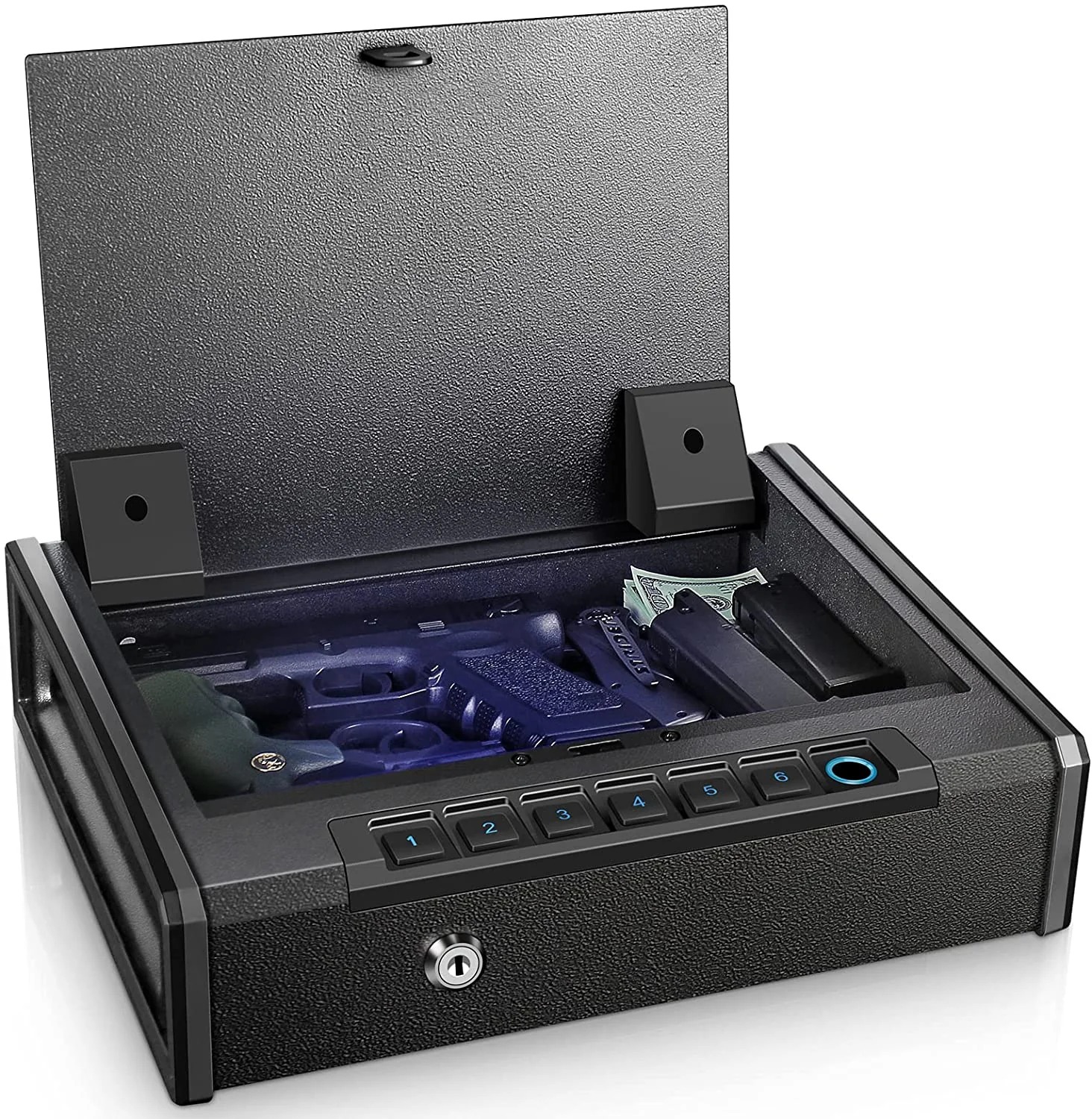
| Quick-access handgun safe | One or two handguns needed quickly | Fast keypad, biometric or mechanical entry; fits a nightstand or closet | Small; often easier to pry open or carry off unless bolted down |
| Lockable case and cable lock | Transport and minimal home storage | Inexpensive; included with many handguns | Controls access but offers little theft protection |
Start with the trade-offs column, because each container's weakness mirrors its strength. A full-size safe is the strongest but slowest; a cabinet keeps children out but not a determined thief; a quick-access safe is fast but small. A common label you will see is "RSC," for Residential Security Container, a basic burglary test standard; fire ratings vary widely by test and duration, so read what a rating actually means before relying on it. Bolt any safe to the floor or wall following the maker's instructions, because an unbolted safe can be carried away and opened elsewhere.
Buy for where your collection is going, not just where it is today, since most owners outgrow their first safe, and to pair a full-size safe for long-term storage with a quick-access safe for a defensive handgun if you need both.
Common mistake: Expecting one container to do every job. A nightstand safe has no room for rifles, and a thin cabinet is not a fire-resistant safe. Match each container to its job.
Humidity and the condition of your firearms
A steel safe keeps people out but can trap damp air in, especially in Iowa basements and outbuildings. Moisture leads to rust on bores, actions and finishes, and to damaged wood stocks. Keep firearms in a climate-controlled part of the house when you can, use a rechargeable desiccant or an electric dehumidifier rod inside the safe, wipe firearms with a lightly oiled cloth before storing them, and check them a few times a year. Our guide to handgun finishes explains how different finishes resist corrosion.
Storing ammunition
Ammunition is durable when kept cool and dry, and unreliable or unsafe when exposed to heat and moisture for long periods. Store it in sealed containers, such as ammunition cans with rubber gaskets, away from heat sources, and add a desiccant pack. Rotate stock by using older ammunition first, and inspect it for corrosion, dents or loose bullets. Keep it locked and, ideally, separate from firearms, which adds another layer between a curious child and a loaded gun. Our guide to best practices for storing ammunition goes deeper.
Home-defense handguns: Readiness versus access
A handgun kept for home defense creates a real tension: It needs to be reachable in seconds by you, and unreachable by children, visitors and thieves. A quick-access safe with a keypad, biometric reader or mechanical buttons is the usual answer, because it opens quickly for the person who knows the code and stays locked for everyone else.
A few habits make that work. Bolt the safe down. Practice opening it in the dark, under a little time pressure, with an empty firearm, so you can do it when startled. Choose an entry method you can operate reliably; some people find biometric readers inconsistent with dry or wet fingers, while keypads and mechanical buttons depend on remembering the code under stress. Keep fresh batteries in electronic safes and know where the backup key is kept, and make sure that key is itself secured. Hidden compartments in furniture can conceal a firearm, but concealment is not a lock; children are very good at finding things.
Whenever the handgun is not under your direct control, on your body or in your hand, it should be locked. If you carry, the same rule applies when you take it off at night or before a shower.
Safety: Every time you take a firearm out of storage, treat it as loaded: Muzzle in a safe direction, finger off the trigger, and check the chamber yourself. Our firearm safety rules for beginners explain why.
When children and visitors are in the house
Children are curious and often know more about where things are kept than adults realize. When grandchildren or guests are visiting, do a quick walk-through: Every firearm locked or under your direct control, keys and codes not where children can find or watch them, and ammunition locked. Talk with older children about what to do if they ever find a firearm: Do not touch it, leave the area and tell an adult. Ask the same questions of homes your children visit; it is a common and respectful question among parents.
A 20-minute storage check
A short walk through the house shows where your storage stands. For each firearm, with the muzzle in a safe direction and the firearm confirmed unloaded before you handle it, the questions are where it is kept, who could reach it today, and whether it is locked in a container or secured with a lock. Then come the keys, combinations and codes: where they are kept and who knows them. Each storage spot gets checked for dampness, rust and a working desiccant or dehumidifier, and the ammunition for being sealed, dry, rotated and locked. Storage is right when every firearm and box of ammunition has an assigned, locked home and you can say who can open each one, and the biggest gap you find is the one to fix first.
Putting it together
Federal law requires dealers to supply a lock or storage device with handguns, and Iowa law penalizes leaving a loaded, unsecured firearm where a child under 14 is likely to get it and then misuses it. Those are minimums. Good storage layers safeguards so that no single lapse leaves a firearm loaded and reachable: Unloaded, locked, ammunition separate, keys and codes controlled. Match containers to jobs, with a full-size safe for the collection and a bolted-down quick-access safe for a defensive handgun, control humidity, and store ammunition cool, dry and locked. Whenever a firearm is not under your direct control, it should be locked.
Check your understanding
Try answering these before you open the answer. If you can decide what to do and explain why, you have it.
1. A neighbor says Iowa has no storage law, so nothing needs to be locked. What is missing from that claim?
Iowa Code section 724.22 penalizes leaving a loaded, unsecured firearm where you know a child under 14 is likely to get it, if the child then misuses it. And the law is a minimum, not a standard of good practice.
2. Your deer rifles are in a locked safe, and the ammunition sits on a shelf beside it. Why lock the ammunition somewhere else?
It adds a layer. If someone gets into one, they don't automatically have the other.
3. You bought a small quick-access safe for your bedside handgun. Why bolt it down?
Small safes can be carried away and pried open elsewhere. Bolting it down keeps it, and the handgun, where it is.
4. Your father kept his revolver in a hidden drawer compartment that "nobody knew about." Why isn't that enough?
Concealment isn't a lock. Children and thieves are good at finding hidden spaces, so the compartment should also lock.
5. You keep a home-defense handgun ready at night. When should it be locked?
Whenever it isn't under your direct control, on your body or in your hand. When you leave the room, leave the house or have visitors, it goes into a locked quick-access safe.
Where to go next
You can find SnapSafe lockboxes for handguns on our website, and anything listed there can be ordered if it isn't in stock.
When your firearms leave the house, how to safely transport your firearms covers the other half of keeping them secure. Best practices for storing ammunition goes deeper on keeping ammunition reliable, and firearm safety for beginners explains the habits behind every storage decision. If you keep a handgun for home defense, selecting personal and home defense ammunition is the next decision.
If this article helped you, we invite you to sign up for email notifications of new blog articles.