
A Guide to Firearms Accessories: Scopes, Slings, Bipods, and More
Joseph McLain Nov 06, 2026
You have a new rifle at home, and the accessory wall at the store is a lot to take in. One friend says the first thing you need is a better scope. Another says a good sling and a bipod will do more for your shooting than any optic. A third says skip the accessories and spend the money on ammunition and practice. Each of them is right about something. This guide explains what each family of accessories does, how to match it to a problem you actually have, what it costs you in weight, money or complexity, and how to test whether it helped. By the end you should be able to name the problem you have, choose the kind of accessory that fixes it, and measure the result.
Start with the problem, not the product
Each accessory family does one job. Optics help you see and aim. Slings help you carry the firearm and steady it. Bipods and rests hold the front end still. Grips improve how your hands control it. Lights help you identify what you are pointing at in the dark. Muzzle devices change how the firearm moves and what it does to the people around it when it fires.
Think of a doctor who listens to the symptoms before writing a prescription. An accessory is a prescription; it only helps if it treats the symptom you have. Every accessory also adds something, whether weight, cost, bulk or another part that can loosen, so an accessory that solves nothing makes the firearm worse.
Key idea: An accessory earns its place by fixing something you noticed at the range or in the field. If you cannot describe the problem in one sentence, wait before you buy.
Optics: Matching the sight to the distance
Scope numbers read in a simple pattern. In a 3-9x40 scope, the 3-9x is the magnification range, from three to nine times closer than the naked eye, and the 40 is the front lens diameter in millimeters. A bigger front lens gathers more light but adds weight and height. More magnification is not automatically better, because it also magnifies your wobble and narrows the area you can see. Our guide to what the numbers on a rifle scope mean goes deeper.
| Sight type | Magnification | Best suited to |
|---|---|---|
| Red dot | None | Fast aiming at close to medium range, with both eyes open |
| Holographic | None | Similar to a red dot, with a reticle that stays usable as your head moves |
| Prism | Fixed, usually low | Compact low-power sight with an etched reticle that works without a battery |
| Fixed-power scope | One setting | Simple, rugged choice for one kind of shooting at known distances |
| Variable-power scope | Adjustable, such as 3-9x | Hunting and target shooting where distances vary |
Read the table from your shooting toward the sight, not the other way. A deer hunter shooting across open fields one day and brush the next wants a variable scope. Someone moving quickly at close range wants a red dot or holographic sight. A shooter who always shoots one known distance can choose a simpler fixed-power scope. The rule is to choose the lowest magnification that lets you see your target clearly at the longest distance you will shoot. Handgun shooters have their own questions, covered in choosing the right optics for pistols.
Slings: Carrying comfortably and steadying your hold
A sling lets you carry a rifle or shotgun for hours with your hands free, and a good sling can also steady your aim when you wrap your support arm into it. The number of attachment points changes how it behaves. A shoulder bag on one strap swings and shifts; a backpack on two straps rides still and spreads the weight.
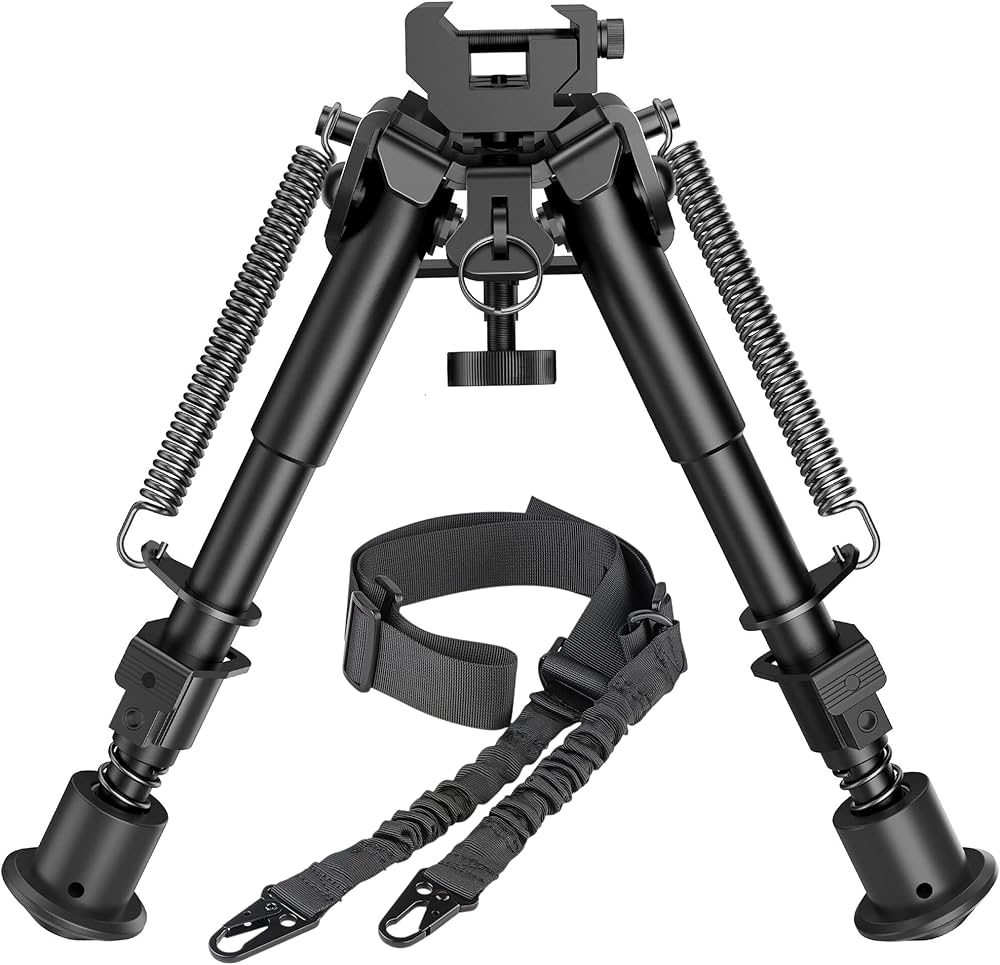
A single-point sling attaches near the rear of the firearm and lets it hang in front of you, which allows quick movement but lets the firearm swing. A two-point sling attaches front and rear, carries comfortably over the shoulder and can be used as a shooting aid, which is why most hunters choose it. Three-point slings are less common and mainly used in tactical settings. Padded or wider straps spread the weight of a heavy rifle; quick-adjust slings let you tighten the sling for carry and loosen it to shoot.
The rule is to start with a two-point sling for hunting and general use. A sling never replaces muzzle control: Keep the muzzle in a safe direction while it is slung, and unload the firearm before crossing a fence, ditch or other obstacle.
Bipods and rests: Taking the wobble out of the shot
Movement at the rifle is multiplied by distance and by magnification, so a steady front end removes one of the biggest errors you can control. A bipod attaches to the rifle and goes where it goes. Fixed-height bipods are simple and light; adjustable bipods let you level the rifle on uneven ground and shoot from prone or sitting. Rests and shooting bags stay at the bench and do not add weight to the rifle; sandbags and padded rests are the standard tools for sighting in and testing ammunition.
A rest tells you what the rifle and ammunition can do, and your field position tells you what you can do. That difference matters: A rifle that groups well from a bench may group much larger from shooting sticks or a sitting position. The rule is to use a rest for zeroing and testing, then confirm your skill from the position you will actually shoot from in the field. Our guide to sighting in rifles at different distances explains the bench routine.
Good practice: A bipod on a hard bench surface can bounce under recoil and change your group. Load the bipod by leaning gently forward into it, the same way every shot.
Grips and foregrips: Control and comfort
A grip gives your hands a better place to hold, which improves control and reduces fatigue. On rifles and carbines with a rail, a vertical foregrip gives the support hand an upright hold, and an angled foregrip lets the hand sit closer to the barrel's line for a more natural wrist angle. Replacement pistol grips on rifles change the angle and size of the trigger-hand hold, which affects how comfortably you reach the trigger.
The rule is to add a grip only when your hand is telling you something: A support hand that tires or slips, or a trigger hand that feels cramped. Whatever you choose must fit your rail system, so read choosing the right rail system before buying.
Lights and lasers: Identifying in low light
A weapon-mounted light lets you identify a target in the dark while keeping both hands on the firearm, which is why it is common on home-defense firearms. Lasers project a dot on the target; green lasers are easier to see in daylight, and red lasers are effective in low light.
The big idea here is safety. A mounted light shines wherever the muzzle points, so using it to search a dark room or yard means pointing a firearm at everything you look at, including family members. Search with a handheld light, and use the mounted light only to identify a target you have reason to believe is a threat. Always know your target and what is beyond it. Our firearm safety rules for beginners apply to every accessory here.
Hunting rules also matter. Iowa and other states restrict the use of lights and lasers for hunting, and Iowa limits hunting hours and the use of artificial light for most game. Check the Iowa DNR regulations, or your state wildlife agency's rules, before you mount a light or laser for hunting. The rule is that a light belongs on a defensive firearm only if you also carry a handheld light for searching.
Muzzle devices: Recoil, rise and flash
Muzzle devices use the gas leaving the barrel, and each type targets a different symptom.
| Device | What it does | What it costs you |
|---|---|---|
| Muzzle brake | Redirects gas sideways and back to reduce felt recoil | Much louder and harsher blast for you and those beside you |
| Compensator | Directs gas upward to reduce muzzle rise | More blast and noise; most useful for fast follow-up shots |
| Flash hider | Reduces the visible flash in low light | Little effect on recoil |
Choose by symptom. Heavy kick suggests a brake, a lifting muzzle a compensator, and a flash that blinds you at dusk a flash hider. Because brakes and compensators send more blast sideways, they make good eye and ear protection even more important, and they can annoy people next to you on a range bench or in a hunting blind. Installing a muzzle device requires the right thread pitch and correct timing, so have a qualified gunsmith install it if you are unsure. On a rifle with a barrel near the federal 16-inch minimum, only a permanently attached device counts toward barrel length; ask a gunsmith or check ATF guidance before changing anything.
Putting it together
Accessories are prescriptions for specific problems. Optics fix seeing and aiming, slings fix carrying and steadying, bipods and rests fix wobble, grips fix control, lights fix identification in the dark and muzzle devices fix recoil, rise or flash. Each adds weight, cost or complexity, so add one only when you can name the problem, choose the type that treats it, install it correctly, and measure whether it helped. Change one thing at a time, so you know which change made the difference, and remember that practice often fixes more than parts do.
Common mistake: Adding several accessories at once. If your groups get worse, you will not know which change caused it.
Try this: A before-and-after test
- Write the problem in one sentence, such as "My shots wander when I shoot prone."
- Pick a measure. For a scope, bipod or rest, shoot a five-shot group from one position and note its size. For a sling, note how your shoulders feel after your usual carry.
- With the firearm unloaded, the action open and ammunition out of the room, install the accessory and confirm it is tight and compatible.
- At the range, wearing eye and ear protection, repeat the same measure under the same conditions.
- Write down both results and keep the accessory only if the measure improved.
You will know it worked when you can point to a measured change, such as a tighter group or an easier carry.
Check your understanding
Try answering these before you open the answer. If you can explain it in your own words, you understand it.
1. You hunt over an open field one day and thick brush the next. Which kind of optic fits, and why?
A variable-power scope, because adjustable magnification handles both long and close shots.
2. Why can high magnification make an unsteady rifle harder to shoot, and what helps?
Magnification also magnifies your wobble. A bipod, rest or sling steadies the front end.
3. Your carbine's muzzle lifts and follow-up shots are slow. Which device fits?
A compensator, which directs gas upward to counteract muzzle rise.
4. Why should you not use a weapon-mounted light to search a dark yard?
It lights wherever the muzzle points, so you would be pointing the firearm at everything you look at. Search with a handheld light.
5. Your rifle groups well from a bench but poorly from shooting sticks. Is a new scope the answer?
Probably not. The rifle has shown what it can do; the difference is the field position, so practice from sticks or add support such as a sling.
Where to go next
If a scope is your next purchase, start with the beginner's guide to mounting a rifle scope, since a good scope on a poor mount will not help you, then use the guide to sighting in a rifle scope to confirm your zero. Choosing the right rail system explains how grips, lights and bipods attach, and choosing the right optics for pistols applies the same problem-first thinking to handguns.
Explore our optics and accessories, and let us know if there's something you'd like that we don't have on the website or in stock.
If you found this informative, we invite you to sign up for email notifications of new blog articles.