
Speer Gold Dot Ammunition In Detail
Joseph McLain Nov 07, 2026
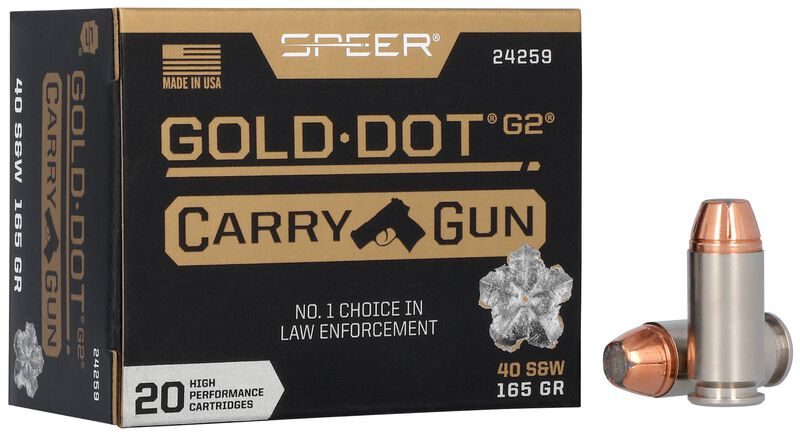
Speer Gold Dot isn't one product but a family: standard Gold Dot, Short Barrel, G2, Carry Gun and Rifle, each in its own box. Maybe you carry a small pistol concealed, keep a full-size handgun at home and have an AR-15 in the closet. Should you buy whatever Gold Dot the local police carry, or are the variants mostly marketing? Which box goes with which gun, and does the difference matter?
By the end you should understand what makes Gold Dot bullets work and how each variant is built for a different job, so you can pick the right variant, caliber and bullet weight for your firearm and purpose, and confirm the choice before you rely on it.
The problem Gold Dot was built to solve
Speer's Gold Dot line has been a mainstay in the law enforcement and personal-defense community for decades. It was developed to address two problems found in earlier hollow-point designs, which were core-jacket separation and inconsistent expansion. A bullet like this is a lead core wrapped in a copper jacket. When it hits something hard and begins to open, the force can strip the jacket away from the core. A bullet that comes apart loses weight, and a lighter bullet has less behind it to push through the target, which can hamper penetration.
Gold Dot's answer is Uni-Cor bonding, in which Speer chemically bonds the copper jacket to the lead core. Think of the difference between plywood and a loose stack of boards. Glued layers move and flex as one piece, while loose boards slide and split apart. When a bonded bullet mushrooms, the jacket peels back into "petals" (the flower-like points of metal you see on a recovered bullet), and the bonding holds those petals together. The result is a consistent diameter, better integrity through barriers, controlled expansion, deep penetration and high weight retention. The traditional Gold Dot pairs a pre-fluted lead core with that chemically bonded jacket, so it expands into consistent petals without losing significant weight.
Key idea: Bonding is about keeping the bullet in one piece. A bullet that stays together can do both of its jobs: It opens up, and it keeps driving deep enough to be effective.
The hollow-point cavity matters as well. In each caliber it is tuned to expand within FBI protocol penetration depths of 12 to 18 inches in ballistic gel. Ballistic gel is a standardized test medium that lets different bullets be compared fairly, and we explain it in our article on the role of ballistic gelatin. That window exists because there are risks at both ends. A bullet that stops too shallow may not do its job, and one that goes too deep raises over-penetration concerns.
Gold Dot is also designed to be "barrier blind," meaning it performs consistently even after striking glass or sheet metal, which is a critical requirement for law enforcement. And it shows minimal fragmentation. The bullet retains a large portion of its mass, which reduces the risk of over-penetration from fragmented pieces. Together, these traits explain why Gold Dot has a reputation for consistent performance across a wide range of velocities and barriers, and why it is a top choice for law enforcement, concealed carriers and civilians alike.
Choosing among the Gold Dot variants
Speer offers several Gold Dot variants, each targeting specific platforms and applications. In practice, choosing among them comes down to two questions. How long is your barrel, and what might the bullet have to get through before it reaches its target?
| Variant | Best for | What sets it apart |
|---|---|---|
| Standard Gold Dot | Self-defense, everyday carry and duty use in full-size and compact pistols | The classic bonded design, with a long record among law enforcement |
| Gold Dot Short Barrel | Subcompact or snub-nose revolvers and concealed carry guns with barrels typically under 3.5 inches | Specialized powders and bullet geometry for lower velocities |
| Gold Dot G2 | Law enforcement and advanced personal defense that need barrier-blind performance | An elastomer-filled cavity instead of a traditional hollow point |
| Gold Dot Carry Gun | Concealed carry in compact pistols | The G2 design engineered for short-barreled carry pistols |
| Gold Dot Rifle | Law enforcement carbines, home defense AR-15s and hunting | Bonded soft point or hollow point built for rifle velocities |
The table gives you the quick map. Read down the "Best for" column and find your own situation, then use the sections below to understand why that variant is built the way it is. When two rows seem to fit, the reasons that follow will help you decide.
Standard Gold Dot: The proven starting point
The classic Gold Dot covers bullets from .380 ACP to .45 ACP, plus revolver calibers like .38 Special and .357 Magnum. It uses standard defensive bullet weights (for example, 115 to 147 grains in 9mm) and provides balanced expansion and penetration, with consistent penetration depths of about 14 to 16 inches in gel. Its pros are a proven track record with decades of use among law enforcement, and extensive ballistic testing that ensures each caliber meets typical FBI performance standards. If your handgun is a full-size or compact pistol and you have no unusual requirements, this is the sensible place to start.
Gold Dot Short Barrel: Why barrel length changes the ammunition
A bullet is pushed by expanding gas, and the barrel is the track it travels on while that push is happening. A shorter barrel gives the gas less distance to work, so the bullet leaves the muzzle at a lower velocity. That matters because a hollow point depends on speed to open reliably. A bullet designed for the velocities of a full-size pistol might open less than it should when fired from a very short barrel.
The Short Barrel variant answers this with specialized powders and bullet geometry that achieve reliable velocity and expansion from shorter barrels. It maintains adequate penetration and rapid expansion at the lower muzzle velocities of short-barreled firearms. Some loads also incorporate slightly milder recoil, which is crucial in lightweight concealed carry handguns, and it minimizes muzzle flash for improved performance in low-light defensive shooting. It is calibrated to minimize excessive over-penetration, a critical factor in close-quarters self-defense.
Gold Dot G2: Preventing a clogged hollow point
A traditional hollow point is like an open cup. If the cup packs with heavy clothing or other material before the bullet reaches its target, it may not open as designed. The G2 bullet solves this by filling the cavity. It uses an elastomer (a soft, rubber-like material) in a filled resin cavity, with a shallow dish in the nose, instead of a traditional hollow point. That prevents clogging when the bullet meets heavy clothing or barriers, and even when the bullet is partially obstructed, the elastomer initiates reliable expansion.
The G2 keeps the weight retention of the bonded design, and it provides uniform expansion across a wider range of velocities and barrier conditions, which yields a predictable wound channel for both law enforcement and advanced personal defense. It typically penetrates 14 to 18 inches in ballistic gel, aligning with stringent FBI standards. If you expect your bullet to meet clothing, glass or other obstacles first, G2 is built for that.
Gold Dot Carry Gun: The G2 idea for small pistols
The Carry Gun variant takes the G2 line and engineers it for the unique challenges of short-barreled, concealed carry pistols. It uses modified powder loads and bullet profiles to account for the lower muzzle velocities typical of compact pistols, so that expansion is reliable and penetration is consistent. The 9mm load uses a 135 gr bullet; check Speer's current list for other calibers. It is designed to deliver controlled expansion and adequate penetration from short barrels while limiting over-penetration. It also meets the criteria for reliable expansion when passing through common concealment barriers such as heavy clothing, which is why it is a favorite among concealed carriers and home defense practitioners.
You may notice that Short Barrel and Carry Gun both target compact guns. As a general sorting rule, Short Barrel is aimed at subcompact and snub-nose revolvers and at barrels typically under 3.5 inches, while Carry Gun is aimed at compact concealed carry pistols that favor a smaller, more manageable firearm.
Gold Dot Rifle: Bonded construction at rifle speeds
Rifle bullets travel much faster than pistol bullets, and the forces on the jacket are much greater. The Gold Dot Rifle line uses a bonded soft point or hollow point designed for rifle cartridges, offering reliable expansion at higher velocities while minimizing fragmentation. It surpasses many standard FMJ or unbonded soft points in weight retention and consistency during short- to mid-range engagements. It is offered in cartridges like .223 Rem, .300 BLK and .308 Win, each emphasizing bonded or soft-point designs for defensive or law enforcement roles. Because rifle cartridges carry more energy than pistol rounds, knowing what is behind your target matters even more.
Gold Dot Rifle is listed for law enforcement carbines, home defense AR-15s and hunting applications, including small-game hunting and hunting hogs at close range. Hunting rules about which cartridges and bullets are legal vary by state, so check with your state's wildlife agency first. Our article on hunting licenses, tags and firearm restrictions in Iowa and neighboring states is a good place to begin.
Caliber and bullet weight: Reading the options
Gold Dot covers a wide range of popular handgun calibers. Weight is stated in grains (gr), a unit of bullet mass, and the options within each caliber let you tune the load to your preference.
| Caliber | Typical Gold Dot weights | Notes |
|---|---|---|
| .380 ACP | 90 to 95 gr | For compact, lightweight defensive carry |
| 9mm Luger | 115, 124, 124 +P and 147 gr | Accommodates a variety of performance preferences |
| .40 S&W | 155, 165 and 180 gr | Robust defensive performance |
| .45 ACP | 185, 200 +P and 230 gr | Balances stopping power with manageable recoil |
| .357 Magnum / .38 Special | 125, 135 and 158 gr | Revolver calibers |
| .357 SIG | 125 gr | Standard weight |
| Additional calibers | Varies | Some specialized loads exist for calibers like .327 Federal Magnum |
The table shows that most calibers offer a spread of weights, so you are choosing within a caliber as well as between them. In general, a heavier bullet in the same cartridge travels a little slower and a lighter one a little faster, so the weights trade velocity for mass. The "+P" label means a load is made to a higher pressure than standard, so check your firearm's manual to be sure it is rated for +P. For rifle applications, Gold Dot is offered in .223 Rem, .300 BLK and .308 Win.
Here is the decision that ties the variants and calibers together. For short barrels under 3.5 inches, choose the Gold Dot Short Barrel variant. For standard or extended barrels, choose standard or G2 loads, and consider the Carry Gun variant for concealed carry platforms. For everyday carry, the 9mm Gold Dot Carry Gun load (135 gr) is designed to provide a good mix of expansion and penetration while ensuring user-friendly recoil. If you are not sure which caliber suits you, our personal protection caliber comparison helps.
Gold Dot compared with other premium defensive ammunition
| Feature | Speer Gold Dot | Federal HST | Hornady Critical Duty/Defense |
|---|---|---|---|
| Bullet construction | Bonded core-jacket with Uni-Cor bonding | Advanced lead-core design (non-bonded) | FTX or FlexLock with polymer tip/cavity |
| Expansion consistency | Excellent, with reliable petal formation | Also top-tier and proven in field tests | Effective expansion, especially in Critical Duty variants |
| Short barrel performance | Gold Dot Short Barrel excels in low-velocity settings | HST Micro variants available | Critical Defense "Lite" for compact carry |
| Barrier performance | G2 and Carry Gun variants perform well even through heavy clothing and light barriers | Widely proven in law enforcement applications | Critical Duty is barrier-blind and designed for stringent standards |
| Price range | Mid to premium | Similar mid to premium | Similar mid to premium |
The most useful row to read first is bullet construction, because it explains the others. Gold Dot gets its consistency from bonding the jacket to the core, HST uses an advanced non-bonded lead-core design, and Hornady relies on a polymer tip or cavity to keep the hollow point open. Three different engineering answers aim at the same goal of reliable expansion. Because all three sit in a similar price range, your choice can be driven by which load runs best in your firearm. For a closer look at each, see our guide to Federal Hydra-Shok and HST, Speer Gold Dot and G2, and Hornady Critical Defense and Critical Duty.
Quality control also plays a role. Speer's rigorous testing aims to ensure every round exhibits minimal velocity variation and reliable expansion, and Gold Dot rounds maintain a reputation for consistent performance whether they are used in full-size service pistols, compact carry guns or rifles.
Matching the variant to the situation
Here is how the choices play out for three different shooters.
- Duty and service pistols. Standard Gold Dot is favored by many agencies for everyday carry in service pistols, delivering consistent expansion and deep penetration. Gold Dot G2 is often recommended for scenarios that demand robust barrier performance, such as auto glass or heavy clothing.
- Concealed carry. Short Barrel is ideal for compact pistols where the shorter barrel tends to reduce velocity, and Carry Gun is optimized for small, concealable platforms, balancing controlled expansion with those lower muzzle velocities and reducing over-penetration risk in tight spaces.
- Carbines and hunting. Gold Dot Rifle loads in .223 or .308 have proven reliable in home defense carbines, and the variants offer reliable performance across varied engagement distances, from a hog at close range to an AR-15 kept for home defense.
Notice how each choice follows the platform. The variant is rarely about the brand and nearly always about the barrel length and the likely obstacles. If you take only one idea from this section, make it that the same bullet does not suit every gun.
Matching your gun to a variant
Your firearm's barrel length, caliber and main use point to a variant. A barrel under 3.5 inches points to Short Barrel; a standard or longer barrel points to standard or G2; a compact concealed-carry pistol invites Carry Gun; and a carbine points to Rifle. The caliber table then gives a bullet weight. At the range, following all range rules with eye and ear protection, a few magazines confirm that the load feeds, fires and ejects reliably and lands where you aim. When you can say "I chose this load because my barrel is this length and I need it to do this," and your firearm has run it without a hitch, the choice is made.
Putting it together
The variants are not marketing: Each one is tuned for a barrel length or a barrier problem, and using the wrong one can cost you reliable expansion. But the police load is not automatically the right one for you, because an agency's full-size duty pistol is not your snub-nose revolver. Start with your barrel length and the obstacles you might face, pick the variant built for that combination, choose a weight from the caliber table, and then prove it runs in your gun.
Check your understanding
Try answering these before you open the answer. If you can decide what to do and explain why, you have it.
1. A Gold Dot bullet passes through a car door and comes out still in one piece with its petals intact. What design feature made that possible?
Speer bonds the jacket to the lead core, so the two can't separate on impact. That holds the petals together as the bullet expands, keeping a consistent diameter, better integrity through barriers and high weight retention.
2. Your friend carries a 3-inch compact 9mm loaded with the same Gold Dot his department issues for 4.5-inch duty pistols. What's the concern?
A shorter barrel gives lower velocity, and hollow points depend on speed to expand reliably. The Short Barrel and Carry Gun variants use powders and bullet geometry tuned to expand and penetrate properly at those lower velocities.
3. What problem does the G2's elastomer-filled cavity solve, compared with a traditional hollow point?
It prevents clogging. A traditional open cavity can pack with heavy clothing or barrier material, while the filled cavity helps the bullet expand reliably even when partially obstructed.
4. A friend carries a snub-nose .38 Special revolver. Which variant fits, and why?
Gold Dot Short Barrel, because it is aimed at snub-nose revolvers and barrels typically under 3.5 inches, where lower velocity makes reliable expansion harder. Gold Dot offers .38 Special in 125, 135 and 158 gr.
5. A test shows a load penetrating 26 inches of gel. Why isn't deeper always better?
Gold Dot cavities are tuned to the FBI's 12 to 18 inch window. Too little penetration may not reach vital organs, but far too much raises the risk that the bullet exits and strikes someone beyond the threat.
Where to go next
If you carry or shoot a 9mm, Speer's 9mm lineup is the next logical read, because it shows how Speer's families fit together in the most popular defensive caliber. Because carrying a load means practicing with it, Speer Lawman training ammunition is the natural companion for range time. To see the bigger picture of what a defensive load must do, read selecting the right personal and home defense ammunition.
If this article helped you, we invite you to sign up for email notifications of new blog articles.