
Segmented .22 LR Ammo: How It Works and When It Makes Sense
Joseph McLain Nov 07, 2026
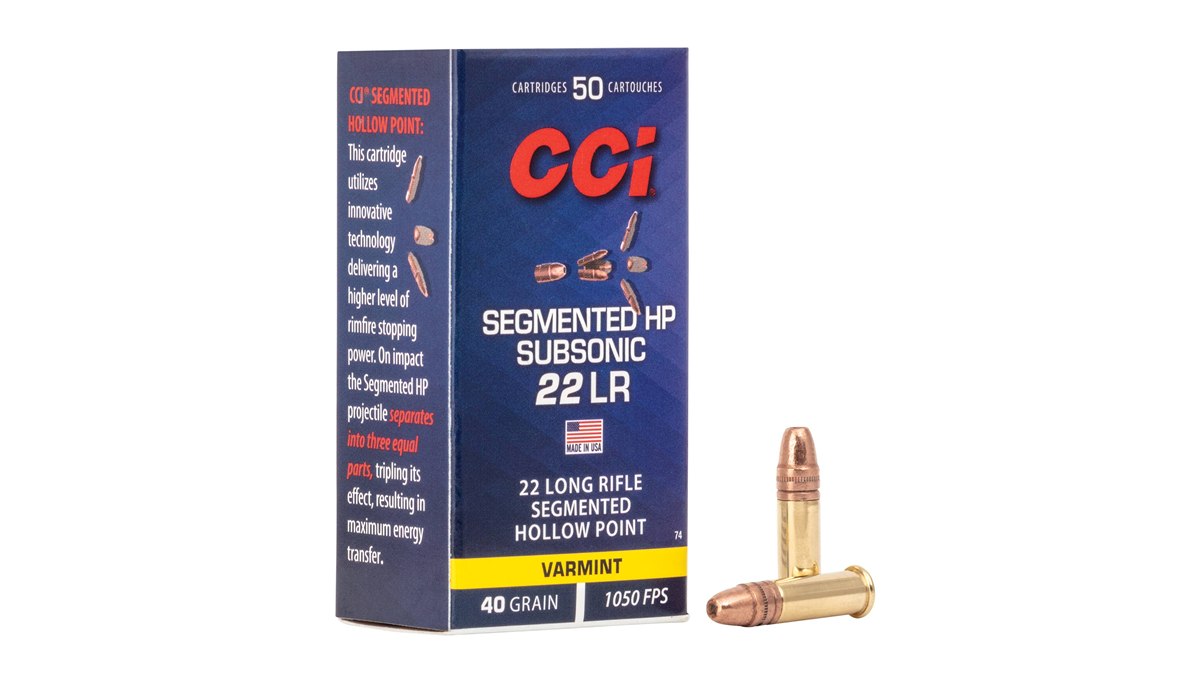
A box of .22 LR says "Segmented HP" across the front. CCI, the company that loads it, says the bullet breaks into three parts when it hits and that each part makes its own wound channel. Getting three wounds from one shot sounds like an easy win. It is a real design with a real purpose, but it also gives something up. Knowing what it gives up is what turns a box label into a good decision.
By the end you will understand how a segmented bullet is built, why it comes apart, and how it behaves compared with solid and ordinary hollow-point .22 LR bullets. You will be able to match a segmented load to the right small-game or varmint job, recognize its limits, and use three simple questions to size up any bullet, whatever the box promises.
What terminal performance means
Terminal performance is what a bullet does once it reaches the target. Does it hold together, open up, or break apart? How deep does it go? How wide a path does it crush along the way? Those answers pull against each other, so a design that wins one contest usually loses another.
A helpful vocabulary comes from a 2014 paper by the FBI Training Division explaining the agency's choice of the 9mm. The paper defines the permanent cavity as the tissue in direct contact with the bullet, which is destroyed. It adds that how much the bullet expands sets the width of that path. The paper also describes a temporary cavity, where tissue is stretched away from the bullet's path. That stretch, it says, has a real wounding effect mainly with bullets moving faster than roughly 2,000 feet per second, such as rifle bullets.
That paper was written about handgun ammunition for law enforcement, not rimfire hunting loads, but its logic carries over. The fastest segmented .22 LR load CCI lists leaves the muzzle at 1,235 feet per second, far below that 2,000 mark. So for a .22 LR, the useful questions are about the crushed path itself. How many paths does the bullet make, how wide are they, and how deep do they go?
Key idea: With a .22 LR, the damage that counts is the path the bullet crushes. A design can make that path deeper, wider, or more numerous, but no design gets all three at once.
How a segmented bullet is built
Start with an ordinary hollow point, a bullet with a cavity in its nose. When it enters tissue, material is forced into the cavity and pushes the walls outward. In a typical hollow point the walls fold back but stay attached, so the bullet ends up wider and still in one piece.
A segmented hollow point is built so those walls do not stay attached. CCI says the bullet in its Mini-Mag Segmented HP is engineered to split into three equal-size pieces on impact, and that each piece makes its own wound channel. CCI's product pages do not show a cutaway or explain the internal design. The clearest outside description we found comes from American Hunter magazine. In 2014 it described CCI's original Segmented Hollow Point as a copper-plated hollow point that is pre-fractured along its length.
Pre-fractured means the weak lines are made at the factory, long before the bullet is fired. Think of a chocolate bar scored into squares. Bend it, and it snaps along the scores instead of at random. A segmented bullet works on the same idea. As the hollow nose starts to open, the bullet separates along those built-in lines and becomes three pieces instead of one wider bullet.
Opening still takes force, and that force comes from speed. CCI makes the point itself when it describes its Suppressor Max load, which leaves the muzzle at only 970 feet per second. CCI says it customized that hollow point to segment reliably at low velocity, and it contrasts the bullet with conventional suppressor rounds. In other words, splitting at slow speed does not happen by accident. It has to be designed in.
"Segmented" describes a behavior, not one design
Other makers use the word too, and the details matter. Federal's Syntech Defense 9mm, a handgun load the company lists for self-defense, is a hollow point that separates into three segments and a deep-penetrating core. Federal says the core penetrates 12 to 18 inches through bare gelatin and heavy clothing, and that the three petals each make a path more than 6 inches deep. CCI does not describe any core in its segmented .22 LR bullets. As CCI describes them, they simply become three pieces.
So when you see "segmented" on a box, ask a follow-up question: Does any part of this bullet keep going deep? The answer changes what the bullet is good for.
What splitting changes about penetration and tissue damage
Imagine dropping a bowling ball into a tub of thick mud, then dropping in the same weight of marbles. The ball sinks deep. Each marble stops near the surface, yet together they disturb a wider patch than the ball did. A bullet that breaks apart behaves more like the marbles.
The reason is weight and shape. After the bullet splits, each piece is a small, ragged chunk carrying only part of the original weight. Light, irregular pieces lose speed quickly in tissue, so they stop sooner than one intact bullet would. Expansion works the same way in a milder form, because a wider bullet meets more resistance than a narrow one. Segmenting sits at the far end of that scale.
Published tests show the pattern. In one side-by-side test published in November 2024, the tester fired CCI Mini-Mag loads from a Smith & Wesson M&P15-22 rifle with a 16.5-inch barrel. The targets were blocks of 10 percent ballistic gelatin, a test material meant to stand in for muscle. The 36-grain copper-plated hollow point opened like a traditional hollow point, to .369 inch, and went 10 inches deep. The 40-grain Mini-Mag Segmented HP split into three main pieces, and two of those broke into smaller fragments. The three main pieces stopped at 6.5, 5, and 3.75 inches. The segmented bullet also left a larger wound channel in the gel than the hollow point did.
Richard Mann, writing for Field & Stream in January 2026, reports a similar picture for CCI's segmented .22 LR family. He says the bullets break into three sections almost immediately after impact and penetrate 6 to 7 inches in 10 percent gelatin. He adds that fragments can spread up to 2 inches from the main path. A few gel blocks are a small sample, so treat these numbers as a snapshot rather than a rating. Our article on ballistic gelatin explains what a gel block can and cannot tell you.
| Bullet type | What it is built to do | Typical depth and path | Main trade-off |
|---|---|---|---|
| Solid (lead round nose) | Stay in one piece | Deepest of the three, with one narrow path | Most likely to pass through a small animal and keep going |
| Hollow point | Open wider and stay mostly in one piece | Moderate depth with one wider path (10 inches in the test above) | May open less, or not at all, when impact speed is low |
| Segmented hollow point | Split into separate pieces | Shallowest, with several short paths near the entry (3.75 to 6.5 inches in the same test) | Gives up depth, and needs enough speed to split |
Read across one row, then compare the rows. No row wins every column. The deepest path is the narrowest, and the widest spread is the shallowest. These are tendencies, not guarantees, and a particular load fired from a particular gun can surprise you. When the animal is small and depth is not the problem, trading depth for spread can make sense. When the animal is larger, or the path to the heart and lungs runs through heavy muscle or bone, a bullet that holds together gives you more margin.
Common mistake: It is easy to assume that three wound channels mean three times the effect. They do not. Each channel is short, and the pieces do not always head toward the vital organs. One path that reaches the heart and lungs does more than three that stop short of them.
CCI's segmented .22 LR loads and what they are for
CCI is clear about the intended job. Its website lists every one of its segmented .22 LR loads for small game or varmints. The table shows the four versions on CCI's site when we checked in October 2026, with figures taken from each product page.
| Load | Bullet weight | Muzzle velocity | Height at 50 yards (100-yard zero) | Use listed by CCI |
|---|---|---|---|---|
| Quiet-22 Segmented HP | 40 grains | 710 fps | 8.9 inches | Small game |
| Suppressor Max | 45 grains | 970 fps | 4.5 inches | Small game |
| Segmented Hollow Point | 40 grains | 1,050 fps | 3.9 inches | Varmint |
| Mini-Mag Segmented HP | 40 grains | 1,235 fps | 2.9 inches | Varmint |
The table shows one idea offered at four speeds. According to NASA, the speed of sound is about 1,100 feet per second in standard sea-level air, and it changes with temperature. Three of these loads start out slower than that, and CCI calls the Suppressor Max subsonic. A bullet that stays below the speed of sound avoids the sharp crack of breaking the sound barrier, so slow loads pair well with suppressors. CCI says the Quiet-22 Segmented HP produces 75 percent less perceived noise than a standard-velocity .22 LR. If you shoot suppressed, our guide to choosing ammunition for suppressors covers how to match a load to your setup.
Now look at the height column. CCI publishes each load's path as if the rifle were zeroed at 100 yards, with the sights 1.5 inches above the bore. Zeroed that way, the slow Quiet-22 bullet has to arc 8.9 inches above the line of sight at 50 yards to come back down at 100. The Mini-Mag version rises only 2.9 inches. You probably will not zero a squirrel rifle at 100 yards, but the lesson holds at any distance. A slower bullet spends more time in the air, so it drops more over the same distance. A small mistake in judging range therefore moves its point of impact more. Switching loads can move your shots as well.
Speed also fades with distance and depends on your gun. CCI's table shows the Mini-Mag Segmented HP slowing from 1,235 feet per second at the muzzle to 982 at 100 yards, and the 16.5-inch rifle in that published test measured the same load at an average of 1,196. CCI does not publish the slowest impact speed at which each bullet still splits, so do not assume a load segments at every distance or from every barrel.
One more label check: CCI also sells a Maxi-Mag Segmented Hollow Point in .22 WMR, a larger cartridge that will not fit a .22 LR chamber. Make sure the box says .22 LR.
Will it cycle your semi-automatic?
Most semi-automatic .22 LR rifles and pistols are blowback designs. Spring pressure and the bolt's own weight hold the action closed, and the push of the fired case drives the bolt back to eject the empty and load the next round. A soft load may not push hard enough to finish that cycle.
CCI says the Quiet-22 Segmented HP can be used in semi-automatics, but the action may have to be cycled by hand. American Hunter reported in 2014 that the 1,050 fps Segmented Hollow Point would not reliably cycle the Ruger 10/22 or other semi-automatic rimfires. CCI says the Suppressor Max cycles in all semi-automatics, and it lists reliable feeding among the Mini-Mag version's features. If you shoot a semi-auto, test any of these in your own gun before you count on it.
What about self-defense?
We looked for an authoritative source that recommends a segmented .22 LR for self-defense and did not find one. CCI lists all four for small game or varmints, not for defense.
Depth is the reason. The FBI paper mentioned earlier says a bullet must penetrate 12 to 18 inches to reach the large vital organs of a person, and that the depth needed varies with body size and the bullet's path. The segmented pieces in the tests above stopped between 3.75 and 7 inches.
Notice what CCI does when it designs a .22 LR for defense. CCI describes its Uppercut load as built for short-barreled self-defense handguns. It uses a jacketed hollow point with a skived nose, meaning the jacket at the tip is cut so the petals peel back evenly. CCI says the bullet is designed to retain weight. It is built to hold together, not to split. Even so, CCI's own claim for it is 8 to 10 inches of penetration in ballistic gel, short of the low end of the FBI's range. If you are choosing ammunition for protection, our article on personal and home defense ammunition walks through the criteria.
Three questions for choosing a bullet
Terminal performance is easier to reason about when you ask the same three questions every time. First, what does this bullet do on impact? Does it hold together, open up, or break apart? Second, how deep does it need to go to reach the vitals of the animal in front of you? Third, how will it behave at your distance and from your gun, including where it lands and whether the gun cycles it? Here is how those questions play out on three common jobs.
- A ground squirrel in the pasture at 25 yards. The body is only a few inches thick, so depth is not the problem, and a segmented bullet's spread suits the job. Even so, the shallowest main piece in that gelatin test went 3.75 inches into gel, so pieces can still exit a small animal. You still need a safe backstop.
- A fox squirrel high in an oak. An upward shot has nothing behind the squirrel but sky, and pieces that exit or bullets that miss will come down somewhere. A segmented bullet does not change that. Wait for a shot with the trunk or the ground behind the squirrel.
- A raccoon raiding the corn crib. A raccoon is far larger than a squirrel, so the path to the heart and lungs is longer, especially at an angle. Mann writes that segmented loads can make lethal body shots on mid-size varmints, but the gel numbers show how little extra depth they carry. On a quartering animal or a shot through the shoulder, a load that holds together gives you more margin. Check the local rules for the animal and the place before you shoot.
Notice the pattern. A small body and a short path point toward spread. A larger body or an angled shot points toward depth. The third question applies to every job, because even the right design fails if it does not land where you aim or your gun will not cycle it. The exercise below answers that question for your own rifle.
Answering question three at the range
Where a segmented load hits in your own gun, and whether it runs, takes one short session to learn. With eye and ear protection on, a safe backstop and a steady rest at 25 yards, fire a five-shot group with your usual .22 LR load, then a five-shot group of the segmented load at the same aiming point on a fresh target. The distance and direction between the two group centers is the correction you need if you hunt with the segmented load. Watch for weak-sounding shots and for any failure to feed, fire or eject, and after a weak shot, stop and make sure the bore is clear before you continue. If you expect longer shots in the field, repeat the comparison at that distance.
Where segmented loads fall short
- They give up depth on purpose. That suits small animals and works against you when the path to the vitals is long.
- They depend on speed. Splitting takes impact force, and bullets slow down with distance. CCI does not publish a minimum speed for splitting.
- Accuracy is adequate, not exceptional. Mann writes that you should not expect stellar accuracy from these loads, though he finds them accurate enough out to about 40 yards. Your rifle may do better or worse.
- They can damage more meat. In the gelatin test above, the segmented bullet left a larger wound channel than CCI's plain hollow point, so expect more damaged meat around the wound.
- The evidence is thin. Beyond CCI's own descriptions, we found two published gel results and a handful of hunters' accounts. We found no controlled study of how these loads perform on game.
Of these five, depth and speed matter most, because they decide whether the bullet can do its job at all. Accuracy comes next, since the best bullet does nothing when it lands away from your aim. If the animal is headed for the table, you may prefer a load that holds together. Finally, the thin evidence is a reminder to treat every claim, ours included, as a starting point for your own testing.
Using segmented .22 LR loads safely
A bullet built to break apart is not a safer bullet. Breaking apart is something it does in soft tissue. A miss, a pass-through, or a hit on a rock, a steel post, or frozen ground will not follow the description on the box, and a .22 LR bullet can travel a long way. Be sure of your target and what is beyond it on every shot.
Read the box and the product page before you shoot. For the Quiet-22 Segmented HP, CCI says not to use it in barrels longer than 24 inches. CCI does not explain the reason. The safe habit with any very soft load is the same: If a shot sounds weak or different, stop. Keep the muzzle pointed in a safe direction, unload, and make sure the bore is clear before you fire again.
CCI also says hearing protection is not needed when the Quiet-22 is fired in locked-breech firearms. A locked breech is an action that stays closed when the gun fires, such as a bolt action. That statement covers one load in one kind of action. A partner's rifle may be louder, and protection costs you nothing, so we still recommend it. Eye protection matters too, because bullet pieces and debris can fly back from a hard surface. Our article on eye and ear protection explains what to look for.
If you hunt with these loads, check the season and the rules for your species first. Our overview of hunting licenses, tags, and firearm restrictions in Iowa and neighboring states gives the general picture, and the Iowa DNR publishes the current regulations. When you clean the animal, trim around each wound path and look for bullet fragments, since a bullet built to break apart can leave pieces in the meat.
Check your understanding
Try answering each question before you open the answer. If you can explain it in your own words, you understand it.
1. You shoot a raccoon with a segmented load, and when you clean it you find three small pieces of bullet, none of them very deep. Why did they stop so soon?
Each piece is a small, irregular chunk carrying only part of the original weight, so tissue slows it quickly. In the published gelatin test, the three main pieces stopped at 6.5, 5 and 3.75 inches, while CCI's plain 36-grain hollow point went 10 inches.
2. You have one box of Mini-Mag Segmented HP and one box of solid round nose. Which do you take for ground squirrels in open pasture, and which for a raccoon that may be quartering away?
The segmented load suits the ground squirrels, because their bodies are shallow and spread matters more than depth. The solid gives you more margin on a raccoon at an angle, because the path to the vitals is longer and a bullet that holds together carries more depth. In both cases you still need a safe backstop.
3. Your semi-automatic rifle will not cycle the Quiet-22 Segmented HP. Is the rifle broken?
Not necessarily. CCI says the action may have to be cycled by hand when this load is fired in a semi-automatic. A soft load may not push the bolt back far enough to finish the cycle. Still, treat any weak-sounding shot as a reason to stop, unload, and make sure the bore is clear.
4. The FBI's 12-to-18-inch standard was built for handgun ammunition used on people. Why doesn't it tell you which .22 LR to use on squirrels, and what does it still teach?
A squirrel's body is only a few inches thick, so the number itself does not apply. The method does. Decide how deep the bullet must go to reach the vitals of your target, then choose a design that gets there.
Where to go next
You can find CCI segmented .22 LR ammunition on our website, including Mini-Mag Segmented HP and a subsonic segmented hollow point, and anything listed there can be ordered if it isn't in stock.
To see how segmented loads fit among the rest of the rimfire shelf, read General Considerations for .22 LR Ammunition Selection, which explains velocity classes and how to find the load your own gun likes. Once you have chosen a bullet, Hunting Ethics: How to Ensure a Clean and Humane Kill covers what the hunter owes the animal.
If this article helped you, we invite you to sign up for email notifications of new blog articles.