
Rimfire vs. Centerfire Cartridges: A Complete Guide for New Shooters
Joseph McLain Nov 07, 2026
You are deciding what to learn on. A .22 is cheap to shoot and barely kicks, but is it a toy next to the 9mm you will actually carry? And why is dry firing a .22 risky when dry firing a 9mm is usually fine? The answers trace back to where a tiny primer sits.
By the end you should understand what "rimfire" and "centerfire" mean, why the primer's location changes cost, recoil, power and reliability, how to handle a cartridge that doesn't fire, and why dry firing is risky for one type and usually fine for the other, so you can choose the right type for training, hunting or defense and practice safely.
Where the spark happens
Every modern cartridge has four parts: A case, a bullet, gunpowder and a primer. The primer is a small charge of shock-sensitive compound. When the firing pin strikes it, it makes a spark that lights the powder, and the burning powder drives the bullet down the barrel. The two families of cartridges differ in where that primer lives.
In a rimfire cartridge, the priming compound is spun into the hollow rim, the flared edge at the base of the case. The firing pin strikes the edge of the rim and crushes it, and that crushing sets off the compound. Common rimfires include the .22 Long Rifle (.22 LR), the .22 Winchester Magnum Rimfire (.22 WMR, often called the .22 Magnum) and the .17 HMR.
In a centerfire cartridge, the primer is a separate small cup pressed into a pocket in the center of the case base. The firing pin strikes that cup. Nearly all modern handgun, rifle and shotgun ammunition is centerfire, from the 9mm Luger and .38 Special to the .223 Remington, .308 Winchester and the 12-gauge shotshell.
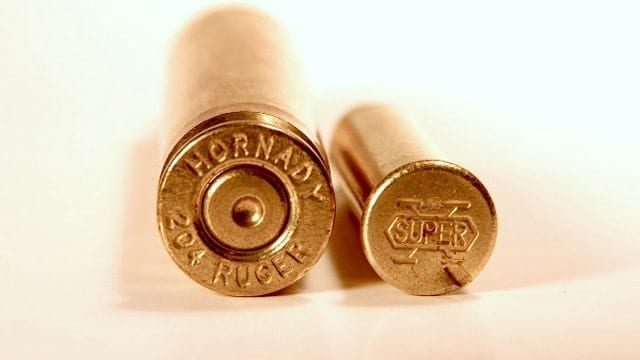
You can tell them apart by looking at the base. A centerfire shows a round primer in the middle. A rimfire base is plain, and after firing it shows a small dent at the edge where the pin struck.
Why the primer's location changes everything else
Picture the firing pin as a small hammer. A rimfire asks the hammer to dent the case itself, so the case walls at the rim have to be thin enough to crush. A centerfire gives the hammer a separate button to strike, so the case walls can be as thick and strong as the job demands.
That one difference sets off a chain. Thin case walls can only contain modest pressure, so rimfire cartridges stay small and relatively low-powered. Thick walls can contain much higher pressure, so centerfire cartridges range from mild target loads to cartridges powerful enough for the largest North American game. A crushed rim cannot be repaired, so a rimfire case is used once. A centerfire case can often be reloaded by pressing in a new primer, adding powder and seating a new bullet.
| Feature | Rimfire | Centerfire |
|---|---|---|
| Where the primer is | Spun into the rim | Separate primer in the center of the base |
| Case strength and pressure | Thin walls, lower pressure | Thicker walls, higher pressure |
| Range of power | Small game, targets, training | Targets through big game and defense |
| Reloading | Not reloadable | Often reloadable |
| Cost per round | .22 LR is usually the least expensive cartridge you can buy | Generally more, varying widely by caliber |
From top to bottom, the table is cause and effect. Where the primer sits decides how strong the case can be, and the strength of the case decides how much power the cartridge can have and what it is good for. One caution on cost: The .22 LR is famously cheap, but other rimfires such as the .22 WMR and .17 HMR cost noticeably more per round, and some common centerfire practice loads cost less than those. Compare prices for the specific cartridges you are considering.
Key idea: Where the primer sits decides how strong the case can be, and the strength of the case decides how much power, what jobs and what costs come with each cartridge.
Recoil, noise and learning
When you are new to shooting, the bang and the push of a centerfire can take over your attention. You end up bracing for the shot instead of watching the sights and pressing the trigger smoothly, and that bracing becomes a flinch, the small jerk or push that sends shots low or to the side. A .22 LR firearm produces very little recoil and much less noise, so your attention stays where it belongs.
Think of learning to drive in an empty parking lot before merging onto the interstate. The skills are the same, and the calmer setting lets them settle in. That is why so many instructors start new shooters on a .22 and why it remains useful for experienced shooters who want to work on trigger control without the cost and fatigue of centerfire practice. Our article on the .22 LR as a training tool goes deeper.
What a .22 can't teach is managing centerfire recoil. If you will carry a 9mm, you eventually need to practice with it. Build your fundamentals on a rimfire, then move to your centerfire and keep returning to the .22 for inexpensive practice between centerfire sessions.
Reliability, misfires and hangfires
Because the priming compound in a rimfire is spun into the rim during manufacturing, a small area of the rim can occasionally end up with too little compound. When the pin strikes that spot, nothing happens. That is one reason rimfire ammunition, even good ammunition, has a higher rate of failures to fire than quality centerfire ammunition. For practice and small game this is an inconvenience. For self-defense it is one more reason to choose centerfire.
Any cartridge that does not fire when the pin strikes it deserves respect, because what looks like a misfire can be a hangfire, a cartridge that ignites a moment late. If you press the trigger and hear a click instead of a bang, keep the muzzle pointed safely downrange and wait at least 30 seconds before opening the action. Then remove the cartridge carefully and set it aside, away from your other ammunition. Some shooters rotate a rimfire round so the pin strikes a different spot of the rim and try it once more after waiting; if it still does not fire, set it aside and dispose of it according to your range's rules. Never keep pulling the trigger rapidly on a dud, and never look into the chamber or muzzle to see what happened.
Rimfire is fine where an occasional failure to fire costs only a moment, and centerfire is the choice when every round has to work.
Common mistake: Opening the action immediately after a click. A hangfire can ignite a moment later. Keep the muzzle downrange and wait at least 30 seconds before you clear the cartridge.
Choosing rimfire or centerfire for the job
Most decisions become clear once you name the job.
Learning and practice. Rimfire, usually .22 LR, for low cost, low recoil and low noise. Add centerfire practice once you will be shooting a centerfire for carry, hunting or competition.
Small game and pests. Rimfire suits rabbits, squirrels and similar small animals at modest distances. The .22 WMR and .17 HMR reach farther and hit harder than the .22 LR, which helps with larger pests. Larger predators such as coyotes call for a centerfire for a clean, humane kill. Check the Iowa DNR's hunting regulations, or the rules where you hunt, for what is legal for each animal.
Deer and larger game. Centerfire, and only cartridges legal where you hunt. In Iowa, rifles used for deer must fire an expanding bullet .350 to .500 inch in diameter with at least 500 foot-pounds of muzzle energy, which rules out every rimfire.
Self-defense. Centerfire with quality defensive ammunition. Rimfire's limited power and higher rate of failures to fire make it a poor choice; see selecting personal and home defense ammunition.
Whatever you choose, match the ammunition to the firearm exactly. Read the caliber marked on the barrel or near the chamber and the caliber on the box, and make sure they match before you load. Several .22 cartridges look similar, and a .22 WMR will not fit or fire safely in a gun chambered for .22 LR.
Dry firing: Why rimfires need protection
Dry firing means pressing the trigger with no live cartridge in the chamber. It is one of the best ways to practice trigger control at home, but the two families of firearms handle it differently.
A rimfire's firing pin is built to strike the edge of the chamber, where the rim normally sits. With no cartridge there, the pin can strike the steel edge of the chamber itself. Repeated strikes can peen, or dent, the chamber edge and can chip or break the firing pin, much like swinging a hammer onto bare concrete instead of a nail. Many rimfire owner's manuals warn against dry firing for this reason, and some newer designs are built to tolerate it.
A centerfire's pin strikes the center of the base, and most modern centerfire firearms are designed so the pin does not contact hard steel in an empty chamber. Occasional dry firing of most modern centerfires is fine. Some older designs and some revolvers and shotguns are exceptions. The rule for both families is the same: Read your owner's manual, and when in doubt, use a snap cap.
Snap caps: The simple fix
A snap cap is a dummy cartridge with the same shape as the real thing but no powder and no live primer. In place of the primer or rim compound it has a cushioned surface that gives the firing pin something to strike. Snap caps let you dry fire any firearm without risking damage, and they let you practice loading and clearing malfunctions without live ammunition in the room.
Rimfire snap caps wear out. The pin leaves a dent in the rim each time, so rotate them and replace them once the rim is dented all the way around. A snap cap protects the gun but does not make it safe, so treat every firearm as loaded and follow the rules in firearm safety for beginners every time.
A safe dry-fire session
Dry fire builds trigger control for free, as long as the routine is strict. Unload the firearm, remove the magazine, open the action, and look and feel to confirm the chamber is empty, then take all live ammunition out of the room. With the muzzle on a safe direction, such as a wall that would stop a bullet, load a snap cap and cycle the action once to watch it feed and eject. Aim at a small spot and press the trigger slowly while watching the front sight; when it stays still as the trigger breaks, your press is clean. At the end, put the snap caps away before any live ammunition comes back into the room, and say out loud that practice is over, so dummy and live rounds never mix. For a smoother press, see trigger control tips.
Putting it together
The rimfire and centerfire question comes down to the strength of the case. Rimfires are cheap, quiet and gentle because their cases are thin, and that same thinness limits their power and makes them a little less reliable. Centerfires cost more and kick harder because their cases are strong, and that strength makes them the right choice for big game and for defense. For most new shooters the best plan uses both: Learn the fundamentals on a .22, practice them affordably for years, and carry, hunt or compete with a centerfire matched to the job. Handle every failure to fire with a 30-second wait, and protect your firearms in dry practice with snap caps where the manual calls for them.
Check your understanding
Try answering these before you open the answer. If you can decide what to do and explain why, you have it.
1. A friend asks why there are no .30-06-sized rimfire cartridges. What would you tell him?
A rimfire's rim has to be thin enough for the firing pin to crush it, which limits how much pressure the case can contain. A centerfire uses a separate primer, so its case walls can be thick and strong enough for high-pressure rifle cartridges.
2. You press the trigger and hear only a click. What do you do?
Keep the muzzle pointed safely downrange and wait at least 30 seconds in case it is a hangfire. Then open the action, remove the cartridge carefully and set it aside away from your other ammunition.
3. A friend suggests a .22 LR for home defense because practice ammunition is cheap. What would you point out?
The .22 LR has limited power and a higher rate of failures to fire than quality centerfire ammunition. A centerfire with defensive ammunition is the better choice, and the .22 can still serve for inexpensive practice.
4. You want to practice trigger control with your .22 pistol at home. Why use a snap cap?
A rimfire's firing pin strikes the edge of the chamber where the rim sits. With no cartridge, it can hit the steel directly and dent the chamber or damage the pin. A snap cap gives it something to strike.
5. Can you hunt deer in Iowa with a .22 Magnum rifle?
No. Iowa allows rifles for deer only with expanding bullets .350 to .500 inch in diameter and at least 500 foot-pounds of muzzle energy, which rules out all rimfires. Confirm current rules in the Iowa DNR regulations.
Where to go next
If rimfire is your starting point, general considerations for .22 LR ammunition selection explains how velocity and bullet type change what a .22 does. To see how far the .22 family extends, the .22 caliber round covers the rimfire and centerfire .22s and how to tell them apart. For centerfire, what goes into cartridge design explains how the primer, powder, case and bullet work together, and our beginner's guide to ammunition walks through calibers and bullet types.
If this article helped you, we invite you to sign up for email notifications of new blog articles.