
Understanding Bullet Shapes for Rifle Rounds: Tips, Bodies, and Bases
Joseph McLain Nov 07, 2026
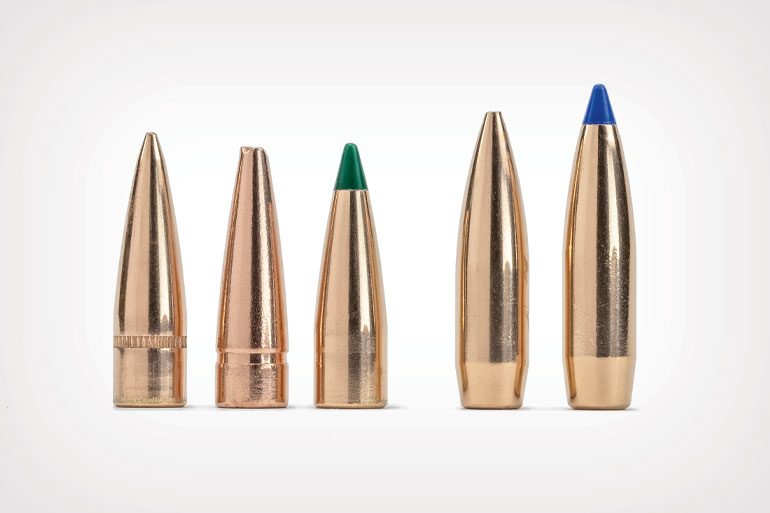
You pick up two boxes of ammunition for the same rifle. The bullet pictured on one has a sleek pointed tip and a tapered rear. The bullet on the other has a blunt flat nose and a squared-off base. Both are legitimate hunting ammunition, so why would anyone make them so differently?
Because each part of a bullet is built for a job, and the shape that flies best isn't always the shape that works best when it arrives. By the end you should be able to look at the tip, body and base and predict how a bullet will fly and what it will do on arrival, and then choose a shape for brush hunting, big game, small game, target shooting or long-range precision.
Three parts, three jobs: The anatomy of a rifle bullet
Every rifle bullet is a finely tuned aerodynamic projectile, and its design is generally broken into three parts.
- Tip. The very front, which meets the air during flight and the target on impact.
- Body (or shank). The main portion, which houses the core (often lead) and is sometimes surrounded by a metal jacket.
- Base. The rear, which influences how the bullet stabilizes and retains velocity in flight.
Each part is engineered for a particular challenge, from reducing drag and improving stability to making expansion on impact predictable. Drag is the air resistance that slows the bullet. Hold your hand out of a car window with the palm facing forward and the wind shoves it back hard. Turn it edgewise and the push nearly disappears. A bullet faces the same push for its whole flight, and its shape decides how much of it there is.
Shape is measured with a number called the ballistic coefficient (BC), which describes how efficiently a bullet overcomes air resistance. A more streamlined bullet has a higher BC, which means it keeps its velocity and energy better over distance. Our article on how ammunition affects your accuracy shows how BC connects to drop and wind drift.
Key idea: A bullet shape is a trade-off. The features that help it fly through the air are often not the features that help it perform when it arrives, so the right shape depends on the job.
The tip: Why the front of the bullet shapes both flight and impact
The tip, also called the meplat, significantly influences both aerodynamics and behavior on impact. Think of five tips arranged from blunt to sleek. The blunt ones push air aside and hit hard at close range, and the sleek ones slip through the air and keep their speed.
Flat nose
A flat-nose bullet has a blunt, non-tapered tip. You will see it most often in lever-action rifles and other firearms with tubular magazines, where the rounds are stacked nose to tail and the tip of one bullet rests against the primer of the next. A blunt tip addresses the safety concern of accidental primer detonation in the magazine. In the air, the abrupt surface produces higher drag, which limits its efficiency over long distances. On impact, the blunt shape encourages rapid energy transfer, which is useful at close range. It suits medium-sized game at close ranges and tubular-magazine rifles, and the increased air resistance makes it less suitable for long-range shooting. Our article on Hornady LEVERevolution looks at ammunition built for lever-action rifles.
Round nose
A round-nose bullet has a gently curved tip and is common in traditional hunting ammunition. It is a compromise. The curved profile improves airflow compared with a flat tip, but it still creates more drag than a pointed design. It is excellent at transferring energy at short distances, which makes it effective for brush hunting and quick close-range shots. Higher air resistance limits its effective range and long-range accuracy.
Spitzer (pointed)
A spitzer is the pointed, tapered tip that minimizes air resistance, and it is widely used in modern hunting and long-range cartridges. The pointed shape reduces drag, which gives a higher BC and better velocity retention over long distances. That makes it suited to long-range shooting and big-game hunting, where reduced wind drift and minimal drop are essential. The catch is on impact. A pointed tip may not expand as readily at close range, sometimes risking over-penetration, and it may not provide the controlled expansion needed for humane kills at close range unless it is paired with an appropriate core design.
Polymer tip
A polymer-tipped bullet has a plastic tip bonded to the metal jacket, combining the aerodynamic benefits of a pointed bullet with the terminal performance of a hollow point. The tip improves aerodynamic efficiency, which enhances stability and velocity retention, and on impact it helps initiate expansion for effective energy transfer. Polymer tips are also more resilient than simple metal tips and can be engineered for various performance characteristics. They are well suited to long-range hunting and precision shooting, where you want both expansion and efficiency. They are generally more expensive than traditional designs, which makes them less common in high-volume or budget shooting.
Hollow point
A hollow point has a concave tip designed to promote rapid expansion. The cavity causes the bullet to expand quickly, increasing its diameter and creating a larger wound channel. The cost is aerodynamic, since a hollow point can be less efficient than a pointed tip and its increased drag can limit long-range effectiveness. Hollow points are used for self-defense applications, particularly where overpenetration must be minimized, and in some match-grade ammunition for precision target shooting, where controlled expansion is beneficial. You can read more about how expansion is tested in our article on ballistic gelatin.
Which tip questions matter most? Ask first how far you will shoot, then how close the animal or target will be when the bullet arrives. A tip that excels at one end of that range usually gives something up at the other.
Common mistake: Judging a bullet by its tip alone. A sleek tip tells you how the bullet flies, but how it expands depends on its construction too, including the core and jacket. A pointed bullet matched to an appropriate core design can expand properly, while a poorly matched one may not.
The base and body: How the back of the bullet controls drag and stability
The body, or shank, is critical in determining stability and overall ballistic performance. Its design influences how well the bullet retains velocity, minimizes drag and holds a stable flight path. The base, meanwhile, plays a key role in aerodynamic efficiency and range performance. Three designs matter.
The easiest way to picture the base is with water. Where a square bridge piling sticks into a stream, the water swirls and churns behind it. Where the piling is tapered, the water closes smoothly behind. Air does the same thing behind a bullet.
A boat tail has a tapered base that narrows toward the rear. That smooths the transition from bullet to air, reducing turbulence, and the drag drops significantly, which gives a higher BC. The bullet keeps its velocity better over long distances and is less affected by wind drift. Boat tails are excellent for long-range shooting, precision hunting where velocity retention and reduced drop are critical, and big-game hunting at extended distances. They are typically more expensive to make and require precise quality control for consistency.
A flat base has a squared-off rear end that is simpler and cheaper to produce. It increases drag, which can lower the BC and make it less efficient at long range. It is also described as offering rapid stabilization on leaving the barrel, a benefit for short- to mid-range accuracy. Flat bases suit short- to medium-range hunting, short- to mid-range target shooting, and hunting where immediate stability matters more than long-range efficiency. They are not ideal for long-range shooting because of the higher drag.
A rebated boat tail has a recessed or indented base, combining elements of both. It offers controlled drag reduction and balances rapid stabilization with efficient velocity retention, which enhances flight consistency and energy retention over a distance. It appears in high-performance hunting rounds and in precision rounds for tactical or competitive shooting. The drawback is that the more complex design can lead to higher production costs and variability in performance if it is not manufactured to tight tolerances.
If you shoot far, pay for a boat tail. If you shoot short to mid range and want an economical bullet, a flat base does the job well.
Putting tip, body and base together
Real bullets combine all three, and the table shows the common combinations.
| Bullet type | Tip shape | Body shape | Base shape | Best uses |
|---|---|---|---|---|
| Flat nose | Flat | Straight | Flat base | Short-range hunting, lever-action rifles, brush hunting |
| Round nose | Round | Straight | Flat base | Brush hunting, short-range hunting with maximum impact |
| Spitzer | Pointed (spitzer) | Often boat tail | Boat tail or flat base | Long-range shooting, big-game hunting, precision shooting |
| Polymer tip | Pointed (polymer) | Often boat tail | Boat tail | Long-range hunting, precision shooting, enhanced expansion |
| Hollow point | Hollowed | Straight | Flat base or boat tail | Small-game hunting, close- to mid-range target shooting |
| Rebated boat tail | Pointed or hollowed | Rebated | Rebated boat tail | High-performance hunting, tactical or precision applications |
Each row is a recipe. The first two rows are the close-range family, a blunt or rounded tip with a straight body and flat base. The spitzer and polymer-tip rows are the long-range family, a pointed tip with a boat tail. The hollow point sits in the middle, and the rebated boat tail is the hybrid that blends traits for demanding uses. Once you see those groupings, a new bullet name on a box stops being a mystery.
Matching bullet shape to your purpose
Long-range precision
Choose a spitzer or polymer tip with a boat tail. High ballistic coefficients, reduced drag and enhanced stability are essential for minimizing wind drift and bullet drop over extended distances. Our article on the role of ballistics in long-range shooting shows what those numbers look like in practice.
Short-range hunting in brush
Choose a flat or round nose with a straight body and flat base. These shapes transfer energy efficiently at close range. Many hunters favor them in thick cover, but remember that brush can deflect any bullet, so wait for a clear lane to the animal.
Big game
Choose a polymer-tipped boat tail or a pointed soft point. Aerodynamic designs enhance accuracy over long distances, and controlled expansion ensures deep penetration and humane kills. Clean, ethical shots are a responsibility, and our guide to hunting ethics covers it in depth.
Small game
Choose hollow points or semi-wadcutters, typically with a straight body and flat base. Rapid expansion and controlled penetration provide effective energy transfer without excessive over-penetration. Wadcutter and semi-wadcutter designs are flat-faced shapes more often seen in handgun rounds, so you may meet them mainly in specialty ammunition.
Target shooting
The right tip depends on your discipline. Flat or hollow points can give crisp scoring, and FMJ is a choice for consistency. Flat-base designs often help stabilize quickly. Consistency and immediate stabilization are key for accurate grouping and scoring, and wadcutter designs are another way to get crisp scoring.
Notice the pattern. As the distance grows, the recommended shape gets sleeker, and as the distance shrinks and the animal gets closer, the recommended shape gets blunter or more open. That is the trade-off from the key idea in action.
Beyond the silhouette: BC, stability, materials and hybrids
Shape is crucial, but it is not the only thing at work. A few advanced ideas help you read the finer points on a box.
- Ballistic coefficient. More streamlined shapes, such as spitzer tips with boat tails, typically show higher BCs and retain velocity and energy better at distance.
- Drag and stability. The interplay of tip, body and base sets overall drag. Lower drag gives flatter trajectories and less wind drift, but a balance must be struck so the bullet remains stable in flight.
- Materials. Copper jackets and polymer tips also affect behavior. A polymer tip can initiate expansion without compromising aerodynamics.
- Hybrid designs. Some high-performance rounds, such as rebated boat tails, combine aspects of several traditional designs for demanding tactical or competitive shooting.
If you read only one of these, make it the stability point, because it explains why a sleeker bullet is not automatically better. A bullet also needs the right spin from your barrel to fly true, and our guide to barrel twist rate explains that side of the story. The other three points refine the choice once you have the shape right.
Testing in your own rifle matters more than people expect. Trying different ammunition in your own firearm shows you how each design performs in the conditions where you actually shoot.
Putting it together
Pointed, boat-tail shapes fly flatter and drift less at distance, while blunt and flat-nose bullets are built for close shots and for tubular magazines, and what happens on impact depends more on construction than on shape. Read the tip, body and base, match the shape to your distance and rifle, and pick the construction that suits the animal.
Check your understanding
Try answering these before you open the answer. If you can decide what to do and explain why, you have it.
1. A friend wants to load pointed spitzer bullets in his tube-fed .30-30 because they fly flatter. What would you warn him about?
In a tube magazine the rounds sit nose to tail, so each bullet's tip rests on the primer of the round ahead. A hard pointed tip can set that primer off under recoil. That's why tube-fed rifles use flat or round noses, or a soft polymer-tipped bullet made for them.
2. A friend wants one bullet for long-range elk hunting. Which shape would you suggest, and why?
A polymer-tipped boat tail or a pointed soft point. The aerodynamic shape reduces drag and wind drift over distance, and the controlled expansion ensures deep penetration and a humane kill.
3. Two bullets have the same weight and tip, but one has a tapered rear and one a squared-off base. Which holds its speed better at 400 yards, and why?
The boat tail. Its tapered rear lets the air close smoothly behind the bullet instead of churning, which cuts drag and raises the ballistic coefficient, so it keeps more speed and drifts less in the wind.
4. A spitzer bullet is the sleekest design, so why might it be a poor choice for a close-range shot?
A pointed tip may not expand readily at close range and can over-penetrate, so it may not give the controlled expansion needed for a humane kill unless it is paired with an appropriate core design.
5. You are choosing economical ammunition for short-range practice. What base shape should you expect, and what do you give up?
A flat base, which is simpler and cheaper to make and stabilizes quickly. You give up long-range efficiency because it creates more drag and has a lower ballistic coefficient.
Where to go next
Shape is only half of the bullet choice, so read understanding bullet weight in rifle rounds next to see how mass changes what you have just learned. Then understanding rifle bullet types shows how construction, such as jackets and cores, works with shape to decide expansion. When you test loads side by side, understanding MOA gives you a way to compare group sizes at different distances.
If this article helped you, we invite you to sign up for email notifications of new blog articles.