
An In-Depth Analysis of Remington UMC Ammunition
Joseph McLain Nov 07, 2026
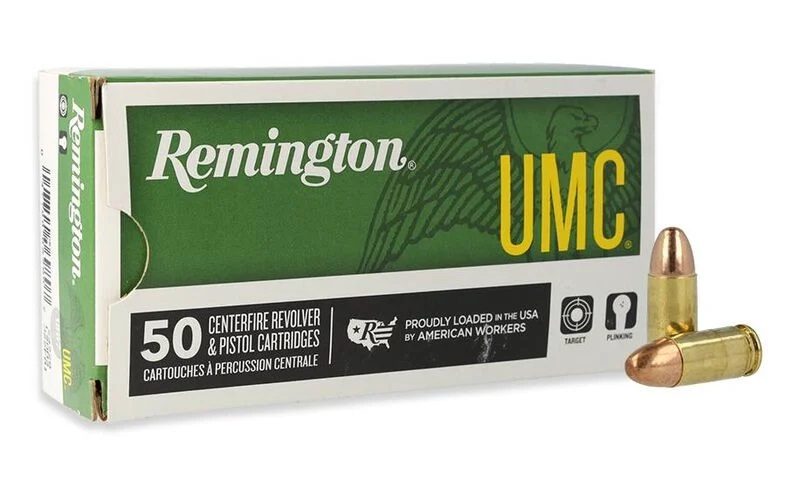
You have a range day coming and a budget that has to stretch, and the plain Remington UMC box is one of the cheaper ones on the shelf. Is it all the practice ammunition you need, or do you get what you pay for?
That depends on what the box has to do. By the end you should be able to say when UMC is the right ammunition, pick the right UMC load for your gun, know the jobs it must never do, and tell whether cheap ammunition is what's holding your groups back.
What UMC is built to be
UMC, short for Union Metallic Cartridge, is one of the oldest names in American ammunition, and today it's Remington's practice line. It is built for one thing: feeding, firing and ejecting reliably, round after round, at a price you can afford to repeat. It uses ordinary brass cases with standard primers, which means the fired brass can be reloaded, and plain bullets, mostly full metal jacket (Remington labels some of its pistol loads "MC," for metal case).
What UMC doesn't chase is sameness. Match ammunition is made so every round is as close to identical as possible, which shrinks groups at long range and costs much more. UMC is made so every round works. For practice, working every time matters more, because a session full of jams teaches you to clear jams rather than to shoot.
UMC sits alongside Federal American Eagle, CCI Blazer Brass, Winchester White Box and PMC Bronze. At this level the lines are close enough that the one your gun runs well at a fair price is the right one, so buy by price and availability in your caliber, and stay with a load once it runs cleanly in your gun.
Key idea: Practice ammunition is judged by whether it runs in your gun and how much practice it buys, not by how small it groups from a machine rest.
Which UMC load for your gun
Start with the cartridge stamped on your barrel or slide; it must match the box exactly. Then choose the weight.
- If you carry a 9mm with a 124-grain defensive load, practice with UMC 9mm 124-grain FMJ, because matching the weight makes practice recoil and hit like your carry load. If you carry a 115-grain load, or don't carry, the 115-grain is cheaper and fine.
- If you shoot a .45 Auto, UMC 230-grain FMJ is the standard practice load and matches the weight of most .45 defensive loads.
- If your AR is marked .223 Remington, UMC .223 55-grain FMJ is loaded to .223 pressure and is safe in it. Our guide to 5.56 NATO and .223 Remington explains why the chamber marking matters.
- If you shoot a less common or older cartridge, look at UMC first. It's made in calibers few practice lines bother with, such as .30 Carbine, .303 British, .32 Auto and .450 Bushmaster, so it's often the cheapest way to keep an old rifle or an Iowa deer rifle in practice.
The jobs UMC must never do
Carry and home defense. A full metal jacket bullet doesn't open. In a person it tends to pass straight through, making a narrow wound and continuing toward whatever is behind them. UMC's few hollow points, such as its .380 and .357 loads, are simple range-grade designs, not bullets built and tested to open through clothing at the right depth. Carry a proven defensive load such as Federal HST, Speer Gold Dot or Federal Punch, and practice with UMC.
Deer hunting. A non-expanding bullet wounds instead of killing quickly, and Iowa requires an expanding bullet for deer under Iowa Code 481A.48. That includes UMC's .450 Bushmaster FMJ: it's a good practice load for an Iowa deer rifle and is never legal for the deer themselves. Practice with it, then sight in and hunt with an expanding hunting load.
Common mistake: Sighting in a deer rifle with cheap FMJ and hunting with something else. Two loads can hit inches apart from the same rifle. Use UMC for practice, then confirm your zero with the box you'll hunt with.
Is cheap ammunition holding you back?
Usually not. A group is made of three things: you, the gun and the ammunition. For most shooters, the shooter is by far the largest part, especially with a handgun, where grip and trigger press dominate. Practice ammunition like UMC is accurate enough for drills, plinking, carbine courses and local matches.
Here's how to tell. With eye and ear protection on, shoot two five-shot groups from a steady rest with UMC and two with a match load, at 25 yards for a pistol or 100 yards for a rifle. If the match load groups clearly and consistently smaller, the ammunition has become your limit for precision work, and the step up is worth it there. If the groups look about the same, the ammunition isn't your limit, and more practice with UMC will help more than a pricier box.
Buying in bulk and storing it
UMC's low price is at its best in bulk boxes and cases. Buying a case once you've confirmed a load runs in your gun saves money and keeps you shooting. Ammunition keeps for many years when it's stored cool and dry, away from humidity and big temperature swings, so a case bought today will shoot the same next year. Our guide to storing ammunition covers how.
Check your understanding
Try answering these before you open the answer. If you can decide what to do and explain why, you have it.
1. You carry Federal HST 124-grain in your Glock 19. Which UMC box goes with it, and why?
UMC 9mm 124-grain FMJ. It matches your carry load's weight, so it recoils and hits about the same, and your practice carries over to what you carry.
2. A friend keeps UMC FMJ in his home-defense pistol because it never jams. What do you tell him?
Reliability is necessary but not enough. FMJ doesn't open, so it tends to pass through and keep going, and it makes a narrower wound. He should find a defensive hollow point his pistol runs reliably, test it, and keep UMC for practice.
3. You hunt Iowa deer with a .450 Bushmaster and found cheap UMC 260-grain FMJ. Can you use it?
For practice, yes. For deer, no: Iowa requires an expanding bullet, and FMJ doesn't expand. Practice with it, then sight in and hunt with your hunting load, because the two may not hit in the same place.
4. Your groups with UMC and a match load are the same size at 25 yards. Should you switch to match ammunition?
Not yet. Identical groups mean the ammunition isn't what's limiting you. Spend the money on practice until the match load groups clearly smaller in your hands.
5. You inherit an M1 Carbine and can't find .30 Carbine practice ammunition locally. What do you look for, and what do you check first?
UMC loads .30 Carbine in FMJ, and it's a sensible practice load. First, have a gunsmith look over an inherited rifle, and make sure the cartridge on the box matches the marking on the rifle exactly.
Where to go next
You can find Remington UMC ammunition on our website in 9mm, .380, .40, .45 Auto, .223, .308, .30 Carbine, .450 Bushmaster and more, and anything listed there can be ordered if it isn't in stock.
To compare UMC with the other big practice lines, read choosing range ammunition. To see where practice ammunition fits on the ladder up to match grade, see ammunition quality, from cheap to match grade. And if you're choosing what to carry, personal and home defense ammunition walks through it.
If this article helped you, we invite you to sign up for email notifications of new blog articles.