
PMC Bronze Ammunition In Detail
Joseph McLain Nov 07, 2026
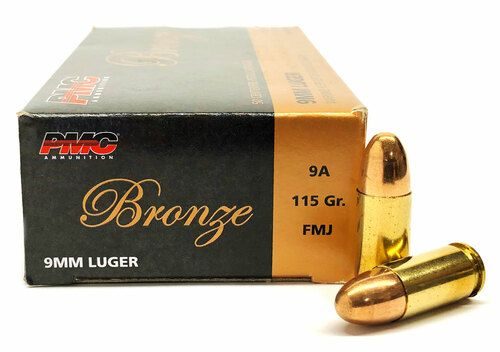
You're stocking up for the range, and one of the cheaper boxes says PMC Bronze, a name you may not recognize. Is it a bargain, or is imported budget ammunition a gamble?
By the end you should be able to say what PMC Bronze is, decide whether it suits your gun and your shooting, pick the right box for the gun you have, and know the jobs to leave to other ammunition.
What PMC Bronze is
PMC stands for Precision Made Cartridges, the ammunition brand of Poongsan, a South Korean company that has made military and commercial ammunition for decades and controls its own production from raw brass and copper to finished cartridge. Bronze is PMC's practice line: new brass cases with standard (Boxer) primers, so the fired brass can be reloaded, and mostly full metal jacket bullets, with a few hollow points and soft points.
The "imported is a gamble" worry doesn't hold up for PMC. It's made by a large, established manufacturer and has a long record in American gun shops as reliable practice ammunition. It sits in the same class as Federal American Eagle, CCI Blazer Brass, Remington UMC and Winchester White Box, and at that level the lines are close enough that the one your gun runs well at a fair price is the right one.
Key idea: Practice ammunition is judged by whether it runs in your gun and how much practice it buys. PMC Bronze does both well; it isn't built for match accuracy or for defense.
Which PMC Bronze box
Match the cartridge on your barrel or slide exactly, then choose the bullet weight to match the load you carry or hunt with, so practice recoils and hits like the real thing.
- If you carry a .380 with a 90-grain defensive load, such as Hornady Critical Defense or Speer Gold Dot, PMC Bronze .380 90-grain FMJ is the natural practice match, because few practice lines make a 90-grain .380.
- If you carry a 9mm with a 124-grain defensive load, PMC Bronze 9mm 124-grain FMJ matches it.
- If you carry a .45 Auto with a 230-grain load, PMC Bronze 230-grain FMJ matches it.
- If your rifle is marked .223 Remington, PMC Bronze .223 55-grain FMJ is loaded to .223 pressure and is safe in it; it also works in a rifle marked 5.56. Our guide to 5.56 NATO and .223 Remington explains why the marking matters.
Some owners report that PMC Bronze runs a little slower than some competing loads. That doesn't affect reliability in most guns, but if you zero a rifle with it, confirm your zero again when you change to a different load.
The jobs to leave to other ammunition
Defense. Full metal jacket doesn't open up, so in a person it tends to pass through and keep going, making a narrow wound. PMC Bronze's few hollow points are basic designs, not bullets built and tested to open through clothing at the right depth. Carry a proven defensive load and practice with Bronze.
Deer. FMJ is never legal for Iowa deer, which requires an expanding bullet under Iowa Code 481A.48, and it wounds rather than kills cleanly anywhere. PMC Bronze's .223 soft point is a varmint load, and the .223 isn't legal for Iowa deer anyway. For deer, use a hunting bullet in a legal cartridge.
Common mistake: Blaming the rifle when budget ammunition groups 2 or 3 inches at 100 yards. That's normal for practice ammunition. If you need smaller groups for precision work, buy match ammunition; if you're practicing, those groups are fine.
Is the ammunition your limit?
For most shooters, especially with a handgun, the shooter contributes far more to group size than practice ammunition does. To check, shoot two five-shot groups from a steady rest with PMC Bronze and two with a match load, at 25 yards for a pistol or 100 yards for a rifle, with eye and ear protection on. If the match load is clearly and consistently tighter, the ammunition is your limit for precision work. If not, practice will help more than a pricier box. Once a load runs cleanly in your gun, buy it in bulk and store it cool and dry.
Check your understanding
Try answering these before you open the answer. If you can decide what to do and explain why, you have it.
1. You carry a Ruger LCP with Hornady Critical Defense 90-grain. What do you practice with?
PMC Bronze .380 90-grain FMJ. It matches your carry load's weight, so recoil and point of impact are close, and practice carries over. Check once that the two land within an inch or two of each other at 7 yards.
2. A friend says imported practice ammunition is unreliable and he'll only buy American brands. Is he right about PMC?
Not about PMC. It's made by a large, long-established manufacturer and has a long record as reliable practice ammunition in American guns. The real test is whether it runs in his gun, which takes one box to find out.
3. Your rifle is marked ".223 Rem" only. Can you shoot PMC Bronze .223 55-grain?
Yes. It's loaded to .223 Remington pressure. Avoid ammunition marked 5.56 NATO in a .223-only chamber.
4. Your neighbor wants to keep PMC Bronze JHP in his home-defense .40 because it's cheap. What do you suggest?
Use it for practice and carry a proven defensive load his pistol runs reliably, such as Federal HST or Speer Gold Dot. A basic hollow point isn't built and tested to open through clothing at the right depth.
5. You zeroed your AR with PMC Bronze and plan to switch to a different brand's 55-grain FMJ. Do you need to re-zero?
Check it. Different loads can hit in different places even at the same weight, especially if one runs slower. Shoot a group with the new load before you trust the old zero.
Where to go next
You can find PMC Bronze ammunition on our website in 9mm, .380, .40, .45 Auto, .38 Special, .357 Magnum, .223, .308, 7.62x39 and more, and anything listed there can be ordered if it isn't in stock.
To compare the big practice lines side by side, read choosing range ammunition. For what FMJ and TMJ mean on the box, see full metal jacket vs. total metal jacket. And if you carry a .380, choosing .380 defensive ammo covers the carry side.
If this article helped you, we invite you to sign up for email notifications of new blog articles.