
Understanding Pistol Bullet Types: Choosing the Right Ammunition for Self-Defense, Competition, and Range Training
Joseph McLain Nov 07, 2026
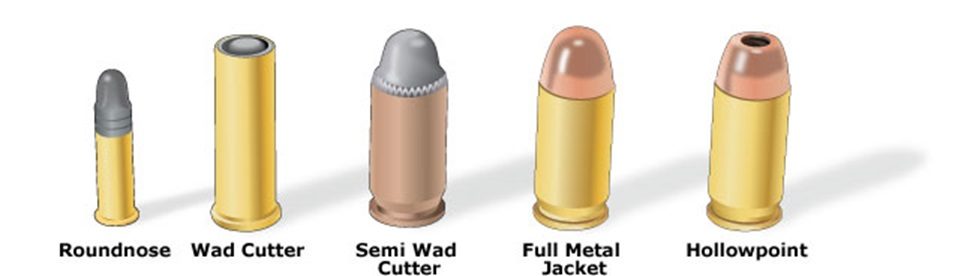
You need a box of 9mm, and the first question to answer is, "What am I using it for?" Ammunition in the same caliber can be built for very different jobs. Is ball ammunition fine for everything, or should you shoot only hollow points? A bullet made for practice isn't built like one made for carry, and neither is built like one made for a match.
By the end you should be able to explain what full metal jacket, hollow point, lead round nose, wadcutter and semi-wadcutter bullets are for, match a bullet type to self-defense, competition or range training, and confirm a load in your own pistol before you rely on it.
The parts of a cartridge and four terms that help you compare bullets
A pistol cartridge is a self-contained unit, and the bullet is only one of its four parts.
- Bullet. The projectile that exits the barrel.
- Case. The container that holds the propellant and bullet together.
- Powder. The propellant that generates gas pressure to push the bullet out of the barrel.
- Primer. The small explosive charge that ignites the powder when struck by the firing pin.
All four have to work for the cartridge to fire, but the bullet is the part that actually meets the target, so it is where we will focus.
Four terms come up constantly when people compare bullets. Bullet weight is measured in grains (gr), and a heavier bullet generally carries more momentum but may also generate more recoil. Ballistic coefficient (BC) measures aerodynamic efficiency, and a higher BC means the bullet keeps its velocity better over long distances. Most pistol shooting happens at shorter distances, so BC is the term you will use least. The pair that matters most for pistols is expansion and penetration. Expansion is a bullet's ability to increase in diameter on impact, which enhances energy transfer. Penetration is its capacity to travel into a target, which is critical in self-defense for reaching vital organs.
Expansion and penetration pull against each other. Picture pushing a sharpened pencil into a block of clay, and then pushing a flat spatula into the same block. The pencil goes deep, and the wider spatula goes shallower but moves more clay aside. A bullet that opens wide transfers more energy but travels less deeply. A bullet that stays narrow goes deeper but spreads less.
Key idea: Every pistol bullet design is a different answer to the same question. How much should it widen, and how deep should it go? Once you know what your job demands, the choice usually makes itself.
Common pistol bullet designs and what each is built to do
Full metal jacket: The practice workhorse
A full metal jacket (FMJ) bullet has a lead core encased in a harder metal jacket, usually copper or a copper alloy. That jacket explains most of its strengths. It resists deforming, and FMJs are known for smooth feeding and reliable function. Their simpler construction also makes them generally less expensive. They tend to penetrate well and show minimal expansion.
Those traits make FMJ a natural fit for range training, where you repeat the same shot many times and cost and reliability matter most. They also suit competitive shooting, where consistency and predictable ballistics are favored in disciplines such as IPSC and USPSA.
Jacketed hollow point: The self-defense standard
A jacketed hollow point (JHP) has a hollowed-out tip designed to expand on impact, increasing the bullet's diameter as it travels through a target. Controlled expansion creates a larger wound channel and transfers energy effectively. Because the bullet widens, it is less likely to exit the target, which reduces the risk to bystanders. That combination is why JHP is the go-to choice for defensive situations. It is also used by law enforcement where controlled energy delivery is critical.
Lead bullets: Round nose, wadcutter and semi-wadcutter
Picture a dial. At one end is the rounded lead round nose, at the other is the flat-faced wadcutter, and the semi-wadcutter sits between them.
A lead round nose (LRN) is made entirely of lead and has a rounded tip. It is typically less expensive and may deform more easily on impact, and it is often found in budget rounds for training. It is less popular for self-defense because of inconsistent expansion. It is also credited with excellent accuracy in older firearms.
A wadcutter (WC) has a flat, sharp-edged front and was originally developed for revolver target shooting. Think of a paper hole punch. The flat nose cuts crisp, clean holes in paper targets, which makes scoring and grouping analysis easier because you can see exactly where each shot landed. A wadcutter is designed for minimal deformation and does not expand, so it is generally not used for self-defense. It shines in bullseye and other match disciplines where precision and minimal target damage are key.
A semi-wadcutter (SWC) has a partially truncated or beveled tip with a slightly curved profile, combining features of the round nose and the wadcutter. It offers improved accuracy over a full wadcutter while still cutting clean holes, better penetration than a wadcutter, and improved cutting ability compared to a round nose. It works for target and match shooting and for training rounds where precision and cost both matter. It can be used in certain defensive scenarios too, though it is not as common as JHP for that purpose.
Specialty designs: Polymer-tipped and boat tail
A polymer-tipped bullet has a polymer tip that improves aerodynamics and helps initiate controlled expansion. The reduced drag improves ballistic coefficient and benefits long-range accuracy, so these bullets show up in self-defense and hunting rounds and in competition where long-range performance is critical. A boat tail bullet has a tapered rear that reduces drag and helps maintain velocity over longer distances. It is more common in rifle ammunition, and our article on rifle bullet shapes shows why. In pistols, some precision competitions or specialty loads may use it.
| Bullet type | Built to | Best uses | Keep in mind |
|---|---|---|---|
| FMJ | Feed smoothly, penetrate, keep cost down | Range training, competition | Minimal expansion |
| JHP | Expand in a controlled way | Self-defense, law enforcement | Look for data on expansion and penetration |
| Lead round nose | Deliver inexpensive accuracy | Budget training rounds | Deforms easily, inconsistent expansion |
| Wadcutter | Cut clean paper holes | Bullseye and match shooting | Does not expand, not for self-defense |
| Semi-wadcutter | Balance cutting and ballistic consistency | Target, match, training | Less common than JHP for defense |
| Polymer-tipped | Reduce drag, start expansion | Self-defense, hunting, long-range competition | Specialty design |
| Boat tail | Reduce drag | Precision competitions, specialty loads | Not common in pistols |
Start with the last column. Every strength in this table comes with a limit, and the limit often decides the job. Minimal expansion is a feature on the range and a drawback in defense. A wadcutter's flat face is perfect for paper and wrong for self-defense. Once you see that, the "Best uses" column is not something to memorize, because you can reason your way to it.
Choosing pistol ammunition for self-defense
For self-defense, the key is ammunition that reliably stops a threat while minimizing risks to bystanders. The bullet must deliver controlled expansion, adequate penetration and predictable performance under stress. That is exactly the balance a jacketed hollow point is designed to strike. Expansion gives effective energy transfer, and because an expanded JHP is less likely to exit the target, it limits the danger to innocent bystanders. Modern JHP designs, often incorporating polymer tips, are intended to give consistent expansion even in adverse conditions.
The bullet is not the only decision. These are the other factors to weigh.
- Caliber. Popular defensive calibers include 9mm, .40 S&W and .45 ACP, each balancing recoil, magazine capacity and stopping power. Our caliber comparison for personal protection goes into detail.
- Bullet weight and velocity. Heavier bullets typically offer more energy transfer but may generate greater recoil, which can affect your control.
- Reliability. Choose ammunition that feeds smoothly and performs consistently in your specific firearm.
- Testing and data. Look for rounds tested by reputable organizations, with data on expansion, penetration and energy transfer. For background on how that testing works, see the role of ballistic gelatin.
If you have to rank them, reliability comes first. The best-designed bullet does nothing for you if it does not feed in your pistol, and a load you cannot control in rapid shooting will not serve you well either. Everything else fine-tunes a choice that has to work in your hands and your firearm first.
Good practice: Practice with your inexpensive FMJ, but also shoot the defensive load you actually plan to use. Confirm that your pistol feeds and cycles it smoothly, and learn how it recoils. A load you have never fired is a guess, not a plan.
Choosing pistol ammunition for competition
Competitive shooting rewards precision, consistency and rapid follow-up shots, so the priorities differ from self-defense. Accuracy and low recoil take center stage, and FMJ is a staple in many disciplines for three reasons. Its simple design produces uniform performance and predictable trajectories. It is typically more cost-effective, which matters when a competition calls for high volumes of fire. And it tends to feed smoothly and resist deformation, so each shot is consistent.
Some competitors move beyond standard FMJ.
- Match-grade ammunition. Manufactured to tighter tolerances, with accuracy often superior to standard FMJ.
- Reduced-recoil loads. Designed to ease recoil so you can shoot quicker follow-up shots and keep sight alignment during rapid-fire stages.
- Specialty rounds. In certain tactical competitions, JHP rounds engineered for minimal expansion can ensure consistency while still offering some terminal performance.
Match-grade ammunition and reduced-recoil loads are the two most widely useful. Tighter tolerances mean each round is closer to the last, which tightens groups, and lower recoil returns your sights to the target sooner. Our article on ammunition quality, from cheap to match grade helps you decide when the extra investment pays off.
Choosing pistol ammunition for range training
The goal of range training is to build fundamentals such as trigger control, sight alignment and proper stance, without worrying about the cost of every round. FMJ is the training workhorse because it is generally less expensive, which allows high-volume shooting. Its consistent performance helps you develop muscle memory and shot-to-shot accuracy, and its reliable feeding and minimal barrel fouling make a session more efficient. With minimal expansion and consistent ballistic performance, it is made for repetition. Our guide to pistol shooting fundamentals covers the skills you are building.
Two alternatives are worth knowing. Reduced-recoil rounds are ideal for new shooters or extended practice sessions because they reduce fatigue. Think of a new shooter who starts anticipating the kick after a long session and begins flinching. A gentler load protects good habits. Some manufacturers also offer reduced-power practice loads and "dummy" rounds designed for training. Note that a true dummy round is inert and does not fire, so it is used for handling drills, never for shooting. Always keep it clearly separated from live ammunition.
Putting it together: How to decide
Here is the decision in plain terms. Start with your purpose, because each use case may call for a different bullet type. If you want to practice a lot, choose FMJ. If you want a load to carry for defense, choose a quality JHP from a reputable maker and test it in your pistol. If you shoot bullseye or match paper, look at wadcutters or semi-wadcutters, and for fast competition look at FMJ, match-grade or reduced-recoil loads. These six factors guide the final choice.
- Purpose. Self-defense, competition or training.
- Firearm compatibility. Works reliably with your pistol, given its chamber dimensions and feeding mechanism.
- Recoil management. Controlling recoil is critical for accuracy and rapid follow-up shots in self-defense and competition.
- Terminal ballistics. For self-defense, examine data on expansion, penetration and energy transfer.
- Cost. Balance performance with budget, especially when training requires high volume.
- Environmental conditions. Temperature, humidity and even clothing can affect performance.
Purpose and compatibility are the two to settle first. Purpose narrows the field to a bullet type, and compatibility tells you whether a specific load will run in your pistol. The other four tune your choice. Weigh the trade-offs between recoil, terminal performance and cost, and expect that no single load wins on all three.
Common mistake: Buying one box for every job. The load that is cheapest for practice is rarely the one you want for defense, and the load that is best for paper may not suit either. Choose by purpose, then test.
Testing two loads in your own pistol
Two loads, shot side by side, tell you what your pistol and your hands prefer. Pair a practice load, usually FMJ, with one that serves your goal, such as a defensive JHP, a match load or a reduced-recoil load. With eye and ear protection on, the muzzle downrange and your finger off the trigger until the sights are on target, shoot a group with each from the same distance and grip, noting group size, where it landed, how the recoil felt and any feeding or ejection problem. A few quick pairs with each show how fast your sights settle. A load that fails to feed is set aside; the rest give you one load for practice and one you trust for your main purpose.
Check your understanding
Try answering these before you open the answer. If you can decide what to do and explain why, you have it.
1. In an apartment, you're choosing between FMJ and a jacketed hollow point for your nightstand pistol. Why does the hollow point lower the risk to people beyond the threat?
An expanding bullet widens as it moves through the target, so it slows faster and is less likely to exit. A bullet that stays narrow is more likely to pass through and keep going.
2. Why is FMJ the usual choice for practice, even though it is not the usual choice for defense?
It is generally less expensive, feeds smoothly and performs consistently, with minimal expansion. That suits repetition and building muscle memory. For defense, you want the controlled expansion of a JHP.
3. A wadcutter cuts a clean hole in paper. Why is that useful to a target shooter, and why is it not a defensive choice?
Clean holes make scoring and grouping analysis easier, which suits bullseye and match shooting. A wadcutter is designed for minimal deformation and does not expand, so it is generally not used for self-defense.
4. Your new defensive load jams in your pistol. Does the bullet design still matter? What should you do?
Reliability comes first. Choose ammunition that feeds smoothly and performs consistently in your specific firearm, so test another load and set the one that jams aside.
5. A new shooter in your family is tired after 50 rounds of 9mm. When would a reduced-recoil load make sense?
For new shooters and long practice sessions, where gentler recoil reduces fatigue and flinching, and in competition, where it makes faster follow-up shots and steady sight alignment easier.
Where to go next
If self-defense is your main interest, read Selecting the Right Personal / Home Defense Ammunition for how to think about the choice, and then the premium defensive ammunition guide to see how several well-known product lines compare. To learn more about the FMJ and its close cousin, Full Metal Jacket vs Total Metal Jacket explains how the two differ. For affordable practice choices, Range Ammo: Maximizing Your Range Time shows what to look for in a training load.
If this article helped you, we invite you to sign up for email notifications of new blog articles.