
In Depth with Federal Hydra-Shok & HST Ammunition
Joseph McLain Oct 27, 2026
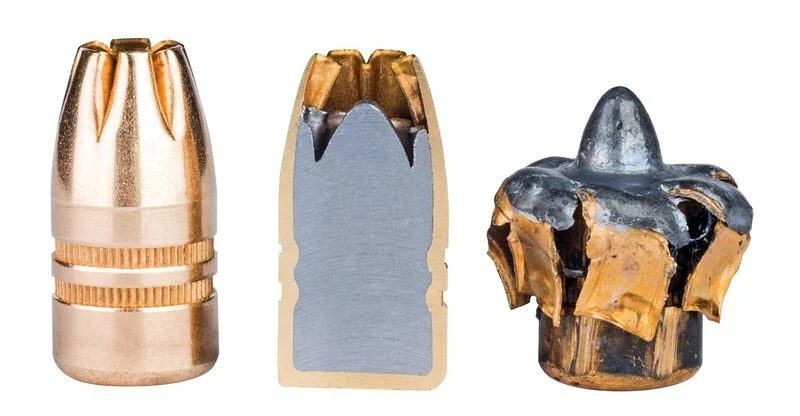
You are standing at the ammunition counter with a handgun you plan to carry or keep for home defense, and two boxes of Federal hollow points are sitting in front of you. One says Hydra-Shok. The other says HST. Both come from the same company, both are made for self-defense, and someone has told you either one will do the job. That may be true, but it does not help you choose. This article explains how each bullet is built, why those designs behave differently, and how that should (and should not) steer your decision. By the end you should be able to pick between them for your own situation, read test results with a sharper eye, and confirm that your pistol runs the load you choose.
What a defensive hollow point has to do
A self-defense bullet has two jobs that pull against each other. It has to expand, meaning the hollow cavity in the nose opens and the bullet mushrooms wider as it moves through the target. It also has to penetrate far enough to reach vital organs. A bullet that expands too little behaves like an ordinary bullet, and a bullet that penetrates too little may not get where it needs to go. Good defensive ammunition keeps those two jobs in balance.
What upsets the balance is the stuff in the way. Heavy clothing, glass and sheet metal are called barriers, and they can pack into the hollow cavity like a wad of cloth stuffed into an umbrella. An umbrella full of fabric will not open, and a plugged hollow point will not expand. Both bullets in this article are Federal's answers to that problem, and the difference between them is how each one solves it.
Two measurements come up again and again when people compare defensive loads. Weight retention is the share of the bullet's original weight that stays together after it passes through the test material. A bullet that sheds its jacket or loses pieces gives up weight, and usually penetration with it. Penetration depth is how far the bullet travels, normally measured in ballistic gelatin, a standardized material used as a stand-in for soft tissue. We explain how that testing works in our guide to ballistic gelatin.
Key idea: Expansion and penetration are a balance, and barriers are what upset it. Every design choice in Hydra-Shok and HST is an attempt to keep that balance when something is in the way.
Hydra-Shok: The center-post bullet that set the baseline
Hydra-Shok came along in the late 1980s, designed by bullet inventor Tom Burczynski and produced by Federal. It arrived in the same years that the 1986 Miami-Dade shootout pushed the FBI to study terminal ballistics, meaning what a bullet does once it reaches the target, and to develop the penetration and barrier tests that defensive ammunition is still judged by. Hydra-Shok's goal fit that moment: A hollow point that would expand reliably even after striking clothing. Many law enforcement agencies adopted it as a standard, and it later became a favorite among civilian shooters as well.
Its signature feature is the center post, a central lead post standing inside the hollow-point cavity. Think of the post as a tent pole inside a tent. It gives the cavity a structure to work around, which helps keep the bullet's jacket from collapsing or clogging when it hits. The post is also described as locking the bullet's core to the jacket. Add a carefully engineered hollow point and a notched jacket, which is a jacket with cuts in it that help it peel back, and you get controlled, even expansion and a consistent wound channel.
Over time Federal refined the line. The Hydra-Shok Deep variant was introduced to give deeper penetration in tougher barrier conditions while still expanding reliably.
Hydra-Shok reliably expands, and that is why its reputation for dependability under stress has lasted. Its limits show up at the edges. Picture a carrier in a heavy winter coat, with several layers of fabric between the muzzle and the target. Layered fabric, or automotive glass, is where Hydra-Shok may show slight differences in results from one shot to the next. That variability, not a failure to work, is the limitation Federal went on to address.
HST: The redesign built for consistency
In the early 2000s Federal set out to address that limitation, particularly consistency and barrier performance. The result was HST, introduced in 2002 for law enforcement. It was built to expand reliably and penetrate to the depths the FBI test protocol calls for, including after passing through the protocol's test barriers such as heavy clothing.
The first thing to notice is what HST left out. It has no center post. The post that helps Hydra-Shok hold its shape is also something that can interfere with expansion, so removing it makes the result more predictable. In its place HST uses a deep, tapered hollow-point cavity that encourages controlled expansion. The jacket also carries skives, carefully placed grooves that reduce resistance as the bullet mushrooms. If you have ever scored a piece of cardboard so it folds exactly where you want, you already understand the idea. The grooves tell the jacket where to open, so it opens the same way every time.
The third idea is about speed. HST is engineered to deliver consistent performance across a wide range of velocities. A bullet slows down at longer range, after passing through a barrier, or when it leaves a short barrel at lower speed. A design that only opens up at full speed would be unreliable in exactly those cases, so HST is built to keep expanding as it slows.
HST began as a law-enforcement product, and its performance led Federal to make it available to civilians in 2013. Today it is used by concealed carriers and defensive shooters, and even by some hunters who want a bullet that performs in varied conditions.
Hydra-Shok and HST side by side
| Feature | Hydra-Shok | HST |
|---|---|---|
| Introduced | 1988 | 2002 for law enforcement; civilian market in 2013 |
| Core design | Center post inside the hollow point; notched jacket | Deep, tapered cavity; skives in the jacket; no center post |
| Expansion | Reliable, with more variation possible through heavy layered fabric | Highly consistent, including after heavy clothing; like most non-bonded hollow points, hard barriers such as auto glass are its toughest test |
| Weight retention | Often 90% or more | Often 90% or more |
| Penetration | Effective in 12 to 18 inches of gel in historical tests | Typically deeper and more consistent; meets or exceeds FBI penetration standards |
| Velocity | Standard and +P defensive loadings | Standard and +P loadings, plus HST Micro loads designed for short barrels |
| Best known for | Long civilian and law enforcement track record; everyday carry | Widely adopted law enforcement duty load; consistent performance in standardized tests |
Here is how to read the table. The two bullets are closer than their reputations suggest. They retain similar weight and both penetrate effectively. The real difference is in the Expansion and Penetration rows, where HST is described as more consistent. Consistency is the word to hold on to, because in a defensive situation you do not get to choose the conditions. A bullet that performs the same way through a T-shirt, a heavy coat or a windshield is easier to trust than one that performs well most of the time.
Reading the test results and field reports
Almost everything you read about these two bullets comes from one of two places, and it helps to know the difference.
Gel and barrier tests are controlled. Hydra-Shok consistently shows reliable expansion in gel, with slight variability when it has to pass through heavy clothing, and historical tests have shown effective penetration on targets with 12 to 18 inches of gel. HST is widely reported to meet FBI penetration standards consistently and to expand uniformly after the protocol's soft barriers. Many law enforcement agencies also report reduced jacket separation and consistent wound channels in field tests.
Field feedback is experience. Civilians and concealed carriers often praise Hydra-Shok for its reliability and legacy, and many still swear by it for everyday carry. Many agencies have adopted HST for its consistency under varied conditions. Both lines produce similar weight retention, often above 90 percent, but HST tends to deliver more consistent terminal results over a broader range of velocities.
The lesson is to treat each source for what it is. A gel test tells you how a particular load behaved under particular conditions. A field report tells you what people trust. Neither one tells you how the load will feed and shoot in your pistol, which is why the testing step later in this article matters. Penetration is also a balance, not a contest. The goal is enough depth to reach vital organs without more than necessary, which is why a bullet that is deeper and more consistent is not automatically the better choice for every situation.
Calibers and variants: What is available
Both lines are offered in a wide range of calibers, so your first step is always the caliber your firearm is chambered for.
- 9mm Luger. Both lines are popular here, most commonly in 124 and 147 grain weights, with +P versions and a 150 grain HST Micro for short barrels. It is an ideal choice for concealed carry and law enforcement because of the balance between expansion and over-penetration control.
- .40 S&W and .45 ACP. Both lines offer options in these calibers, designed for reliable performance in defensive scenarios.
- .38 Special and .357 Magnum. Revolver cartridges; .38 Special loads offer more manageable recoil in small revolvers than .357 Magnum. Check which line is currently offered in your revolver's caliber.
- Specialized variants. Hydra-Shok Deep is intended for deeper penetration, particularly when hitting through barriers, and some versions of HST are loaded to +P.
The calibers are the starting point, and the variants are the fine-tuning. A +P load is loaded to higher pressure than a standard load. That raises velocity and penetration, which is especially helpful in full-sized duty pistols. Because higher pressure puts more stress on a firearm, check your owner's manual or the manufacturer to confirm your pistol is rated for +P before you buy it. For a closer look at one popular caliber, see Federal's 9mm lineup.
How to choose between Hydra-Shok and HST
With the design differences in mind, the choice becomes a set of "if this, then that" questions.
- If you carry concealed or keep a home-defense handgun, either line works. HST's more consistent expansion may give it an edge when the bullet has to pass through clothing or light barriers, and it may be preferable if you are particularly concerned about over-penetration.
- If your use is law enforcement or duty, follow your agency's requirements; HST is a common duty choice because of its consistency in standardized testing. If hard barriers such as auto glass are a real concern, compare bonded designs as well.
- If you value tradition or already have a record with Hydra-Shok, it is still a venerable choice backed by decades of real-world use. There is no need to switch unless you want the incremental improvements HST offers.
- If your pistol is short-barreled, look at HST's short-barrel variants, which are engineered for expansion at lower velocity.
The two questions that matter most are the first and the last. What do you expect the bullet to pass through, and how much velocity will your barrel give it? Everything else is refinement. For full-sized service pistols both rounds come in standard and +P versions, and testing in your specific firearm with your intended load is recommended.
Price and availability play a smaller role. Hydra-Shok is often available at a slightly lower cost, but HST has become widely adopted enough that the difference may be minimal. In some law enforcement circles HST is now the standard, and the civilian market may follow that trend. Personal preference counts too. Many shooters have a long history with Hydra-Shok, while others value the evolution HST represents after years of feedback on Hydra-Shok's limitations in certain barrier tests.
Common mistake: Choosing a defensive load by reputation and never firing it in your own pistol. Even a proven bullet is only a good choice if your pistol feeds it reliably.
Putting it together
The person who told you either one will do was mostly right, and now you can see why. Hydra-Shok and HST both expand reliably and hold their weight; HST was built later to be more consistent across clothing and velocities, and it has become the more common duty choice. So the decision is smaller than the marketing suggests. If you already carry Hydra-Shok and your pistol runs it, there is no urgent reason to switch. If you are choosing fresh, HST is the more modern design, and the HST Micro loads make sense in very short barrels. Either way, the step that matters most is the one below: Prove the exact load in your own pistol, then practice with affordable ammunition that hits in the same place.
Try this: Prove your carry load in your own pistol
- Choose your load by caliber, barrel length and variant, using the "if this, then that" list above.
- At the range, follow standard safety practice. Keep the muzzle downrange and your finger off the trigger until the sights are on the target. Our firearm safety guide covers the rules to review first.
- Fire at least a couple of full magazines of the exact load you intend to carry, and ideally a whole box. Write down any failure to feed, fire or eject.
- Shoot the same drill with affordable practice ammunition, such as the loads in our range ammo article, and compare where each one hits.
- If you have any malfunction, stop and work out why before you trust that load. Try another variant or brand, and ask an instructor to watch you shoot.
You will know it worked when your carry load has fed, fired and ejected every round without trouble, and it lands close to where your practice ammunition does. Then you can practice with the inexpensive ammunition and trust the carry load to behave the same way.
Check your understanding
Try answering these before you open the answer. If you can explain it in your own words, you understand it.
1. Why did Federal remove the center post when it designed HST?
The post, while helpful, can interfere with expansion. Without it, and with a deep tapered cavity and skives in the jacket, expansion becomes more predictable and consistent.
2. What problem does heavy clothing create for a hollow point, and which design changes in HST address it?
Fabric can pack into the cavity and keep the bullet from opening. HST's deep, tapered cavity and skives in the jacket encourage controlled, uniform expansion, and the design is built to keep expanding across a wide range of velocities.
3. Both lines often retain 90 percent or more of their weight. Why is that not enough to choose between them?
Weight retention shows the bullet stays together, but it does not show how consistently the bullet expands and penetrates through barriers. That consistency is where HST is described as stronger.
4. You own a compact, short-barreled pistol. What should you consider?
Barrel length lowers velocity, so consider HST's short-barrel variants, which are engineered for low-velocity expansion. Then test the load in your own firearm.
5. A friend has carried Hydra-Shok for years without a problem. Should he switch?
Not necessarily. Hydra-Shok has decades of real-world success, and there is no need to switch unless he wants the incremental improvements HST offers.
Where to go next
If you want to see how these bullets stack up against other premium choices, start with our comparison of Federal Hydra-Shok and HST, Speer Gold Dot and Hornady Critical Defense and Critical Duty. To widen the picture beyond one brand, Selecting the Right Personal / Home Defense Ammunition walks through the other choices that matter. And if you are still deciding on a caliber, our caliber comparison for personal protection is the logical next step.
Check out our ammo inventory and let us know if there's something you'd like that we don't have on the website or in stock. Our goal is to have everything you need so if we're lacking, say the word and we'll add it.
If you found this informative, we invite you to sign up for email notifications of new blog articles.