
The Hornady Custom Line of Ammunition: Precision, Performance, and Purpose
Joseph McLain Nov 07, 2026
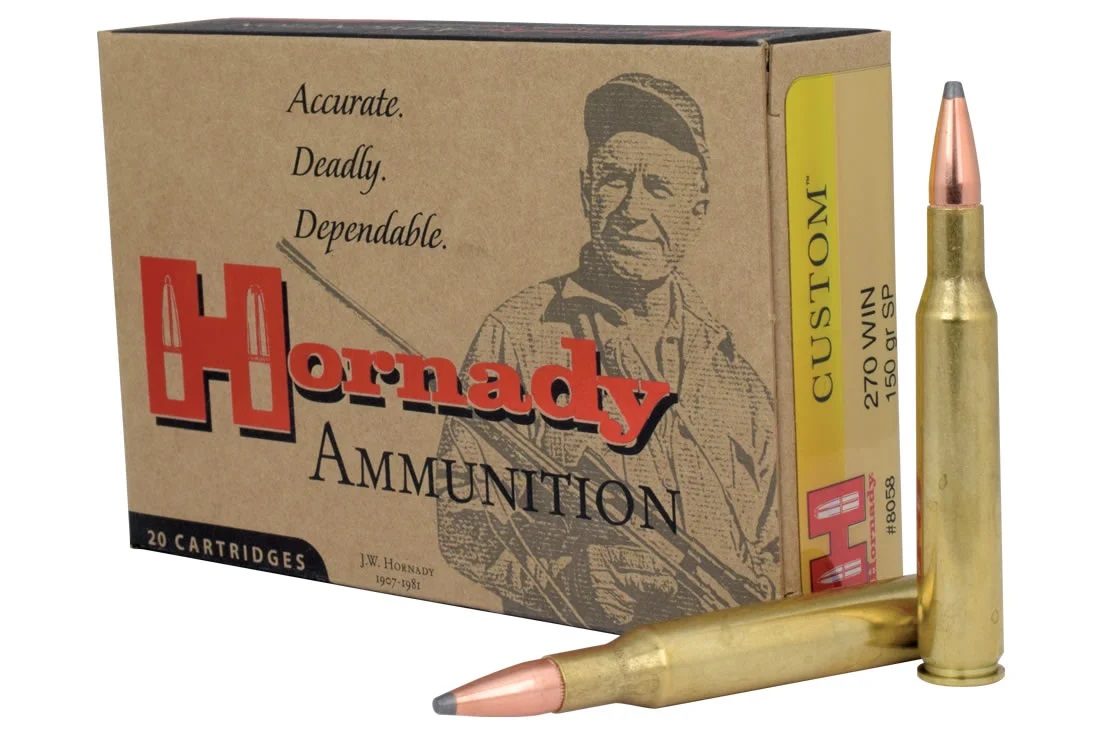
The Hornady section of the ammunition wall can stop you cold: American Whitetail, Custom, Superformance, Precision Hunter, Outfitter. Inside Custom alone there are boxes marked InterLock, SST, FTX and CX. You have one rifle and one deer season, and you want to know which box to put in it.
Here's the secret that makes the wall simple: Hornady uses a handful of bullets across many lines, and the bullet decides how the load behaves on game. By the end you should be able to pick the right bullet for your hunt, know when Custom is the right line for it, and know why Custom is often the only choice for an older or less common rifle.
Choose the bullet first, then the line
A hunting bullet has two jobs that pull against each other. It has to open up, or mushroom, so it makes a wide wound, and it has to hold together well enough to push through to the heart and lungs. A bullet built to open fast does the first job better; a bullet built to stay together does the second. Each Hornady bullet sits at a different point on that line.
InterLock is Hornady's traditional soft point: a lead core in a copper jacket, with a ring inside the jacket that grips the core so the two are less likely to separate. It opens steadily and holds together well at ordinary speeds. It's a dependable whitetail bullet at woods and field-edge distances.
SST (Super Shock Tip) adds a pointed polymer tip. The tip helps the bullet keep its speed, so it drops less at distance, and on impact it's driven into the nose to start rapid opening. That makes SST a fine open-country deer bullet. The trade is that it opens fast, so at close range from a fast cartridge it can break up more than a tougher bullet would, and it isn't the bullet for big-boned animals like elk.
FTX (Flex Tip eXpanding) has a soft, flexible tip. It was designed for lever actions, where each bullet rests on the primer of the round ahead in a tube magazine and a hard point is dangerous. The soft tip is safe there, and it still gives the bullet a pointed shape. Hornady also uses FTX in the straight-wall cartridges Iowa hunters use, such as its 165-grain .350 Legend load.
CX is a solid copper bullet with no lead. A one-piece bullet can't separate, so it keeps nearly all its weight and penetrates deeply. It needs more speed to open than a lead-core bullet, and it's the choice where lead-free ammunition is required.
- If you hunt whitetail in timber or at field edges, inside about 200 yards, choose InterLock, because it opens reliably and holds together at those speeds.
- If you hunt open country where shots run 200 to 350 yards on deer or pronghorn, choose SST, because its tip keeps it flatter and opens it at longer range.
- If you shoot a lever action or a straight-wall cartridge like the .350 Legend, choose FTX, because it's safe in a tube magazine and built for those cartridges' speeds.
- If you hunt elk or other big animals, or you must use lead-free, choose CX, because it holds together through heavy bone.
If you're not sure and you hunt Midwest whitetail, start with InterLock.
Key idea: The name of the line on a Hornady box tells you the price, packaging and powder. The name of the bullet tells you what the load will do in the animal. Read the bullet name first.
Where Custom fits among Hornady's lines
The lines mostly repackage the same bullets with a different priority. American Whitetail is the budget line, mostly InterLock, for ordinary deer hunting. Custom is the long-running middle line: a choice of bullets in the widest range of cartridges. Superformance uses special powders to push the same bullets faster, which flattens the shot a little. Precision Hunter uses the ELD-X, a sleek bullet built for long range. Outfitter pairs the copper CX bullet with sealed, nickel-plated cases for hunts in rain and snow.
- If you hunt whitetail at ordinary distances and want the lowest price, American Whitetail with InterLock does the job.
- If you want a specific bullet in your cartridge and American Whitetail doesn't offer it, look in Custom, which carries the broadest choice.
- If your hunt is long range on elk or mule deer, step up to Precision Hunter, because the ELD-X is built for long shots on big animals.
Custom is often the answer for an older rifle
Custom's real strength is breadth. Hornady loads it in cartridges few other makers still bother with, such as the .30-40 Krag, .250 Savage and .218 Bee. If you've inherited a rifle in a cartridge you can't find on most shelves, Custom is one of the first places to look.
Before you shoot an old rifle, match the cartridge on the box exactly to the marking on the barrel, and have a gunsmith look over any rifle you don't know the history of. A box that's "close" isn't safe; a .30-40 Krag and a .30-30 are different cartridges, even though both are .30 caliber.
Common mistake: Buying the most advanced bullet on the shelf and expecting it to extend your range. A sleeker bullet flies flatter, but it doesn't make your hold steadier. Your range is the distance at which you can keep every shot inside a deer's 8-inch vital area from a hunting position.
Sighting in with the load you choose
Every load hits a little differently, even in the same rifle and bullet weight, so sight in with the exact box you'll hunt with. Wear eye and ear protection, shoot from a steady rest, and let the barrel cool between groups, because a hot barrel can move the shots. If your rifle shoots one bullet clearly better than another, that's the one to hunt with; rifles have preferences, and a few groups will show you your rifle's.
Check your understanding
Try answering these before you open the answer. If you can decide what to do and explain why, you have it.
1. You hunt Iowa's shotgun season with a .350 Legend. Which Hornady load fits, and why that bullet?
The 165-grain FTX. FTX is Hornady's bullet for straight-wall and lever-action cartridges, built to open at their speeds, and the .350 Legend is legal for Iowa deer.
2. Your 7mm Remington Magnum shoots SST beautifully, and you're going elk hunting in Colorado. Do you keep using it?
Switch for elk. SST opens fast, and a fast magnum hitting a big-boned elk at close range is exactly when it can break up before it reaches the vitals. Choose a tougher bullet, such as Hornady's CX, or a bonded bullet, and sight in again with it.
3. Your grandfather's rifle is marked ".250 Savage" and no store near you has ammunition. Where do you start?
Hornady Custom, which still loads .250 Savage with an InterLock bullet. Match the box to the barrel marking exactly, and have a gunsmith look over the rifle before you shoot it.
4. A friend sees the same 150-grain SST in both a Custom box and a Superformance box. Why pay more for Superformance?
Superformance uses powders that push the same bullet faster, so it drops a little less at long range. If his shots are under about 250 yards, the difference won't matter and the Custom box is fine.
5. A new Hornady line appears next season with a bullet you've never heard of. How do you decide whether it suits your deer hunting?
Ask what the bullet is built to do: open fast, hold together, or both, and at what distance. Then match that to your animal and your shots, the same way InterLock, SST, FTX and CX match different hunts. Sight in with it before trusting it.
Where to go next
You can find Hornady Custom ammunition on our website, including InterLock, SST, FTX and CX loads and handgun XTP loads, and anything listed there can be ordered if it isn't in stock.
For a side-by-side of every Hornady hunting line, read Hornady's hunting lines compared. To understand why bullets open the way they do, see how deer bullets work. And for Iowa's straight-wall cartridges, choosing a straight-wall deer rifle covers the options.
If this article helped you, we invite you to sign up for email notifications of new blog articles.