
Hornady BLACK Ammunition: The Versatile Choice for Tactical Shooters
Joseph McLain Nov 07, 2026
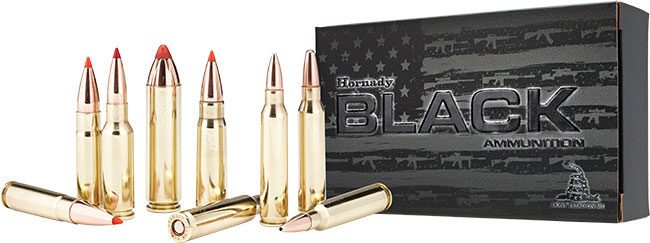
You built an AR-15 with a short barrel, and it runs one brand of ammunition perfectly but sometimes fails to eject another. Is Hornady BLACK something special for short and suppressed rifles like a .300 Blackout, or regular ammunition in a black box? The real answer is in how semi-automatic rifles use gas, and only your own rifle can settle it.
By the end you should be able to explain why semi-automatic rifles can be particular about ammunition, what each bullet in the BLACK line is built for, and whether a BLACK load fits your rifle and your purpose.
Why semi-automatic rifles can be particular
A gas-operated semi-automatic rifle uses some of the gas from each shot to cycle its action. In a direct-impingement AR-15, the gas travels back through a tube and pushes the bolt carrier; in a piston rifle, the gas pushes a piston that moves the action. Either way, the rifle needs the right amount of gas at the right moment.
Too little gas, and the bolt may not travel far enough to eject the empty case and pick up the next round, a malfunction called short-stroking. Too much, and the rifle cycles violently, which can cause wear, harder recoil and other problems. The amount of gas depends partly on the ammunition: How quickly its powder burns and how much pressure it produces at the point where gas is tapped from the barrel. A short barrel, a suppressor or an unusual muzzle device changes the gas a rifle receives, which is why those rifles are often the first to show ammunition sensitivity.
Think of a garden hose turning a sprinkler. Too little water pressure and the sprinkler stalls; too much and it whips around and wears out. The rifle is the sprinkler, and the ammunition helps decide the pressure.
Key idea: A semi-automatic rifle runs best when the ammunition delivers the gas it was set up for. A load that runs perfectly in one rifle can short-stroke in another, so reliability is something you confirm in your own rifle.
What Hornady says BLACK is designed to do
Hornady introduced BLACK as a line aimed at modern sporting rifles and other semi-automatic firearms, pairing loads tuned for reliable function in those rifles with bullets chosen for particular jobs. That is the core idea: Rather than a single bullet type across many cartridges, each BLACK load combines a cartridge with a bullet suited to how that cartridge is commonly used.
BLACK is designed with semi-automatic function in mind, but no ammunition maker can test every combination of barrel, gas system and accessory. A load designed to run broadly is a good place to start, not a guarantee, which is why a function test in your own rifle matters.
The bullets in the line, and what each is for
| Bullet | How it is built | What it is built to do |
|---|---|---|
| FMJ | Full metal jacket over a lead core | Economical practice; does not expand |
| V-MAX | Polymer-tipped, thin jacket | Very rapid expansion and fragmentation, as on varmints |
| SST | Polymer-tipped hunting bullet with a mechanically locked core | Rapid expansion with more penetration than a varmint bullet |
| A-MAX, ELD Match and BTHP match bullets | Streamlined target bullets | Accuracy and long-range flight; not designed for hunting performance |
These bullets are nearly opposites in some ways. A V-MAX is built to come apart quickly in a small animal; an SST is built to open quickly but keep going far enough for deer-sized game; match bullets are built to fly consistently, not to perform on animals. FMJ is for practice. Our article on rifle bullet types explains how construction relates to purpose.
Common mistake: Choosing a bullet for a job it was not designed to do. A match bullet or a varmint bullet is not a deer bullet, and FMJ is for paper and steel. Match the design to the task.
The cartridges, and what each BLACK load is for
5.56 NATO and .223 Remington. BLACK has included 5.56 NATO loads such as a 62-grain FMJ for training and heavier match-style bullets for longer-range accuracy. Before buying any 5.56 or .223 ammunition, check your barrel's marking; a rifle marked only .223 Remington should not be fed 5.56 NATO. Our article on 5.56 NATO and .223 Remington explains why, and Hornady's 5.56mm ammunition covers the rest of Hornady's 5.56 lineup.
.300 AAC Blackout. This cartridge lives in two worlds. Hornady's BLACK supersonic load uses a 110-grain V-MAX, and its subsonic load uses a heavy 208-grain A-MAX. The subsonic load is designed to stay below the speed of sound, which makes a suppressed rifle much quieter, and its heavy bullet carries far less energy than a supersonic load. Because the A-MAX is a match-style bullet, it is not built for reliable expansion at subsonic speeds, so hunters who want a quiet hunting load usually look for one designed to expand at low velocity. Our article on the .300 AAC Blackout explains the cartridge, and choosing ammunition for suppressors explains why subsonic loads can be harder to cycle.
7.62x39. The BLACK 7.62x39 load uses a 123-grain SST, which gives AK-pattern and other 7.62x39 rifles a tipped, expanding bullet with brass cases rather than the steel cases common in surplus-style ammunition.
Other cartridges. The line has also included cartridges such as the 6.5 Grendel and 6mm Creedmoor with match-style bullets, and handgun cartridges were added later. Hornady adds and drops loads over time, so check the current catalog for exactly what is available.
In Iowa, none of the rifle cartridges above are legal for deer: Iowa allows rifles for deer only with expanding bullets .350 to .500 inch in diameter that produce at least 500 foot-pounds of energy at the muzzle. Check the current Iowa Hunting and Trapping Regulations for what is legal for coyotes and other animals, and for night-hunting and equipment rules.
Where BLACK fits among Hornady's lines
Hornady offers several lines with different purposes. Match ammunition is built for the smallest possible variation in velocity and the tightest groups. Custom and Superformance are hunting lines, with Superformance using powders that add velocity. TAP and law-enforcement lines are built for specific duty requirements. BLACK sits between them as a multi-role line for semi-automatic rifles, using bullets borrowed from those other lines to suit each cartridge's common use.
Choose BLACK when you want one dependable load for a semi-automatic rifle in a particular role, and to move to a specialized line when a single job, such as hunting expansion or peak precision, matters most. Our guides to Hornady Custom and Hornady Superformance explain those lines.
Proving a load in your own rifle
One box of ammunition tells you what you need to know. Set the rifle up exactly as you will use it, including any suppressor or muzzle device, and with eye and ear protection on and the muzzle downrange, fire the whole box in full magazines, noting every malfunction and which round it happened on. Shoot two or three five-shot groups from a rest and compare them with your usual ammunition, and when you clean the rifle, notice how much carbon built up. A load that ran every round, grouped as well as your usual load and didn't foul the action unusually has earned a place in your rotation.
Putting it together
Semi-automatic rifles depend on the gas each cartridge delivers, so short barrels, suppressors and muzzle devices can make them particular about ammunition. Hornady's BLACK line is designed with those rifles in mind and pairs each cartridge with a bullet suited to a common job: FMJ for practice, V-MAX for varmints, SST for hunting where the cartridge is legal, and match bullets for accuracy. Read the bullet type on the box, not just the color of the box, check your barrel marking, follow Iowa's hunting rules, and prove any load in your own rifle before you trust it.
Check your understanding
Try answering these before you open the answer. If you can decide what to do and explain why, you have it.
1. Why can a short-barreled or suppressed AR be particular about ammunition?
Barrel length and suppressors change the gas available to cycle the action. A load that delivers too little gas can short-stroke, and too much can make the rifle cycle violently.
2. After adding a suppressor, your AR runs fine, but with a different load the empty case sometimes stays in the chamber and the next round doesn't feed. What is happening?
Short-stroking: the bolt isn't traveling far enough rearward to eject the case and pick up the next round, usually because that load delivers too little gas to your rifle as it is now set up. Try a load that cycles reliably in your configuration and confirm it with a full box.
3. Which BLACK bullet suits coyotes, and which is designed for deer-sized game?
The V-MAX suits coyotes and varmints because it fragments rapidly. The SST is designed to expand and still penetrate for deer-sized game where the cartridge is legal.
4. Why might a hunter look beyond the BLACK 208-grain subsonic .300 Blackout load?
Its A-MAX is a match-style bullet not designed for reliable expansion at subsonic speeds. Hunters usually choose a load built to expand at low velocity.
5. A load runs perfectly in your friend's rifle. Do you need to test it in yours?
Yes. Gas systems, barrel lengths and accessories differ, so reliability is confirmed in your own rifle.
Where to go next
You can find Hornady BLACK ammunition on our website, including 5.56 NATO, .300 Blackout, 7.62x39 and .224 Valkyrie loads, and anything listed there can be ordered if it isn't in stock.
If you shoot an AR-15, 5.56 NATO and .223 Remington explains the barrel marking that decides what you can safely buy. For an AK-pattern rifle, the AK-47 and SKS covers the platform. Understanding the .300 AAC Blackout explains the two-world cartridge, and rifle bullet types shows how bullet construction relates to purpose.
If this article helped you, we invite you to sign up for email notifications of new blog articles.