
Hornady's 9mm Lineup: A Comprehensive Guide
Joseph McLain Nov 07, 2026
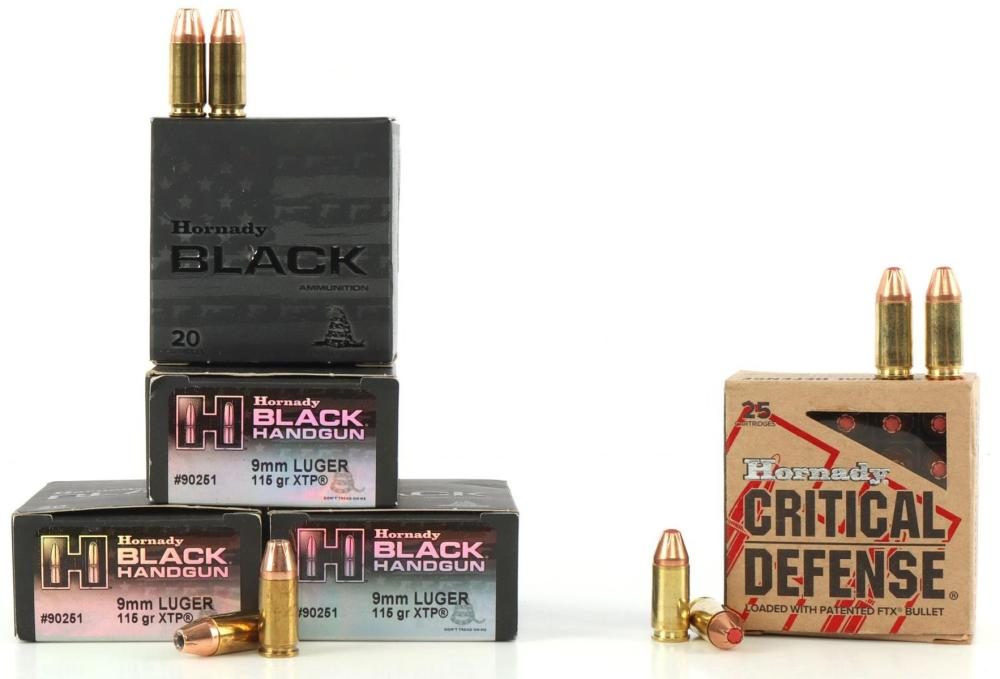
The Hornady shelf has more 9mm names than most people can keep straight: Critical Defense, Critical Defense Lite, Critical Duty, American Gunner, Custom, Subsonic, Handgun Hunter, Backcountry Defense. Several have red tips, several say XTP, and the boxes don't tell you which one belongs in the pistol on your belt.
Most 9mm owners need one load to carry or keep for defense and one to practice with. By the end you should be able to pick Hornady's best carry load for your pistol, know why the two "Critical" lines are not interchangeable, match a practice load to it, and know when one of the specialty loads is the right tool.
The short answer
For a compact or full-size pistol, carry Hornady Critical Duty 135-grain (standard pressure). For a very small pistol with a barrel around 3 inches, Hornady's own choice is Critical Defense 115-grain, which works but sits near the shallow edge of what a defensive bullet should do. Practice with a brass-cased full metal jacket load close in weight, such as a 124-grain FMJ, because Hornady doesn't make an inexpensive 9mm practice line. The specialty loads are for suppressors, hunting and the backcountry, not for carry.
What a defensive bullet has to do
A defensive bullet has two jobs. It has to go deep enough to reach the heart, lungs and major blood vessels from a bad angle, through an arm or a winter coat, and it should open up, or expand, so it makes a wider wound. The FBI test that most makers and independent testers follow calls for 12 to 18 inches in ballistic gelatin, a stand-in for muscle. Under 12, a bullet may stop short. Much over 18, it's more likely to pass through and keep going toward whatever is behind the person.
Ordinary hollow points can fail at the first step: clothing packs into the cavity like a cork, and the bullet goes through without opening. Hornady's answer, used in both Critical lines, is a soft red polymer tip that fills the cavity so fabric can't get in. On impact the tip is driven back into the bullet and starts the opening. That is the main thing to understand about the red tips. They don't make a bullet more powerful; they make it open more consistently through clothes.
Bullet weight is given in grains, a tiny unit (7,000 to a pound). A lighter bullet leaves faster; a heavier one leaves slower and has more momentum, which generally helps it keep driving after it opens.
Critical Defense and Critical Duty are built for different guns
The names sound alike, and the boxes look alike, so many people assume Critical Duty is just a stronger Critical Defense. They were built for different pistols and different tests.
Critical Defense (115-grain FTX) was designed for small concealed-carry pistols with short barrels. A short barrel gives the bullet less speed, so this bullet is built to open easily at the lower speed. The cost is depth. Hornady's own test from a 3-inch barrel through heavy clothing measured 11.25 inches, just under the 12-inch line, and independent tests have landed from about 11.5 to 14 inches. That's adequate, but there is little margin, and heavy winter clothing takes some of what margin there is.
Critical Duty (135-grain FlexLock) was built for police duty pistols and the FBI's full barrier test, which adds wallboard, plywood, sheet steel and auto glass to heavy clothing. Its jacket is locked to its core by a ring inside the bullet (Hornady calls it InterLock), so it holds together through those barriers instead of shedding its jacket. In Hornady's test of the +P version from a 4.5-inch barrel, it reached 13 to 15 inches through every barrier, auto glass included. It recoils a little more and costs about the same. It comes in standard pressure and +P (loaded to higher pressure for more speed); the standard-pressure load already reaches the right depth, so start there.
- If you carry a compact or full-size 9mm, such as a Glock 19, SIG P365 XL or Smith & Wesson M&P, choose Critical Duty 135, because it gets deeper with margin to spare and was tested against barriers Critical Defense was never built for.
- If you carry a very small 9mm with a barrel near 3 inches, such as a Glock 43 or Smith & Wesson Shield, Critical Defense 115 is the Hornady load built for that barrel. It's a reasonable choice, especially in light clothing. If you want more margin through a heavy coat, Critical Duty 135 is the Hornady step up if your pistol runs it reliably, and Federal HST 124-grain is an excellent choice outside Hornady.
- If recoil is what keeps you from shooting the 115 well, consider Critical Defense Lite (100-grain). It is lighter and slower, so it has less push to drive deep; choose it only when the softer recoil is the difference between shooting well and not.
If you're not sure, start with Critical Duty 135 standard pressure and prove it in your pistol, as described below.
Common mistake: Choosing a defensive load by how big the expanded bullet looks in a photo. A bullet that opens wide and stops at 10 inches looks better in the picture and does worse in a person. Ask how deep it went before you ask how wide it got.
What XTP means, and where American Gunner and Custom fit
XTP is Hornady's older hollow point, designed as a hunting and general-purpose bullet. It has no polymer tip. It opens more modestly than a modern defense bullet and tends to go deep, which is why it does well on game and in a suppressed gun. It shows up in three lines: American Gunner (115-grain, and 124-grain +P), a lower-priced line; Custom (124 and 147-grain), the long-running version; and Subsonic (147-grain).
American Gunner is often sold as one load for both practice and carry. As a carry load it's acceptable, because an XTP that goes deep and opens a little still does the main job, and it beats carrying full metal jacket. As a practice load it costs more than plain FMJ. If you can afford to carry Critical Duty and practice with FMJ, that pair is better at both jobs. If your budget allows only one box of hollow points, American Gunner is a sound one.
Your pistol makes the final call
A load that jams is worthless, however it does in gelatin. Before you trust a defensive load, fire at least 50 rounds of it through the pistol you'll carry, with every magazine you'll carry, loaded full, because a full magazine pushes hardest against the slide. With eye and ear protection on, shoot some slowly at 7 yards to see where they hit compared with your sights. One malfunction may be the gun or your grip; clean it and try again. A second with the same load means switch loads.
Good practice: Replace carry rounds at least once a year by shooting them, and don't keep rechambering the same top round, which can push the bullet deeper into the case. Our guide to testing and rotating your carry ammunition shows how to check for it.
Practice ammunition that matches
You'll fire far more practice ammunition than carry ammunition, so it should recoil and hit about like your carry load. Hornady doesn't make a low-cost 9mm full metal jacket line for everyday practice, so most people practice with another brand's brass-cased FMJ. Match the weight as closely as you can: 124-grain FMJ with Critical Duty 135, 115-grain with Critical Defense 115. Then shoot your carry load and your practice load side by side once, at 7 yards. In a carry pistol, landing within an inch or two of each other is a match.
Hornady's Steel Match line is a steel-cased competition load. The steel case keeps the price down but can't be reloaded, and some indoor ranges don't allow steel cases, so check before you bring it.
The specialty loads: Suppressors, hunting and the backcountry
Subsonic 147-grain XTP is for shooting with a suppressor. Sound travels about 1,125 feet per second at room temperature, and a bullet faster than that makes its own crack that no suppressor can remove. The heavy 147-grain bullet is loaded to stay below that speed from a pistol. A carbine's longer barrel adds speed, so if you shoot it from a carbine, a chronograph tells you whether it is still subsonic.
Handgun Hunter (115-grain +P) uses a MonoFlex bullet made of solid copper alloy, one piece of metal with no separate jacket and core to come apart. Backcountry Defense (138-grain +P) uses Hornady's DGH bullet, whose nose is locked to its core so it drives straight and deep rather than turning. Both are built to go deep through hide, muscle and bone, which is what you want from a 9mm on game or as a last-resort defense against a large animal. They are not carry loads for defense against people, where you want a bullet that opens and stops inside the target. Both are +P, so use them only in a pistol rated for +P.
Hunting rules come from your state. In Iowa, Iowa Code 481A.48 requires a deer handgun to have at least a 4-inch barrel and fire an expanding bullet between .350 and .500 inch with a published muzzle energy of at least 500 foot-pounds. The 9mm bullet, at .355 inch, passes the size test, but no 9mm load comes close to 500 foot-pounds, so the 9mm is not legal for Iowa deer. Our guide to handgun deer hunting in Iowa walks through every requirement.
Check your understanding
Try answering these before you open the answer. If you can decide what to do and explain why, you have it.
1. You carry a Glock 19 and a friend hands you a box of Critical Defense, saying it's "the same thing as Critical Duty, just cheaper." What do you tell them?
They're different bullets for different guns. Critical Defense is built to open at the lower speed of a short barrel and runs near the 12-inch minimum. Critical Duty is built for duty-size pistols like the Glock 19 and goes deeper, with margin, through barriers. In a Glock 19, carry Critical Duty 135.
2. It's January, you carry a Shield in a coat, and your pistol runs both Critical Defense 115 and Critical Duty 135 without a hiccup. Which do you carry?
Critical Duty 135. Critical Defense already sits close to 12 inches through heavy clothing from a short barrel, and a winter coat takes more. Since your pistol runs Critical Duty reliably, take the extra depth.
3. A neighbor asks for "the strongest 9mm Hornady makes" for home defense and picks Backcountry Defense. What's wrong with that choice?
It's built to go very deep through a large animal without opening much. In a house, that means a bullet more likely to pass through a person and keep going through walls. For defense against people, Critical Duty 135 is the right Hornady load.
4. You bought a 9mm carbine with a suppressor and loaded Subsonic 147 XTP, but it still cracks. Why?
The carbine's longer barrel adds speed, and the bullet is now going faster than sound, so it makes its own crack. Check it with a chronograph; if it's over about 1,125 feet per second, you need a load made to stay subsonic from a carbine barrel.
5. A new load from another maker advertises 13 inches of penetration from a 5-inch barrel in bare gelatin. You carry a 3-inch micro-compact. How much should that number reassure you?
Not much. Your shorter barrel gives the bullet less speed, and bare gel leaves out what clothing does. Look for a test from a short barrel through heavy clothing that shows 12 inches or more on every shot, the same standard that separates Critical Defense from Critical Duty, then prove it in your own pistol.
Where to go next
You can find Hornady 9mm ammunition on our website, including Critical Duty, Critical Defense, Critical Defense Lite, American Gunner, Custom XTP, Subsonic, Handgun Hunter and Backcountry Defense, and anything listed there can be ordered if it isn't in stock.
For the full comparison of the two Critical lines across calibers, read Hornady Critical Defense vs. Critical Duty. To see how Federal's lineup answers the same questions, see Federal's 9mm lineup. And if you shoot suppressed, choosing ammunition for suppressors explains subsonic loads in more depth.
If this article helped you, we invite you to sign up for email notifications of new blog articles.