
The Ins and Outs of the Fiocchi Range Dynamics Product Line
Joseph McLain Nov 06, 2026
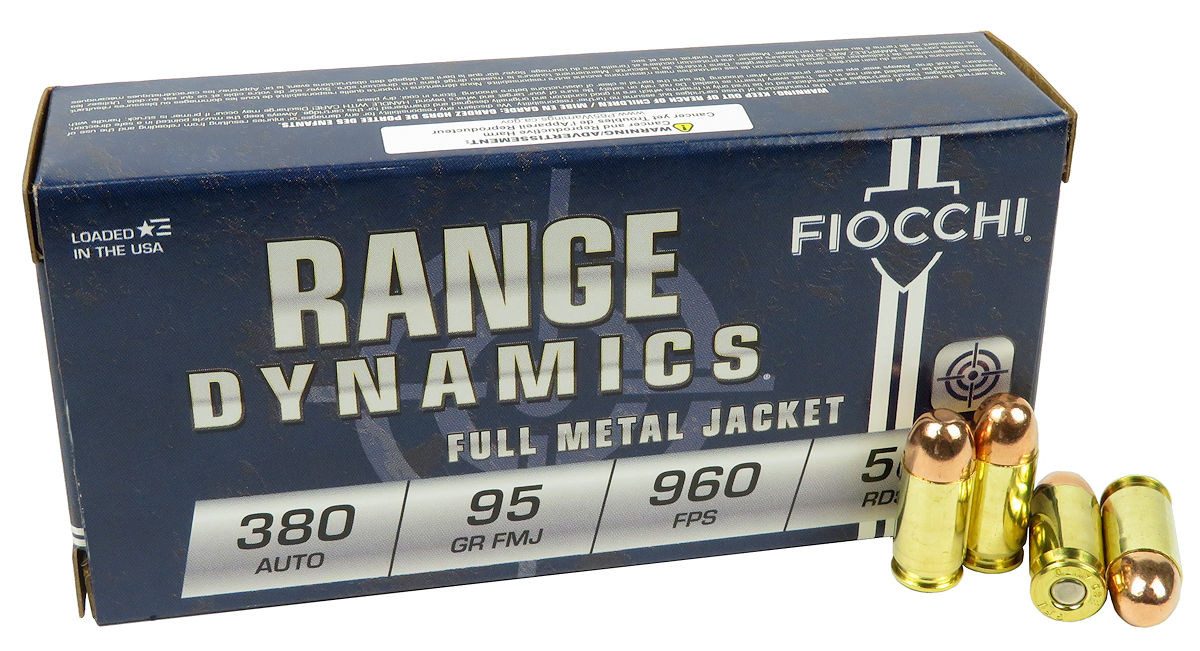
You are planning a range day with one goal: Shoot a lot without spending a lot. A big box of Fiocchi Range Dynamics fits the budget, but is budget ammunition any good? What do FMJ, CMJ and "boxer-primed" actually mean? How does it compare with the other value brands? By the end you should be able to decide whether it fits your practice plan, read the terms on the box, and set realistic expectations for accuracy, cleanliness and reloading.
Range Dynamics is good practice ammunition: reliable, reloadable full metal jacket loads in the same class as Federal American Eagle, CCI Blazer Brass and Winchester White Box. Among those, buy whichever runs reliably in your gun and costs least where you shop. It isn't defensive or hunting ammunition. Fiocchi puts its hollow points in its Defense Dynamics line and its hunting soft points in Field Dynamics, and that's where you should look for those jobs.
What Fiocchi Range Dynamics is for, and where it is made
Fiocchi is an Italian ammunition manufacturer with a heritage dating back to the late 1800s. It is widely recognized for its shotgun shells, handgun ammunition and rifle ammunition, and it has built a reputation for quality at competitive prices. Range Dynamics is Fiocchi's value-oriented centerfire line, focused on range practice, training sessions and casual competition. If you see "Range Dynamics" on a Fiocchi box, you can expect affordable, reloadable and reliable ammunition for everyday range use. That is a niche similar to Federal's American Eagle or CCI Blazer Brass lines.
Although Fiocchi is based in Italy, it also runs a U.S. manufacturing facility in Ozark, Missouri, which gives American shooters ready access to competitively priced ammunition. Fiocchi makes ammunition on both sides of the Atlantic, so check the box if country of origin matters to you. Fiocchi's facilities typically meet rigorous ISO standards, a type of quality-management certification, and the cartridges are meant to follow SAAMI specifications, the industry's published standards for cartridge dimensions and pressure. Quality checks cover primer seating, powder charge uniformity and bullet seating. The line is not match-grade, but the consistency is reliable enough for everyday range use.
Key idea: Practice ammunition has one job: Buy you trigger time. Skill grows with repetition, so a dependable, affordable load that lets you shoot more often can do more for your shooting than a premium box you ration.
Reading the box: Brass, bullets and packaging
Range Dynamics keeps costs down by using straightforward components and making them in large quantities. Four features on the box tell you how it is built and how you can use it.
- Boxer-primed brass cases. The brass is basic but holds consistent dimensions, which helps it function reliably in standard firearms. Boxer-primed brass is also the kind reloaders can reuse, because the spent primer can be pushed out and replaced, which adds a cost-saving benefit for shooters who reload.
- FMJ or CMJ bullets. Most loads use a full metal jacket (FMJ) bullet, which has an exposed lead base, or in some calibers a complete metal jacket (CMJ), which encloses the base too and cuts the lead you breathe at an indoor range. Our article on full metal jacket and total metal jacket bullets explains the difference.
- Not a defensive or hunting line. Range Dynamics bullets are built for practice and don't expand. Fiocchi's defensive hollow points are in its Defense Dynamics line, and its pointed soft points for hunting are in Field Dynamics.
- Bulk packaging. You can often find these rounds in bulk packs of 50, 100 or 200 rounds, which suits high-volume shooters and training sessions. Large production runs, called economies of scale, help keep costs low.
The brass and bullet choices decide how you can use the ammunition, and the packaging decides what it costs you.
Calibers and loads: What you can buy
Range Dynamics covers a broad range of calibers for both pistols and rifles. The weights below are in grains (gr), a small unit of bullet weight.
| Type | Cartridge | Typical load |
|---|---|---|
| Handgun | 9mm Luger | 115 gr or 124 gr FMJ (or CMJ) |
| Handgun | .40 S&W | Typically 165 gr or 180 gr FMJ |
| Handgun | .45 ACP | Commonly 230 gr FMJ |
| Handgun | .380 ACP | Approximately 95 gr FMJ |
| Handgun | .357 Magnum, .38 Special, .44 Magnum, 10mm | Some variants may be available, though they are less common under the Range Dynamics branding |
| Rifle | .223 Rem / 5.56 NATO | Typically 55 gr or 62 gr FMJ, ideal for high-volume AR-15 practice |
| Rifle | .308 Win | Commonly 147 gr or 150 gr FMJ, for target shooting and plinking, not hunting |
| Rifle | .30-06, 7.62x39 and others | Occasional runs |
The main volume for the line is in the common handgun calibers, .223 and .308, and the rarer calibers appear in occasional runs. That means your odds of finding Range Dynamics in a popular caliber are far better than in an unusual one.
Safety: Before you buy .223 Rem or 5.56 NATO, check the caliber marked on your barrel, and read our article on why 5.56 NATO and .223 Remington are not entirely interchangeable. Practice ammunition is still live ammunition, so always match the cartridge to your firearm's marking.
What to expect from the line
Accuracy: What to expect from a practice load
How tightly Range Dynamics groups depends on your firearm as much as the ammunition, so be wary of anyone's single number. Shooters generally describe it as accurate enough for drills, plinking and casual competition, which is what the line is built for, and some firearms clearly "like" particular loads more than others. If you measure rifle groups, you will see them described in MOA, or minute of angle, where one MOA is about one inch at 100 yards (see understanding MOA). Only your own gun can tell you how a load groups for you.
Common mistake: Expecting match-grade groups from practice ammunition, or blaming the box when a group opens up. Practice ammunition is not match-grade, and a lot of group size comes from the shooter and the firearm. Compare a few loads before you decide anything about the ammunition itself.
Reliability and cleanliness
Shooters consistently report minimal malfunctions with Range Dynamics, citing dependable feeding and ejection in both pistols and rifles. Consistent primer seating and powder charges contribute to reliable cycling and extraction. Cleanliness is typical of budget ammunition, so routine cleaning after extended sessions is recommended. Regular cleaning keeps fouling from building up and keeps your firearm running its best. The brass is usually bright and fitted with standard boxer primers.
Reloading potential
Many reloaders appreciate the dimensional consistency of the brass, which is known to offer multiple reload cycles when treated properly. As a reloading source, Range Dynamics is comparable to other mainstream budget lines, which makes it a cost-effective choice for high-volume shooters. If you reload, you can experiment with your Range Dynamics brass to fine-tune the powder charge and bullet combination and improve accuracy. Reloaders should always follow published load data from a reputable source.
The fairest way to judge any practice load is side by side with another in your own gun: same distance, same rest, five-shot groups, noting any malfunctions and how dirty the gun gets. Two budget lines that both run reliably will usually group within a hair of each other, which is why price and availability, not brand, usually decide.
How Range Dynamics compares with other budget lines
It helps to see where the line sits among the other budget-friendly choices.
| Budget line | Similarity | Distinction |
|---|---|---|
| Federal American Eagle | Affordable, reloadable FMJ ammunition ideal for training | Both come from long-established makers; the practical difference is usually price and what your local shelf carries |
| Remington UMC | Cost-effective, high-volume training ammunition with standard performance | Differences typically come down to slight variances in velocity and grouping, influenced by manufacturing processes |
| CCI Blazer Brass | Reliable, reloadable brass ammunition at a competitive price point | Brand preference or local availability may determine the choice |
| Winchester White Box | A big-box staple known for affordability and decent performance | As with any high-volume line, you will hear occasional stories of an odd lot, so the decision comes down to how it runs in your gun and local pricing |
These lines are much more alike than different, and the differences are small. Range Dynamics stands shoulder to shoulder with them on reliability, cost and performance, and it fills the niche for everyday training ammunition without the advanced features of premium defensive lines. The practical rule is simple. If two lines are both reliable in your firearm, buy the one that is easier to find and costs less. Our guide to choosing between American Eagle, Winchester White Box, Remington UMC, PMC Bronze and Blazer Brass covers that decision in more depth.
Putting Range Dynamics to work
Range Dynamics meets the fundamental needs of shooters who want reliable, everyday ammunition, and it works best in three situations.
- Range training and high-volume practice. Cost-effectiveness and bulk packaging make extensive training sessions and practice drills affordable.
- Introductory competitions. For local IDPA, USPSA or benchrest events where match-grade performance is not the main goal, it offers dependable performance.
- Reloading. The reloadable, boxer-primed brass appeals to reloaders who want to experiment with custom loads and reduce costs further.
Which of these matter most depends on you. New shooters get the most from the first use, because high-volume practice is how fundamentals are built. Seasoned shooters value reliable, no-frills ammunition for training sessions and local competitions, and reloaders value the brass. Four habits help everyone get the most out of it.
- Purchase in bulk. Buying in larger quantities, such as 250- or 500-round boxes, maximizes your savings.
- Clean routinely. Regular cleaning after extended sessions ensures good performance and prevents fouling.
- Try reloading trials. If you reload, experiment with the brass to fine-tune your powder charge and bullet combination.
- Test different loads. Different firearms may "prefer" certain bullet weights or load velocities, so try several to find the best match for your platform.
While Range Dynamics lacks the advanced bullet technologies found in premium lines, it does the job it was designed for, which is maximizing trigger time without breaking the bank. For plinking, introductory competition and keeping your proficiency up, it delivers performance that is good enough at a competitive price.
Putting it together
Budget ammunition is not a false economy when its job is practice: A reliable, affordable load buys you the trigger time that builds skill. It is the wrong tool for defense or for squeezing out the smallest groups. Pick a Range Dynamics load in a common caliber, compare it with one other budget line in your own gun, and buy in bulk whichever runs reliably and costs less.
Check your understanding
Try answering these before you open the answer. If you can decide what to do and explain why, you have it.
1. You're starting to reload 9mm. At the range, one bucket holds fired Range Dynamics brass and another holds fired steel-cased rounds. Which do you take home, and why?
The Range Dynamics brass. It's boxer-primed, so the spent primer pushes out and a new one goes in, and its consistent dimensions hold up through several reloads. Most steel-cased ammunition uses Berdan primers and steel that isn't meant to be resized, so it isn't practical to reload.
2. Your pistol shoots a 2.5-inch group at 25 yards with Range Dynamics. Is something wrong with the ammunition?
Probably not. That is plenty for training and casual target shooting. To find out whether the ammunition is the limit, shoot another load the same day; if both group about the same, work on your fundamentals.
3. A friend carries Range Dynamics FMJ in his pistol because it's what he practices with and he knows it feeds. What would you tell him?
Feeding is only half the job. A full metal jacket bullet doesn't expand, so it stops a threat less effectively and is more likely to pass through and keep going. Carry a proven defensive hollow point, such as one from Fiocchi's Defense Dynamics line or another well-tested defensive load, and shoot enough of it to confirm it runs in that pistol. Keep practicing with the cheaper FMJ.
4. How would you choose between Range Dynamics and Federal American Eagle?
Both are affordable, reloadable FMJ ammunition ideal for training, so the choice comes down to price, local availability and what your firearm likes best. Run a comparison test and keep the one that performs well and costs less.
5. You shoot drills every week. A box of match ammunition costs about three times as much as Range Dynamics and groups a little tighter. Which should you buy for those drills?
Range Dynamics. Weekly drills build skill through repetition, and the cheaper box gets you three times the trigger time for the same money. The match ammunition's small accuracy edge doesn't matter for drills. Save it for the rare event where the last fraction of an inch counts.
Where to go next
You can find Fiocchi Range Dynamics practice ammunition on our website, including .380 Auto, .38 Special, 5.56 NATO and 7.62x39 loads, and anything listed there can be ordered if it isn't in stock.
If you want to understand where budget ammunition sits on the quality scale, ammunition quality, from cheap to match grade explains what you get at each level. To make the most of every box you shoot, mastering the fundamentals of shooting will do more for your groups than any ammunition change. And for ideas on planning a productive session, read maximizing your range time with affordable, reliable ammunition.
If this article helped you, we invite you to sign up for email notifications of new blog articles.