
Federal Syntech: Ammunition Reimagined
Joseph McLain Nov 06, 2026
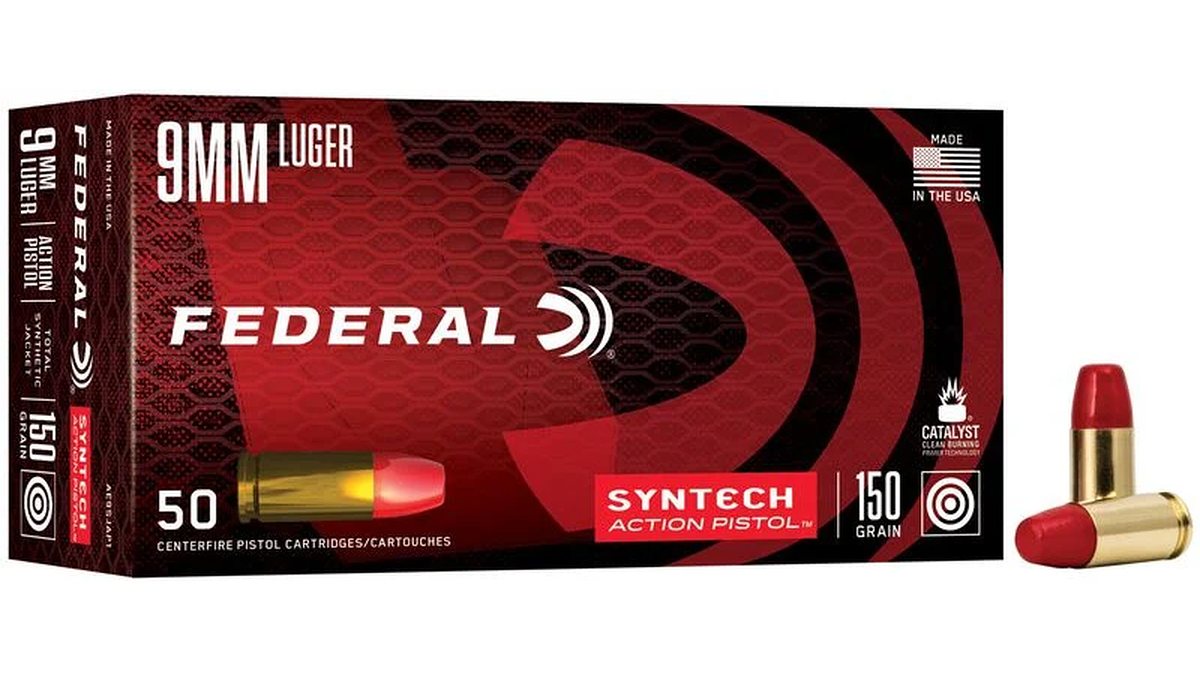
It is the end of a long range day. Your hands are gray, the pistol is hot, and you know the next hour belongs to a bore brush. Federal Syntech promises less fouling and less lead, but it costs more than plain full metal jacket ammunition. Is it worth it for the way you shoot?
The answer depends on where you shoot, how much you shoot and whether you shoot steel, because Syntech changes some things about a cartridge and leaves others exactly the same. By the end you should be able to decide whether Syntech fits your shooting and which line to buy.
What Syntech changes in the cartridge
Most practice ammunition uses full metal jacket bullets: A lead core wrapped in a copper or copper-alloy jacket. The jacket is what grips the rifling, the spiral grooves inside the barrel that spin the bullet, and over many rounds some copper rubs off and builds up in the bore. Our article on FMJ and TMJ bullets explains the jacket in more detail.
Syntech replaces that copper jacket with a polymer coating that Federal calls the Total Synthetic Jacket. The bullet still has a lead core, but the surface touching the barrel is polymer rather than copper, and the coating covers the bullet completely, including its base. Federal pairs it with its Catalyst lead-free primer, so the priming compound that ignites the powder does not contain lead.
Think of sliding a heavy box across a floor. Push it directly and the box and floor both scuff; put a plastic sheet underneath and it slides with less wear and less heat. The polymer jacket is that sheet between the bullet and the barrel.
Key idea: Syntech changes the surface that touches your barrel and the chemistry of the primer. It reduces metal fouling and primer lead, but it does not eliminate carbon residue, lead exposure from other sources, or the need for safe shooting habits.
Fouling: What you are actually cleaning
After a range session you are cleaning three different things: Carbon from burned powder, metal fouling from bullet jackets and lead, and general grime such as burnt lubricant and unburned powder. Syntech targets only the metal fouling. You will still see carbon, especially in the action and on the muzzle, and you will still need to clean and lubricate the firearm.
For many shooters, the difference shows up in the bore. Copper fouling is the stubborn part of barrel cleaning that takes repeated passes with a solvent. If your shooting builds a lot of it, such as frequent high-volume practice, Syntech can make cleanup noticeably quicker. If you shoot a few boxes a month, the difference may be small. So value Syntech's cleaner bore in proportion to how much you shoot.
Air quality indoors
Lead at the firing line comes from more than one place. Traditional primers contain lead compounds, and an exposed lead bullet base can release lead as hot gases strike it. Syntech addresses both with a lead-free primer and a fully coated bullet. That is why it is popular at indoor ranges and in classes where shooters spend hours at the line.
Reducing a source is not the same as removing all exposure, though. Lead dust can come from other shooters' ammunition, from range surfaces and from cleaning. Good habits still matter: Shoot at ranges with proper ventilation, do not eat, drink or smoke at the line, wash your hands and face with soap and water afterward, and change clothes before hugging children if you shoot often indoors. Our article on eye and ear protection covers the rest of your protective gear.
Common mistake: Assuming a cleaner round means you can skip hygiene. Wash your hands after shooting and cleaning, and choose well-ventilated ranges, whatever ammunition you use.
Heat and long strings of fire
Every shot heats the barrel, mostly from the burning powder, with some added by friction as the bullet is forced through the rifling. Federal says the polymer jacket reduces that friction. In practice, the barrel still gets hot in a long string, because powder combustion is the larger source of heat. The difference matters most when many rounds are fired with little time to cool, such as a full-day class or a pistol-caliber carbine stage. So treat reduced friction as a small benefit in high-volume shooting, not as a reason to ignore a hot barrel.
Steel targets and splash-back
When a bullet hits a steel target, it breaks apart and fragments spray outward along the face of the plate, a hazard called splash-back. Federal designed Syntech's polymer jacket to reduce jacket fragments, and several Syntech loads are marketed for steel shooting.
That is a risk reduction, not a safe distance. Steel targets still need to be in good condition without craters or pitting, angled to direct fragments downward, and set at the minimum distances the target maker specifies for your cartridge, and everyone nearby needs eye protection. Our guide to shooting targets covers safe steel setup. Follow the steel maker's distances whatever ammunition you shoot.
The five Syntech lines
Federal organizes Syntech into five lines built around the same coated bullet and lead-free primer, each tuned for a different job.
Syntech Range is the general practice load for high-volume shooting and indoor ranges. Buy it when you want cleaner practice ammunition and do not need anything specialized.
Syntech Training Match is designed to match the velocity, trajectory and point of impact of Federal's HST defensive loads, so practice feels and hits like the ammunition you carry. Point of impact is where the bullet lands relative to your sights. If your practice rounds hit differently than your carry rounds, you can unknowingly train yourself to compensate in the wrong direction. Our article on Federal Hydra-Shok and HST covers the carry load it mirrors.
Syntech Action Pistol is built for action shooting sports. It is loaded to meet the power factor thresholds those sports use, a calculation from bullet weight and speed that keeps competitors from using unrealistically light loads, and its flatter-nosed bullet is designed to knock steel down reliably while keeping recoil controllable.
Syntech PCC is designed for pistol-caliber carbines, whose longer barrels and different feeding geometry can make them more particular than pistols. Our guide to pistol-caliber carbines explains the platform.
Syntech Defense uses a segmenting hollow point: The front of the bullet breaks into several segments while the core continues forward to penetrate. That is a different approach from bonded hollow points, which are designed to expand while staying in one piece. Each approach has supporters; what matters most is that the load functions reliably in your firearm and that you practice with it. Our premium defensive ammunition guide compares defensive designs.
Choosing a Syntech line
| If you mainly... | Consider | Why |
|---|---|---|
| Practice often or shoot indoors | Syntech Range | Cleaner bore and no primer lead for routine practice |
| Carry Federal HST | Syntech Training Match | Practice that matches your carry load's point of impact |
| Shoot action pistol matches or steel | Syntech Action Pistol | Meets power factor; reliable on steel; controllable recoil |
| Run a 9mm carbine | Syntech PCC | Built for carbine feeding and barrel length |
| Want a defensive load with the same concept | Syntech Defense | Segmenting hollow point; test in your firearm |
Choose by your most common shooting, not your occasional shooting. Most people need only one or two lines. The cost across all of them is price: Syntech generally costs more than basic FMJ practice ammunition, so the value depends on how much you care about cleanup, indoor air quality, matching your carry load, or steel performance. If none of those matter to you, basic FMJ remains a sensible choice.
Putting it together
Syntech replaces the copper jacket with a polymer coating and uses a lead-free primer. That reduces copper fouling in the bore, removes primer lead and reduces jacket fragments on steel, while carbon fouling, barrel heat from powder and the need for hygiene and safe steel setup remain. Choose the line that matches what you do most: Range for routine practice, Training Match to mirror HST, Action Pistol for matches and steel, PCC for carbines, and Defense if you want the concept in a carry load and confirm it works in your firearm. Then decide whether those benefits are worth the price for the amount you shoot.
If you're not sure, buy Syntech Range if you shoot indoors or more than a few hundred rounds a month, Syntech Training Match if you carry HST, and plain FMJ such as American Eagle if neither applies.
Check your understanding
Try answering these before you open the answer. If you can decide what to do and explain why, you have it.
1. You shoot 500 rounds of 9mm a month at an indoor range and dread cleaning. Is Syntech worth the extra cost for you?
Likely yes. At that volume, less copper fouling saves real cleaning time, and the lead-free primer and fully coated bullet reduce what you breathe indoors. You'll still clean carbon from the action and still wash up after shooting.
2. You shoot two boxes a month outdoors and clean your pistol quickly. Should you switch to Syntech?
Probably not. At that volume the cleaning difference is small, and outdoor air carries most primer smoke away. Plain FMJ such as American Eagle in your carry weight is the better value.
3. You carry Federal HST 124-grain. Which Syntech line goes with it, and why?
Syntech Training Match, because it's built to match HST's velocity, trajectory and point of impact, so what you practice transfers to what you carry. Shoot both on the same target once to confirm they land together in your pistol.
4. A friend says Syntech's low splash-back means he can shoot steel at 5 yards. What do you tell him?
Reduced fragments aren't zero fragments. Follow the steel maker's minimum distance for the cartridge, keep plates angled and free of pits and craters, and everyone nearby wears eye protection, whatever the ammunition.
5. Your 9mm carbine jams occasionally with practice ammunition that runs fine in your pistol. What Syntech line might help, and what's the reason?
Syntech PCC. Carbines feed and cycle differently from pistols and can be particular about ammunition, and that line is built for them. Test a few boxes before you buy in bulk.
Where to go next
You can find Federal Syntech ammunition on our website, including Syntech Range, Training Match and Defense loads, and anything listed there can be ordered if it isn't in stock.
To see where Syntech fits among Federal's other 9mm loads, read Federal's 9mm lineup. FMJ vs. TMJ explains another way makers reduce lead exposure, and range ammo compares Syntech with ordinary practice loads. If you shoot a carbine, pistol-caliber carbines explains why they can be particular about ammunition.
If this article helped you, we invite you to sign up for email notifications of new blog articles.