
Federal Gold Medal Ammunition: A Benchmark for Precision Shooting
Joseph McLain Nov 06, 2026
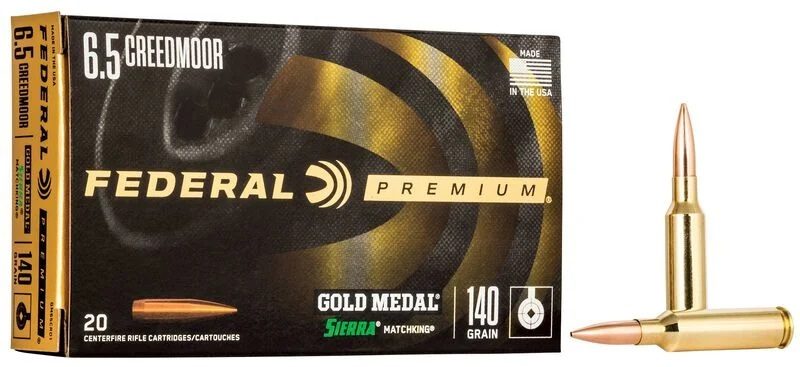
Your rifle groups well at 100 yards, but when you stretch to 300 or 500, the shots start landing higher and lower than each other. Would match ammunition fix that, or is it money better spent elsewhere?
That depends on what's actually spreading your shots. By the end you should be able to say what match ammunition does differently, tell whether it will help you or whether your money belongs elsewhere, choose the right Federal Gold Medal load for what you shoot, and know why match ammunition usually isn't a hunting load.
What match ammunition does
Match ammunition doesn't make a bullet fly harder. It makes every bullet fly like the last one. Small round-to-round differences in powder charge, primer, case and bullet seating make each bullet leave the barrel at a slightly different speed. A faster bullet drops less than a slower one, so at 100 yards the difference is tiny, but by 500 yards it shows up as shots stacked above and below each other, called vertical stringing.
Federal Gold Medal is built to shrink those differences: uniform cases, consistent powder charges, primers chosen for consistent ignition, carefully seated bullets, and match bullets made to tight tolerances. The result is a smaller spread in speed from shot to shot, which you can measure with a chronograph as extreme spread (fastest minus slowest) or standard deviation (how far a typical shot strays from the average). Lower numbers mean tighter groups at distance.
Key idea: Match ammunition removes one source of spread: shot-to-shot speed variation. It only helps once that's the biggest source left in your rifle, your setup and your shooting.
Will it help you?
A group is the sum of three things: you, the rifle and the ammunition. Match ammunition shrinks only the third. If your fundamentals or your rifle are the bigger problem, a premium box won't change much.
Here's how to find out. With eye and ear protection on, shoot three five-shot groups from a solid rest with your usual ammunition, then three with a Gold Medal load, at the longest distance you shoot regularly. If the Gold Medal groups are clearly and consistently smaller, especially in their up-and-down spread, ammunition was a real factor and the match load is worth it for that shooting. If the groups look about the same, the next improvement is your rifle setup or your practice.
- If your 100-yard groups are already small and open up mainly vertically at distance, try Gold Medal, because that's the pattern speed variation produces.
- If your groups are large even at 100 yards, work on fundamentals, scope mounting and bedding first, because match ammunition won't fix them.
- If you shoot competition (PRS, F-Class, High Power), use match ammunition, and buy enough of one lot for a season, because each lot can shoot slightly differently.
Which Gold Medal load
The line is a family built around different match bullets.
- Gold Medal Sierra MatchKing is the original, built around Sierra's MatchKing bullet, in calibers such as .223 (69-grain), .308 (168 and 175-grain), .300 Win Mag and .338 Lapua. If you're not sure, start here; it's the long-standing standard.
- Gold Medal Berger uses Berger's very sleek match bullets, which hold speed and resist wind better at long range. Choose it when wind at distance is your main problem.
- Gold Medal CenterStrike, introduced in 2023, uses Federal's own open-tip match bullet in .223, 6.5 Creedmoor and .308. It's another sound match choice; let your rifle's groups decide between it and MatchKing.
- Gold Medal Grand is clay-target shotgun ammunition built for consistent patterns.
- Gold Medal rimfire brings the same consistency to .22 LR for small-bore target shooting.
Rifles have preferences. If you can, try two Gold Medal loads in your caliber and keep the one that groups smaller.
Match bullets and hunting
Most Gold Medal rifle loads use bullets built to group tightly on paper and steel, not to expand reliably and hold together in an animal. The small hole in a match bullet's nose comes from how it's made, not from a hunting design. Some may open violently or unpredictably; others may barely open at all. For hunting, use a load whose bullet is built for game, such as Federal Terminal Ascent or a Berger Hybrid Hunter load, which is a separate hunting line, not Gold Medal.
Common mistake: Hunting with match ammunition because it's the most accurate load in your rifle. Accuracy that ends in a wounded animal isn't accuracy that matters. Choose a hunting bullet that groups well in your rifle, and sight in with it.
Check your understanding
Try answering these before you open the answer. If you can decide what to do and explain why, you have it.
1. Your .308 groups 0.8 inch at 100 yards with bulk ammunition, but at 500 yards your shots string 8 inches up and down. Will Gold Medal help?
Likely yes. Small groups up close with vertical stringing at distance is the pattern that shot-to-shot speed variation produces, which is what match ammunition reduces. Test Gold Medal Sierra MatchKing 175-grain against your bulk load at 500 yards.
2. Your rifle groups 3 inches at 100 yards with any ammunition. Should you buy match ammunition?
Not yet. At that size, your rifle setup or fundamentals are the bigger problem. Check scope mounting and bedding, and practice your trigger press, before spending on premium ammunition.
3. You're heading to Wyoming for pronghorn and your 6.5 Creedmoor groups best with Gold Medal CenterStrike. Do you hunt with it?
No. It's a match bullet, not built to expand reliably in game. Choose a hunting load such as Terminal Ascent or a Berger Hybrid Hunter load, check that it groups well, and sight in with it.
4. You shoot a PRS season and bought Gold Medal from three different lots. What might you notice?
Each lot can shoot slightly differently, so your scope settings for distance may shift a little between lots. Buy enough of one lot for the season, or confirm your data each time you open a new lot.
5. A shooter asks whether he should buy match .22 LR for his first squirrel rifle. What do you tell him?
Not at first. Match .22 helps a skilled small-bore shooter shave groups at 50 yards. For a new squirrel hunter, a good standard-velocity hunting load his rifle groups well is enough, and the savings buy practice.
Where to go next
You can find Federal Gold Medal ammunition on our website, including Sierra MatchKing, Berger and CenterStrike rifle loads and Gold Medal shotshells, and anything listed there can be ordered if it isn't in stock.
To see how ammunition variation shows up on target, read how ammunition affects accuracy. For a hunting bullet that holds its accuracy at distance, see Federal Terminal Ascent. And to measure groups properly, understanding MOA walks through it.
If this article helped you, we invite you to sign up for email notifications of new blog articles.