
Federal's 9mm Lineup: A Comprehensive Guide
Joseph McLain Nov 06, 2026
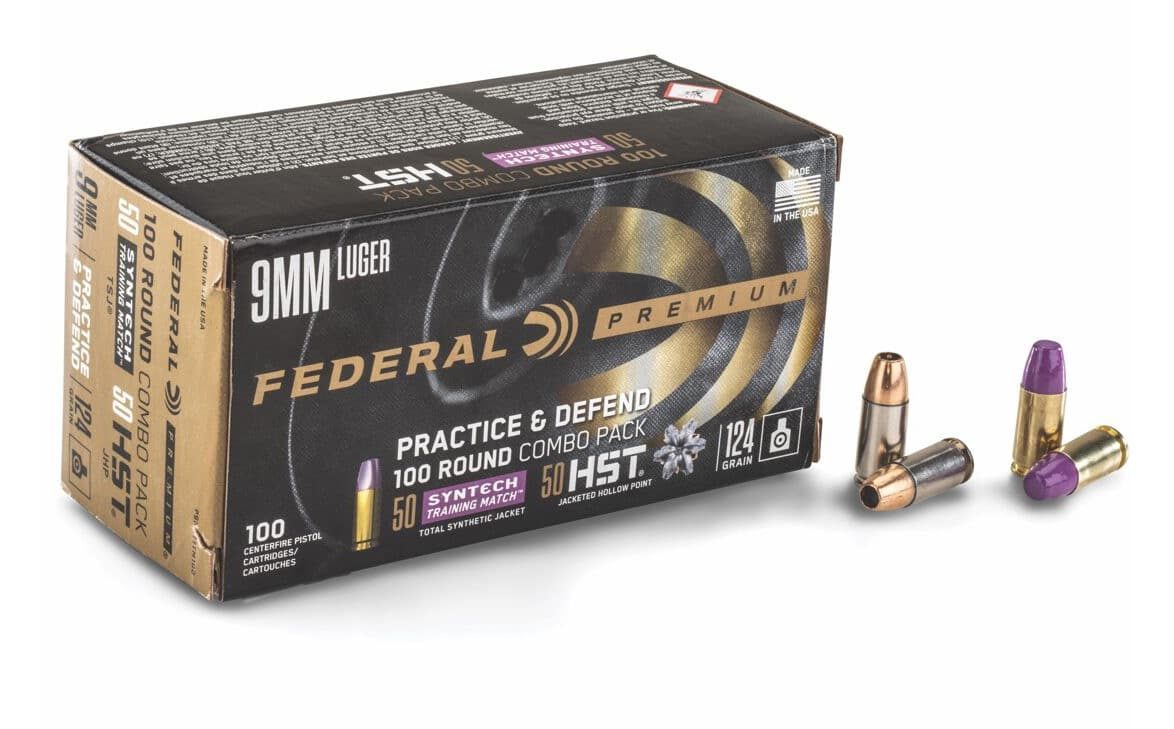
You own a 9mm, and the Federal shelf has a dozen boxes that all say 9mm Luger: HST, Hydra-Shok Deep, Syntech Defense, Punch, American Eagle, Syntech, BallistiClean, Gold Medal. Which ones do you actually need?
Most 9mm owners need exactly two boxes: one load to carry or keep for defense, and one load to practice with. By the end you should be able to choose both from Federal's lineup, know why, and know what to do if your pistol doesn't like your first choice.
The short answer
For carry or home defense, choose Federal HST 124-grain (standard pressure). For practice, choose American Eagle 124-grain FMJ, which matches its weight. If you prefer heavier bullets or shoot a pistol-caliber carbine, make the pair HST 147-grain and American Eagle 147-grain FMJ Flat Point. If cost is what's stopping you from buying a defensive load at all, Federal Punch 124-grain is a sound choice. Here is why, and what would change the answer.
What a defensive bullet has to do
A defensive load is a hollow point: a bullet with a cavity in its nose that opens like a mushroom when it hits flesh, making a wider wound than a round-nosed bullet. Opening up is only half the job. The bullet also has to go deep enough to reach the heart, lungs and large blood vessels from a bad angle, through an arm or a winter coat.
The FBI's test, which most independent testers copy, calls for 12 to 18 inches of penetration in ballistic gelatin, a stand-in for muscle. Under 12 inches, the bullet may stop short of the organs that matter. Much past 18, it is more likely to pass through and keep going toward whatever is behind the person. Federal's defensive loads are all built to land in that window. What separates them is how they get there, and how hard they were tested on the way.
Bullet weight is measured in grains, a tiny unit (7,000 to a pound). In 9mm, 115, 124 and 147 grains are the common weights. A lighter bullet leaves the muzzle faster; a heavier one leaves slower and pushes a little longer in recoil. In the 9mm, unlike the smaller .380, there is enough power that good bullets in any of these weights reach the 12-to-18-inch window, so weight is a matter of what your pistol runs and how it feels, not a question of whether the bullet works.
Key idea: In 9mm, the leading defensive loads from the major makers all do the job in gelatin. The load you should carry is the good one that runs perfectly in your pistol and hits where you aim.
Federal's defensive loads, and which to carry
HST is Federal's police duty bullet, later sold to everyone. It was built to pass the FBI's barrier tests, which fire through heavy clothing, wallboard, plywood, sheet steel and auto glass, and to hold together while it does. That is more than a citizen usually needs, and it is exactly why HST is the default: it was built for the worst case and still opens reliably in the ordinary one. It comes in 124 grains, 124 grains +P and 147 grains, all in nickel-plated cases, and in a 150-grain "Micro" load intended for very small pistols. Many police agencies have issued HST for years, so it has a long record of working in real pistols, not just in gel.
Punch is Federal's newer defensive line, designed from the start for private citizens rather than police. Its 124-grain hollow point is built to reach proper depth through heavy clothing at close range, but it isn't overbuilt to pass auto glass and steel, which is part of why it costs less. For someone carrying for personal protection, close-range shots through clothing are the realistic case, so Punch is a sound choice when price matters.
Hydra-Shok Deep is a 135-grain update of the 1989 Hydra-Shok, the bullet with a post in the middle of its hollow point. Federal redesigned it to go deeper, and reports about 15 inches in bare gelatin. It is a good load. It has a shorter public test record than HST, so it is a second choice rather than the first.
Syntech Defense (138 grains) works differently from all the others. Instead of holding together, the bullet breaks into three pieces that cut side channels a little over 6 inches deep, while its core keeps going to 12 to 18 inches, according to Federal. It is a reasonable design, but it is the odd one out: the core alone does the deep work, and the side channels stop well short of it. For most people, a bullet that stays in one piece, like HST, is the simpler, better-proven choice.
- If you want the best-proven Federal carry load, choose HST 124-grain, because it was built to the hardest test and has the longest real-world record.
- If you like heavier bullets, or your pistol shoots them closer to the sights, choose HST 147-grain. It is slower, recoils with more of a push than a snap, and does the same job.
- If you carry a very small 9mm such as a SIG P365 or Glock 43, HST 124 or 147 still works well. The 150-grain Micro is built for these pistols too, but it is harder to find, so don't wait for it.
- If price is the reason you're still carrying range ammunition, buy Punch 124-grain today. A real defensive load you can afford beats an ideal one you never buy.
If you're not sure, buy HST 124-grain standard pressure and prove it in your pistol, as described below.
Common mistake: Carrying full metal jacket practice ammunition because "a hit is a hit." An FMJ bullet doesn't open, so in a 9mm it tends to go straight through and keep going, and it makes a narrower wound on the way. It is the right bullet for practice and the wrong one for carry.
Do you need +P?
A +P load is loaded to higher pressure for more speed. HST comes in a 124-grain +P, and it is a good load, but the standard-pressure 124 and 147 already reach the right depth and open well. What +P adds is more recoil, more muzzle flash and more wear on the pistol, in return for a little speed. Use it only if your pistol's maker says the pistol is rated for +P, and even then, most people shoot standard pressure faster and more accurately. Start with standard pressure. Our guide to +P ammunition goes further.
Your pistol makes the final call
The best load on paper is worthless if it jams in your gun. Before you trust a defensive load, fire at least 50 rounds of it through the pistol you'll carry, using every magazine you'll carry, loaded full each time, because a full magazine pushes hardest against the slide and that is how you'll carry it. With eye and ear protection on, shoot some of them slowly at 7 yards to see where they land compared with your sights.
One malfunction can be the gun or the shooter, so clean the pistol and try again. A second failure with the same load means it's time to switch: from HST 124 to HST 147, or to Punch. Fifty rounds of HST costs real money, but it is the price of knowing the gun will work the one time it has to.
Good practice: Replace your carry rounds at least once a year by shooting them at the range, and don't keep chambering the same top round, which can push the bullet deeper into the case. Our guide to testing and rotating your carry ammunition explains how to check for that.
Practice ammunition: Match the weight
You'll fire far more practice ammunition than defensive ammunition, so the practice load should recoil and hit like your carry load. The simple way to get that is to match the bullet weight.
American Eagle is Federal's everyday practice line: full metal jacket bullets (a lead core covered in copper) in brass cases, in 115, 124 and 147 grains (the 147 has a flat point). It is the right default. Buy the weight that matches your carry load: 124 with HST 124 or Punch, 147 with HST 147. Many people buy 115-grain because it is cheapest; it is fine for learning the basics, but it recoils more sharply than a 124 or 147 carry load and may hit a little differently, so do at least some practice with the matching weight.
Syntech (sold under American Eagle) replaces the copper jacket with a polymer coating, the way a nonstick pan has a coating between food and metal. Less copper rubs off in the barrel, so the gun stays cleaner between cleanings. If you shoot a lot at an indoor range or hate cleaning, Syntech is worth the small extra cost. Our article on Federal Syntech goes deeper.
BallistiClean is a 100-grain lead-free frangible load, meaning the bullet is made to break into small pieces when it hits steel. That makes it the right choice when a range requires lead-free or frangible ammunition, or when you shoot steel targets at short distances, where a solid bullet can bounce back. It is not a defensive load, and frangible doesn't mean you can ignore the range's minimum distance for steel.
Gold Medal Action Pistol (147 grains) and Syntech Action Pistol (150 grains) are for USPSA and IDPA matches, where a load must reach a minimum "power factor" (bullet weight times speed). If you don't compete, you don't need them. If you do, they are built to make the minimum, but check them with a chronograph in your own pistol, especially one with a short barrel, because a shorter barrel gives less speed than Federal's test barrel.
One box for both jobs?
Federal's Train + Protect line was built for exactly that idea: a 115-grain hollow point cheap enough to practice with. The appeal is real, because you practice with what you carry. The catch is that it is a compromise on both sides: more expensive than American Eagle for practice, and less tested than HST or Punch for defense, and it has been hard to find. Two boxes, a proven defensive load and a matching practice load, give you the best of each for little more money.
9mm in a carbine
A pistol-caliber carbine, a rifle-sized gun that fires 9mm, has a barrel around 16 inches long instead of 4. The longer barrel lets the powder push the bullet longer, so the same load leaves noticeably faster. A light hollow point that was designed to open at handgun speed can open too fast and too wide at carbine speed, and then stop short. A heavier bullet handles the extra speed better. For defense in a carbine, choose HST 147-grain, and practice with American Eagle 147-grain. Our guide to pistol-caliber carbines covers the guns themselves.
Check your understanding
Try answering these before you open the answer. If you can decide what to do and explain why, you have it.
1. You bought a box of HST 124-grain for your Glock 19 and a case of 115-grain American Eagle for practice. What would you change, and why?
Buy 124-grain American Eagle for at least some of your practice. The 115-grain is fine for basics, but the 124 matches your carry load in weight, so it recoils and hits more like what you'll actually carry.
2. Your new micro-compact jams twice in 50 rounds of HST 147-grain. What do you do?
Clean it and confirm it isn't the magazine or your grip, then switch loads, to HST 124-grain or Punch 124-grain, and run another 50 rounds. A load that jams twice in your gun isn't your carry load, no matter how well it does in gelatin.
3. A friend says Syntech Defense must be best because it makes three wound channels instead of one. What do you tell them?
The three pieces cut side channels only about 6 inches deep; the deep work is still done by the core alone. HST does that deep work with a whole bullet that stays together and has a longer record in real pistols. Syntech Defense is a reasonable load, but it isn't better because it splits.
4. A coworker carries 115-grain FMJ because it's cheap and "goes through anything." What's wrong with that?
Going through is the problem. A full metal jacket doesn't open, so it tends to pass through and keep going toward whatever is behind the person, and it makes a narrower wound. Punch 124-grain costs a little more and is built to stop inside the target while opening.
5. Your brother-in-law asks what to load in the 9mm carbine he keeps for home defense. What do you tell him, and why does it differ from his pistol?
HST 147-grain. The carbine's long barrel drives every load faster than his pistol does, and a light hollow point can open too fast at that speed and stop short. The heavier bullet handles the extra speed and still reaches the right depth.
Where to go next
You can find Federal 9mm ammunition on our website, including HST, Punch, Syntech Defense, American Eagle and Syntech, and anything listed there can be ordered if it isn't in stock.
If you're still deciding whether a 9mm hollow point is the right defensive choice for your home or carry gun, choosing personal and home defense ammunition frames the decision. To see how bullet weight changes recoil and point of impact, read pistol bullet weight. And for how HST compares with Federal's older Hydra-Shok, see Hydra-Shok and HST.
If this article helped you, we invite you to sign up for email notifications of new blog articles.